
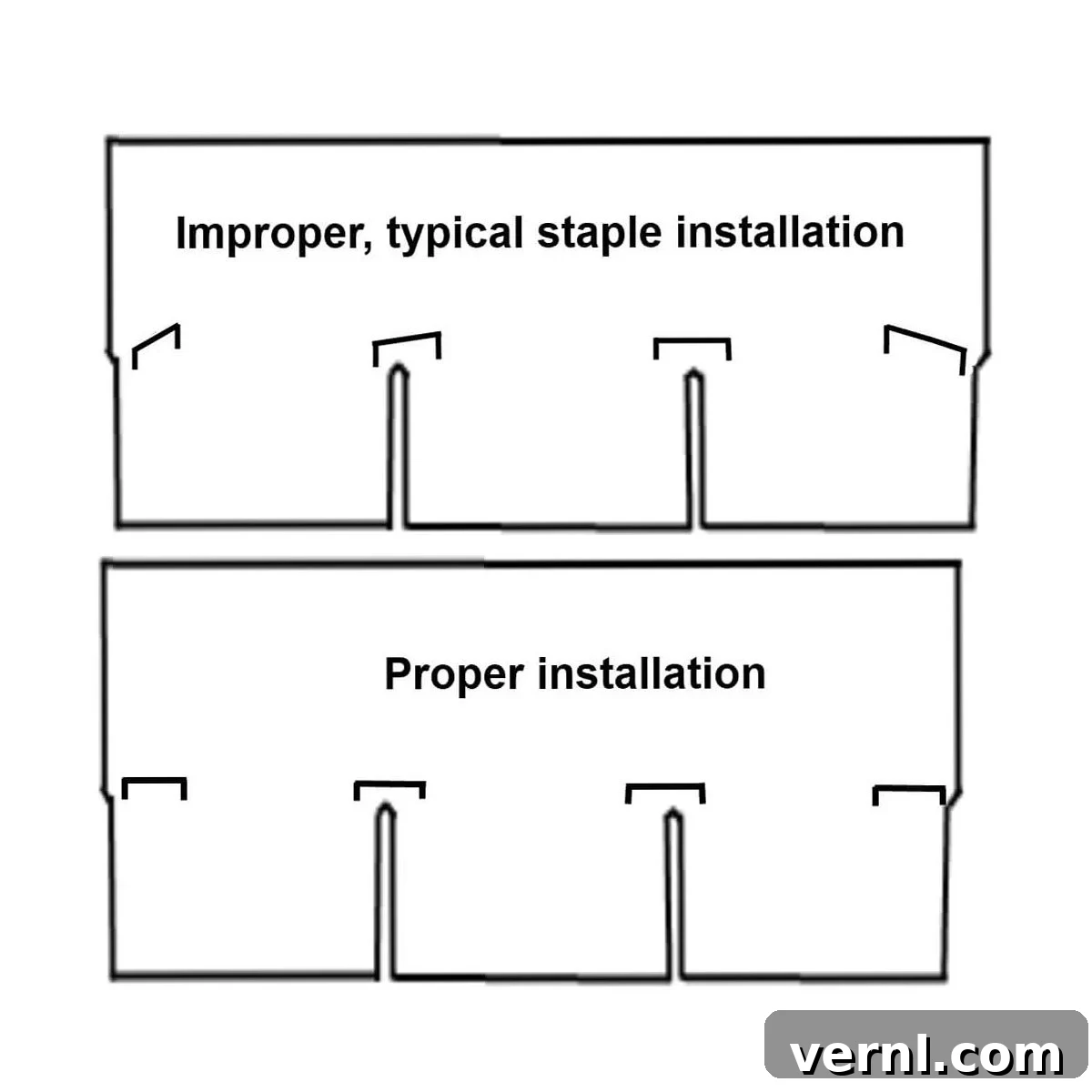
Embarking on a construction project, especially one involving your home’s roof, can feel overwhelming. Amidst the myriad decisions, one crucial detail often sparks a significant debate among homeowners and professionals alike: the choice between roofing staples and nails for securing asphalt shingles. While staples have a long history in the roofing industry, once considered a common and accepted practice for attaching asphalt shingles to a roof deck, their prominence has waned due to evolving standards and a deeper understanding of roof performance.
The traditional method of stapling shingles, though still preferred by some roofers for its perceived convenience, faces increasing scrutiny. In many regions, such as Minnesota, the use of staples for asphalt shingle installation is now explicitly prohibited by building codes, signaling a broader industry shift towards more robust fastening methods. This comprehensive guide will delve into the historical context, practical considerations, inherent challenges, and modern alternatives to help you understand why the seemingly simple choice of a fastener can profoundly impact your roof’s durability, longevity, and resistance to the elements. We will explore the critical differences, the problems commonly caused by improper staple usage, essential maintenance tips for existing stapled roofs, and the superior alternatives available today, ensuring your roofing investment stands the test of time.
Why Roofing Staples Once Held Sway in Shingle Installation
For decades, roofing staples were a ubiquitous choice for attaching asphalt shingles. This method, often seen as an age-old technique, gained widespread popularity due to several operational advantages that historically appealed to roofers. The sheer volume of shingle installation required on a typical roof made efficiency a top priority, and staples offered a compelling solution in this regard, promising quicker job completion times.
One of the primary reasons for the enduring preference among some roofing professionals lies in the design and ergonomics of staple guns themselves. Compared to their coil nail gun counterparts, staple guns are generally smaller, lighter, and better balanced. This ergonomic advantage can significantly reduce roofer fatigue over long working hours, especially when navigating steep or complex roof angles. Coil nail guns, which are fed by a bulk coil of nails, typically feature a larger, bulkier magazine that can make them more cumbersome to handle and maneuver. This difference in form factor often translates directly into perceived ease of use and speed of application on the job site, contributing to higher productivity for roofing crews.
Beyond the physical attributes of the tools, several other factors contributed to the widespread use and continued preference for staples:
- Reduced Jamming Issues: Staple guns are traditionally less prone to jamming compared to nail guns designed for shingles. This reliability translates into fewer interruptions during installation, allowing crews to work more continuously and maintain a higher pace. In the fast-paced environment of roofing, even minor delays due to equipment malfunction can impact project timelines, labor costs, and overall profitability.
- Monetary Advantages: On a per-fastener basis, staples often present a lower upfront cost than roofing nails. When considering the thousands of fasteners required for a single roof, these cost savings can accumulate, making staples an attractive option from a material expense perspective for contractors looking to manage project budgets tightly. This cost-effectiveness, however, often overlooks the long-term performance implications.
- Superior Portability and Functionality: The compact nature of staple strips offers significant logistical benefits. Roofers can easily carry multiple sticks of staples in their tool belts or pockets, enabling rapid reloads on the roof without needing to descend for supplies. This efficiency in handling and reloading contributes to a quicker workflow and minimizes downtime, allowing crews to maximize their time on the roof itself.
- Optimized Space and Time Management: Coil nails, by their very nature, are bulky. A coil of nails takes up considerably more space on a roof deck or in a tool caddy, which can be challenging in tight working conditions. Furthermore, reloading a coil nail gun can be a more time-consuming process than inserting a new stick of staples. Moreover, the vulnerability of nail coils to damage is a practical concern; if a coil is dropped or accidentally stepped on, it can deform, making it much more susceptible to jamming the nail gun. Staples, being smaller and more resilient in strip form, mitigate these logistical challenges, streamlining the installation process.
The Critical Differences: Roofing Staples vs. Nails and Their Impact on Roof Integrity
While staples may offer perceived operational ease for the roofer, their fundamental design presents significant drawbacks when compared to roofing nails, particularly concerning long-term roof integrity and performance. The core problem with stapled shingles stems from their inherent susceptibility to improper installation, which can lead to a host of structural vulnerabilities that compromise the entire roofing system.
The primary challenge lies in achieving a perfectly perpendicular drive. Unlike a nail, which has a round, forgiving head, a staple features two prongs connected by a narrow crown. For a staple to seat correctly and provide optimal holding power, it must be driven straight and flush into the shingle and underlying roof deck. However, it is remarkably difficult to maintain a staple gun at a perfectly perpendicular angle to the shingle’s surface consistently. Even a slight deviation can result in the staple being driven at an improper angle, causing one leg to penetrate fully while the other bends or fails to secure properly. This common improper installation significantly compromises the staple’s ability to hold the shingle firmly, leading to a cascade of problems.
Understanding the Consequences of Improper Staple Installation:
- Reduced Holding Power and Increased Uplift Risk: When staples are driven at an angle, their effective holding power is drastically reduced. This weakened grip makes the shingles far more susceptible to lifting and detaching during high winds, heavy rain, or severe storms. The narrow crown of the staple also provides less surface area to compress the shingle against the deck compared to the broad, flat head of a roofing nail, further diminishing its resistance to wind uplift forces that can tear shingles away.
- Premature Shingle Damage: Improperly seated staples can also tear through the shingle material over time, especially as the roof expands and contracts with temperature fluctuations. This can lead to unsightly blemishes, cracking, and premature deterioration of the shingle, exposing the underlying roofing materials to damaging moisture and harsh UV radiation. Such damage compromises the shingle’s waterproofing capabilities and shortens its effective lifespan.
- Water Penetration Points: If a staple fails to seat properly, tears the shingle, or allows the shingle to lift, it can become a direct entry point for water. Even a small amount of moisture infiltrating the roof deck can lead to significant problems over time, including wood rot in the decking and structural components, mold growth in the attic, and compromise of the entire roof’s structural integrity. These issues are often hidden until extensive damage has occurred.
- Voided Manufacturer Warranties: A crucial point often overlooked by homeowners is that many asphalt shingle manufacturers explicitly void their product warranties if staples are used instead of nails. Manufacturers stipulate specific fastening methods to ensure their products perform as intended. Non-compliance leaves homeowners unprotected against material defects or premature shingle failure, making future repairs or replacements an out-of-pocket expense.
In contrast, roofing nails, with their distinct round heads and sturdy shanks, offer a much greater margin for error and superior performance. As long as a nail is driven straight into a shingle, the precise orientation of the nail gun relative to the shingle surface is far less critical. The broad, flat head of a roofing nail provides superior compression, securely fastening the shingle and distributing the load more effectively across a wider area. This design inherently reduces the likelihood of improper installation and significantly enhances the shingle’s resistance to wind uplift and other environmental stressors, contributing to a more durable and longer-lasting roof system.
Common Problems and Red Flags Associated with Shingle Staples
Identifying whether shingles have been installed using staples rather than nails can often be done through careful visual inspection, especially when issues begin to manifest on the roof. One tell-tale sign is the faint outline of staples pushing through the shingle’s surface, a phenomenon sometimes referred to as “bridging” or “cupping.” This occurs when the staple’s crown creates an uneven pressure point, causing the shingle material to deform slightly around it as it ages or experiences thermal cycling. Beyond these subtle visual cues, the types of damage observed on a roof can also strongly suggest the use of staples.
When staples are installed improperly – which, regrettably, is a very common occurrence due to the inherent difficulty of consistent perpendicular application – they lead to a cascade of problems that compromise the entire roofing system’s performance and longevity. These issues are far less prevalent with nails, whose round heads provide a forgiving contact surface regardless of the nail gun’s precise angle, as long as the nail enters straight into the shingle and deck.
Key Problems Commonly Caused by Shingle Staples:
- Premature Shingle Detachment: The most immediate and noticeable problem is the increased likelihood of shingles blowing off the roof. An improperly driven staple offers weak resistance to wind gusts, making the roof highly vulnerable to even moderate weather events that a nail-fastened roof would typically withstand. This leads to missing shingles, requiring frequent and costly repairs.
- Accelerated Shingle Deterioration: The uneven pressure from angled staples can stress the shingle material, leading to cracks, splits, and tears around the fastener points. This accelerates the aging process of the shingles and diminishes their protective qualities, causing them to break down faster than their expected lifespan.
- Water Intrusion and Secondary Damage: Openings created by lifted, torn, or improperly seated shingles provide direct pathways for water to penetrate the roof deck. This can lead to a host of severe and costly secondary issues:
- Wood Rot: Constant moisture exposure can cause the plywood or OSB roof decking to rot, severely weakening the roof’s structural integrity and potentially compromising the entire roof system.
- Mold and Mildew Growth: Damp conditions in the attic or roof structure create ideal environments for mold and mildew, which can pose significant health risks to occupants and further degrade building materials.
- Interior Damage: Water leaks can manifest as unsightly stains on ceilings and walls, damaging insulation, drywall, light fixtures, and other interior finishes, requiring extensive indoor repairs.
- Difficulty in Repairs: Repairing a roof with stapled shingles can be significantly more challenging. Replacing a shingle that has pulled away from angled staples might require careful work to avoid further tearing or damaging adjacent shingles, potentially complicating what should be a straightforward repair and increasing labor costs.
Maintaining a Stapled Roof and Understanding When Replacement Becomes Necessary
If your home currently has a roof installed with staples, it’s not necessarily an immediate cause for panic or an urgent need for full replacement, especially if the roof is relatively new and no significant issues have emerged. However, it is crucial to acknowledge the inherent risks associated with staple fastening and adopt a proactive approach to maintenance and inspection. Being aware of these potential vulnerabilities allows you to monitor your roof effectively and make informed decisions about its upkeep and eventual replacement.
Regular, thorough roof inspections are paramount for homes with stapled shingles. Homeowners should make it a habit to visually check their roof for common red flags such as lifted or curled shingle tabs, visible staple outlines pushing through the shingle surface, or any signs of wind damage like missing or detached shingles. After severe weather events, a visual check from the ground or, ideally, a professional inspection is highly recommended. Prompt attention to minor issues can prevent them from escalating into major, costly repairs. Even a small lifted shingle can allow water penetration that leads to significant underlying damage over time.
When to Consider a Roof Replacement:
While minor repairs for a stapled roof might suffice initially, there comes a critical point when persistent problems signal the undeniable need for a comprehensive replacement. If you notice shingles starting to blow off regularly, even during moderate wind conditions, or if you are continually calling roofers for patch-up repairs, these are strong indicators that the roof covering is not performing as intended and has reached the end of its reliable lifespan. Constant “nuisance repairs” not only accumulate in expense but also provide only temporary relief, failing to address the fundamental issue of inadequate fastening.
In such scenarios, investing in a full roof replacement will almost certainly be less costly and less of a hassle in the long run. The recurring costs of repairs, the inconvenience of dealing with leaks, and the stress of worrying about the next storm quickly outweigh the cost of a new, properly installed roof. A new roof, installed with proper nailing techniques and compliant with current building codes, will offer superior wind resistance, enhanced durability, improved waterproofing, and the invaluable peace of mind that comes with a valid manufacturer warranty. For homeowners considering selling their property, an old roof with recurring issues can also be a significant point of negotiation or concern for prospective buyers, potentially impacting resale value. When professional inspectors identify a roof with improperly installed shingles and ongoing problems, the recommendation often leans decisively towards replacement to avoid future headaches for the new owner and ensure long-term structural integrity.
Modern Alternatives to Traditional Shingle Staples for Superior Roof Longevity
The evolution of construction science and materials has ushered in a new era of roofing fasteners and systems, moving decisively beyond the age-old practice of shingle stapling. Today’s alternatives are meticulously designed for enhanced durability, superior wind resistance, improved waterproofing, and greater compliance with stringent building codes and manufacturer warranties. Making an informed choice about your roof’s fastening system is vital for its long-term performance, protecting your home and your investment for decades to come.
Some of the most common and modernized alternatives to traditional shingle staples include:
- Roofing Nails: The Enduring Industry Standard for Asphalt Shingles:
Roofing nails are unequivocally the preferred and often mandated fastener for asphalt shingles across North America. They offer a significantly sturdier hold due to their single-point penetration and broad, flat head, which compresses the shingle firmly against the roof deck. This design ensures much better wind resistance, drastically reducing the likelihood of shingle uplift and damage during adverse weather conditions. Modern roofing nails are typically hot-dipped galvanized or stainless steel to prevent rust and corrosion, further extending the lifespan of the fastening system. Proper nailing, adhering to the shingle manufacturer’s specific guidelines regarding nail placement, quantity (typically 4-6 nails per shingle), and depth, is critical to ensure both optimal performance and the validity of your manufacturer warranty.
- Screws: Specialized Fastening for Diverse Roofing Materials:
While not commonly used for asphalt shingles, screws are a highly effective and robust fastener for certain types of roofing, particularly metal roofing systems, some tile applications, and in situations requiring exceptionally strong, pull-out resistant connections. Their threaded design provides an excellent mechanical grip, making them extremely resistant to withdrawal forces. Screws offer unparalleled security, rarely pulling out once installed correctly. When specified for a particular roofing system, they often come with integrated washers or sealing components to ensure watertight integrity, making them an ideal choice for specific, high-performance applications where maximum hold is paramount.
- Adhesive Systems: Seamless and Advanced Waterproofing:
Modern adhesive roofing systems represent a significant leap forward in waterproofing and installation efficiency. These systems, often incorporating self-adhering membranes (such as modified bitumen or advanced synthetic underlayments), create a seamless, monolithic layer over the roof deck. Their primary advantage lies in their superior waterproofing capabilities and faster installation times, especially for low-slope or flat roofs where traditional shingle installation might be less effective. Adhesives eliminate the need for penetrations, thereby dramatically reducing potential leak points. They are also incredibly durable and flexible, accommodating thermal expansion and contraction without compromising the roof’s integrity. These systems are typically used as underlayments beneath primary roofing materials or as the primary roof covering themselves.
- Mechanically Attached Systems: Robust Solutions for Commercial and Flat Roofs:
Mechanically attached roofing systems are robust solutions primarily employed in commercial and large-scale flat roof applications, such as TPO, EPDM, or PVC membranes. These systems utilize specialized fasteners that secure the membrane directly to the roof deck, often with large plates or bars to distribute stress and resist wind uplift. They are renowned for their strength, high wind uplift resistance, and relative ease of inspection and repair compared to fully adhered systems. Unlike fully adhered systems, mechanical attachment allows for some movement and facilitates easier localized repairs without disturbing large sections of the roof. The choice of fastener type and spacing is critical and dictated by engineering calculations based on local wind zones and building design requirements.
- Roofing Clips or Strips: Enhancing Shingle Performance and Expansion:
Roofing clips or strips offer a more advanced alternative to traditional staples, particularly in specialized shingle applications or high-wind areas. These innovative fasteners are designed to allow for the natural expansion and contraction of shingles due to temperature fluctuations, a critical feature that staples typically lack. By enabling this movement, clips help prevent buckling, curling, and premature stress on the shingle material that can lead to cracking. They improve overall roof integrity and quality by distributing stress more evenly and offering superior resistance to wind uplift compared to staples, making them a premium choice for enhancing the long-term performance and aesthetic appeal of certain shingle types, especially architectural shingles.
Frequently Asked Questions About Roofing Fasteners
Are shingle staples waterproof or rust-resistant?
While many shingle staples are manufactured from stainless steel or galvanized steel, which inherently offers good rust resistance, this alone does not make the entire roofing system waterproof. The potential for staples to be improperly installed, leading to tears, punctures, or uplifted shingles, can create direct pathways for water intrusion into the roof deck. Even if the staple itself doesn’t rust, its improper application can severely compromise the roof’s waterproofing capabilities. For optimal long-term performance and comprehensive moisture protection, a combination of truly rust-resistant fasteners and meticulous, code-compliant installation techniques is absolutely essential.
Are roofing staples allowed by building codes?
The permissibility of roofing staples varies significantly by region and specific building codes. In many states and municipalities, particularly those with stringent wind uplift requirements and updated construction standards, roofing staples are explicitly prohibited for asphalt shingle installation. This is largely due to well-documented concerns over their reduced holding power, higher susceptibility to improper installation, and inferior wind resistance compared to roofing nails. Always consult your local building department or a qualified, licensed roofing contractor to ensure full compliance with current local codes and regulations, as using prohibited fasteners can lead to inspection failures, costly re-work, and potential insurance claim denials.
Do roofing staples void shingle manufacturer warranties?
Yes, in many cases, using roofing staples instead of nails can indeed void your asphalt shingle manufacturer’s warranty. Most leading shingle manufacturers explicitly specify the exact type, size, and quantity of fasteners, along with precise nailing patterns, that must be used to validate their product warranty. Deviating from these manufacturer-mandated specifications, such as using staples, is almost always considered improper installation and can result in the warranty being nullified. This leaves homeowners completely without protection against manufacturing defects or premature shingle failure, making it a critical consideration when choosing a roofing contractor and fastener type for your new roof.
How can I tell if my roof uses staples or nails?
Visually inspecting your roof can often reveal the type of fasteners used. Look for the following signs, though a professional inspection is always recommended for a definitive answer:
- Signs of Staples: You might see faint, oblong indentations or small, rectangular outlines pushing through the shingle surface, especially on older roofs or those exposed to heat. This is due to the staple’s crown creating uneven pressure. In some cases, if shingles are lifting or damaged, you might directly see the narrow, crown-shaped staples beneath.
- Signs of Nails: Nails leave distinct round impressions or you may see the broad, flat head of a nail if shingles are lifting or missing. A professional roofer can perform a more definitive inspection, sometimes carefully lifting a shingle tab or inspecting the underside of a shingle from the attic to expose the fasteners underneath without causing damage.
What is the typical lifespan of a roof installed with staples compared to nails?
A roof installed with staples generally has a significantly shorter functional lifespan compared to one installed with nails, especially if the staples were not perfectly installed or are in a high-wind area. While a properly nailed asphalt shingle roof can last 20-30 years or more (depending on shingle quality and climate), a stapled roof, due to its increased vulnerability to wind uplift, shingle detachment, and potential for water intrusion from improper fastening, may show signs of failure and require extensive repairs or even early replacement within 10-15 years, or even less in severe weather regions. The integrity of the fastening system is a primary determinant of a roof’s overall longevity and its ability to withstand environmental stressors.
Should I replace my stapled roof immediately if it’s not showing problems?
Not necessarily immediately, but it warrants careful monitoring and professional assessment. If your stapled roof is relatively new and has not exhibited any clear signs of problems like lifted or missing shingles, active leaks, or visible damage, you don’t need to rush into a full replacement. However, vigilance is key. Schedule regular professional inspections (perhaps annually or bi-annually, and always after major storms) to catch any potential issues early. Understand the inherent risks associated with stapled roofs, especially concerning wind resistance and the potential for voided manufacturer warranties. It is prudent to keep a budget in mind for potential future repairs or an eventual replacement, as the likelihood of issues arising over time is considerably higher with stapled roofs compared to those properly installed with nails.
Sources and Further Reading
- MJM: “M J Moser Inspection & Construction Consulting”
- Iowa State University: “Effectiveness of clips, staples and cement as fasteners for asphalt-shingle tabs.”
- Angi: “Should Roofers Use Nail Guns Or Hand Nail Shingles?”