The Ultimate Guide to Car Jacks: Types, Safety, and Choosing the Best One for Your Vehicle
The importance of proper vehicle lifting equipment cannot be overstated. A personal incident where a stock scissor jack buckled during a routine tire rotation served as a stark reminder of the critical need for safety knowledge and reliable tools. Such an incident could have been fatal, underscoring that even factory-issued equipment isn’t always foolproof without proper understanding and complementary safety measures.
“Safety is always of the utmost priority whenever doing any automotive work, whether you’re a novice or an expert,” emphasizes expert mechanic Alan Gelfand. This sentiment resonates deeply, not only for preventing accidents but also for ensuring the longevity of your vehicle and your peace of mind.
Beyond safety, convenience plays a significant role in your automotive maintenance journey. Whether you’re just beginning to tackle your own car repairs or aiming to elevate your home mechanic skills, investing in the right car jack can dramatically reduce time, frustration, and physical strain. Choosing the appropriate jack ensures that tasks are performed efficiently and effectively, empowering you to handle a wider range of projects.
This comprehensive guide will walk you through the various types of car jacks available on the market, detailing their specific applications, advantages, and limitations. We’ll also share invaluable pro-tips from industry experts on safe operation and offer advice on how to select the best car jack to suit your specific vehicle and maintenance needs. Prepare to enhance your garage arsenal and approach vehicle lifting with confidence and expertise.
Prioritizing Safety: The Golden Rules of Automotive Lifting
Before delving into the specifics of each jack type, it’s paramount to establish a foundation of universal safety principles. Working underneath a vehicle supported by a jack can be incredibly dangerous if precautions are not meticulously followed. The risks include catastrophic equipment failure, vehicle instability, and serious injury or fatality.
- Always Use Jack Stands: This is the most crucial rule in vehicle lifting. A jack is designed to lift, not to hold a vehicle for an extended period or while someone is working underneath it. Once the vehicle is lifted, immediately place appropriately rated jack stands under solid points of the frame or designated lift points and slowly lower the vehicle onto them. Never rely solely on a hydraulic or mechanical jack to support a vehicle while performing maintenance.
- Work on Level, Solid Ground: Always operate your car jack on a firm, level, non-slippery surface. Uneven ground or soft surfaces like gravel or dirt can cause the jack to sink, shift, or kick out, leading to immediate instability. If a perfectly solid surface isn’t available, consider using a sturdy piece of plywood or a similar base to distribute the jack’s weight.
- Check Weight Capacity: Every jack and jack stand has a maximum weight capacity. Always ensure that the equipment you’re using is rated to safely lift and support your vehicle’s weight. Exceeding these limits can lead to structural failure of the equipment.
- Consult Your Vehicle’s Owner’s Manual: Before lifting, always refer to your vehicle’s owner’s manual to identify the correct jacking points and recommended procedures. Improper placement can damage your vehicle’s chassis or cause it to slip off the jack.
- Regular Equipment Inspection: Before each use, thoroughly inspect your jack and jack stands for any signs of damage, wear, corrosion, leaks, or deformation. Never use equipment that appears compromised.
- Chock Wheels: Always place wheel chocks on the wheels that will remain on the ground to prevent the vehicle from rolling, even if you are on a flat surface. Engage the parking brake as an additional precaution.
Scissor Jack: The Roadside Emergency Essential
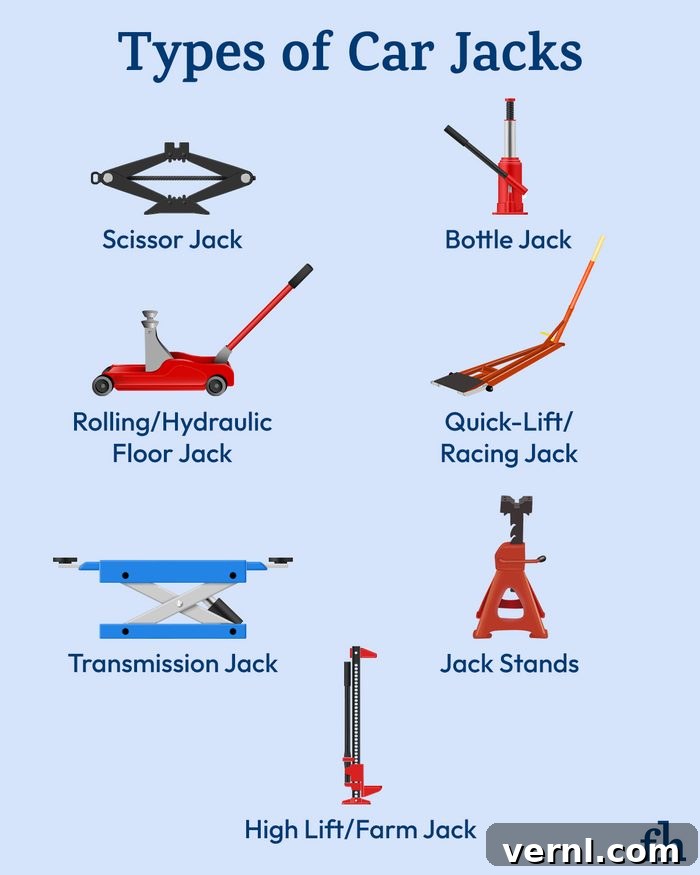
The scissor jack, typically ranging from $25-$80, is the most basic and widely recognized lifting device, often included as standard equipment in the trunk of most cars and SUVs. Its diamond shape and hand-crank operation are familiar to anyone who has ever had to change a flat tire on the side of the road. The mechanism works by turning a threaded rod, which causes the scissor arms to extend and lift the vehicle.
This type of jack usually features a wider bottom for better ground contact and often a specialized top saddle designed to securely lock onto a vehicle’s pinch weld, common on unibody cars. Master auto technician Chris “Moose” Pyle notes, “They are pretty safe if used correctly. They can shrink down very small, they work fast, and they are lightweight.” These characteristics make them ideal for quick, emergency situations where space and portability are key.
Pros
- Comes with Most Vehicles: Often included from the factory, making it readily available for emergencies without additional purchase.
- Compact and Lightweight: Its collapsible design allows for easy storage in even small trunks, taking up minimal space.
- Easily Stored: Perfect for keeping in your vehicle for unexpected roadside issues.
- Affordable: If you need a replacement or a spare, scissor jacks are among the most budget-friendly options.
Cons
- Slow Operation: The hand-cranking mechanism can be time-consuming and labor-intensive, especially for higher lifts.
- Limited Height Range: Generally designed for just enough clearance to change a tire, not for extensive under-vehicle work.
- Less Stable Than Other Types: The narrow base and single-point lift make it less stable than other jack designs, increasing the risk of the vehicle slipping if not positioned perfectly.
- Limited Weight Capacity: Typically suited only for smaller cars and light SUVs. Exceeding its capacity can lead to buckling, as tragically experienced in the introductory anecdote.
Safety Precautions: Alan Gelfand strongly advises, “Never get under a car supported only by a scissor jack. They’re designed exclusively for tire changes.” This means that any work requiring you to be beneath the vehicle necessitates the use of robust jack stands.
Pro-tip: To ensure smooth operation and prevent seizing, lightly grease the screw mechanism of your scissor jack periodically. This simple maintenance step can significantly extend its lifespan and reliability.
Bottle Jack: Power in a Compact Form
For those with higher-clearance or heavier vehicles, a bottle jack (typically $20-$100) is an excellent choice for tire changes and routine maintenance. These jacks are characterized by their compact, cylindrical design, resembling a bottle. They operate using hydraulic pressure, where a hand pump extends a ram straight upward, providing substantial lifting power.
Some advanced models might even feature air-powered cylinders for even easier operation. “They can lift a crazy amount of weight,” notes Pyle, highlighting their impressive capacity for their size. He adds, “They are simple to use and very compact. However, the base and top of the jack are small, so they tend to sink into the ground, and the vehicle can fall off the jack if it moves excessively.”
Pros
- Very High-Weight Capacity for Size: Bottle jacks offer an impressive lifting capability within a small footprint, making them suitable for heavy trucks, SUVs, and even some industrial applications.
- Compact Design: Despite their power, they remain relatively small and easy to store in a workshop or a vehicle with sufficient space.
- Affordable: Providing significant lifting power at a reasonable price point, they offer great value.
- Heavy-Duty Applications: Larger bottle jacks can double for various industrial lifting tasks, showcasing their versatility.
Cons
- Requires Higher Initial Ground Clearance: Due to their vertical design, bottle jacks often require a certain amount of clearance to fit under the vehicle, making them unsuitable for low-profile cars.
- Less Stable Base: The small footprint, while contributing to compactness, can make them less stable on uneven or soft surfaces, as Pyle points out. The risk of the vehicle shifting or the jack sinking is higher compared to jacks with wider bases.
- Limited Lift Height for Some Jobs: While powerful, their maximum lift height might be insufficient for certain maintenance tasks requiring significant under-vehicle access.
Safety Pro-tip: Gelfand cautions, “They can kick out if not placed on solid, level ground, so store a piece of plywood in your trunk as an emergency tool to create a solid surface for roadside repairs.” This simple addition can significantly enhance stability and prevent dangerous accidents, especially on unpaved shoulders.
Rolling/Hydraulic Floor Jack: The Home Mechanic’s Workhorse
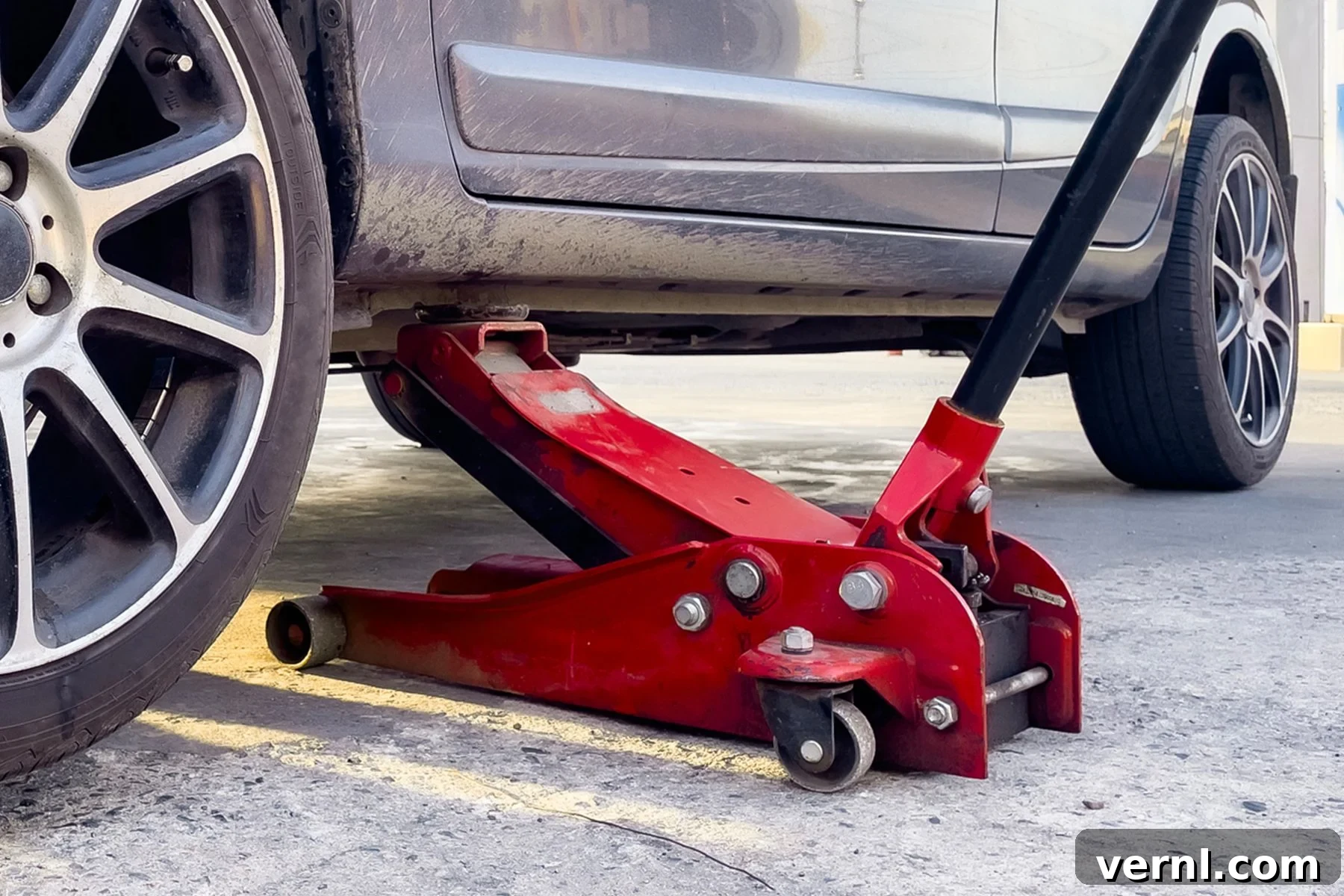
For the vast majority of home DIY repairs, the rolling or hydraulic floor jack ($50-$500) is the preferred choice. It’s essentially an evolution of the bottle jack, offering enhanced stability and ease of use. Characterized by its long, low profile and a wide, stable base equipped with casters, it can be easily maneuvered under a vehicle. The hydraulic mechanism is operated by pumping a long lever handle, quickly lifting the vehicle.
“They are designed not to be picked up, but still can be,” Pyle explains, highlighting their sturdy construction. “The convenience is to just roll it around using the pump handle. This is the safest jack of them all, and most commonly seen in a shop.” Its robust design and ease of positioning make it an indispensable tool for routine tasks like oil changes, tire rotations, and brake jobs.
Pros
- Quickly Lifts Vehicles: The hydraulic system, combined with a long pump handle, allows for rapid elevation of the vehicle with minimal strokes.
- Minimal Effort: Pumping the handle requires far less physical exertion compared to a scissor jack, making longer jobs more manageable.
- Relatively High Lift Capacity: Floor jacks come in various capacities, often capable of lifting everything from small cars to large trucks.
- Stable Platform: Its wide base and low center of gravity provide superior stability compared to scissor or bottle jacks, reducing the risk of tipping or slipping.
- Maneuverability: Casters (wheels) allow for easy positioning under the vehicle.
Cons
- Heavy and Bulky: Floor jacks are typically made of steel, making them quite heavy and cumbersome to move without their wheels. They also require significant storage space.
- Can Leak Hydraulic Fluid Over Time: Like all hydraulic equipment, seals can degrade, leading to fluid leaks that can reduce performance and create messes. Regular maintenance is crucial.
- Cost: While entry-level models are affordable, higher-capacity or professional-grade floor jacks can be a significant investment.
Safety Precautions: “Always use jack stands with floor jacks, check for hydraulic leaks before each use and never exceed its stated weight rating.” Even though they are highly stable, relying solely on a hydraulic system is unsafe. Regularly inspect for any signs of fluid leakage around seals or hoses, and ensure the jack’s capacity matches your vehicle’s weight.
Pro-tip: Gelfand recommends, “For European sports cars and lowered vehicles, select a low-profile model that provides about a 3-inch clearance.” This ensures the jack can slide under the vehicle without damaging bodywork or suspension components.
Quick-Lift/Racing Jack: Speed and Efficiency for Enthusiasts
If you’re a frequent tinkerer or simply value speed and portability, upgrading to an aluminum racing jack ($150-$1,000) is a worthwhile consideration. These jacks are essentially high-performance versions of the traditional floor jack, distinguished by their lightweight aluminum construction and often featuring convenient carry handles. The key innovation lies in their dual-pump mechanisms, which allow them to lift vehicles exceptionally quickly with minimal pumping effort.
“This is an investment worth making for car owners who tinker frequently, because this model features an easy-to-remove handle for improved storage,” advises Gelfand. Their speed makes them popular in professional racing pits and for enthusiasts who perform frequent adjustments or inspections.
Pros
- Extremely Fast Lifting: The dual-pump system dramatically reduces the number of strokes required to reach full lift height, saving considerable time and effort.
- Lightweight Aluminum Construction: Unlike heavy steel floor jacks, racing jacks are significantly lighter, making them easier to transport, maneuver, and store.
- Portability: Often equipped with carry handles, they are designed for easy movement between locations, ideal for track days or multiple vehicle maintenance.
- Low Profile: Most racing jacks are designed with a very low minimum height, perfect for sports cars and vehicles with limited ground clearance.
Cons
- More Expensive Than Standard Floor Jacks: The advanced materials and mechanisms come at a premium, making them a larger investment.
- Can Be Overkill for Casual Users: If you only perform occasional maintenance, the added cost and features might not justify the investment.
- Potentially Less Durable: While strong, aluminum might not withstand the same level of abuse as heavy-duty steel jacks over extended professional use.
Safety Pro-tip: While speed is a significant advantage, it can sometimes lead to carelessness. “Speed can lead to carelessness, so don’t forget that these still require jack stands for safety.” The fundamental rules of safe lifting remain paramount regardless of how fast your jack operates.
Service Jack: Professional-Grade Durability and Performance
Professional auto service centers and heavy-duty mechanics often rely on robust service jacks ($300-$1,500). These tools are similar in design to hydraulic floor jacks but are built to an entirely different standard, featuring pro-grade lifting capacities, enhanced durability, and higher-quality components designed for continuous, demanding use. Some advanced models also incorporate compressed air to activate their hydraulic lifting mechanisms ($200-$1,000+), further reducing physical effort and increasing speed.
Service jacks are engineered to withstand the rigors of daily commercial use, often in busy workshop environments where reliability and performance are critical.
Pros
- Exceptional Durability: Constructed with heavy-duty materials and components, these jacks are built to last through years of demanding professional use.
- Smooth, Fast Operation: Designed for efficiency, they offer precise control and quick lifting capabilities, which are essential in a professional setting.
- Reliable for Daily Use: Their robust construction ensures consistent performance and reliability under constant stress.
- Hydraulic Versions Minimize Physical Effort: Air-assisted or fully pneumatic versions drastically reduce the physical effort required to lift heavy vehicles, improving technician ergonomics.
- Higher Lift Capacity: Often capable of lifting heavier vehicles, including light commercial trucks and large SUVs, with ease.
Cons
- Expensive: The professional-grade construction and features come with a significantly higher price tag, making them a substantial investment.
- Unnecessary Features for DIY Repairs: For the average home mechanic, the added cost and capabilities often exceed what is needed for occasional use.
- Hydraulic Versions Require an External Air Compressor: If choosing an air-assisted model, a dedicated air compressor is necessary, adding to the overall cost and setup complexity.
- More Complex, Thus More Potential Failure Points: The added complexity of air-hydraulic systems can introduce more components that could potentially fail, requiring specialized maintenance.
Safety Warnings: Despite being professional-grade equipment, these still require proper jack stands to ensure safety when working under a vehicle. Furthermore, if you’re using a hydraulic version, regularly check the air connections, hydraulic fluid levels, and hydraulic seals for any signs of wear or leakage to prevent malfunctions.
Pro-tip: Gelfand suggests, “If your garage floor has uneven areas, then choose models featuring swivel casters installed on all wheels.” This feature allows for greater flexibility and easier maneuverability around workshop obstacles and imperfections.
High Lift/Farm Jack: The Off-Roader’s Multitool
This multipurpose jack ($50 to $200), often referred to as a Hi-Lift jack, is a staple for off-road enthusiasts and those working in agricultural settings. Unlike conventional jacks, it doesn’t fit underneath the vehicle. Instead, it lifts from a vehicle’s bumper, frame, or wheel, using a long vertical rod with a notched lifting bar and a moveable climbing mechanism. Each stroke of the handle advances the lifting mechanism by approximately 1.5 inches, allowing it to lift heavy loads quickly, often up to three or four feet in the air.
“They have more features than just lifting,” remarks Pyle. “A couple of guys can lift a jeep to max height and then push the jack and vehicle over to get the stuck tires out of ruts. It can be used vertically too, with chains attached to it, making it a come-along.” Its versatility extends beyond lifting, functioning as a winch, clamp, or spreader, making it an invaluable recovery tool.
Pros
- Extreme Lift Height: Capable of lifting vehicles significantly higher than most other jacks, often up to 60 inches, which is crucial for off-road recovery.
- Versatile for Off-Road Recovery: Ideal for extracting stuck vehicles from mud, sand, or snow, as it can lift from high points on the vehicle.
- Can Be Used for Winching: With appropriate accessories, it can function as a manual winch or a powerful clamping tool.
- Mechanical Reliability: No hydraulic fluid to leak or seals to fail, making it reliable in harsh conditions.
Cons
- Requires Specific Lifting Points: Often needs a steel bumper, rock slider, or specialized recovery points for safe operation; unsuitable for plastic bumpers or delicate bodywork.
- Dangerous if Used Improperly: The long handle and high-leverage mechanism can be extremely hazardous if not operated with extreme caution and attention, with a high risk of the handle kicking back or slipping.
- Heavy and Awkward: While powerful, high-lift jacks are typically quite heavy and ungainly to carry and position.
- Requires Significant Effort: The lifting mechanism, though effective, can require considerable physical exertion from the user.
Safety Warning: These jacks are notoriously dangerous if the handle slips or if the vehicle moves unexpectedly during operation. They demand careful attention and strict adherence to safety protocols. Never place any part of your body between the handle and the vertical bar, or between the lifting mechanism and the vehicle’s frame. Always wear heavy-duty gloves when operating.
Pro-tip: Gelfand advises, “Add a large baseplate accessory to prevent sinking in soft terrain, and never use this type of jack for standard vehicle maintenance.” Due to their inherent instability and lifting method, they are not designed for routine under-car work where stability is paramount.
Transmission Jack: Specialization for Drivetrain Work
If your automotive projects involve removing or installing heavy and awkward drivetrain components, such as transmissions or transfer cases, then a transmission jack ($200-$1,000) is an indispensable tool. This specialized jack is uniquely designed with an adjustable cradle that can tilt and pivot, providing precise positioning and secure support for these challenging components.
Its low profile and wheeled base allow for careful maneuverability directly under the vehicle, making the often-difficult task of aligning heavy parts much safer and more manageable.
Pros
- Allows Precise Positioning: The adjustable cradle with tilt and swivel capabilities enables fine-tuning of the component’s angle, crucial for aligning bolt holes during installation.
- Specially Designed for Heavy, Awkward Components: Its wide, secure platform with tie-down points ensures that bulky and oddly shaped parts like transmissions are safely supported during removal and reinstallation.
- Enhances Safety and Reduces Strain: By securely holding and precisely positioning heavy components, it significantly reduces the risk of injury and physical strain on the mechanic.
Cons
- Expensive: As a highly specialized tool, transmission jacks represent a significant investment compared to general-purpose jacks.
- Single-Purpose Tool: Its design is highly specific, meaning it has limited utility outside of drivetrain work, making it less versatile for general garage tasks.
- Requires Storage Space: Despite its specific purpose, it still requires dedicated storage space in a workshop.
Safety Warnings: It is crucial to ensure the load (transmission, etc.) is properly secured to the cradle using straps before moving or lifting. Regularly check the hydraulic system for leaks and ensure all locking mechanisms are fully engaged to prevent accidental drops or shifts.
Pro-tip: Gelfand emphasizes, “Before removal or installation, always use ratchet straps to secure the transmission to the cradle.” This prevents the component from shifting or falling, which could cause serious injury or damage to the vehicle.
Jack Stands: Non-Negotiable Safety Equipment
Regardless of the type of jack you choose for lifting your vehicle, jack stands ($20-$100) are an absolutely essential and non-negotiable complement. These simple yet critical pieces of equipment are designed specifically for safety, providing stable and firm support for vehicles once they have been raised into the air. They are not lifting devices but rather safety support devices.
“The most essential safety rule, which applies to every type of jack, is that you should never depend solely on the hydraulic or mechanical lifting system to hold up a vehicle during maintenance work,” states Gelfand. He continues, “After lifting the vehicle, always move the weight to suitable jack stands.” This principle is fundamental to preventing catastrophic accidents and ensuring your safety when working under a vehicle.
Pros
- Essential Safety Equipment: Jack stands are the primary safety measure to prevent a vehicle from collapsing while you are working underneath it. They are literally lifesavers.
- Inexpensive Insurance Against Catastrophic Failure: For a relatively low cost, jack stands provide crucial protection against the potential failure of a hydraulic jack, which could result in severe injury or death.
- Stable and Reliable Support: Once properly placed and engaged, they offer superior long-term stability compared to any lifting jack.
- Variety of Capacities and Heights: Available in various weight ratings and adjustable heights to accommodate a wide range of vehicles and lifting needs.
Cons
- Additional Step in the Process: Some individuals may be tempted to skip this crucial step to save time, greatly increasing the risk of an accident.
- Not Buying a High-Quality Enough Model for Your Vehicle’s Weight Capacity: Choosing jack stands with an inadequate weight rating for your vehicle can compromise safety. Always ensure their capacity exceeds your vehicle’s weight.
- Requires Proper Placement: Incorrect placement on weak points of the vehicle or on unstable ground can still lead to vehicle instability.
Safety Warning: Never work under a vehicle without proper jack stands securely in place and supporting the vehicle’s weight. Before each use, inspect the ratcheting mechanisms, welds, and overall structure of your jack stands for any signs of damage, rust, or wear. Before starting to work under a vehicle, double-check its stability by gently rocking it and verifying your jack stand placement on solid points as specified in your vehicle’s manual. It’s also wise to keep a minimum of two pairs of jack stands with varying capacities around the shop to cover different vehicle types and situations.
Choosing the Right Car Jack for Your Needs
With a diverse array of car jacks available, selecting the ideal one requires careful consideration of several factors. The “best” jack isn’t a one-size-fits-all solution; it’s the one that most appropriately matches your vehicle, your typical maintenance tasks, and your personal circumstances.
- Vehicle Type and Weight: This is the most critical factor. Do you drive a compact sedan, a heavy-duty pickup truck, a low-slung sports car, or a high-clearance SUV? The jack’s weight capacity and minimum/maximum lift height must be compatible with your specific vehicle. Low-profile jacks are essential for sports cars, while bottle jacks or higher-capacity floor jacks are better for trucks.
- Planned Maintenance Tasks: Consider what kind of work you’ll be doing. For simple tire changes, a scissor jack or bottle jack might suffice. For more extensive repairs like brake jobs, oil changes, or suspension work, a stable and easy-to-use floor jack is indispensable. Specialized tasks like transmission swaps will require a transmission jack.
- Frequency of Use: If you’re an occasional DIYer, a standard floor jack might be perfect. For frequent tinkerers or professional use, the speed of a racing jack or the durability of a service jack might justify the higher investment.
- Garage Space and Storage: Floor jacks, especially heavy-duty ones, take up considerable space. If space is limited, a compact bottle jack or even a lightweight aluminum racing jack with a removable handle could be a better choice.
- Budget: Car jacks range widely in price. Determine how much you’re willing to invest, keeping in mind that safety and reliability are worth prioritizing over the lowest price.
- Ground Surface: Will you be working in a well-maintained garage with a concrete floor, or on a gravel driveway or uneven outdoor surface? Jacks with wide bases (like floor jacks) are more stable on varied surfaces, while bottle jacks may require a baseplate on soft ground.
Maintaining Your Car Jack for Longevity and Safety
Proper maintenance of your car jack isn’t just about extending its lifespan; it’s a critical component of ensuring safe operation every time you lift a vehicle. A well-maintained jack performs reliably, reducing the risk of accidents caused by equipment failure.
- Keep It Clean: After each use, wipe down your jack to remove dirt, grease, and debris. This prevents contaminants from entering hydraulic systems or interfering with mechanical parts.
- Lubricate Moving Parts: For scissor jacks, periodically apply a light coat of grease to the threaded rod to ensure smooth operation and prevent rust or seizing. For floor jacks, lubricate pivot points and casters as recommended by the manufacturer.
- Check Hydraulic Fluid: For hydraulic jacks (bottle, floor, transmission), regularly check the hydraulic fluid level. If it’s low, top it up with the manufacturer-specified hydraulic oil. Look for any signs of leakage around seals or hoses, which could indicate a need for repair or seal replacement.
- Inspect for Damage: Before and after each use, conduct a thorough visual inspection. Look for bends, cracks, dents, corrosion, loose fasteners, or any other signs of wear or damage to the frame, pump mechanism, lifting arm, or wheels. Never use a damaged jack.
- Proper Storage: Store your jack in a dry, clean environment to prevent rust and corrosion. If it’s a hydraulic jack, store it in its lowest retracted position to relieve pressure on the seals and extend their life.
- Bleed Air from Hydraulic Systems: Occasionally, air can get trapped in hydraulic systems, leading to spongy operation or reduced lifting capacity. Consult your jack’s manual for instructions on how to bleed the air out.
About the Experts
- Alan Gelfand is owner of German Car Depot, an independent automotive service center in Hollywood, Florida. During his extensive career, he has used nearly every jack type for both professional work and in emergency situations.
- Chris “Moose” Pyle is a master-certified technician with 20-plus years of automotive experience. He has also worked as an expert for JustAnswer, the expert on-demand platform, since 2006.
RELATED:
- Do You Know What That Little Button on Your Seat Belt Is For?
- What Those Lines on Your Backup Camera Really Tell You
- Here’s What The Small Panel On Your Car’s Front Bumper Is For