
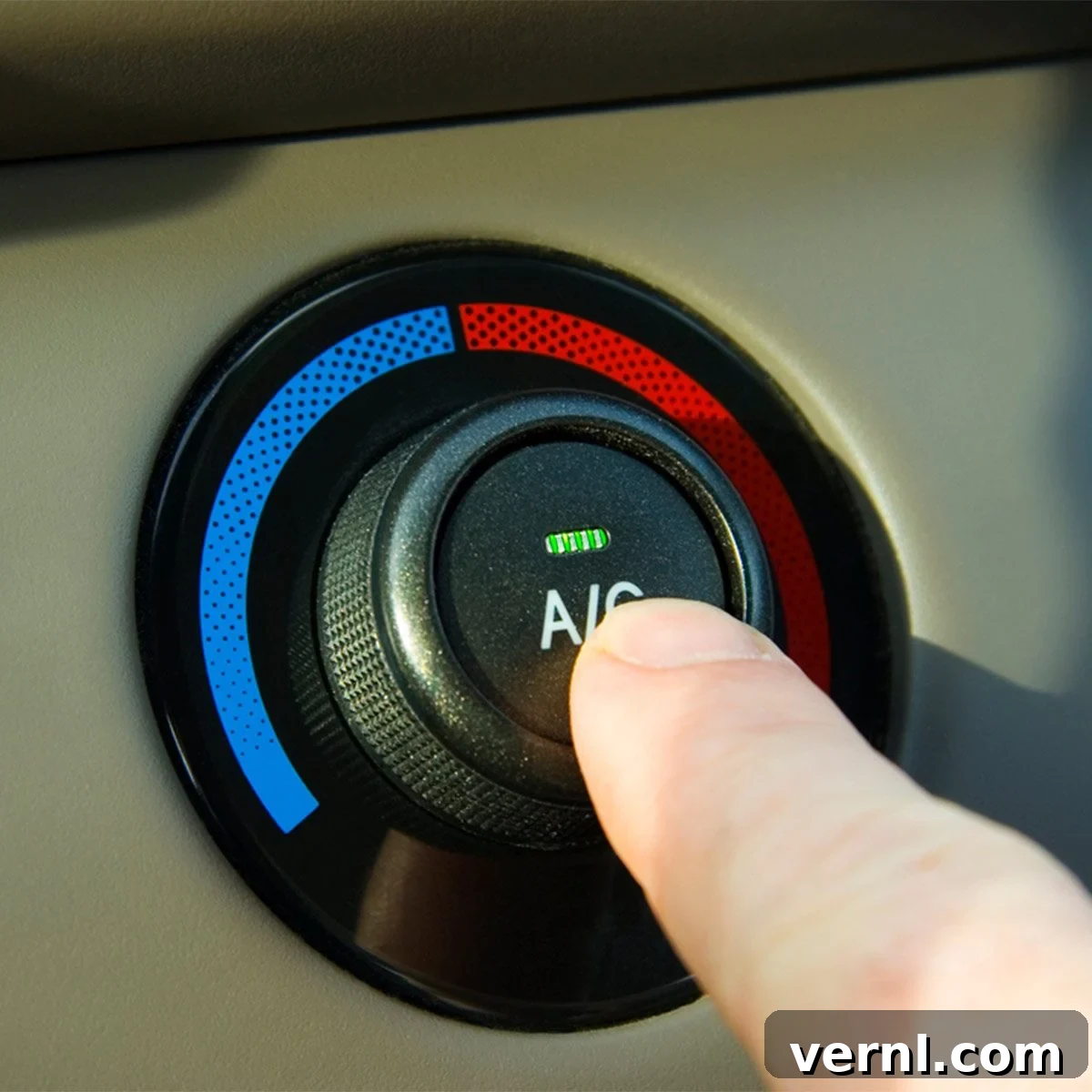
As summer temperatures soar and humidity clings to the air, there are few things more universally dreaded than stepping into a car that feels like a sauna. The immediate reflex for most drivers is to crank up the car’s air conditioner, seeking instant relief from the sweltering heat. While the allure of a cool cabin is undeniable, a growing number of drivers are questioning the hidden costs of this modern convenience, particularly its impact on fuel consumption and vehicle health.
For those striving to optimize fuel economy and save money, a conscious reconsideration of how and when you use your car’s AC could lead to significant benefits. Beyond the immediate financial implications, excessive AC usage can also place undue stress on your vehicle’s vital systems.
Joe Giranda of CFR Classic emphasizes this point, stating, “On scorching days, the cooling system has to work doubly hard to control the engine temperature, and having the AC on also increases the chances of overheating, especially in older or poorly maintained cars.” Conversely, he notes that “cutting down on using the AC decreases the stress on essential systems, optimizing the vehicle’s performance and longevity.” This perspective highlights a broader understanding of AC usage, extending beyond just fuel efficiency to encompass the overall health and lifespan of your car.
Understanding the intricacies of your car’s air conditioning system and its alternatives can empower you to make more informed decisions, enhancing both your comfort and your vehicle’s efficiency. This article delves into the common debate surrounding AC usage, explores practical alternatives, and offers expert insights to help you navigate hot weather driving more effectively.
The Mechanics of Your Car’s Air Conditioner and Its Fuel Demand
To fully grasp why running your car’s AC affects fuel consumption, it’s essential to understand its basic operation. A car’s air conditioning system doesn’t just magically create cool air; it works by removing heat and humidity from the cabin. This process is driven primarily by the compressor, a component that pressurizes refrigerant. The compressor is powered directly by the engine via a serpentine belt. When the AC is engaged, the engine has to work harder to turn this compressor, thereby increasing its workload and, consequently, its fuel consumption.
The refrigerant then flows to the condenser, usually located in front of the radiator, where it releases heat to the outside air. From there, it moves to the expansion valve and evaporator, which cools the air entering the cabin. All these steps require energy, and a significant portion of that energy is drawn directly from the engine’s power output. This direct mechanical load is the primary reason why your vehicle’s fuel economy drops when the AC is running, especially at lower speeds or when the system is working hard to cool a very hot interior.
The Great Debate: AC On vs. Windows Down
The question of whether to use your car’s air conditioner or simply roll down the windows for cooling has been a long-standing point of contention among drivers and automotive experts alike. Both methods undeniably lead to increased fuel consumption compared to driving with windows up and no AC. The crux of the debate lies in determining which option has a greater impact on overall miles-per-gallon (mpg).
To definitively address this, the Society of Automotive Engineers (SAE) and General Motors conducted a controlled study. Their research meticulously compared the fuel efficiency of driving with the car air conditioner on against driving with the windows down under various conditions. This study sought to provide concrete data to finally settle the debate.
Driving With Your Windows Down: Aerodynamics vs. Mechanical Load
The SAE and GM study yielded insightful results. After rigorous testing at speeds of 31, 50, and 68 mph in 86-degree F weather, they concluded that driving with the windows down is generally more fuel-efficient than running the A/C. The test also measured the fuel efficiency of closed windows and no A/C, which, as expected, proved to be significantly better on fuel than both other options.
The science behind this involves a trade-off: when you drive with windows down, you increase the aerodynamic drag on the vehicle. This resistance forces the engine to work harder to maintain speed. However, at lower speeds, the energy required to overcome this drag is often less than the energy consumed by the AC compressor. As speeds increase, aerodynamic drag becomes a more dominant factor. Many experts suggest a “sweet spot” – typically around 40-50 mph – below which rolling down windows is more efficient, and above which, the drag created by open windows might start to negate the fuel savings, potentially making AC a marginally better option from a purely aerodynamic standpoint. However, the SAE study suggests that even at highway speeds, windows down still showed an advantage.
Extreme Weather Temperatures: When AC Becomes a Necessity
While the data largely supports the fuel efficiency of driving with windows down, the practical reality of extreme weather often dictates otherwise. There are times when comfort, safety, and even vehicle health outweigh marginal fuel savings. For instance, in very high temperatures or high humidity, rolling down the windows might not provide adequate cooling, making the cabin uncomfortably hot and potentially dangerous for prolonged periods. The constant blast of hot, humid air might even make you feel warmer, or trigger allergies with dust and pollen.
Multiple tests have consistently shown that open windows are generally more fuel-efficient than AC, even if some experts occasionally posit the opposite. However, it’s crucial to note that the difference in fuel economy doesn’t appear to be as substantial when external conditions aren’t extremely hot. For milder days, a simple window crack might suffice, but on scorching days, the AC’s cooling power becomes indispensable for comfort and concentration behind the wheel. The key is to use it strategically and efficiently, which we will explore further.
Optimizing Your Car’s AC Usage and Exploring Alternatives
If you need to cool off during a hot summer drive, considering rolling the windows down first is a good start. However, this isn’t the only strategy to save money on gas and reduce the strain on your vehicle. Implementing smart AC habits and exploring alternative cooling methods can make a significant difference. We have a ton of tips for better gas mileage and fuel economy that are worth implementing in conjunction with smart AC use.
Smart AC Usage Tips:
- Pre-Cool Your Car: Before turning on the AC, open all your car doors and windows for a minute or two to let the super-heated air escape. This significantly reduces the initial workload on your AC system.
- Use Recirculation Mode: Once the cabin is cool, switch your AC to “recirculation” mode. This means the system is cooling the air already inside the cabin, which is much easier than continuously trying to cool the hotter outside air.
- Don’t Over-Chill: Set your AC to a comfortable, rather than freezing, temperature. Every degree lower requires more energy. Aim for a temperature that allows you to be comfortable without needing a jacket.
- Gradual Cool Down: When you first start your AC, don’t blast it at full power immediately. Start with a moderate setting and gradually increase if needed.
- Regular Maintenance: A well-maintained AC system is a more efficient one. Ensure your refrigerant levels are correct and that the system is free of leaks. Follow these directions to recharge your car’s air conditioner if needed.
Alternative Cooling Strategies:
- Park in the Shade: Whenever possible, park your car in a shaded area. This simple act can dramatically reduce the interior temperature before you even get in.
- Use Sunshades: A reflective sunshade placed in the windshield when parked can block a significant amount of solar heat, keeping the dashboard and steering wheel cooler.
- Window Tinting: Professionally installed window tinting can block UV rays and reduce heat transfer into the cabin, making your AC more effective when you do use it.
- Ventilation Fans: Some drivers use solar-powered or battery-operated ventilation fans to continuously extract hot air from the parked car.
- Dress Appropriately: Wearing light-colored, breathable clothing can make a huge difference in how hot you feel, reducing your reliance on artificial cooling.
- Stay Hydrated: Drinking plenty of water helps your body regulate its own temperature, making you less susceptible to the heat.
Understanding the Impact on Vehicle Health and Longevity
Beyond fuel efficiency, the sustained use of your car’s air conditioning system, especially under strenuous conditions, can have a tangible impact on its overall health and longevity. As Joe Giranda pointed out, the cooling system has to work harder on hot days, increasing the chances of engine overheating. This isn’t just about the engine; various components within the AC system itself also experience increased wear and tear.
The AC compressor, for instance, is a critical and often expensive component. Constant operation, particularly in stop-and-go traffic or extreme heat, puts significant stress on its internal mechanisms, seals, and bearings. Additionally, the belts that drive the compressor and the hoses that carry the refrigerant can degrade faster under continuous high-pressure operation and heat cycles. Over time, this can lead to leaks, reduced performance, and costly repairs. By being mindful of AC usage, you not only save on fuel but also extend the life of these essential components, delaying the need for repairs and maintaining the vehicle’s optimal performance.
Frequently Asked Questions (FAQ)
Does the outside temperature affect AC efficiency?
Absolutely, the outside temperature plays a crucial role in how efficiently your car’s AC system operates. The warmer the ambient temperature, the harder your AC system will have to work to transfer heat from the cabin to the outside and keep you cool. This is a fundamental principle of thermodynamics: the greater the temperature difference, the more energy is required to move heat against that gradient.
Factors like driving in slow traffic, towing, or navigating mountain terrain can further exacerbate this issue. Chris “Moose” Pyle, a master-certified technician with JustAnswer, explains the mechanics: “In front of the radiator is the AC condenser which is very hot, often over 250 degrees. So you are pulling extremely hot air through the radiator and into the engine compartment with the fan.” In heavy traffic or uphill climbs, there’s less airflow over the condenser, making it even harder for the system to dissipate heat, thereby increasing the load on the compressor and the engine.
Are hybrid or electric vehicles affected the same way?
While the underlying physics of cooling remain consistent, the impact of running the AC on hybrid and electric vehicles (EVs) manifests differently. For electric or hybrid vehicles, running the AC primarily depletes the battery, reducing your effective driving range. Joe Giranda estimates this reduction to be around 10 to 15%, which can be a significant consideration for EV owners on longer journeys.
However, there are nuances. Hybrid vehicles, which combine an internal combustion engine with an electric motor and battery, can sometimes handle the heat a bit better. As Pyle notes, “hybrid vehicles can handle the heat a tad bit better.” This is because the engine in a hybrid can engage to power the AC compressor or recharge the battery, providing a more flexible energy source. A fully electric vehicle, on the other hand, relies solely on its high-voltage battery to power the AC compressor and all other auxiliary systems. This direct drain on the battery means range is directly impacted by AC usage.
Interestingly, Pyle also highlights that “A fully electric vehicle does not really get an effect from high heat; extreme cold is what attacks the electric models.” This is a crucial distinction. While high heat makes the AC work harder (and thus drain the battery faster), the EV’s propulsion system itself is generally less affected by high ambient temperatures compared to an internal combustion engine which can struggle with overheating. Extreme cold, conversely, significantly impacts battery chemistry and efficiency, leading to reduced range and slower charging in EVs.
About the Experts
- Joe Giranda is the Director of Sales and Marketing for CFR Classic. With 23 years of experience in the automotive industry, he brings a wealth of knowledge as an automotive expert.
- Chris “Moose” Pyle is a master-certified technician with over 20 years of hands-on automotive experience. Since 2006, he has also served as an expert for JustAnswer, a prominent expert on-demand platform, offering reliable advice on a wide range of automotive issues.