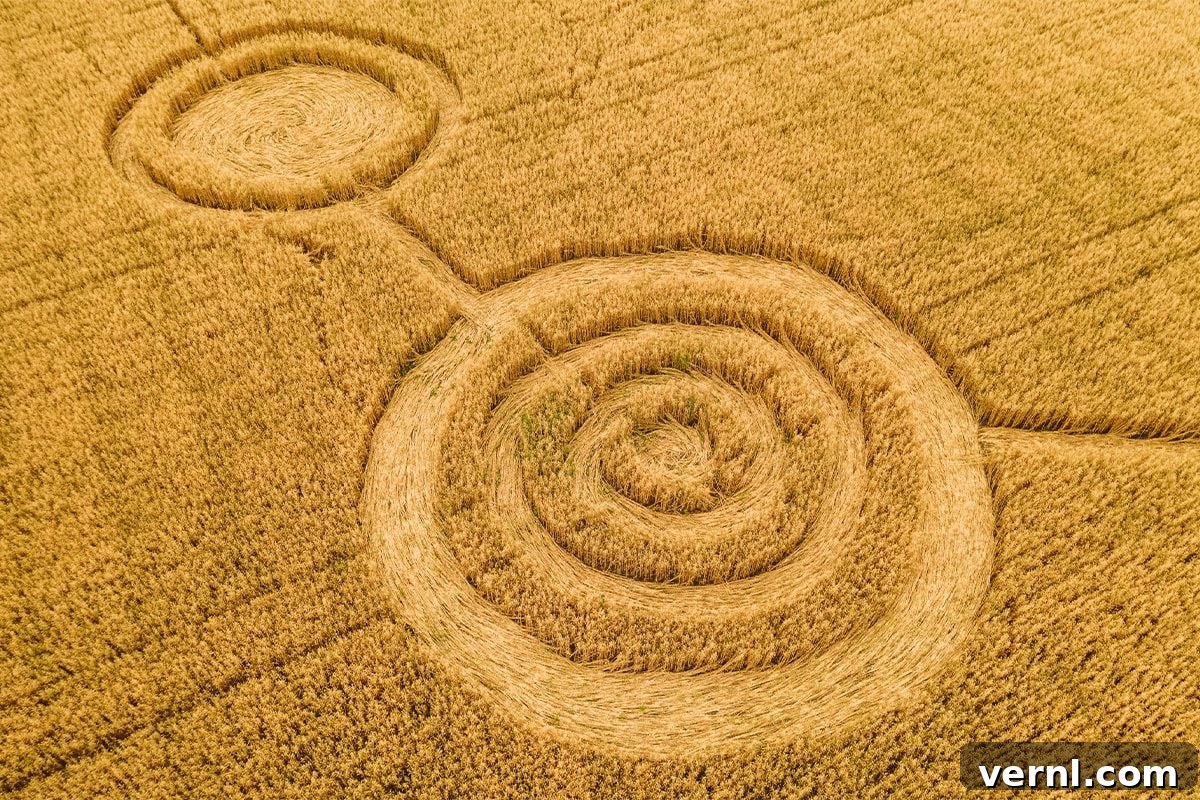
You’re soaring high above an agricultural landscape, gazing down at a patchwork of green and gold fields, when suddenly, a striking sight captures your attention: a bizarre, intricately formed pattern etched into a crop field. It’s too precise, too geometric, to be a mere accident of nature, sparking immediate curiosity. While these enigmatic formations, famously known as crop circles, have long fueled imaginations and been linked to tales of extraterrestrial visitors and UFO lore, the compelling reality is often far more grounded. Rather than interstellar intervention, the true origins of these captivating field patterns frequently lie within the realms of advanced agricultural techniques, unique weather events, or ingenious human artistry.
To unravel the enduring mystique surrounding crop circles, we delve into their various interpretations, drawing insights from experts like Talon Becker, a commercial agriculture specialist at the University of Illinois Extension, who sheds light on the practical explanations behind these visually stunning phenomena.
What Exactly Are Crop Circles? Understanding the Phenomenon
At their core, crop circles are distinctive sections of agricultural fields where crops—typically wheat, barley, rapeseed, or corn—have been flattened, bent, or cut in a way that forms discernible geometric patterns. These designs can range from simple, elegant circles to incredibly elaborate and complex pictograms, often incorporating intricate mathematical principles and symbolic forms. While the term “crop circle” suggests circular shapes, the reality is that these patterns are not limited to just circles; they encompass squares, rectangles, spirals, fractals, and even three-dimensional-looking formations, showcasing a remarkable diversity in design.
The defining characteristic of these patterns, whether natural or man-made, is the stark contrast between the flattened crops within the design and the untouched, upright vegetation surrounding them. This clear delineation is what gives crop circles their profound visual impact and contributes to their mysterious allure, making them appear as if they were intentionally inscribed onto the landscape by some powerful, unseen force.
The Enduring Mystery: A Look at Crop Circle Mythology and Its Cultural Impact
The modern mythology surrounding crop circles took root and blossomed in the late 1970s, primarily in the picturesque rural landscapes of southern England. It was here that large, often complex, patterns began to appear in local fields without any immediate, logical explanation. Farmers would wake to find sections of their crops mysteriously flattened, while the surrounding plants remained perfectly upright and undisturbed. This inexplicable precision, combined with the era’s burgeoning public interest in UFOs, extraterrestrial life, and outer space—fueled by science fiction films, books, and genuine space exploration milestones—quickly led to theories of alien visitations and landings.
These unnatural impressions garnered significant global media attention, despite their initial concentration in England. News reports, documentaries, and speculative articles propelled crop circles into the international spotlight, transforming them from a local oddity into a worldwide phenomenon. The fascination intensified throughout the 1980s and reached its zenith in the early 1990s. At this peak, two Englishmen, Doug Bower and Dave Chorley, famously came forward, claiming responsibility for creating many of the country’s most iconic crop circles. They detailed their surprisingly simple methods, involving planks of wood, ropes, and surveying techniques, effectively debunking many of the more fantastical theories.
While their confession, often referred to as “the ultimate hoax,” dispelled much of the extraterrestrial mystery for many, it paradoxically failed to extinguish the public’s fascination. Instead, it shifted the narrative for some, from alien architects to master human artists. For others, the allure of the unknown persisted, fostering skepticism about the confessions themselves or inspiring a belief that *some* circles might still be genuinely unexplained. The enduring appeal of crop circles lies in this blend of human ingenuity, artistic expression, and the timeless human desire to believe in something beyond the ordinary, something truly wondrous and unexplained in our vast universe.
Demystifying the Patterns: What Really Causes Crop Circles?
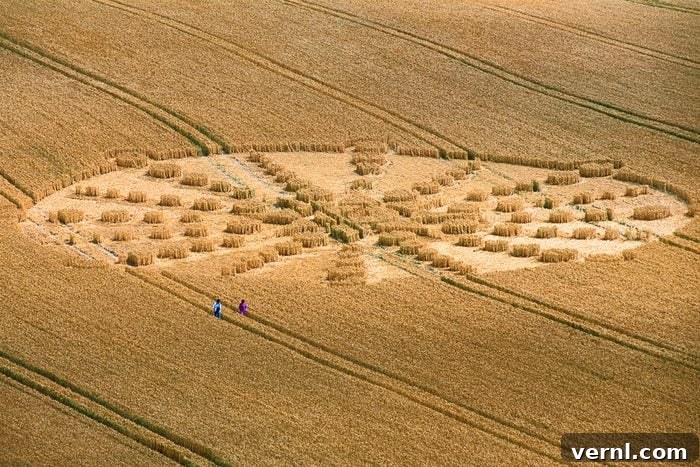
While the romantic notion of mysterious or otherworldly causes for crop circles certainly holds a captivating appeal, modern science and agricultural expertise offer a range of practical and highly probable explanations. Today, the most likely reasons for these formations are often rooted in sophisticated farming practices, specific meteorological conditions, or the deliberate actions of artists and pranksters. Understanding these underlying mechanisms allows us to appreciate the complexity of rural landscapes and the diverse forces that shape them.
Precision Agriculture and Field Management: The Unseen Hands of Modern Farming
Many seemingly inexplicable field patterns are, in fact, direct results of contemporary agricultural techniques designed for efficiency and optimal crop yield. Modern farming is a high-tech endeavor, and from the air, its precision can sometimes mimic the artistry of a crop circle creator.
Cutting for Silage: Strategic Harvesting Creates Geometric Shapes
One common explanation for geometric patterns, particularly noticeable in fields of grass or corn, involves the process of cutting for silage. Silage is a fermented, high-moisture animal feed produced by harvesting crops at a specific stage. Talon Becker explains, “When cutting for silage, the moisture level is key. Certain areas are drying faster than others, so farmers will cut some parts but not others.” This selective harvesting is crucial because the ideal moisture content for fermentation varies across a large field due to subtle differences in soil type, elevation, or sun exposure. Farmers use advanced sensors and techniques to identify these areas. As they cut the sections that have reached the optimal moisture level, leaving the remaining, wetter crops to dry further, the resulting harvested patches can form clear, often rectangular or square, patterns visible from above. To those unaware of this precise agricultural practice, these clean-cut squares or strips might appear as an intentional, enigmatic design rather than an efficient harvesting strategy.
Tile Lines: Subsurface Drainage Systems and Differential Growth
Another fascinating cause of patterned crop growth stems from subsurface drainage systems, commonly known as tile lines. These systems involve perforated pipes installed several feet underground in a grid-like pattern beneath agricultural fields. Their primary purpose is to catch and drain excess water away from the root zone, thereby improving soil aeration, promoting healthier root development, and preventing waterlogging. Talon Becker notes, “There’s a pattern whenever you have tile lines installed, and if it is a very wet year, you’ll get better crop growth over the tile lines.” In years with heavy rainfall, the crops directly above these efficient drainage lines thrive more robustly due to superior access to oxygen and reduced water stress. This differential growth—lush, taller crops directly over the tile lines and less vigorous growth between them—can produce an unnatural, grid-like crop pattern that becomes remarkably distinct from an aerial perspective, mimicking intentional design.
Center Pivot Irrigation Systems: Circular Fields for Efficient Watering
The iconic circular fields often seen in arid or semi-arid regions are a direct result of center pivot irrigation systems. These systems spray water from a central pivot point, rotating in a continuous circular pattern across the field. Historically, farmers adapted square fields to this circular watering method. However, with the advent of advanced GPS seeders and precision planting technology, farmers can now plant circular crop fields from the outset, perfectly matching the irrigation pattern. This design maximizes water efficiency and ensures uniform distribution across the entire growing area. While unusual and striking when viewed from above, these perfectly circular fields are not mysterious symbols but rather the logical outcome of innovative planting technology and highly efficient, water-saving farming practices tailored to modern demands.
Natural Phenomena Shaping the Landscape: When Nature Creates Patterns
Beyond human intervention, nature itself possesses the power to create patterns in fields, albeit often less geometrically perfect than their man-made counterparts.
Lightning Strikes and Wind: Forces of Nature at Play
Talon Becker points out that “The most common true crop circle would be a lightning strike. The lightning will strike in one area and fry the plants,” leaving a damaged, often circular or irregular, section in a field. The intense heat and electrical discharge from a lightning strike can instantly cook or destroy vegetation in a concentrated area, leaving a clear impression. Similarly, strong winds can also be responsible for unusual patterns. Powerful gusts, downdrafts, or microbursts can knock down mature crops in their path, creating localized flattened areas. Depending on the wind’s direction and intensity, these flattened sections can sometimes exhibit swirling patterns or distinct boundaries, appearing as if a deliberate force has pressed them down. While typically less precise than human-made patterns, these natural occurrences contribute to the array of unexplainable field anomalies.
Human Ingenuity and Artistic Expression: From Pranks to Agri-Art
Perhaps the most famous and widely accepted explanation for the more intricate and artistic crop circles involves human hands and minds.
Pranks and Hoaxes: The Art of Crop Flattening
While the heyday of unexplained crop circle appearances was decades ago, the practice of creating them as pranks or artistic statements continues. Talon Becker confirms, “This practice is common, especially in England. It’s mainly people just having fun, pushing down crops and creating geometric patterns.” These creators, often working under the cover of darkness, utilize simple tools such as planks, ropes, and surveying equipment to meticulously flatten crops, bending the stalks without breaking them, to produce elaborate designs. The motivation ranges from simple mischief and testing human gullibility to showcasing remarkable artistic skill and challenging conventional explanations. These “hoaxers” have, in their own right, become a significant part of crop circle lore, demonstrating the impressive capabilities of human ingenuity.
Corn Mazes and Marketing: Transforming Fields into Art and Advertisements
Inspired by the enduring popularity and visual impact of crop circles, many farms have transformed this concept into a thriving commercial endeavor: intricate corn mazes. Each fall, these farms design and cut elaborate labyrinthine patterns into their cornfields, offering a unique recreational activity for the public. The creation of these often massive and highly detailed designs is made possible by sophisticated GPS seeders, drone technology, and digital design software, allowing for precision mapping and execution. Similarly, the vast canvas of agricultural fields has been co-opted by marketers for large-scale advertising. These “agri-ads” have promoted everything from new TV shows and blockbuster movies to consumer products and major events, such as London’s bid for the 2012 Olympic Games. These large-scale, visible-from-space advertisements leverage the visual impact of field patterns to capture attention, turning crops into monumental billboards.
About the Expert
- Talon Becker is a commercial agriculture specialist at University of Illinois Extension in Champaign, Illinois. His expertise offers valuable, practical insights into the realities of modern farming practices that often underlie perceived mysteries in agricultural landscapes.