The mere mention of spiders often sends shivers down spines, a widespread phenomenon known as arachnophobia. The Cleveland Clinic reports that a significant portion of the population, between three to fifteen percent, experiences this intense fear. While this aversion is common, it’s worth noting that the vast majority of spiders encountered in North America pose little to no threat to humans. In fact, out of the thousands of spider species, only a handful are considered medically significant. Among these, one species stands out for its notoriety and the concern it evokes: the brown recluse spider. If you’re someone who already feels uneasy around spiders, the brown recluse is likely to amplify those feelings.
Fortunately, for many, encountering a brown recluse spider remains an unlikely event. Their primary habitat is restricted to specific regions, predominantly the Midwest and the South of the United States. Unless you reside in these geographical areas, your chances of a close encounter are considerably slim. However, for residents within this range, vigilance is key. Jeremy Bradley, a training manager at Arrow Exterminators, strongly advises individuals in these regions to be aware of their presence and understand their habits.
“Brown recluses are remarkably adaptable and can establish themselves both outdoors and indoors,” Bradley explains. “However, a particular focus should be placed on undisturbed areas within and around any building. These quiet, often forgotten spaces provide the ideal environment for these shy creatures to thrive, making them prime locations for potential encounters.” Understanding where these spiders prefer to hide is the first crucial step in effective prevention and management.
Unveiling the Enigmatic Brown Recluse Spider
The brown recluse spider, scientifically known as Loxosceles reclusa, is a small yet fascinating creature, typically about the size of a quarter when its legs are extended. Despite its intimidating reputation, this spider is far from aggressive. In fact, many people can live in homes harboring brown recluses for years without ever experiencing a bite. Their natural inclination is to avoid confrontation, preferring to retreat and hide rather than engage. However, like most creatures, they will defend themselves if they feel threatened or directly provoked. Bites often occur accidentally when a person inadvertently presses against the spider, such as by sitting on one hidden in upholstery, putting on clothing or shoes where a spider has sought refuge, or rolling over on one in bed. These scenarios, though accidental, highlight the importance of awareness in areas where brown recluses are prevalent.
For those grappling with arachnophobia, the thought of such an accidental encounter can be the stuff of nightmares. Yet, understanding their behavior can help demystify some of the fear. Unlike many other spider species renowned for their intricate web-spinning abilities, brown recluses are not web-builders in the traditional sense. They are active hunters, preferring to lie in wait in secluded spots and ambush their prey when it ventures too close. Bradley notes that their diet consists primarily of insects and other arthropods, which surprisingly includes other spiders. This predatory behavior positions them as an important, albeit often feared, component of the ecosystem. Their hunting strategy is akin to that of a wolf, overpowering their prey with a potent venom designed to subdue and digest.
While brown recluses are a source of concern, it’s worth remembering the broader role spiders play in our environment. Many garden spiders, for instance, are beneficial predators that help control pest populations. Understanding the diverse world of spiders, including your garden spiders, can foster a more balanced perspective and even encourage you to entice more of these helpful arachnids into your yard, ensuring they are the harmless kind.
Distinguishing Features: What Does a Brown Recluse Spider Look Like?
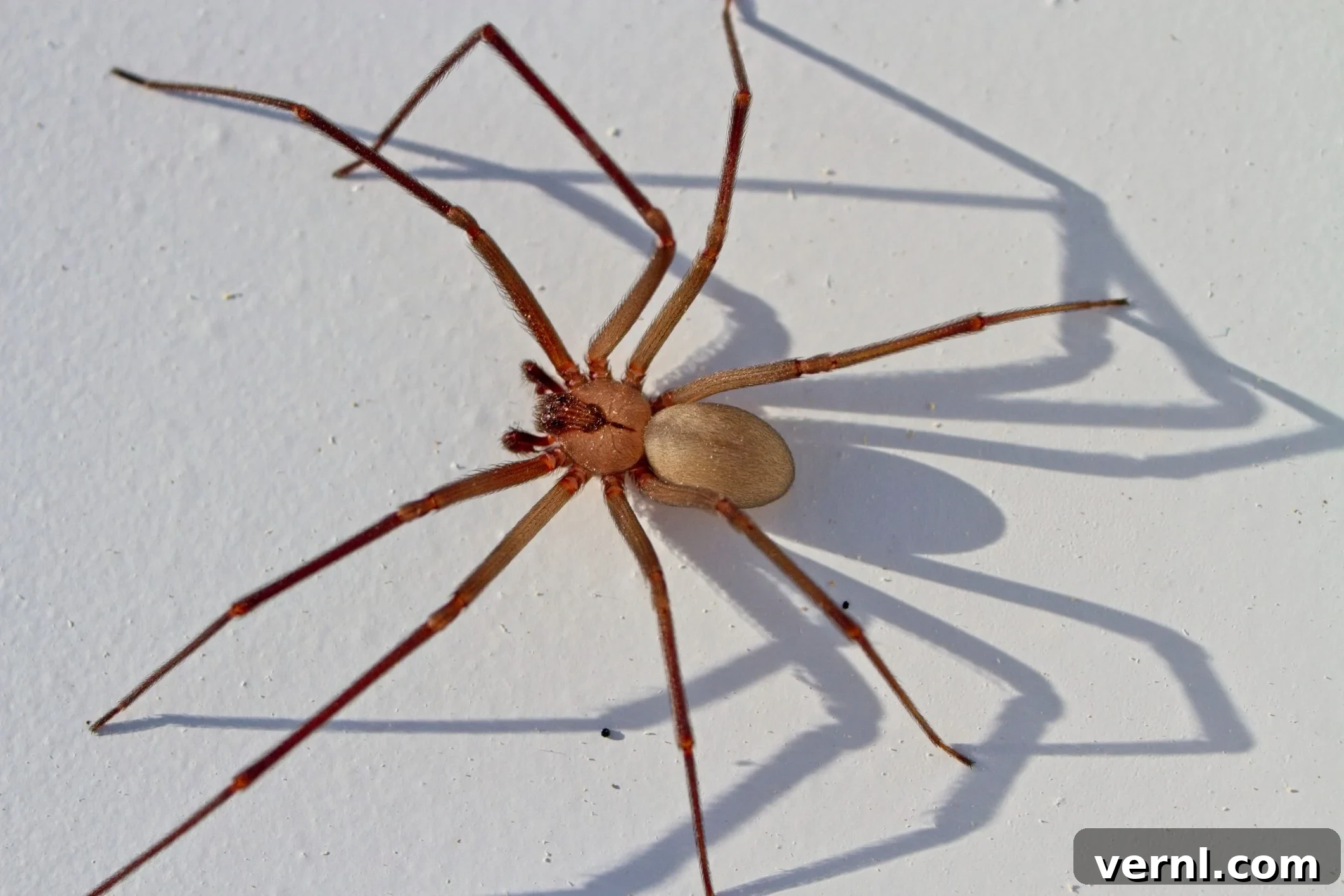
Identifying a brown recluse spider can be challenging, as its appearance shares similarities with various other harmless spider species. However, certain key characteristics can aid in its positive identification. The body and legs of a brown recluse typically range in color from a light tan to a darker brown. These spiders are relatively small, with their bodies measuring roughly nine millimeters long (less than half an inch). The most distinctive and widely recognized feature is the dark, violin-shaped pattern located on its back, specifically on the cephalothorax (the fused head and thorax). The narrow part of this violin pattern points towards the abdomen, giving the spider its common nicknames: “violin spider” or “fiddleback.”
Despite this distinctive marking, Bradley warns that many spiders possess similar markings or variations that can be misleading to the untrained eye. Therefore, relying solely on the violin shape for identification can lead to misidentification, causing unnecessary alarm. For a definitive identification, a magnifying glass is often required to observe a more unique anatomical feature: its eyes. Unlike most spiders, which typically have eight eyes arranged in four pairs, the brown recluse is one of the few species with only six eyes, arranged in three pairs (a median pair and two lateral pairs) in a semicircular pattern. This specific eye arrangement is a critical diagnostic feature that sets the brown recluse apart from many other spiders that might share similar coloration or body patterns. Observing this detail accurately is essential for confirming its identity and avoiding misjudgment.
Geographical Distribution: Where Do Brown Recluse Spiders Live?
The natural habitat of the brown recluse spider is primarily concentrated within a specific band of the central and southern United States. They are well-established residents in 16 states, where they are considered endemic. These states include:
- Alabama;
- Arkansas;
- Georgia;
- Illinois;
- Indiana;
- Iowa;
- Kansas;
- Kentucky;
- Louisiana;
- Mississippi;
- Missouri;
- Nebraska;
- Ohio;
- Oklahoma;
- Tennessee;
- Texas.
While these are their native territories, there have been occasional reports of brown recluse sightings in states outside this range. However, these isolated incidents are almost always attributable to accidental transportation. A spider might hitch a ride in a box, furniture, luggage, or a vehicle, inadvertently traveling far from its natural home. These stray individuals rarely establish new populations in non-endemic areas due to unfavorable environmental conditions or lack of mating opportunities, so residents outside the 16-state range generally need not be overly concerned about encountering established populations.
It’s also important to note that the brown recluse (Loxosceles reclusa) is not the only species of Loxosceles found in the United States. Other recluse spiders, though less common or restricted to different geographic zones, also inhabit various regions. For instance, the desert recluse, Loxosceles deserta, is typically found in the arid environments of southern Arizona and California, extending into parts of Mexico. Another species, the Apache recluse, Loxosceles apachea, occupies areas within southern Arizona and New Mexico. Globally, there are roughly 50 recognized species within the genus Loxosceles. A significant characteristic shared among all these species is that their venom possesses similar necrotic properties. For this reason, the University of California Integrated Pest Management Program strongly advises that all species of Loxosceles spiders should be approached with caution and ideally avoided due to the potential for their bites to cause skin damage.
Understanding the Impact: Are Brown Recluse Spiders Deadly?
Despite the widespread fear and alarming stories often associated with the brown recluse spider, it is crucial to clarify that their bites are not considered deadly. There has never been a single recorded case of a human fatality directly attributable to a brown recluse spider bite. This fact often comes as a surprise to many, challenging preconceived notions about the spider’s danger level. While their venom is potent and can cause significant local damage, it is not lethal to humans.
In most instances, a brown recluse bite results in relatively mild discomfort, often comparable to a bee sting. The initial reaction might be little more than a slight stinging sensation, which might go unnoticed at first. However, in some cases, the bite can progress to something more severe, leading to the development of a necrotic wound. This type of wound is characterized by tissue death and can be slow to heal, sometimes taking several months to fully resolve. While the vast majority of bites do not result in such severe outcomes, it is this necrotic potential that gives the brown recluse its infamous reputation.
In very rare circumstances, particularly in vulnerable individuals, a brown recluse bite can trigger systemic reactions. These can manifest as chills, fever, nausea, or dizziness. Such generalized symptoms are not common and typically occur only in specific populations: very young children whose immune systems are still developing, the elderly who may have weakened immune responses, or individuals with pre-existing health conditions that compromise their overall health. For the average healthy adult, a brown recluse bite is unlikely to cause such severe widespread effects, though local skin damage can still be a concern.
Visualizing the Aftermath: What Does a Brown Recluse Spider Bite Look Like?
The appearance and progression of a brown recluse spider bite can vary, but a typical scenario involves a distinct sequence of events. Initially, the bite may go unnoticed or feel like a minor sting. However, within approximately three to eight hours after the bite, the affected area usually begins to swell, and an irritating itch develops. This swelling and itching can persist for a surprisingly long duration, sometimes up to three weeks, indicating a prolonged inflammatory response at the site of envenomation.
In more severe cases, and what is characteristic of a necrotic brown recluse bite, the wound can develop a unique and unsettling appearance. As the venom begins to break down tissue, a bluish necrotic lesion may form in the center of the bite. This central area of dead tissue is often pale or sunken, surrounded by an angry reddish ring of inflamed skin. This distinctive pattern is sometimes referred to as a “bull’s-eye” lesion or a “red, white, and blue” lesion, reflecting the coloration of the affected tissue. Over several days or even weeks, this lesion can gradually expand and deepen, as more tissue succumbs to the venom’s effects. The resulting wound can be quite significant, sometimes leaving a deep, disfiguring scar that may require medical attention for proper healing and to prevent secondary infections. Prompt identification and medical consultation are crucial to manage the wound effectively and minimize potential long-term damage.
Effective Strategies: How To Get Rid of Brown Recluse Spiders
Controlling and eradicating brown recluse spiders can be a particularly challenging endeavor due to their inherently secretive nature and remarkable adaptability. “Given their small size, incredible dexterity, and unwavering determination to survive, they possess the ability to infiltrate almost any building at any time they choose,” emphasizes Bradley. Their preference for secluded, undisturbed environments makes them adept at avoiding detection, often hiding in plain sight or in areas rarely frequented by humans.
Indoors, brown recluses commonly seek refuge in undisturbed environments where they can remain hidden and safe. These locations often include cluttered storage areas, rarely opened closets, forgotten cubbies, seldom-used cabinets, and beneath furniture that is infrequently moved. Basements, attics, crawl spaces, and garages are also prime hiding spots, as they typically offer the quiet, dark conditions these spiders prefer. Outdoors, their preferred habitats are equally discreet, encompassing wooded lots, mature landscapes with dense vegetation, piles of wood, rocks, or other debris, and structures featuring wooden siding or roofing that offer numerous cracks and crevices for concealment.
The most effective strategy to keep these unwelcome guests out of your home is to eliminate any factors that might attract them or provide easy access. By making your home less appealing and less accessible, you significantly reduce the likelihood of an infestation. To achieve this, Bradley offers a comprehensive set of preventative tips:
- Practice Good Housekeeping and Lawn/Landscape Maintenance: A clean and tidy environment, both inside and outside your home, is crucial. Regularly vacuuming, dusting, and decluttering storage areas removes potential hiding spots and food sources. Outdoors, keep your lawn mowed, trim shrubs and trees away from your house, and remove leaf litter, woodpiles, and other debris that can serve as harborage for spiders and their prey. Reducing the insect population around your home naturally reduces the food supply for brown recluses.
- Seal Small Openings, Crevices, and Cracks Around Your Home: Brown recluses are small and can squeeze through incredibly tight spaces. Inspect your home’s foundation, exterior walls, windows, and doors for any cracks, gaps, or openings, no matter how tiny. Use caulk, weatherstripping, or expandable foam to seal these entry points. Pay close attention to utility penetrations (pipes, wires) and ensure screens on windows and doors are intact and tightly fitted. This physical barrier is a primary defense against their entry.
- Schedule Routine Pest Control Service with a Local Provider: For persistent problems or in areas with high brown recluse populations, professional pest control is often the most reliable solution. Certified exterminators have the expertise, tools, and treatments to effectively manage spider infestations. They can identify specific hiding spots, apply targeted treatments, and offer ongoing prevention strategies that are tailored to your property. A routine service can create a protective barrier around your home and help monitor for any signs of re-infestation, providing peace of mind in high-risk areas.
By diligently implementing these preventative measures, homeowners can significantly reduce the risk of encountering brown recluse spiders and help create a safer, more comfortable living environment.