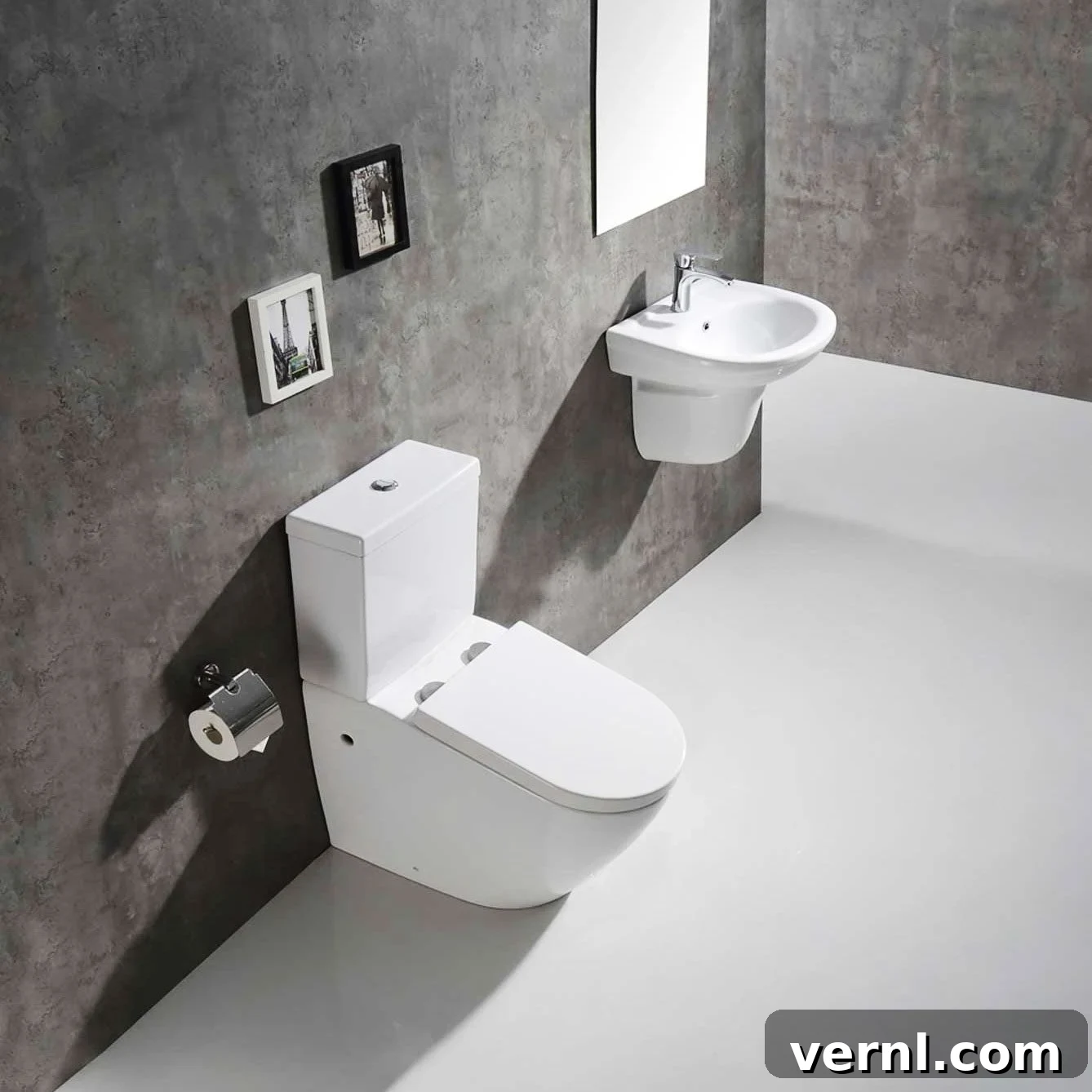
The engineers behind Slanty, a British-produced toilet, are sparking a global conversation with their remarkably innovative, albeit controversial, approach to toilet design. Unlike conventional models, the Slanty toilet re-imagines the user experience from a uniquely angled perspective, aiming to influence human behavior in public and commercial settings.
While the internal plumbing mechanisms operate much like any standard toilet, the defining feature of the Slanty lies in its seat profile. Departing sharply from the traditional horizontal toilet seat, the top surface of the Slanty tilts noticeably downwards at an approximate eight to thirteen-degree angle. This seemingly minor adjustment is designed to subtly, yet effectively, alter the user’s posture, shifting their body weight and making prolonged sitting uncomfortable.
Depending on one’s perspective, this groundbreaking design is either hailed as a necessary upgrade for public health and efficiency, or decried as a degrading symbol of corporate micromanagement. This article delves into the mechanics of the Slanty toilet, exploring its intended benefits, the heated public debate it has ignited, and its broader implications for workplace culture and public convenience.
Understanding the Ingenious Design of the Slanty Toilet
The concept for the Slanty toilet originated from a rather common, yet frustrating, experience encountered by its designer, Mahabir Gill. During a visit to a public restroom in the United Kingdom, Gill found himself facing an unusually long queue. As he recounted to the BBC in 2019, “I stopped off at the motorway to go to the loo and realized there’s a huge queue. I wondered what people were doing in there, some were coming out with their mobile phones.”
This observation struck Gill as both unsanitary and highly inefficient. He recognized a growing trend of individuals using public restrooms not merely for their primary purpose, but as private spaces for leisure activities, primarily smartphone use, leading to extended occupancy and unnecessary waiting times. Driven by a desire to address this modern phenomenon, Gill conceived a solution rooted in ergonomic design: the Slanty toilet.
The core innovation of the Slanty lies in its inclined seat. By introducing a downward slope of between eight and thirteen degrees, the toilet subtly shifts a significant portion of the user’s body weight onto their legs. This redistribution of weight creates a sensation of mild discomfort within approximately five minutes of sitting, subtly encouraging users to complete their business more quickly. The design is deliberately engineered to be uncomfortable enough to discourage loitering, but not so uncomfortable as to be genuinely painful or unusable for its intended brief function.
This approach mirrors similar design strategies seen in public spaces globally, such as park benches with sloped seats or those fitted with inconvenient armrests in the middle, all strategically placed to prevent people from settling in for extended periods. The Slanty toilet applies this same principle to the restroom, aiming to optimize flow and reduce wait times, particularly in high-traffic commercial and public environments.
Unpacking the Potential Advantages of a Slanted Toilet System
The benefits championed by the creators of the Slanty toilet primarily coalesce around three key pillars: individual health, public sanitation, and organizational productivity. Each of these areas presents a compelling argument for the adoption of this unconventional design, particularly in commercial and public sectors.
Health Benefits: According to information provided on the Slanty website, spending excessive amounts of time seated on a toilet can be more than just a time-waster; it can be an unhealthy habit with tangible negative health implications. Prolonged sitting in a typical toilet posture can contribute to the development of painful hemorrhoids and a weakening of the pelvic floor muscles. By encouraging shorter restroom visits, the Slanty toilet aims to mitigate these risks, promoting better long-term health for its users. The design subtly prompts individuals to adopt a more natural and efficient posture for bodily functions, reducing the strain associated with prolonged sitting and potentially improving overall gastrointestinal health.
Enhanced Sanitation: In an era of heightened awareness regarding germ transmission and public health, the Slanty toilet positions itself as a tool for a more sanitary bathroom experience. The discomfort induced by the slanted seat is intended to significantly reduce the likelihood of users engaging in non-essential activities, such as scrolling through smartphones or reading. This reduction in extraneous activity directly translates to less time spent touching surfaces within the cubicle, thereby minimizing the potential spread of germs and bacteria. In public and commercial restrooms, where hygiene is paramount, any design that subtly discourages germ-spreading behaviors can be a considerable asset in maintaining cleaner, healthier facilities for everyone.
Boosted Productivity: Perhaps the most aggressively marketed benefit, particularly for commercial clients, is the Slanty toilet’s potential to significantly enhance workplace productivity. The product is pitched as an ingenious, albeit subtle, management tool designed to curtail prolonged bathroom breaks. As asserted on the Slanty website, an eight- to thirteen-degree downward slant is projected to reduce the average time an individual spends in the restroom by over 25 percent. For businesses, this translates directly into more employee working hours, reduced operational downtime, and a perceived boost in overall efficiency. However, this particular benefit also sparks the most intense debate, raising questions about employee trust, privacy, and the ethics of monitoring or influencing personal time in such a direct manner. Installing uncomfortable toilets, for many, represents a deeply passive-aggressive tactic that can erode employee morale and foster resentment, creating a workplace environment where employees feel distrusted rather than valued.
This brings us to a crucial question: how might employees and the broader public react to the widespread implementation of such a design? At first glance, the initial and overwhelmingly common reaction suggests a strong sense of disapproval and even outrage.
Public and Media Reactions to the Slanted Toilet
Since its public introduction, the Slanty toilet has been a hot topic across a wide spectrum of media outlets, from popular social media platforms to prestigious news organizations like the BBC and Good Morning America. Much of the discourse has revolved around recaps of social media reactions, which have largely skewed negative, often laced with humor, disbelief, and indignation. Journalists, pundits, and the general public have chimed in with a range of pointed commentary.
Many critics have framed the Slanty toilet as a quintessential example of “dystopian design,” reflecting a future where even basic human comforts are sacrificed at the altar of efficiency and corporate control. CNET, for instance, famously labeled it “The meanest attempt to decrease smartphone usage so far,” capturing the widespread sentiment that the design is a punitive measure against personal downtime. Similarly, The Atlantic highlighted its “dystopian” nature, questioning the ethical boundaries of designing discomfort into everyday objects for productivity gains.
Wired UK offered one of the most comprehensive investigations into the phenomenon with its article, “The Corporate Poo Patrol is Coming after your Precious Toilet Time.” This piece provided an in-depth analysis of the Slanty, situating it within a broader trend of products and policies aimed at reducing employees’ time spent in restrooms. It underscored the tension between employer desires for maximized productivity and employee expectations for basic comfort and privacy, framing the toilet as a battleground in the modern workplace culture wars.
Conversely, the manufacturers of Slanty have also showcased early reviews on their official website that largely affirm the product’s advertised performance. These testimonials often speak to the toilet’s effectiveness in achieving its core goal of reducing restroom occupancy times. One such example reads: “We purchased the Slanty a few months ago and I was a little skeptical at first when my partner showed me the design. I can honestly say that it does what it says, that is, it definitely reduces the time we spend using the toilet.” While these reviews offer a counter-narrative, they often come from individuals or businesses directly invested in the product’s success, leaving room for skepticism among the broader public.
Accessibility Concerns: Slanted Toilets for Seniors, Children, and the Disabled
While the Slanty toilet is designed to induce discomfort after a short period for most users, its suitability is highly dependent on individual physical capabilities. The five-minute threshold for discomfort is an average, influenced by factors such as a user’s leg strength, core stability, and overall mobility. This inherent design choice immediately raises significant concerns regarding accessibility and inclusivity for various segments of the population.
For a substantial portion of the population, including young children, seniors, and anyone with mobility issues or disabilities, a slanted toilet is simply not a viable or humane option. Children, who may struggle with balance and body control, could find the angled seat precarious and potentially unsafe. Seniors, who often contend with reduced muscle strength, joint pain, or balance impairments, would likely find the Slanty toilet extremely difficult, if not impossible, to use safely and comfortably. Similarly, individuals with various physical disabilities – whether requiring wheelchairs, crutches, or simply having limited lower body strength or stability – would face immense challenges. The design, by its very nature, could exacerbate existing physical limitations, leading to increased risk of falls or discomfort that transcends the intended “mild” inconvenience.
The imperative for inclusive design dictates that public and commercial facilities should be accessible to all individuals, regardless of age or physical ability. Introducing a toilet design that actively excludes or disadvantages vulnerable groups contradicts fundamental principles of accessibility. While the Slanty might serve a niche purpose for reducing loitering among able-bodied adults, its broader implementation would necessitate careful consideration of alternative, accessible facilities to ensure no demographic is inadvertently marginalized or denied basic sanitation needs. Any widespread adoption would likely require a multi-faceted approach, incorporating traditional, accessible toilet options alongside the Slanty, rather than as a sole replacement.
Note: It is worth mentioning that the concept of an angled toilet seat is not entirely novel, nor is it exclusively British. The Stoke-on-Trent based manufacturer Twyfords, for example, held a 1911 patent for its “Natura” toilet, which was available in both forward and backward sloping models. For a fascinating glimpse into this and other unusual plumbing products from Twyfords’ history, Terry Woolliscroft’s blog provides an insightful resource (see Terry Woolliscroft’s blog). The fact that the Natura never gained widespread traction in the past might serve as a cautionary tale for the future trajectory of the Slanty toilet, suggesting that societal acceptance of discomfort in restrooms remains a significant hurdle.
The Future and Availability of the Slanty Toilet
Currently, the Slanty toilet is primarily available within the United Kingdom, where it was conceived and first introduced. For those outside the U.K., particularly in regions like the United States, acquiring a Slanty toilet remains a waiting game, as it has not yet been launched globally. This limited availability suggests that the company is likely gauging market reaction and navigating regulatory and cultural differences before considering a broader international rollout.
The future of the Slanty toilet hinges on several critical factors. Public perception, as demonstrated by the strong reactions it has elicited, will play a significant role. The balance between desired efficiency and perceived corporate intrusion will determine its long-term viability in commercial settings. Furthermore, addressing the legitimate accessibility concerns raised by disability advocates and elderly care organizations will be paramount for any widespread adoption, requiring thoughtful solutions or clear guidelines for its installation alongside accessible alternatives.
Whether the Slanty toilet becomes a pervasive fixture in public and commercial restrooms or remains a niche, controversial product, its introduction has undeniably sparked an important dialogue. It forces us to examine the evolving relationship between design, comfort, human behavior, and productivity in public spaces. The Slanty toilet stands as a potent symbol of modern attempts to subtly engineer human interaction and efficiency, pushing the boundaries of what society deems acceptable in the most private of public spaces.