Car Won’t Start? Simple Troubleshooting Tricks to Get You Going
Few feelings are as utterly helpless as being stranded when your car steadfastly refuses to start. While most people don’t carry a full set of mechanic’s tools in their trunk, I’ve spent over 50 years as an ASE and General Motors Master Technician, a vocational educator, and a dedicated vehicle owner. This extensive experience has taught me the value of preparedness. That’s why I always keep a multi-tool, a reliable jump starter, heavy-duty jumper cables, a safety hammer, and a compact tool kit in my vehicles. These items are indispensable for those inevitable “uh-oh” moments on the road.
However, before you throw in the towel and call for a tow, know that a non-starting car doesn’t always mean a costly repair. There are several clever tricks you can try, none of which require specialized tools. These simple, no-cost solutions are organized by symptom, offering practical steps you can take immediately. While these methods won’t address the underlying mechanical issue, one of them might just be enough to get your engine fired up, allowing you to drive safely to the nearest mechanic for a proper diagnosis and fix. Ahead, discover invaluable tips from seasoned technicians that could be your lifeline when your car decides to take an unexpected break.
Additionally, if you drive an electric vehicle, here’s how you can jump start your electric car.
Why Won’t My Car Start? Understanding the Root Causes
The question, “Why won’t my car start?” is one I’ve heard countless times over my career. The truth is, the causes can range dramatically, from something as minor as a $1 fuse to a major problem like a $5,000 engine failure. Understanding the most common culprits can help you narrow down the possibilities.
The Most Common Reasons Your Car Fails to Start
Automotive starting issues often stem from a few core areas:
- Battery-Related Problems: This is arguably the most frequent cause. It includes a completely dead battery, severely corroded or loose battery terminals, or a component in the electrical system that is constantly draining the battery’s charge, leading to its demise.
- Starter Motor Malfunctions: The starter motor is responsible for turning the engine over to initiate combustion. A faulty starter, a worn-out starter solenoid, or issues with the wiring leading to the starter can prevent this crucial process.
- Electrical System and Wiring Issues: Beyond the battery and starter, a myriad of electrical problems can arise. This could involve damaged wiring harnesses, blown fuses, defective relays, or problems with the ignition switch itself, preventing power from reaching necessary components.
- Fuel, Ignition, or Air Intake System Troubles: For an engine to run, it needs a precise mix of fuel and air, ignited at the right time. Problems like a clogged fuel filter, a failing fuel pump, faulty spark plugs or ignition coils, or a blocked air filter can all prevent the engine from firing up.
- Engine Mechanical Failures: While less common for a sudden no-start situation without prior symptoms, severe internal engine problems such as a broken timing belt, low compression, or catastrophic internal damage can also prevent an engine from starting.
These issues are typically influenced by factors such as the age and wear of components, the diligence of preventive maintenance, and even environmental conditions like extreme temperatures or severe weather.
Troubleshooting Your Non-Starting Car: No Tools Required
When your car refuses to start, the first step is to listen and observe. Different symptoms point to different potential problems. Here are some no-tool tricks you can try, categorized by what your car does (or doesn’t do) when you attempt to start it.
If the Car Clicks When Trying to Start
A distinct clicking sound when you turn the key but no engine crank is a classic sign of insufficient power reaching the starter motor. This often indicates a weak battery, dirty or loose battery terminals, or a failing starter motor or solenoid. While a jump start with jumper cables or a portable jump starter might be necessary, try these tricks first.
Try Cycling the Key
If your car powers on (lights, radio work) but won’t start, perform a simple diagnostic. Turn on your dome light and observe it closely as you attempt to start the engine. If the light dims significantly or goes out, it’s a clear indicator of a very weak or nearly dead battery. To potentially generate a bit more power or overcome initial resistance in the battery, terminals, or starter, try the “key cycling” trick.
Repeatedly turn the ignition key (or press the “Start” button) to the start position about 10 times in quick succession. This action attempts to heat up the battery and electrical connections, potentially reducing resistance. After cycling, pause for about five minutes to allow the battery to recuperate slightly. Then, try starting the engine normally. If the dome light remained bright during your initial attempt, indicating a stronger battery, this trick might not be the solution, and you should move on to the next tip.
Try Tapping on the Battery Terminals
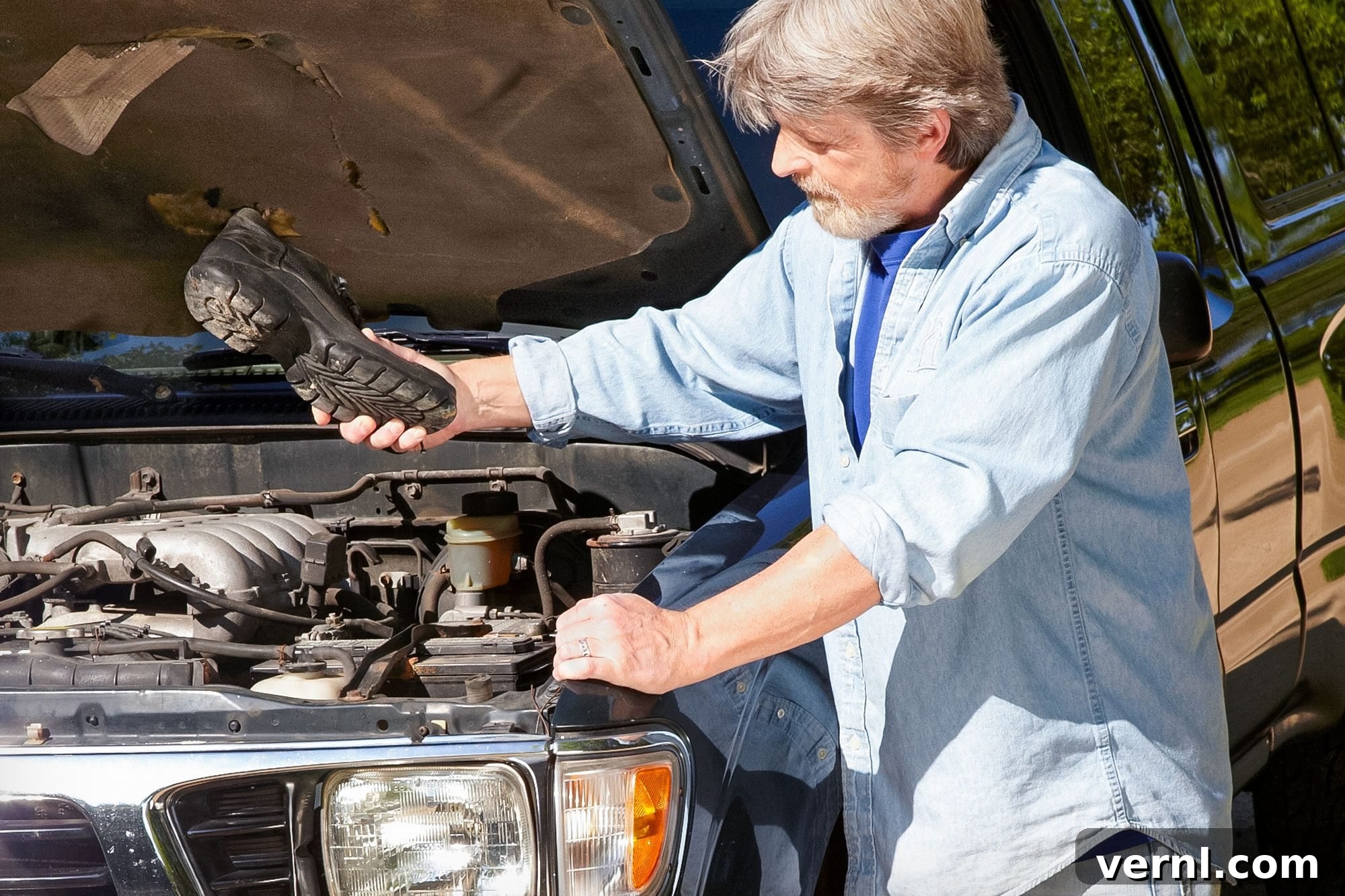
When you’re stranded without tools, cleaning corroded battery terminals isn’t an option. However, you might be able to temporarily improve contact. Sometimes, a thin layer of corrosion or a slightly loose connection prevents the full electrical current from flowing. Carefully, but firmly, smack each battery terminal with the heel of your shoe. The goal is to rotate the terminal slightly around its battery post, dislodging just enough corrosion or tightening the contact point momentarily. Be cautious not to hit so hard that you risk fracturing the battery post or cracking the battery casing, as this could lead to a more severe problem. After gently “jarring” the terminals, attempt to start the engine.
Try Tugging on the Battery Cables
Just as important as the battery terminals themselves are the cables connecting to them and extending to the starter and engine block. A loose positive (+) battery cable connection at the starter or a loose or corroded negative (-) cable where it bolts to the engine block or chassis can severely impede electrical flow, preventing your car from starting. Visually inspect the connections where you can. Then, firmly but carefully tug on both the positive and negative battery cables at all their connection points. A solid, clean connection is crucial for the high current needed to turn the engine. Sometimes, this simple movement can momentarily re-establish a sufficient electrical path.
Try Tapping the Starter Motor
If you can safely access the starter motor, located typically on the side of the engine near the bottom, it might be worth a gentle tap. The starter contains electrical contacts (solenoid) that can sometimes get stuck due to wear or buildup. Using a sturdy object like the tire iron from your car jack, give the starter motor a few firm, sharp taps. This physical jolt can sometimes free up the stuck contacts, allowing the starter to engage the flywheel and crank the engine. Ensure your car is in park/neutral with the parking brake engaged before attempting this.
Try “Popping” the Clutch (Manual or Standard Transmission Cars Only)
For vehicles equipped with a manual transmission, “popping the clutch” is a classic emergency starting technique that can bypass a dead battery or a non-functioning starter. ASE and Volkswagen Master Technician Bill Kirkpatrick highly recommends this method but emphasizes that it should only be attempted if you have a helper to safely push your vehicle and if conditions are right. Safety is paramount.
Here’s how to do it safely:
- Prepare the Vehicle: Engage the parking brake firmly and activate your emergency flashers to alert other drivers.
- Clear the Path: Ensure the road ahead of you is clear of traffic, pedestrians, and any obstructions or debris. You need a straight, flat, or slightly downhill stretch of road.
- Engage Gear: With your foot firmly on the brake pedal, depress the clutch pedal fully. Turn the ignition key to the “run” position (do not try to start). Then, place the gear shifter into second gear.
- Release Parking Brake: Once ready, release the parking brake.
- Get a Push: Have your helper begin pushing the car from behind. They should push on sturdy parts of the frame or body, avoiding glass, taillights, or decorative trim, which can easily break.
- Build Speed: As the car gains momentum, aim for a speed of around five miles per hour.
- Engage the Clutch: When you reach sufficient speed, quickly and completely lift your foot off the clutch pedal. This sudden engagement will connect the moving wheels to the transmission and, crucially, to the engine.
- Engine Engagement: The car will likely “jerk” as the transmission forces the engine to turn over. With enough power (torque) from the momentum, the engine should hopefully start.
- Post-Start Actions: As soon as the engine fires, immediately depress the clutch pedal again, shift the transmission into neutral, and apply the brakes to bring the car to a safe stop. Keep the engine running for at least 10 to 15 minutes to allow the alternator to begin recharging the battery.
If There’s No Click When You Turn the Key
If you turn the key or push the start button and hear absolutely nothing – no clicks, no whirring, just silence – the problem could be an entirely dead battery, a faulty ignition switch, or an issue with the neutral safety switch.
Try Shifting the Shifter
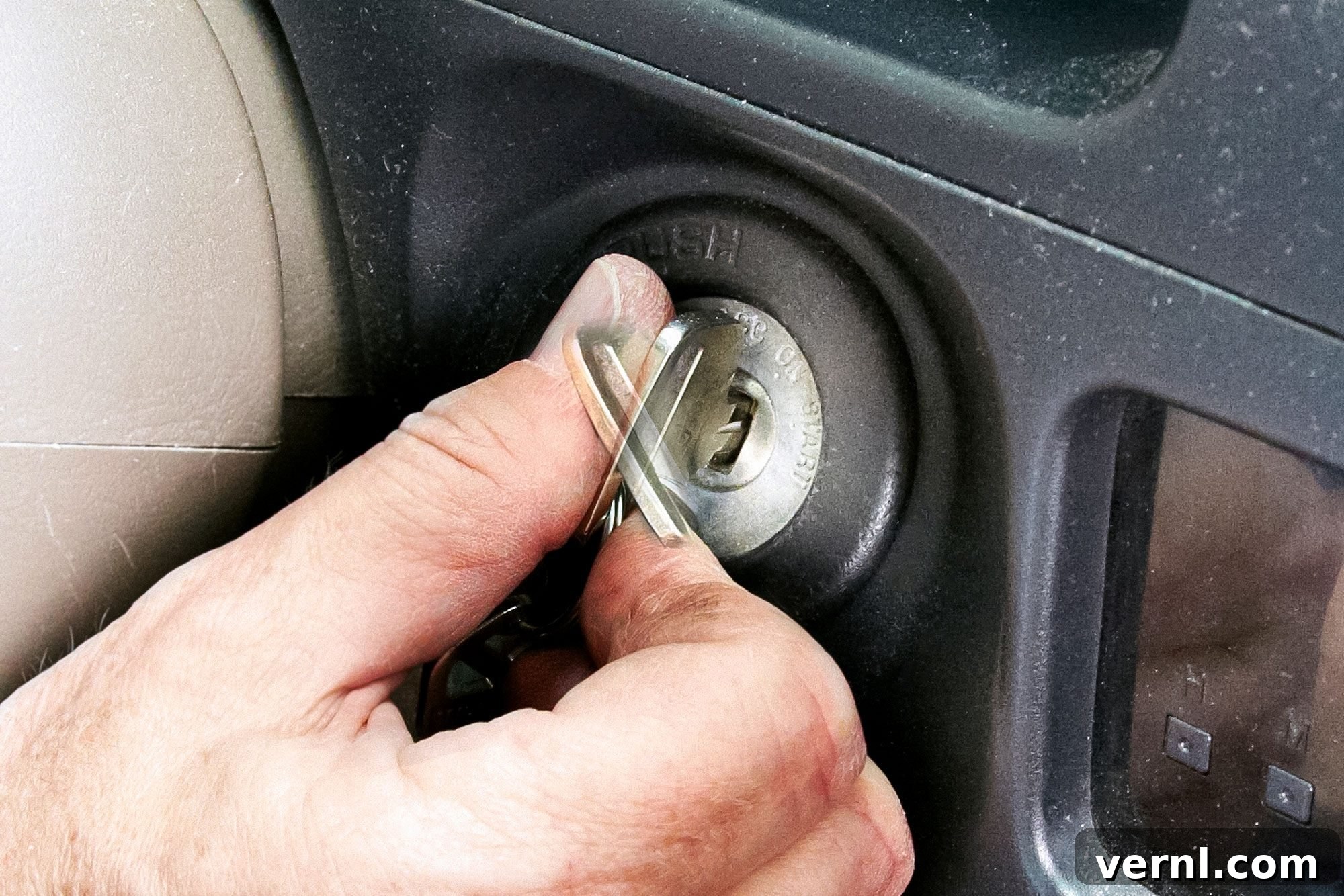
Automatic transmission vehicles have a safety feature called a neutral safety switch (or transmission range selector) that prevents the engine from starting unless the car is in Park (P) or Neutral (N). Sometimes, the electrical contacts inside this switch can become worn, dirty, or slightly misaligned, causing a failure to start even when the shifter appears to be in the correct position.
With your foot firmly on the brake pedal, move the shift lever slowly through all the gear positions, from Park down to the lowest gear (e.g., L or 1) and back up to Park, doing this a couple of times. This action can sometimes jostle the internal contacts of the neutral safety switch, re-establishing a proper electrical connection. Once back in Park, try starting the engine. If it still doesn’t work, try moving the shifter to the Neutral position and attempting to start the engine from there. This trick often resolves issues caused by a finicky neutral safety switch.
If the Engine Cranks But Won’t Fire Up
This scenario means the starter motor is successfully turning the engine over, but the engine isn’t catching and running on its own. This typically points to problems with the fuel delivery, ignition system, or air intake – the “spark, fuel, and air” triad essential for combustion.
Troubleshooting Fuel and Ignition Systems Without Tools
Try Swapping Relays
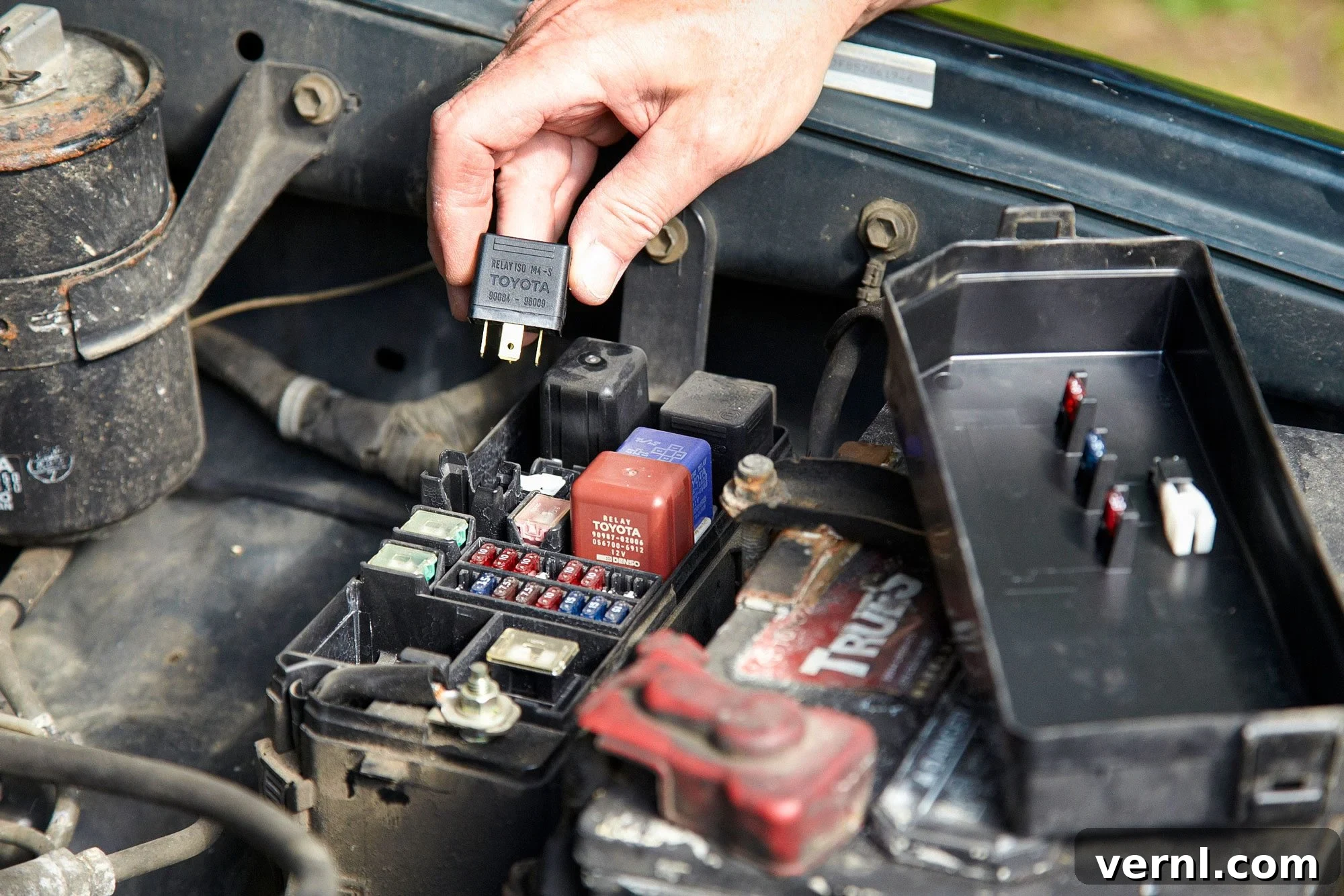
A common cause for an engine cranking but not starting is a failing fuel pump. The fuel pump’s job is to deliver fuel from the tank to the engine’s injection system. You can often check its function by listening carefully. With the radio off and in a quiet environment, turn the ignition key to the “run” position (without engaging the starter). Listen for a distinct, two-second buzzing or whirring sound coming from the rear of the car – that’s the fuel pump priming the system. If you hear nothing, the fuel pump relay might be faulty, or the pump itself could be failing.
First, consult your owner’s manual or examine the legend on the underside of your under-hood fuse box cover to locate the fuel pump relay. Once identified, carefully pull the fuel pump relay straight up and out of its socket. Next, find another relay within the same fuse box that has an identical part number (often controlling a non-critical system like the horn or fog lights). Swap this working relay into the fuel pump’s empty socket. Push it in firmly. Again, turn the key to the “run” position and listen for that two-second buzzing sound. If you hear it, try starting the engine. This simple swap can often bypass a faulty relay and get you going.
Try Smacking the Fuel Tank
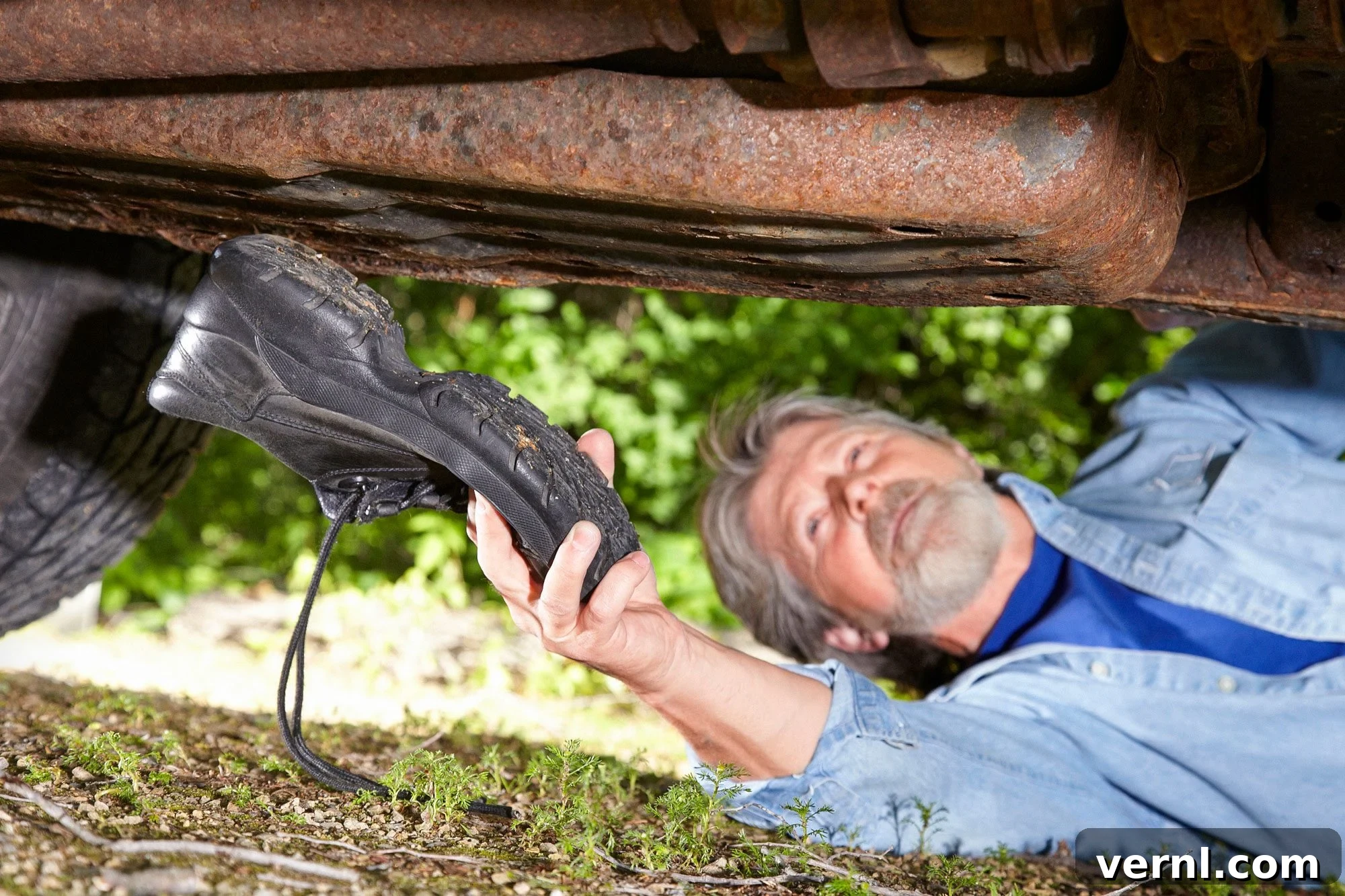
If swapping the fuel pump relay didn’t work and you suspect the fuel pump itself, another old trick is to give the fuel tank a gentle but firm tap. The fuel pump motor, located inside the fuel tank, can sometimes get stuck, especially if it’s nearing the end of its life or if there’s sediment in the tank. Using the heel of your shoe or a similar blunt object, gently hit the bottom of the fuel tank several times. This slight vibration or jolt can sometimes free up the pump motor, allowing it to temporarily function. Immediately after tapping, try starting the vehicle. This is a temporary fix, but it might provide enough life to get you to a service station.
Try Un-flooding a Flooded Engine
If you attempt to start your car and are met with a strong smell of gasoline, your engine is likely flooded. This happens when too much fuel has been injected into the cylinders without igniting, drenching the spark plugs and preventing combustion. Modern fuel-injected cars have a “clear-flood” mode designed for this exact situation. While the car is in “Park,” press the accelerator pedal all the way to the floor and hold it there. While keeping the pedal down, crank the engine for about 5-10 seconds. This action tells the engine control unit (ECU) to cut off fuel delivery while continuing to move air through the engine, effectively clearing out the excess gasoline from the cylinders. Release the accelerator and try starting normally.
Try Tricking the Computer (Accelerator Pedal Method)
In some cases, a vacuum leak or a malfunctioning temperature sensor can cause the engine’s computer to calculate an incorrect air/fuel mixture, making it too lean (not enough fuel) to start a cold engine. If you’ve tried other tricks and your car still cranks but won’t start, try this method to manually adjust the fuel mixture. Press the accelerator pedal halfway down and hold it in that position. Then, attempt to start the engine. This action sends a signal to the engine’s computer, instructing it to inject more fuel into the cylinders, potentially providing the richer mixture needed for ignition, especially in colder conditions or with minor sensor issues.
Check the Wire Harnesses (Visual Inspection and Reseating)
According to Bill Kirkpatrick, a loose or corroded electrical wire harness can lead to a multitude of perplexing issues, including starting problems. While you won’t be able to repair a damaged harness without tools, you can perform a visual inspection and attempt to reseat connections. Open the hood and carefully look for any dirty, loose, or visibly corroded connectors, especially those associated with the engine’s sensors, ignition system, or fuel system. Simply disconnecting and then firmly reconnecting these connectors can sometimes scrape away enough corrosion or oxidation buildup on the wire terminals to re-establish a solid electrical contact. This is a quick and free diagnostic step that can surprisingly resolve intermittent electrical issues.
When to Call a Professional
While these no-tool tricks can be incredibly useful in a pinch, it’s crucial to understand their limitations. They are temporary solutions designed to get you moving, not to fix the underlying problem. As soon as you realize your car will not start after thoroughly trying these expert-recommended techniques, it’s time to stop attempting further fixes. Continuing to crank a problematic engine can cause more damage or completely drain a weak battery. At this point, the safest and most sensible action is to call for a tow to your trusted mechanic. A professional will have the diagnostic tools and expertise to accurately identify and repair the root cause of your car’s starting issues, ensuring your vehicle is safe and reliable on the road.
Frequently Asked Questions About Car Starting Problems
Why won’t my car start when I have power (lights, radio work)?
This is a common and often confusing scenario. If your car lights, radio, and dashboard indicators all function normally, it suggests that your battery isn’t completely dead. However, the energy required to power accessories is significantly less than the massive surge of current needed to turn the starter motor and crank the engine. The easy answer often points to a defective starter motor, a bad starter relay or solenoid, or another failed electrical connection or system preventing that high current from flowing from the battery to the starter.
More specifically, a fully charged car battery should read approximately 12.6 volts when the engine is off and around 14.6 volts when the engine is running (indicating the alternator is charging). If the battery’s voltage drops significantly below nine volts when you attempt to start the engine—perhaps due to an aging battery, a defective starter drawing too much current, or high-resistance battery connections—there simply won’t be enough electrical current to close the starter circuit and energize the starter motor. Yet, there might still be enough residual voltage in the battery to illuminate your lights or play the radio, creating the illusion of having “power” when you actually lack the crucial cranking power.
Why won’t my car start when it’s cold?
Cold weather significantly impacts a car’s starting ability. The main reasons a car might refuse to start in the cold are:
- A Dead or Weak Battery: Cold temperatures drastically reduce a battery’s cranking power and its ability to hold a charge. A battery that’s merely weak in warm weather might be completely insufficient in the cold.
- Thick Motor Oil: Motor oil thickens in cold temperatures, making it harder for the engine to turn over. This puts extra strain on the starter and battery.
- Frozen Fuel System: While less common with modern fuels, water can condense in the fuel tank and freeze, blocking fuel lines or the fuel filter. Diesel fuel can also “gel” in extreme cold.
- Defective Engine Sensors: Sensors like the coolant temperature sensor tell the engine’s computer how to adjust the fuel-air mixture for starting. A faulty sensor might provide incorrect readings, leading to an overly lean or rich mixture that prevents ignition.
- Starter Motor Issues: While a starter can fail at any temperature, the increased resistance from cold oil and a struggling battery can expose a marginal starter motor’s weakness, leading to a no-start condition.
Why won’t my car start after getting gas?
A no-start condition immediately after fueling up can be particularly puzzling and frustrating. Beyond the general issues discussed above, a few specific factors related to fueling can cause problems:
- Evaporative Emission Control System (EVAP) Valve Issues: A faulty EVAP purge valve or vent valve can cause the engine to flood, especially after filling up, as it can disrupt the fuel vapor management system.
- Fuel Pump Shock: If your fuel tank was nearly empty and you filled it with very cold gasoline, the sudden temperature change could potentially shock a hot, working fuel pump, causing it to fail.
- Dislodged Sediment: A near-empty tank often has sediment at the bottom. Filling the tank can stir up this sediment, which might then clog the fuel filter or, in severe cases, the fuel pump inlet, leading to a lack of fuel delivery.
- Loose Gas Cap: While less likely to cause a complete no-start, a loose or faulty gas cap can sometimes trigger a check engine light and interfere with the EVAP system, potentially contributing to starting difficulties in some vehicles.
Why won’t my car start with a new battery?
It’s incredibly frustrating to invest in a new battery only to find your car still won’t start. Before assuming the new battery is faulty or a major problem exists, check these critical points:
- Battery Charge: Even new batteries can sometimes be sold partially discharged or lose charge during storage. Ensure your new battery is fully charged before installation.
- Shifter Position: Double-check that the shifter for automatic transmissions is securely in Park (P). If it’s not fully engaged, the neutral safety switch will prevent starting.
- Cable Connections: Verify that the battery cables are properly and securely connected. The positive (+) cable must be on the positive (+) battery post, and the negative (-) cable on the negative (-) post. Loose connections are a very common oversight.
- Ground Cable Integrity: Check the other end of the negative (-) cable where it attaches to the engine block or chassis. Ensure this connection is solid, clean, and free of corrosion. A poor ground connection prevents the electrical circuit from completing.
- Other Electrical/Starter Problems: If all battery connections are perfect and the battery is charged, the problem lies elsewhere. A bad starter motor, a faulty ignition switch, a blown main fuse, or other significant electrical issues are the next most likely culprits, even with a brand-new battery.
About The Experts
This comprehensive guide benefits from the insights of highly experienced automotive professionals:
- Bill Kirkpatrick: With over 50 years dedicated to the auto repair industry and vocational education, Bill is an ASE and Volkswagen Master Technician. His career spans roles as a shop owner and dealership service manager. Bill retired as a Pennsylvania Department of Education (PDE) certified automotive technology and small engine instructor, and he also holds certifications as a PA certified emissions and safety inspection instructor and inspector.
Sources
- Joe Simes, ASE and Toyota Master Technician, Pennsylvania Department of Education certified automotive technology instructor: email June 30, 2024.
- AAA (American Automobile Association): Reasons Your Car Won’t Start.
- Kelly Blue Book: Is My Car Battery Dead? November 29, 2023.
- Duffy, J. (2014). Modern Automotive Technology (8th ed., pp.482, 516, 520). The Goodheart-Willcox Company, Inc., Tinley Park, IL.