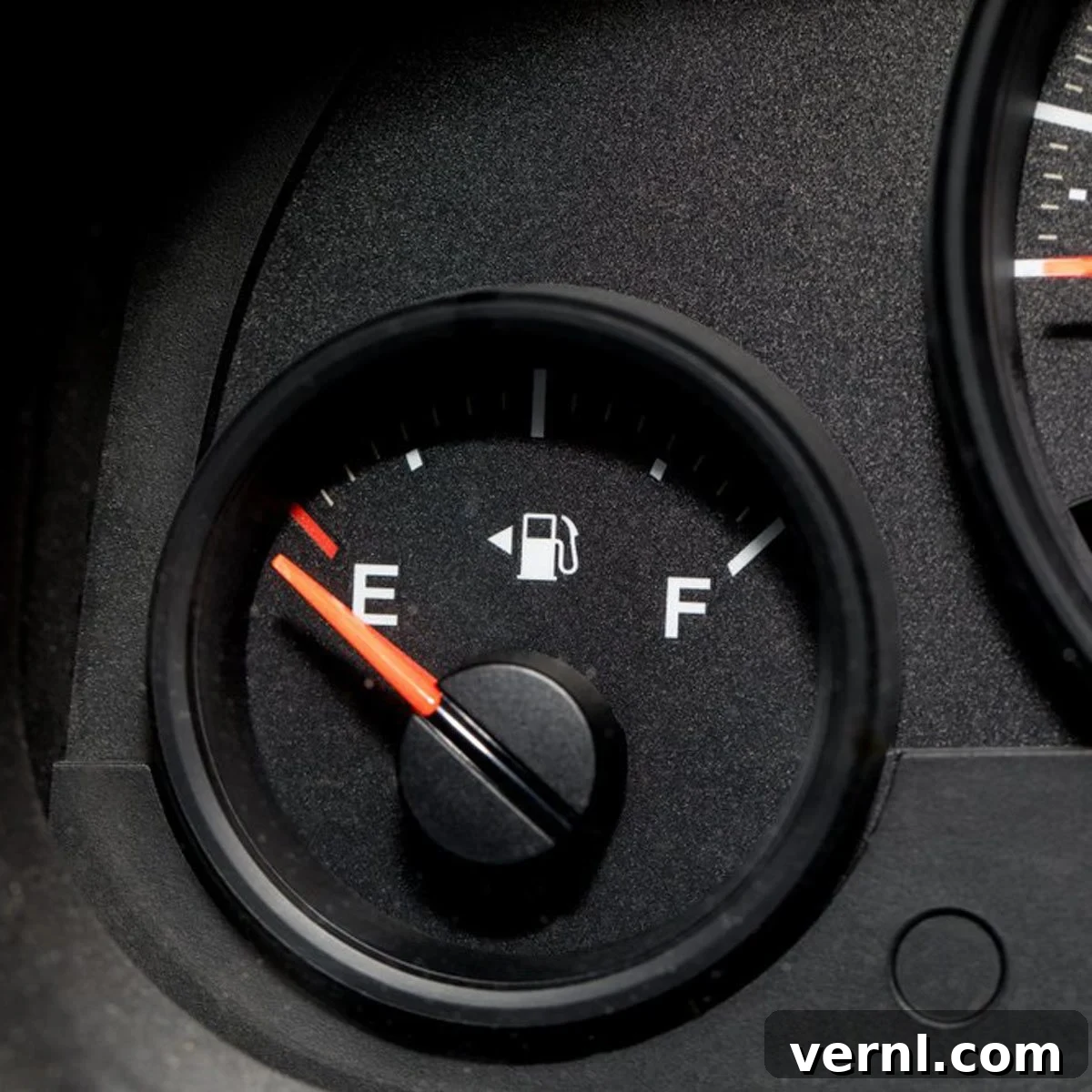
How Far Can Your Car Go on Empty? Decoding Your Fuel Warning Light
It’s a universal motorist experience: that sinking feeling in your stomach as the fuel warning light illuminates on your dashboard. For many, it triggers a mild panic, a quick mental calculation of the nearest gas station, and a silent prayer. For others, it’s a familiar sign that there are still a few miles left in the tank, thanks to years of anecdotal evidence or parental advice. We’ve all been there, pushing our luck a little too far, hoping to make it to the next exit or the cheaper gas station across town. Some are fortunate enough to coast into the pump on fumes, while others face the inconvenient and often lengthy walk to refuel.
The anxiety surrounding the “empty” light is legitimate. Beyond the obvious inconvenience of running out of gas, there are genuine concerns about the potential harm this habit can inflict on your vehicle. While it’s tempting to test the limits of your fuel tank, understanding the real risks and knowing how much buffer your car truly provides can save you from a costly repair bill and unnecessary stress.
This comprehensive guide dives into the specifics of what that little amber light truly means. We’ll explore reliable data that reveals how many miles popular car models can typically travel after the fuel light appears, discuss the hidden dangers of consistently running your tank low, and equip you with practical advice for navigating those nail-biting moments when your fuel gauge is bottomed out.
By the way, have you ever wondered why all cars don’t have gas tanks on the same side? It’s a common curiosity!
The Hidden Dangers of Driving on Empty: More Than Just an Inconvenience
While the immediate consequence of running out of gas is getting stranded, the long-term effects of consistently driving with a near-empty tank can significantly shorten the life of crucial components in your car. It’s a habit that many drivers fall into, but one that carries substantial risks beyond simply needing a tow. In essence, neglecting your fuel tank can be one of the subtle things your mechanic won’t tell you that lead to bigger problems down the road.
1. Strain and Damage to the Fuel Pump
Your car’s fuel pump is responsible for drawing gasoline from the tank and sending it to the engine. This pump is designed to operate while fully submerged in gasoline, which acts as a lubricant and a coolant. When your fuel tank consistently runs low, the fuel pump can become exposed to air. This not only increases its operating temperature but also reduces lubrication, leading to premature wear and potential failure. A failing fuel pump can cause your car to stall, misfire, or even prevent it from starting altogether. Replacing a fuel pump is a complex and often expensive repair, far outweighing the cost of a few extra gallons of gas.
2. Sucking Up Sediment and Contaminants
Over time, tiny particles of dirt, rust, and other contaminants can accumulate at the bottom of your fuel tank. While modern fuel filters are designed to catch most of these, running your tank extremely low increases the chances of these sediments being drawn into the fuel lines. This can clog your fuel filter faster, leading to reduced engine performance, fuel delivery issues, and eventually, blockages that can damage fuel injectors or even the engine itself. A clean fuel system is vital for efficient engine operation, and keeping your tank adequately filled helps prevent these unwelcome particles from circulating.
3. Potential Damage to the Catalytic Converter
If your engine begins to misfire due to an inconsistent fuel supply caused by a nearly empty tank, unburnt fuel can enter the exhaust system. This unburnt fuel can then reach the catalytic converter, a critical component designed to reduce harmful emissions. The catalytic converter operates at extremely high temperatures, and the introduction of unburnt fuel can cause it to overheat, leading to irreversible damage. Replacing a catalytic converter is one of the most expensive car repairs, often costing thousands of dollars.
4. Inconvenience and Safety Risks
Beyond mechanical damage, running out of gas leaves you stranded. This isn’t just an inconvenience; it can pose significant safety risks, especially if you run out on a busy highway, in an unfamiliar area, or during inclement weather. Waiting for roadside assistance or walking to a gas station can put you in vulnerable situations. Furthermore, the time lost and the potential cost of a tow service or emergency fuel delivery far outweigh the few dollars saved by waiting for the absolute last drop of fuel.
Understanding these risks underscores the importance of proactive fueling habits. While it’s comforting to know there’s a buffer after the fuel light comes on, it’s always best practice to refuel before your tank gets critically low.
Decoding the Fuel Light: How Much Buffer Do You Really Have?
The amber glow of your fuel warning light isn’t a hard stop; it’s an urgent reminder. Car manufacturers intentionally design a buffer into the fuel system, meaning there’s still a reserve of gasoline left even after the light appears. This buffer is a safety net, giving drivers a crucial window to find the nearest fueling station before their engine sputters to a halt. The precise amount of this reserve, however, varies significantly between different car models and manufacturers, making it a common source of anxiety and speculation for drivers.
For years, drivers have relied on anecdotal evidence or the reassuring words of experienced motorists – the classic “you’ve got a few more miles left” advice from Dad. While often true, the exact mileage can be a mystery. Factors such as driving style, road conditions, speed, and even the use of air conditioning can all influence how far you can truly go once that light flashes on. This variability is why concrete data is invaluable.
The Research That Illuminates: A Closer Look at Fuel Reserves
To demystify the “empty” tank dilemma, reputable sources have conducted extensive research. For instance, Your Mechanic undertook a comprehensive study, analyzing the top 50 best-selling cars in the United States. Their research focused on providing drivers with concrete data: how many gallons of gas typically remain in the tank when the warning light activates, and the estimated number of miles those remaining gallons can take you.
While this particular dataset was based on 2015 models, the underlying engineering and fuel reserve capacities tend to remain remarkably consistent across newer and older versions of the same car lines. Manufacturers typically don’t drastically alter these fundamental aspects year over year, making the approximations derived from this research highly relevant even for current vehicles. This invaluable information empowers drivers to make informed decisions rather than relying on guesswork when faced with a low fuel situation.
Understanding this data can transform your anxiety into assurance. Instead of panicking when you’re in an unfamiliar area and the gas light illuminates, you can consult this information (or commit your car’s specific figures to memory) to gauge your remaining range with greater confidence. This knowledge allows you to calmly plan your route to the nearest gas station without unnecessary stress or the risk of running dry.
Below is a visual representation of this critical data, illustrating the estimated miles you can drive after your fuel warning light comes on for various popular car models. This chart also includes notes on specific models where the warning light trigger is tied to a ‘distance to empty’ calculator rather than a fixed fuel volume.
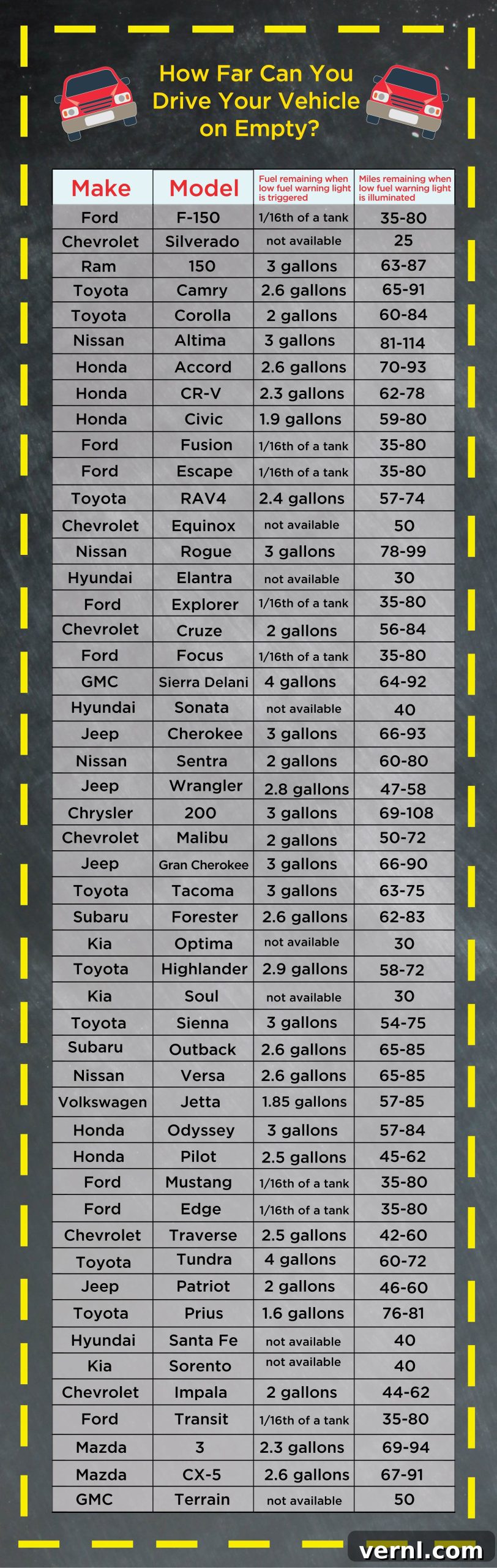
Your Mechanic’s Note: For vehicles with “Not available” listed for the point at which the warning light comes on, the light is triggered based on the distance to empty calculator having the listed number of miles remaining. This means that for some vehicles, the warning isn’t activated at a fixed fuel level, but rather when the car’s computer estimates that you can only travel a certain number of miles based on your recent driving patterns and fuel efficiency. Therefore, while the warning light gives you a heads-up, your actual remaining range can fluctuate more with these models based on how and where you’re driving.
Practical Advice for Driving on Low Fuel
Knowing your car’s approximate range on empty is powerful, but it’s still best to adopt smart habits. Here’s what to do if you find yourself pushing the limits:
1. Stay Calm and Assess Your Options
Panic is your enemy. As soon as the light comes on, calmly assess your surroundings. Look for signs indicating upcoming gas stations or check your navigation system for nearby options. Knowing your car’s reserve range, as per the data, should provide a degree of confidence.
2. Optimize Your Driving Style for Fuel Economy
If you’re truly running on fumes, every drop counts. Employ fuel-efficient driving techniques:
- Reduce Speed: Driving at lower, consistent speeds (e.g., 55-60 mph on a highway) significantly improves fuel economy compared to higher speeds.
- Avoid Rapid Acceleration and Hard Braking: Smooth, gradual acceleration and gentle braking minimize fuel consumption.
- Maintain a Steady Pace: Use cruise control on flat roads if available and conditions allow.
- Minimize Idling: If you find yourself stopped for more than a minute, it might be more fuel-efficient to turn off your engine if safe to do so.
3. Turn Off Non-Essential Accessories
Anything that draws power from your engine can consume fuel. Turn off the air conditioning, heater, radio, heated seats, defrosters, and even disconnect phone chargers if they are not absolutely necessary. While the impact might seem minimal, every little bit helps when you’re teetering on empty.
4. Head Directly to the Nearest Gas Station
Resist the urge to drive out of your way for slightly cheaper gas. Your priority should be to refuel as quickly and safely as possible. Use GPS or a mapping app to identify the closest gas station and proceed there directly.
5. Be Mindful While Pumping Gas
Once you arrive at the pump, stay focused. There are certain potentially dangerous mistakes you should avoid while pumping gas, such as re-entering your vehicle while fueling, leaving the pump unattended, or failing to discharge static electricity. Always prioritize safety during the refueling process.
6. Consider Carrying Emergency Fuel (with caution)
For drivers who frequently travel long distances in remote areas, carrying a small, legally approved container of emergency gasoline can offer peace of mind. However, gasoline is highly flammable and must be stored and transported according to strict safety guidelines. Always use an approved container and keep it in a secure, well-ventilated area, preferably outside the passenger compartment. It’s also wise to understand 10 things you should know about gasoline and the correct way to store gasoline for safety.
The Takeaway: Don’t Push Your Luck, But Don’t Panic
The bottom line is that while your car does provide a safety margin after the fuel warning light illuminates, consistently pushing your tank to its limits is a risky habit that can lead to costly repairs and significant inconvenience. Knowing the approximate range for your specific vehicle, as revealed by studies like Your Mechanic’s, can alleviate panic in a pinch. However, this knowledge should serve as a safety net, not an invitation to gamble with your car’s health.
The best practice remains simple: refuel when your tank reaches about a quarter full. This ensures your fuel pump is always submerged, reduces the risk of drawing in sediment, and prevents you from ever having to truly worry about how many miles you can drive on empty. Drive smart, drive safe, and keep that fuel gauge above the red line.