
In the realm of bathroom fixtures, few elements are as fundamental yet often overlooked as the toilet. While modern advancements bring forth luxurious features like bidet attachments and heated seats, an essential consideration that significantly impacts comfort, accessibility, and safety often goes unnoticed: toilet height. Anyone who has ever attempted to use a toilet designed for small children can attest to the awkwardness and discomfort when the fixture doesn’t match their stature. Conversely, a toilet that’s too low can pose significant challenges for adults, particularly those with mobility concerns.
Fortunately, today’s market offers distinct choices to cater to diverse needs: standard height and chair height toilets, often referred to as comfort height, right height, or ADA-compliant toilets. Understanding the nuances between these options is crucial for making an informed decision that enhances daily living. To illuminate these differences, we consulted with Leah Tuttleman, an esteemed interior designer at Re-Bath bathroom remodeling, whose expertise guides us through the intricacies of selecting the ideal toilet height for your home. While all toilets fundamentally serve the same purpose and are constructed from similar materials, our focus here will be on the distinctions in height, primarily for standard, floor-bolted models. It’s worth noting, however, that wall-mounted toilets also offer the flexibility of installation at either height, providing further customization for modern bathrooms.
Unpacking Toilet Height Options: Standard vs. Comfort
When embarking on the journey to select a new toilet, the first critical distinction you’ll encounter is between standard height and comfort height models. These two categories represent more than just a few inches; they signify a fundamental difference in user experience, dictated by their design dimensions.
Standard Height Toilets: The Traditional Choice
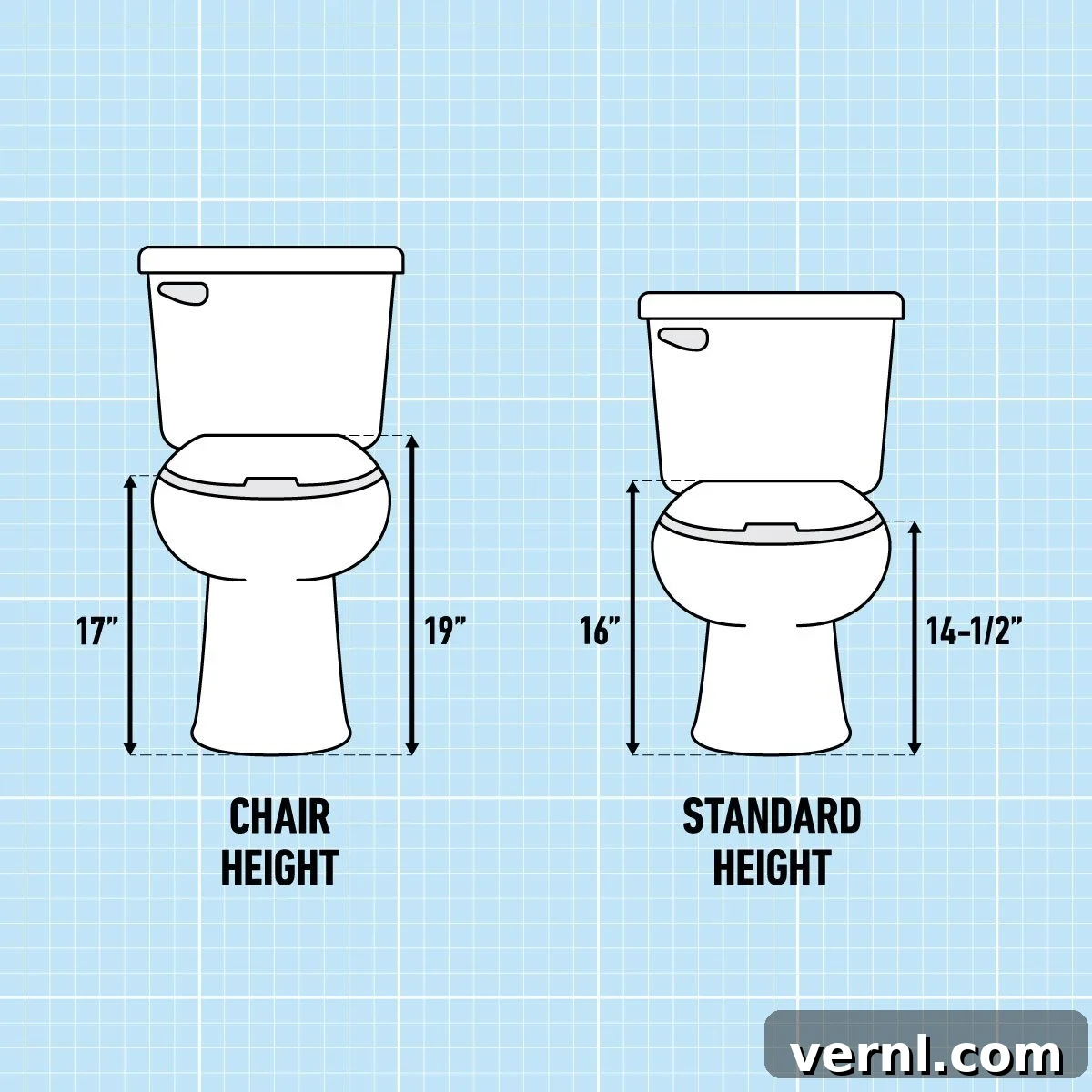
Standard height toilets typically range from approximately 14-1/2 to 16 inches from the floor to the top of the bowl or seat. This measurement is vital, as a toilet sold without a seat might list its height as 14-1/2 inches to the top of the bowl. Once a standard seat is installed, it adds roughly a half-inch or more, bringing the total height to around 15 inches off the ground. For decades, this height has been the prevailing norm in most households, offering a universally recognized dimension that, for many, simply felt “normal.” It’s a height deeply ingrained in residential and commercial architecture, largely due to historical manufacturing practices and a general assumption about average user stature.
While traditional, this height can present challenges. For taller individuals, it often necessitates a deeper squat, which can strain knees and hips. For the elderly or those recovering from surgery, the effort required to sit down and stand up from a lower position can be considerable, impacting independence and increasing the risk of falls. Despite these potential drawbacks, standard height toilets remain a popular choice, particularly in settings where children are primary users or where space constraints dictate a slightly more compact fixture.
Comfort Height Toilets: The Evolving Standard
In contrast, comfort height toilets, sometimes called “chair height” or “right height,” stand taller, usually measuring between 17 to 19 inches high from the floor to the top of the seat. As Leah Tuttleman highlights, these toilets have steadily transitioned from a specialized option to what is now considered a new industry standard. The design philosophy behind comfort height toilets is to emulate the height of a typical dining room chair, making the act of sitting down and standing up significantly easier and more natural for a wider range of users.
Similar to standard height models, a comfort height toilet sold without a seat might be listed at 16-1/2 inches to the bowl. The crucial addition of a toilet seat then brings its total height into the ADA-compliant range of 17 to 19 inches. This adherence to Americans with Disabilities Act (ADA) guidelines underscores their commitment to accessibility, making them an excellent choice for multi-generational homes, individuals with mobility challenges, or anyone simply seeking a more comfortable experience. The extra few inches, while seemingly minor, make a profound difference in biomechanics, reducing stress on joints and providing greater stability.
Why Toilet Height is a Critical Consideration for Every Home
Beyond aesthetic appeal or water efficiency, the height of your toilet profoundly impacts daily comfort, ease of use, and overall safety. It’s a choice that transcends mere preference, becoming a vital factor in the functionality and long-term livability of your bathroom. The ideal height often depends on the specific needs and demographics of your household, making it a decision that warrants careful consideration.
Enhanced Comfort and Reduced Strain
For many, particularly taller individuals or those grappling with joint issues like arthritis or bad knees, a comfort height toilet offers unparalleled ergonomic advantages. The elevated seat reduces the distance one must squat, translating into less strain on the knees, hips, and lower back. This slight elevation minimizes the effort required for sitting and standing, transforming a potentially strenuous task into a more fluid and comfortable motion. The biomechanics are straightforward: a higher seat allows for a more natural leg position, preventing the deep knee bend that can be uncomfortable or even painful for certain body types or conditions. This can be especially beneficial in preventing the sensation of “pins and needles” or numbness that can occur when sitting on a lower toilet for extended periods.
Promoting Ease of Use for All Ages
The impact of toilet height on ease of use varies significantly across different age groups and physical abilities. For families with young children, a standard height toilet often proves more practical. Its lower profile makes potty training less daunting for toddlers, allowing them to comfortably reach the seat and place their feet firmly on the ground, which is crucial for stability and a sense of independence. Moreover, young boys find it considerably easier to aim without the need for a step stool, simplifying bathroom routines and reducing messes.
Conversely, for older adults or individuals with temporary or permanent mobility impairments, a comfort height toilet is a game-changer. As Leah Tuttleman aptly notes, “a higher toilet seat or a seat riser can make getting up and down easier.” The additional two to three inches might seem negligible, but for someone struggling with balance, strength, or flexibility, this difference is monumental. It empowers them to maintain independence, reducing reliance on caregivers and mitigating the risk of falls, which are a significant concern in bathrooms. This aspect is particularly relevant for those planning to age in place, where every element of home design contributes to long-term safety and autonomy.
A Crucial Element for Safety and Accessibility
Safety in the bathroom is paramount, and toilet height plays an understated yet critical role. For individuals with limited mobility, a standard height toilet can be a hazard. The deeper squat required increases the likelihood of losing balance, slipping, or experiencing a fall, especially on wet or slippery surfaces. Comfort height toilets, by reducing this effort, inherently enhance safety. They provide a more stable platform for transitioning between sitting and standing, making the bathroom a much safer environment for seniors, individuals with disabilities, or anyone recovering from surgery or injury.
This commitment to safety is precisely why the Americans with Disabilities Act (ADA) specifies a height range of 17 to 19 inches for compliant toilets. This guideline isn’t arbitrary; it’s based on extensive research into ergonomics and accessibility needs. Incorporating a comfort height toilet, along with other modifications like grab bars and non-slip flooring, transforms a bathroom into an accessible sanctuary, fostering dignity and independence for all users, regardless of their physical capabilities.
Choosing the Right Toilet Height for Your Unique Needs
Deciding between a standard height and a comfort height toilet is a personal choice, deeply influenced by the specific dynamics of your household and individual preferences. To guide you through this decision-making process, consider these three pivotal factors: accessibility, installation logistics, and ultimately, personal comfort.
Prioritizing Accessibility: Who Benefits Most?
Accessibility is arguably the most compelling reason to opt for a comfort height toilet. As mentioned, the ADA’s specified height range of 17 to 19 inches exists precisely because a standard height toilet can be exceedingly difficult, if not impossible, for many individuals with mobility challenges to use safely and comfortably. This includes the elderly who may experience decreased muscle strength and balance, individuals who use wheelchairs or walkers, people recovering from hip or knee surgery, or those living with chronic conditions like arthritis or multiple sclerosis.
For these users, a chair height toilet makes the act of going to the bathroom not just easier, but also significantly more dignified. It minimizes the need for assistance, preserves privacy, and reduces the physical strain that can exacerbate pain or lead to injury. Beyond those with diagnosed mobility issues, larger and taller individuals often find chair/comfort height toilets inherently more accessible and comfortable, even if they don’t have specific mobility concerns. The natural chair-like posture it encourages simply aligns better with their taller frames, preventing awkward contortions and discomfort.
Installation Considerations: A Practical Perspective
While often secondary to comfort and accessibility, the practicalities of installation can influence your decision, especially if you plan on a DIY approach. Generally, standard height toilets tend to have less porcelain and are consequently lighter than their comfort height counterparts. This difference in weight can be a significant factor during installation, particularly for one-piece toilets, where the tank and bowl are integrated into a single, streamlined unit. One-piece toilets, while aesthetically pleasing and easier to clean, are inherently heavier than separable two-piece models, making them more cumbersome to maneuver and install, especially in a comfort height configuration.
If ease of installation is a primary concern, and other factors like mobility are not paramount, a standard height, two-piece toilet will generally be the most manageable option due to its lighter weight and easier component handling. Regardless of height, remember to verify the “rough-in” size of your current plumbing setup. The rough-in measurement is the distance from the wall behind your toilet to the center of the floor drain. A simple way to measure this accurately is from the wall to the bolts securing your toilet to the floor. These bolts are precisely at the midpoint of the drain, eliminating the need to remove the existing toilet for measurement.
Leah Tuttleman confirms that both standard height and chair height toilets are available in common rough-in sizes of 10, 12, and 14 inches. Always measure this distance meticulously before purchasing your new toilet to ensure compatibility with your existing plumbing, preventing costly and frustrating installation delays. A mismatch in rough-in can render even the most perfect toilet uninstallable without significant plumbing modifications.
Prioritizing Personal Comfort: The Ultimate Test
Ultimately, your toilet should serve as a source of comfort and safety in your daily routine. When selecting this crucial fixture, it’s vital to consider not only your current circumstances but also anticipate future needs. While swapping out a toilet is a relatively straightforward home improvement task, it’s not something most homeowners wish to undertake frequently. Therefore, making the right choice upfront is a wise investment in your long-term well-being.
For individuals who are particularly tall, perhaps 6 feet 6 inches or more, a chair-height toilet can dramatically improve comfort by preventing awkward knee contortions and undue pressure on joints. While a younger, healthier individual might not immediately perceive this as a significant issue, the benefits become increasingly apparent with age, as joint flexibility decreases and the risk of discomfort rises. As Tuttleman advises, however, “comfort-height toilets may not be suited for everyone.” Shorter individuals, for instance, might find their feet dangling uncomfortably if the toilet is too high, leading to reduced stability and a less secure feeling. For them, a standard height toilet that allows their feet to rest firmly on the ground is often the superior choice.
To truly ascertain the best fit, Leah Tuttleman offers invaluable advice: “It’s a good idea to test different heights to determine which is best for you.” Visiting a showroom where various toilet heights are displayed allows for a practical “sit test.” This direct experience can provide invaluable insight into what feels most comfortable and stable for your unique body type and mobility needs, transforming an abstract decision into a tangible one. Consider how the height impacts not just sitting, but also the ease of rising, especially if you anticipate any future changes in mobility.
Meet the Expert Behind the Insights
- Leah Tuttleman, an interior designer at Re-Bath, is an Allied member of the American Society of Interior Designers. With over 25 years of extensive experience, she has contributed to all facets of design, from commercial to residential projects, encompassing design direction, meticulous project management, and innovative fabrication. Her profound expertise in creating functional and aesthetically pleasing spaces makes her a trusted authority in bathroom remodeling and design.
Choosing the right toilet height is a decision that impacts daily comfort, accessibility, and safety for every member of your household. By carefully considering your individual needs, future planning, and the practicalities of installation, you can select a fixture that not only meets but exceeds your expectations, transforming a mundane necessity into an ergonomic asset in your home.