
Ultimate Guide to Whole House Fans: Efficient Cooling for Your Home
Are you looking for an innovative and cost-effective way to keep your home cool and comfortable? Whole house fans offer an excellent alternative to traditional air conditioning, providing a refreshing breeze and significantly reducing your energy bills. Unlike conventional AC systems that recirculate indoor air, whole house fans actively pull in cool, fresh outdoor air and expel hot, stale air, creating a natural and invigorating indoor climate. Once you install them in a room, the temperature will naturally drop, leading to a more comfortable living environment. In this comprehensive guide, we’ll delve into everything you need to know about whole house fans, from how they work to choosing the best option for your specific needs.
What is a Whole House Fan and How Does It Work?
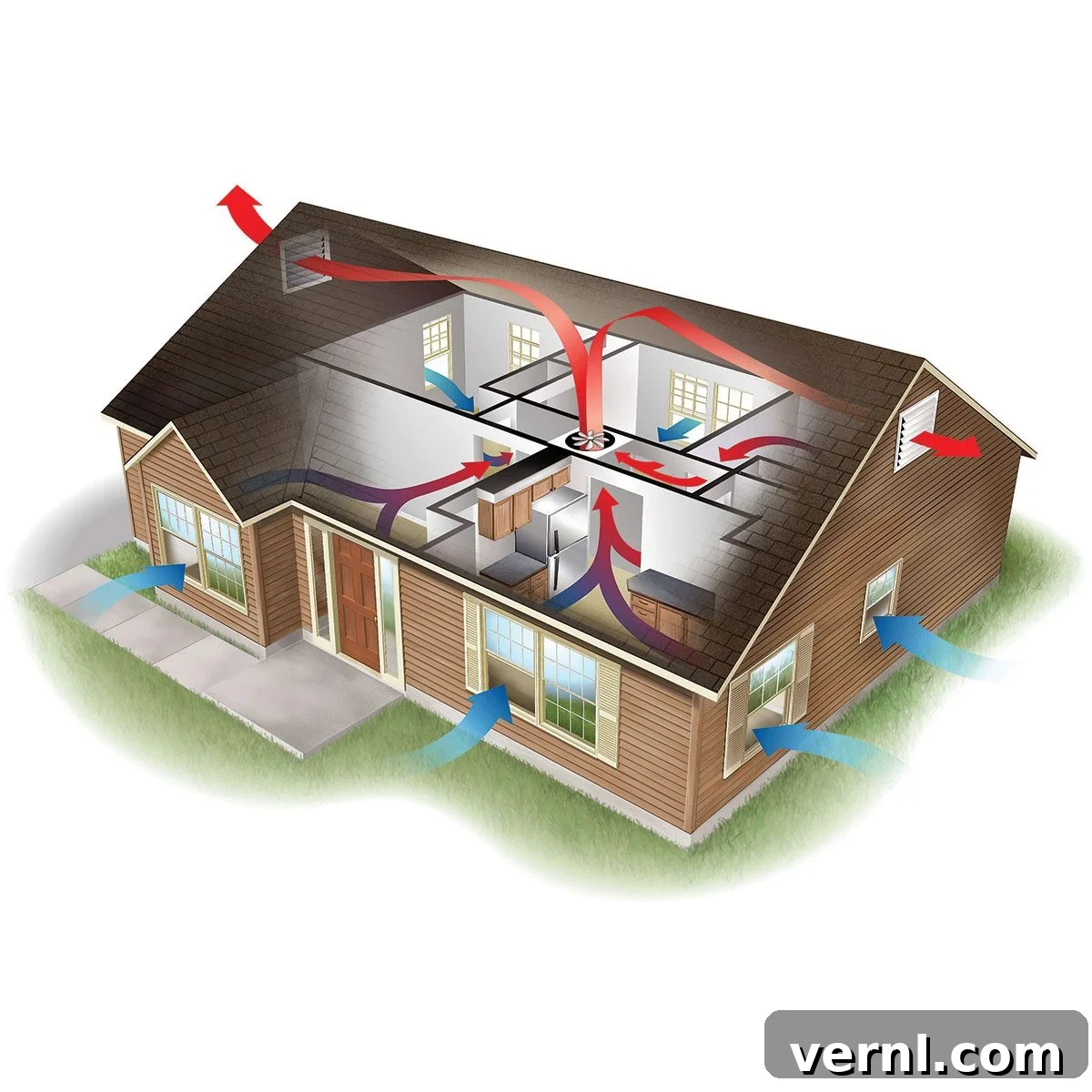
A whole house fan is a powerful ventilation system designed to cool your entire home by drawing in cooler outside air and expelling warmer indoor air. Typically installed in a central ceiling location, usually in a hallway or attic access point, this large electric fan creates a rapid airflow throughout your living space. When the outdoor temperature drops in the evening or early morning, the fan is activated, pulling fresh air in through open windows and doors. This incoming cool air pushes the trapped hot air from your home up into the attic, where it then escapes throughattic vents.
The operational concept is elegantly simple and incredibly effective: an attic-mounted fan works as the exhaust, pushing hot air accumulated throughout the day out through your attic’s existing vents or newly installed ones. Simultaneously, it acts as an intake, drawing in cooler, fresher air from outside through any open doors and windows. This rapid and efficient air exchange can completely refresh the air in a typical house within just two to three minutes, depending on the fan’s power and the home’s size. This process not only removes built-up heat but also generates a pleasant, natural breeze, making your home feel significantly cooler without the harshness of air conditioning.
A well-sized whole house fan can circulate the air in your home up to six times an hour, effectively flushing out heat and pollutants. This constant movement of fresh air can dramatically lower indoor temperatures, especially during mild to warm evenings. However, it’s crucial to understand that whole house fans are not air conditioners; they don’t dehumidify the air or actively cool it below the ambient outdoor temperature. Instead, they leverage natural temperature differences to achieve cooling and ventilation.
When operating a whole house fan, safety is paramount. Always ensure that multiple windows and doors are open before turning the fan on. Failure to do so can create negative pressure within your home, leading to a “backdrafting” effect. This can cause gas-burning appliances, such as your furnace, water heater, or even a fireplace, to pull combustion gases and dangerous carbon monoxide into your living space instead of venting them safely outside. Additionally, it’s important to be aware that whole house fans may not be permitted in all regions or might require specific installation guidelines. Always check your local building codes and regulations before purchasing and installing a whole house fan to ensure compliance and safety.
Quiet Whole House Fans vs. Attic Fans: What’s the Difference?
While often confused due to their shared goal of home ventilation, quiet whole house fans and attic fans serve distinctly different purposes in maintaining indoor comfort and air quality. Understanding these differences is key to choosing the right system for your home’s needs.
Whole House Fans: These systems are designed to cool the living spaces of your home. As the U.S. Department of Energy states, “Whole house fans pull outdoor air into a home through open windows and exhaust it through vents in the attic and roof.” Their primary function is to create a powerful cross-ventilation, drawing cooler air through your occupied rooms and expelling the hot, stagnant air into the attic, which then vents outside. They directly impact the temperature and freshness of the air you breathe and live in, making your home feel cooler and more comfortable. Whole house fans are typically installed in a central ceiling location, allowing them to draw air from the entire house.
Attic Fans: In contrast, an attic fan is made specifically to ventilate the attic space itself, not the living areas below. Attics can become incredibly hot during summer days, often reaching temperatures well over 130°F (55°C). An attic fan’s role is to pull this superheated air out of the attic and push it outside, preventing heat and humidity from building up. By doing so, it helps to:
- Reduce heat transfer: Less heat radiates from the attic into your living spaces, reducing the load on your air conditioning.
- Prevent moisture issues: It helps to mitigate problems like mold and mildew by reducing humidity buildup, which is particularly crucial in preventing damage to insulation and structural components.
- Extend roof life: By preventing excessive heat buildup, an attic fan can help prolong the life of your roof shingles and other roofing materials. In colder climates, it also plays a role in preventing ice dams by keeping the roof decking temperature consistent.
While an attic fan can indirectly help with home cooling by reducing the heat load on the ceiling, it does not provide the direct, rapid air exchange and “breeze effect” that a whole house fan offers in your living areas. Many homeowners find that using both an attic fan and a whole house fan in conjunction provides the most comprehensive and energy-efficient cooling and ventilation strategy for their homes, especially in hotter climates.
Whole House Fan Benefits: Why You Should Consider One
Embracing a whole house fan for your home’s cooling needs comes with a multitude of advantages, particularly when aiming for energy efficiency and environmental responsibility.
Significant Energy Savings and Environmental Friendliness
One of the most compelling reasons to install a whole house fan is the drastic reduction in energy consumption compared to traditional air conditioning. These fans use significantly less electricity, often just 10-20% of what a central AC unit consumes. By relying on a whole house fan during cooler parts of the day or night, you can substantially decrease your air conditioner’s runtime, leading to remarkable savings on your utility bills. This lower energy usage also translates directly into a reduced carbon footprint, making whole house fans an environmentally friendly choice for sustainable living.
Natural and Comfortable Cooling
Unlike the dry, often recirculated air from an AC unit, a whole house fan introduces a constant flow of fresh, cool outdoor air into your home. This creates a pleasant, natural breeze effect that many find far more comfortable and invigorating. The feeling of fresh air circulating through your home, flushing out stale air, odors, and even airborne pollutants, contributes to a healthier and more enjoyable indoor environment.
Pre-Chilling Your Home
In regions experiencing very hot temperatures, a whole house fan can act as an effective “pre-chiller.” By running the fan for several minutes in the early morning or evening when outside temperatures are lower, you can purge accumulated heat from your home before the hottest part of the day. This pre-cooling significantly reduces the workload on your air conditioner, allowing you to switch on the AC for a shorter duration, or even avoid using it altogether on milder days.
Ideal for Dry Climates
If you reside in a dry climate with significant diurnal temperature swings (i.e., hot days and cool nights), a whole house fan truly shines. You can effectively cool down your indoor temperature by running the fan on cooler nights and turning it off during the hottest times of the day. During the day, keep your windows and doors shut to trap the cool air inside. This strategy leverages the natural temperature gradient, providing comfortable cooling without the high energy costs of refrigeration-based systems.
Improved Indoor Air Quality
By constantly exchanging indoor air with fresh outdoor air, whole house fans help to improve indoor air quality. They effectively remove stale air, cooking odors, pet dander, and other indoor airborne pollutants, creating a healthier living space.
Considerations and Limitations
While whole house fans offer numerous benefits, it’s important to acknowledge their limitations. They cannot cool inside temperatures lower than outside temperatures, as they rely on drawing in ambient air. They also do not dehumidify, which means if you live in a humid region, you’ll likely still need to rely on your air conditioner on hot, muggy summer days to manage moisture. Furthermore, individuals who suffer from severe allergies might find that these fans draw in outdoor pollen and dust, potentially exacerbating symptoms. Strategic timing of fan use or incorporating high-quality window screens can help mitigate this, but it’s a factor to consider.
Installation Guide for Whole House Fans: How to Choose the Best One
Proper installation and selection are crucial for maximizing the efficiency and comfort a whole house fan provides. While some homeowners might consider a DIY approach, consulting a local HVAC installer is often recommended to ensure the fan perfectly fits your home and climate needs.
Sizing Your Whole House Fan: CFM Matters
Choosing the right size fan is perhaps the most critical step. The fan’s capacity is measured in Cubic Feet per Minute (CFM), indicating how much air it can move. A common guideline is to select a fan that can exchange the air in your home 3 to 6 times per hour. To calculate your home’s total cubic footage, multiply your square footage by your ceiling height (e.g., 2000 sq ft x 8 ft ceiling = 16,000 cubic feet). For optimal cooling, aim for a fan with a CFM rating that allows for 3 to 5 air changes per hour (ACH). For example, 16,000 cubic feet x 3 ACH = 48,000 CFM needed per hour, or 800 CFM per minute (48000/60). However, don’t just focus on the largest fan; consider other factors like noise, insulation, and the complexity of installation. Sometimes, several smaller fans strategically placed can offer better airflow and quieter operation than one massive unit, especially in homes with complex layouts.
Attic Ventilation: A Non-Negotiable Requirement
A whole house fan’s effectiveness is directly tied to the adequacy of your attic ventilation. The fan needs an easy and sufficient path to expel the hot air it pulls from your living spaces. Without proper attic vents (such as soffit, ridge, or gable vents), the fan will struggle to move air efficiently, potentially creating backpressure and forcing hot air back down into your home. As a general rule, you should have at least 2 to 4 square feet of net free ventilation area (NFVA) for every 750 CFM of fan capacity. If your existing attic ventilation is insufficient, you may need to install additional venting, which could influence your fan size choice or overall project cost.
Fan Types and Noise Levels
Today’s market offers a variety of whole house fan types, each with different features regarding installation, insulation, and noise output. Traditional models are powerful but can be louder, while newer designs prioritize quiet operation and energy efficiency. Noise is measured in “Sones,” with lower Sone ratings indicating a quieter fan. Consider the fan’s Sone rating, especially if it will be located near bedrooms or living areas.
Location and Installation
Most whole house fans are installed in a central hallway ceiling, allowing them to draw air evenly from multiple rooms. Installation typically involves cutting an opening in the ceiling, framing out a box for the fan, and ensuring proper attic sealing and insulation around the unit. Professional installation ensures safety, compliance with building codes, and optimal performance, especially when dealing with electrical wiring and attic modifications.
Rebates and Tax Credits: Saving Even More
Before making a purchase, it’s always wise to contact your local utility company. Many energy providers offer rebates or incentives for installing energy-efficient appliances, including whole house fans. Additionally, you may be eligible to reclaim a portion of the cost as an energy tax credit on your income taxes, thanks to various government initiatives promoting energy efficiency. These programs can significantly offset the initial investment, making a whole house fan even more affordable.
Pros and Cons of Whole House Fans: Energy-Efficient Home Ventilation
A whole house fan is an excellent choice for energy-efficient home ventilation, but different models offer distinct features and benefits. Here’s a breakdown of the main types to help you decide.
Standard (Traditional) Whole House Fan
Standard whole house fans are the most traditional and often the most affordable option. These large-diameter fans are widely available and remain a popular solution for homeowners, particularly in warmer regions where maximizing airflow is a priority. They are typically installed in a large opening in the ceiling, often requiring modification of attic joists to create the necessary framing for the fan box. While their upfront cost is generally lower, the installation can be more involved and potentially more expensive, especially if significant attic modifications or additional venting are required.
A notable disadvantage of standard fans is their uninsulated opening. During winter, this vented opening acts much like an open window to your attic, allowing warm, moist air from your home to escape easily, leading to heat loss and potential condensation issues in the attic. To counteract this, homeowners will need to construct an insulated box or cover to seal the fan opening during the off-season, adding to maintenance and effort.
Pros
- Affordable initial cost
- Larger diameter often means more powerful airflow (higher CFM)
- Effective for rapid air changes
Cons
- Installation can be more difficult and costly (may require joist modification)
- Significant heat loss in winter without adding supplemental insulation/cover
- Generally noisier than newer models
- Can be less aesthetically pleasing due to larger louvered grills
Insulated-Door (Automatic Damper) Whole House Fan
For homes in areas experiencing frequent cold snaps or significant seasonal temperature variations, insulated-door fans, also known as automatic damper fans, are a superior choice. These models come equipped with integrated, insulated panels (often with an R-value of R-22 or R-38) that automatically open when the fan is in operation and close tightly when it’s turned off. This smart feature is invaluable not only during colder winter months, preventing heat loss and drafts, but also during summer when your AC is running, keeping unwanted heat from entering your conditioned space through the fan opening.
While these models might not move as much air as some of the largest standard fans, they are engineered to run significantly quieter, measured in lower Sone ratings. This makes them an ideal choice for continuous use, allowing you to run them all night for comfortable sleeping temperatures. Like standard fans, these units are commonly installed in a central hallway, but smaller, more compact models are now available that are specifically designed to fit easily between existing trusses or joists, simplifying installation and reducing structural modifications.
Pros
- Insulated panels (R-22 or R-38) add to energy efficiency by preventing heat loss/gain
- Quieter operation than standard fans, suitable for nighttime use
- Easier installation with models designed to fit between joists
- Better aesthetic integration with sleek grill designs
Cons
- May not move as much air (lower CFM) compared to the largest standard fans
- More expensive initial cost
Inline (Duct-Mounted) Whole House Fan
Inline or duct-mounted whole house fans represent a more discreet and targeted approach to home cooling. These units, which consist of a fan motor connected to an insulated ductwork system, are particularly effective for zonal cooling. While they typically don’t move as much air as central standard fans, the flexibility of installing one fan per bedroom or high-traffic area allows for a personalized “breeze effect” precisely where you need it most.
One of the key advantages of inline fans is their small, less obtrusive intake port, which is far less noticeable than the large louvered panels required by other fan types. This makes them a preferred choice for homeowners concerned about aesthetics. Installation is also generally simpler, as a flexible duct connects the intake port (mounted in the ceiling) to the fan motor (located remotely in the attic). Like insulated door fans, inline fans often feature damper doors within the ductwork that automatically close when the fan is off, preventing warm air from leaking out in winter and maintaining the home’s thermal envelope.
Pros
- Perfect for single rooms or specific zones, providing targeted cooling
- Extremely quiet operation, as the fan motor is typically mounted remotely in the attic
- Easy and discreet installation with small intake grills
- Integrated damper doors prevent heat loss in winter
- Minimal visual impact on ceilings
Cons
- Not designed for cooling an entire large house with a single unit
- Lower CFM per unit, potentially requiring multiple units for whole-house cooling
- More expensive per unit if multiple fans are needed
Usage Tips for Optimal Performance
- Timing is Everything: Run your fan during the coolest parts of the day and night. Typically, early mornings and evenings are best.
- Open Windows Strategically: Open windows on the shaded side of your house or those that allow for a cross-breeze. Open them slightly for a gentle breeze or wider for a rapid air change.
- Close Off Unused Rooms: If you’re only trying to cool specific areas, close doors to unused rooms to concentrate the airflow.
- Attic Ventilation Check: Periodically ensure your attic vents are clear and unobstructed for optimal exhaust.
- Winterizing: For standard fans, remember to install your insulated cover during colder months to prevent heat loss. Insulated-door and inline fans handle this automatically.
FAQ: Your Whole House Fan Questions Answered
How long should you run a whole house fan?
The optimal run time for a whole house fan largely depends on your home’s location, the current outdoor and indoor temperatures, and your desired cooling effect. On typical warm days, running the fan for 20 to 30 minutes in the morning and evening is often sufficient to flush out hot, stale air and bring in cooler, fresher air. However, on exceptionally warmer days or if your home has accumulated a lot of heat, you may need to run it longer, perhaps for an hour or more, to thoroughly purge the hot air and achieve the desired cooling effect. Always monitor the inside and outside temperatures; run it when the outside air is cooler than inside, and turn it off or reduce usage when outdoor temperatures begin to rise above comfortable levels.
Can a whole house fan work in humid climates?
While whole house fans are highly effective in dry climates with significant temperature drops at night, their efficiency is significantly reduced in humid climates. If the outside weather is both hot and humid, running a whole house fan will simply pull moisture-laden air into your home. This can make your indoor environment feel sticky and uncomfortable, rather than cool and refreshing. In such conditions, the primary function of cooling through evaporation or air exchange is hindered by the high moisture content, and you will likely still need to rely on an air conditioner for dehumidification and comfort.
Are whole house fans noisy?
The noise level of a whole house fan varies significantly by type and model. Older, standard whole house fans can be quite noisy, often producing sound levels comparable to a loud washing machine. However, modern “quiet whole house fans” and inline models are specifically engineered for low-noise operation. They often feature isolated motors, advanced blade designs, and insulated housings, resulting in Sone ratings as low as 0.8 to 2.0 Sones, which is quieter than many ceiling fans. When choosing a fan, pay close attention to its Sone rating for optimal comfort.
Can I use a whole house fan with my air conditioner?
Yes, they can be used together to optimize cooling efficiency. Many homeowners use their whole house fan to “pre-cool” their home in the evenings or mornings when outdoor temperatures are low, and then switch to their air conditioner during the hottest parts of the day. This reduces the AC’s workload and run time, saving energy. You should not run both at the exact same time, as the whole house fan can pull cool conditioned air out of your home, defeating the purpose of your AC.
What about allergies and pollen?
Since whole house fans draw in outdoor air, they can bring in outdoor allergens like pollen and dust. If you or a family member suffers from severe allergies, this is a valid concern. To mitigate this, consider running the fan during times when pollen counts are lower (e.g., late evening, after a rain shower) or ensure your windows are fitted with high-quality, fine-mesh screens to filter out larger particles. Some homeowners choose to use their whole house fan less frequently during peak allergy seasons or rely more on their AC during those times.
Sources:
- NREL: “Whole House Fan: How to install and use a whole house fan”
- USDE: “Measure Guideline: Ventilation Cooling”
- USDE: “Whole-House Fans”
- FSEC: “Measured Natural Cooling Enhancement of a whole House Fan”
- NIST Publications: “Savings in Electric Cooling Energy By the Use of a Whole-House Fan”
- The California State University: “Experimental study of whole house fan airflow efficiency”
- USDE: “Cooling with a Whole House Fan”
- USDE: “Attic Ventilation Fans”