
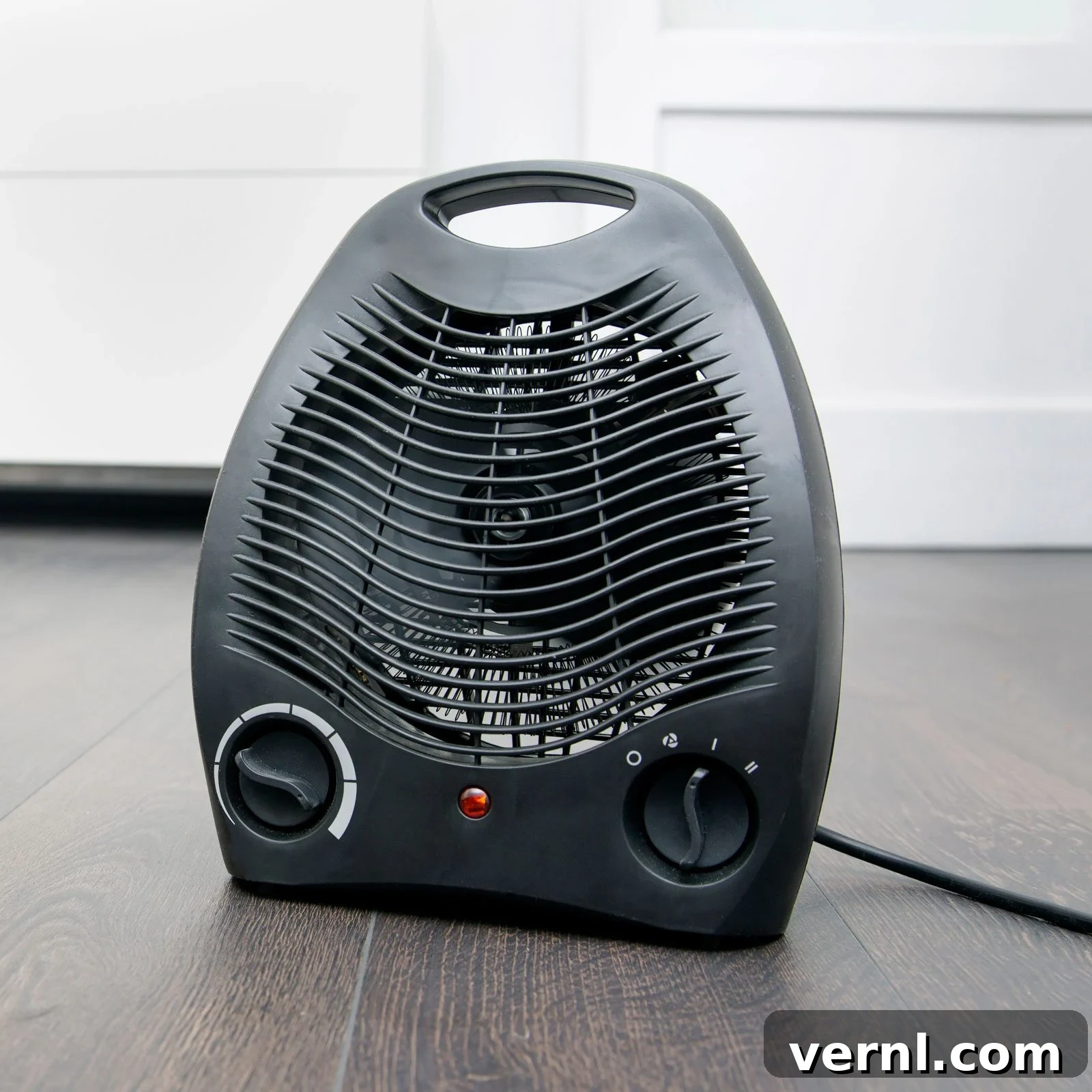
My relocation to sunny Texas from the often-frigid climate of Minnesota transformed my outlook on outdoor living, promising enjoyment for far more than just four months of the year. This shift inspired me to create a unique home office in our garage, equipped with a mosquito screen, and even a compact home theater. It’s a space my spouse and I frequent, even when winter temperatures dip into the low 40s Fahrenheit. Our secret to staying comfortably warm in this transitional space? A reliable space heater.
Space heaters excel at delivering targeted warmth, making them an excellent choice for boosting comfort in a chilly room or supplementing an underperforming primary heating system. However, even these powerful devices have their limitations, as was evident during the intense “bomb cyclone” of Christmas 2022, which prompted us to retreat indoors. While incredibly convenient, it’s vital to understand the energy demands of a space heater to manage its impact on your electricity bill effectively.
Do you own a space heater? Are you aware of its operating cost and energy usage? Understanding these details can empower you to make more informed decisions about your home heating. This article will guide you through calculating your space heater’s energy consumption, comparing it to other household appliances, and offering practical strategies for maximizing efficiency and safety.
How Much Does a Space Heater Cost to Run? A Deep Dive into Energy Usage
Space heaters are a popular solution for localized warmth, providing comfort exactly where and when you need it most. Whether it’s to take the chill out of a home office, a drafty bedroom, or a garage workspace, these portable devices offer immediate relief. However, their convenience often comes with a significant energy cost. This comprehensive guide aims to demystify your space heater’s energy consumption, providing clear calculations, comparisons with other household appliances, and actionable tips to reduce your electricity bill while ensuring safe and efficient operation.
Understanding Space Heater Wattage: How Much Power Do They Use?
The vast majority of electric space heaters designed for residential use are rated for a maximum power output of 1,500 watts. This 1,500-watt rating is an industry standard, often cited by hardware retailers like Ace Hardware, in partnership with leading home comfort product manufacturers such as Lasko. This particular wattage is not arbitrary; it’s typically the highest power draw that can safely operate on a standard 15-amp household electrical circuit without overloading it and tripping the circuit breaker. Exceeding this limit can pose a fire hazard and lead to electrical problems.
It’s important to note that while 1,500 watts is the maximum, many contemporary space heaters offer multiple heat settings. These settings often include lower wattages, such as 750W or 900W, which consume considerably less energy. Running your heater on a lower setting is an effective way to reduce its energy footprint and, consequently, your operating costs. Always consult the specific wattage ratings on your heater’s product label or user manual for the most accurate information, as some models may feature slightly different power configurations.
Calculating Space Heater Electricity Usage: From Watts to Your Bill
To truly grasp how much your space heater impacts your electricity bill, it’s essential to understand the unit by which your utility company charges you: the kilowatt-hour (kWh). While a 1,500-watt electric space heater draws approximately 12.5 amps of current at 120 volts (based on the formula Watts = Amps × Volts), your utility provider doesn’t bill you for amps. Instead, you’re charged for the total electrical energy consumed over a period, measured in kilowatt-hours. One kilowatt-hour signifies the amount of energy used by a 1,000-watt (or 1-kilowatt) appliance operating for one hour.
Step-by-Step Calculation for Your Space Heater’s Daily Cost:
Determining your space heater’s energy consumption in kWh and its daily operating cost is a straightforward process:
- Identify Your Heater’s Wattage: Check the label on your space heater. Most standard electric models are 1,500 watts at their highest setting.
- Estimate Daily Usage Hours: Determine approximately how many hours per day you typically run your space heater.
- Calculate Daily Watt-Hours: Multiply your heater’s wattage by the number of hours you use it per day. (e.g., Watts × Hours/Day = Watt-Hours).
- Convert to Kilowatt-Hours (kWh): Divide your total daily watt-hours by 1,000. (e.g., Watt-Hours / 1,000 = kWh). This conversion is necessary because utility companies bill in kilowatts, not watts.
- Find Your Electricity Rate: Locate the cost per kilowatt-hour (kWh) on your most recent electricity bill. This rate can vary significantly by location, energy provider, and even time of day (for time-of-use plans).
- Calculate Daily Operating Cost: Multiply your daily kWh by your electricity rate per kWh. (e.g., kWh × Cost/kWh = Daily Cost).
Practical Example: My Garage Office Heater
Let’s apply this formula to a real-world scenario, such as my 1,500-watt space heater operating in the garage office for eight hours each day:
- Heater Wattage: 1,500 watts
- Daily Usage: 8 hours
- Daily Watt-Hours: 1,500 watts × 8 hours = 12,000 watt-hours
- Daily Kilowatt-Hours (kWh): 12,000 watt-hours ÷ 1,000 = 12 kWh
According to the U.S. Bureau of Labor Statistics, the average residential electricity cost in the U.S. was approximately $0.163 per kilowatt-hour as of November 2022. Using this national average:
- Daily Cost: 12 kWh × $0.163/kWh = $1.956
Therefore, running a 1,500-watt space heater for eight hours daily would cost you approximately $1.96 per day. Over a standard 30-day month, this adds up to roughly $58.80. This illustrates how quickly the costs can accumulate, especially during peak heating seasons or with extensive daily use. It’s a substantial sum that highlights the importance of mindful energy management.
Do Space Heaters Consume a Lot of Electricity Compared to Other Home Appliances?
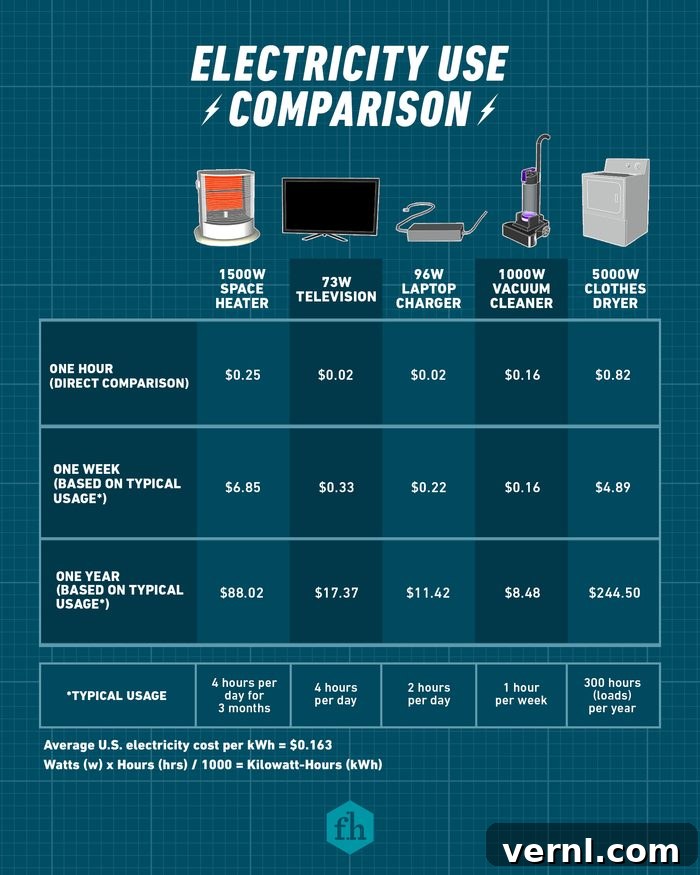
The question of whether space heaters use “a lot” of electricity is best answered through comparison. Generally, appliances designed to generate heat are among the highest energy consumers in a typical household. This category includes devices like electric ovens, water heaters, clothes dryers, and, naturally, space heaters (both resistive and infrared types). While a space heater’s power draw is significant when active, its overall energy footprint can be managed effectively depending on how and how often it’s used, especially when contrasted with other common household devices.
Television
Modern televisions, particularly LED and OLED models, are remarkably energy-efficient compared to their predecessors. The wattage of a TV varies based on its size, technology, and brightness settings. For example, my television consumes about 73 watts, which is fairly average for its size. This figure immediately underscores that a 73-watt TV uses substantially less power than a 1,500-watt space heater.
Let’s put it into perspective: Running a 73-watt TV for four hours daily at the average U.S. electricity rate ($0.163/kWh):
- Daily kWh: (73 watts × 4 hours) ÷ 1,000 = 0.292 kWh
- Daily Cost: 0.292 kWh × $0.163/kWh = approximately $0.047 (just under 5 cents)
- Annual Cost: Roughly $17.15
This calculation doesn’t even factor in vampire energy (standby power), which is minimal for most modern TVs. In stark contrast, a 1,500-watt space heater operating for the same four hours daily would cost nearly $1.00 per day (0.978 kWh × $0.163/kWh = ~$0.98), equating to around $88 for just three months of daily winter usage. The difference highlights the considerable energy intensity of heating appliances.
Laptop Computer
Laptops are designed for mobility and energy efficiency, drawing power from their charger when plugged in and using their internal battery otherwise. A laptop’s energy consumption can vary significantly based on its activity. Simple tasks like email checking or web browsing use much less power than intensive activities such as video editing, gaming, or running complex software. A typical laptop charger might range from 45 to 90 watts.
Consider a 96-watt laptop charging for two hours daily:
- Daily kWh: (96 watts × 2 hours) ÷ 1,000 = 0.192 kWh
- Daily Cost: 0.192 kWh × $0.163/kWh = approximately $0.031 (about 3 cents)
- Annual Cost: Roughly $11.31
This demonstrates that a laptop’s energy draw is a mere fraction of a space heater’s, further emphasizing the higher power requirements for generating heat.
Vacuum Cleaner
Vacuum cleaners are high-power, albeit intermittently used, appliances. Their wattage can range widely, from smaller handheld units to robust upright or central vacuum systems. According to M Healthy, a typical vacuum cleaner can consume between 1,000 to 1,440 watts, although my personal model is an efficient 840W. To find your vacuum’s precise energy usage, consult its label for the wattage rating or multiply its amps by its voltage. Let’s calculate the cost for a 1,000-watt vacuum cleaner used for one hour per week:
- Weekly kWh: (1,000 watts × 1 hour) ÷ 1,000 = 1 kWh
- Annual Cost: 1 kWh/week × 52 weeks/year × $0.163/kWh = approximately $8.48
Although a vacuum cleaner can draw power comparable to a space heater during operation, its infrequent and short-duration use results in a significantly lower annual energy cost.
Clothes Dryer
The electric clothes dryer is often one of the most energy-intensive appliances in a home. The average family completes approximately 300 loads of laundry annually. A typical electric clothes dryer can have a wattage between 3,000 and 5,000 watts. Assuming a 5,000-watt dryer and an average drying cycle of 45 minutes (0.75 hours) per load:
- Energy per Load: 5,000 watts × 0.75 hours ÷ 1,000 = 3.75 kWh
- Annual kWh (300 loads): 3.75 kWh/load × 300 loads = 1,125 kWh
- Annual Cost: 1,125 kWh × $0.163/kWh = approximately $183.38
This calculation clearly positions the clothes dryer as a major contributor to the annual electricity bill. For context, if a 1,500-watt space heater ran for a cumulative 300 hours (e.g., 2 hours per day for 150 days during winter), its energy consumption would be:
- Total kWh: (1,500 watts × 300 hours) ÷ 1,000 = 450 kWh
- Total Cost: 450 kWh × $0.163/kWh = approximately $73.35
While space heaters draw substantial power, their typical usage pattern – targeted and often intermittent – means their annual cost, when managed properly, can be considerably less than that of consistently used high-power appliances like a clothes dryer. Mindful usage is paramount for managing these costs.
Frequently Asked Questions (FAQs) About Space Heaters
How Can I Reduce the Energy Consumption of My Space Heater?
Reducing your space heater’s energy footprint doesn’t mean compromising on comfort. Strategic usage and leveraging your device’s features can lead to noticeable savings on your electricity bill. Here are several effective strategies:
- Embrace Zonal Heating: Space heaters are most efficient when used for zonal heating. Instead of attempting to warm an entire home with a single space heater, focus its warmth on only the room or specific area you are actively occupying. This practice allows you to set your central thermostat lower, reducing the workload on your primary heating system and generating substantial overall energy savings.
- Utilize Timers and Intermittent Operation: Avoid letting your space heater run continuously when it’s not absolutely necessary. If your heater has a built-in timer, program it to switch off automatically after a set period, such as when you leave a room or go to sleep. For models without timers, cultivate the habit of manually turning it off once the desired warmth is achieved or when you’re no longer in the space. Reactivating it only when truly needed conserves significant energy.
- Adjust Thermostat Settings or Engage ECO Modes: Many modern space heaters are equipped with adjustable thermostats or energy-saving (ECO) settings. These features allow the heater to cycle on and off to maintain a comfortable temperature, rather than operating constantly at full power. Using a lower temperature setting or activating the ECO mode can drastically cut down on electricity usage, potentially reducing consumption by almost half.
- Enhance Home Insulation and Seal Drafts: One of the most impactful ways to lessen your reliance on supplementary heating is to ensure your home is well-insulated and free from drafts. Seal any gaps around windows and doors with weatherstripping or caulk. If feasible, consider adding insulation to attics, walls, and floors. A properly sealed and insulated room retains heat much more effectively, allowing your space heater to work less frequently and more efficiently to maintain warmth.
- Optimize Heater Placement: Position your space heater in an open area, ensuring it’s at a safe distance from walls, furniture, drapes, and other flammable materials. Avoid placing it directly under windows, as heat can quickly escape. Proper placement ensures maximum heat distribution and minimizes heat loss.
By integrating these strategies into your routine, you’ll not only save on your space heater’s operating costs but also contribute to lowering your overall home heating expenses.
How Long Can I Let a Space Heater Run Continuously?
While modern space heaters incorporate numerous safety features, continuous and unsupervised operation is generally discouraged due to potential risks. Most manufacturers and safety experts recommend limiting continuous use to approximately four to six hours. Prolonged, uninterrupted operation significantly elevates the risk of overheating, electrical fires, and damage to both the unit and surrounding property. This risk is particularly pronounced if you are asleep, away from home, or not present in the same room as the heater.
You should immediately turn off your space heater and allow it to cool if you notice any of the following warning signs:
- Strange Odors: A burning smell, a distinct plastic scent, or any other unusual odor could indicate internal components overheating or dust accumulating and burning on the heating element.
- Unusual Sounds: Any clicking, buzzing, grinding, or excessive fan noise that deviates from the heater’s normal operational sounds warrants immediate attention.
- Fluctuations in Heat Output: If the heater intermittently stops producing heat, or if the warmth it emits feels inconsistent despite stable settings, it may signal an internal issue.
- Frequently Tripping Circuit Breakers: This is a definitive sign that the heater is drawing too much power for its designated circuit, indicating a potential overload or an internal fault. Never repeatedly reset a circuit breaker without thoroughly investigating the underlying cause.
- Excessive Heat on Casing or Cord: If the heater’s exterior casing or power cord feels excessively hot to the touch (beyond normal operational warmth), it’s a critical warning sign of overheating.
Always ensure your space heater is placed on a stable, level surface, at least three feet away from any flammable materials (such as curtains, bedding, rugs, or paper). Prioritize models equipped with essential safety features like tip-over protection (which automatically shuts off the unit if it’s accidentally knocked over) and overheat protection (which powers down the heater if its internal temperature reaches an unsafe level). Regular cleaning of dust from the heater’s vents and grilles is also crucial for maintaining optimal performance and preventing fire hazards.
Choosing the Best Space Heater for Your Specific Needs
Selecting the ideal space heater requires careful consideration beyond just its aesthetic appeal. Whether you’re aiming to warm a small personal space, a drafty garage, or even a sensitive greenhouse environment, factors such as safety, energy efficiency, and the heater’s type are paramount. Different categories of space heaters are engineered for distinct environments and heating preferences:
- Convection Heaters: These heaters primarily warm the air in a room, making them an excellent choice for heating larger, enclosed spaces over extended periods. Examples include oil-filled radiant heaters and ceramic heaters with fans. They provide a more gentle, widespread ambient warmth that gradually permeates the entire space.
- Radiant (Infrared) Heaters: Radiant heaters, like specialized infrared models, directly warm objects and people within their line of sight, much like the sun’s rays. They are best suited for immediate, directional warmth in smaller areas or when you need to feel warm quickly without necessarily heating the surrounding air. They are highly efficient for personal spot heating.
- Ceramic Heaters: Often a type of convection heater, ceramic heaters use ceramic heating elements and an internal fan to quickly generate and distribute warm air. They are typically compact, fast-acting, and popular for personal workstations, small offices, or bedrooms due to their efficiency in these environments.
- Fan Heaters: These units are among the quickest to produce heat, utilizing a fan to blow warm air directly into a room. While they offer rapid heating, they can sometimes be noisier than other types and may tend to dry out the air.
When making your selection, always prioritize models that feature an adjustable thermostat, multiple heat settings for flexibility, programmable timers, and crucial safety features such as tip-over switches, overheat protection, and cool-touch exteriors. If available, Energy Star certification can also serve as an indicator of superior energy efficiency. Always confirm that the heater’s wattage is appropriate for your electrical circuit to prevent overloads, and consider the noise level if the heater is intended for a quiet space like a bedroom or a home office.
For more detailed insights and product recommendations on selecting and safely operating space heaters, explore these valuable resources:
- What to Know About Space Heaters
- The Best Space Heater for Every Room
- The Safest Space Heaters
- The Best Energy-Efficient Space Heaters
- What Are Infrared Space Heaters and How Do They Work?
- Best Infrared Space Heaters
- Why You Shouldn’t Use Extension Cords for Space Heaters
- How Much Does It Cost to Heat a Garage?
- Best Garage Heaters
- The Mr. Heater Garage Heater
- Best Portable Bathroom Heaters
- The Lasko Portable Space Heater Is a Permanent Fixture in My Bathroom
- Best Greenhouse Heaters for Efficient Plant Growth
Sources
- U.S. Bureau of Labor Statistics: Average energy prices for the United States, regions, census divisions, and selected metropolitan areas; (2024)
- Eco Cost Savings: TV Wattage – 2024’s Most Efficient TVs Revealed [With Data]; (2024)
- M Healthy: Appliance Energy Use & Equivalent Exercise; (2024)
- National Park Service: Laundry Practices and Water Conservation; (2021)