
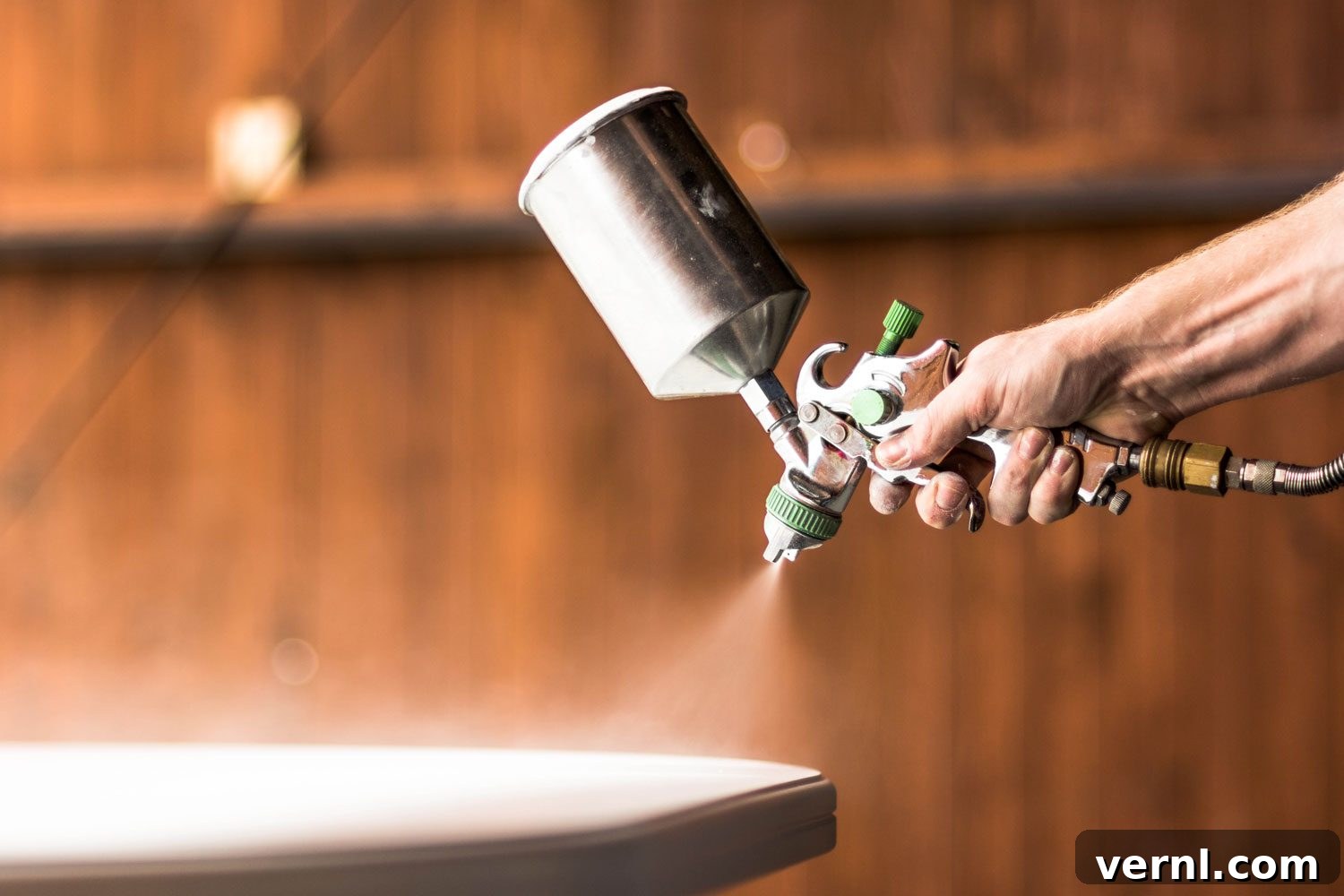
If the art of spray painting wood hadn’t been a viable profession, I might have found myself adrift for many years. From my late twenties to mid-thirties, it was the cornerstone of my livelihood. I honed my skills working at two distinct furniture finishing companies before ultimately establishing and managing my own dedicated spray booth operation.
So, to definitively answer the question, “Can you spray paint wood?” — the resounding answer is an unequivocal yes. However, a more nuanced and crucial inquiry follows: “Should you?” This second question delves into a much broader realm of considerations.
While spray painting wood generally offers a superior finish compared to traditional brush application, especially for achieving a smooth, factory-like appearance, it’s a process fraught with potential pitfalls if not approached correctly. Errors can range from improper paint mixing, leading to frustrating drips, runs, or unsightly splotches, to accidentally coating unintended surfaces, including your own attire or even skin. Beyond aesthetic concerns, a significant hazard lies in the potential inhalation of toxic fumes, particularly when working with certain paint types and without adequate personal protective equipment (PPE).
Another critical aspect to weigh is the equipment investment and setup. For smaller projects such as a single chair, a decorative frame, or a compact cabinet, readily available aerosol cans can be an effective and convenient solution. However, when tackling larger pieces of furniture, extensive exterior woodwork, or engaging in production-level finishing, the requirements escalate. You’ll need to either purchase or rent a dedicated paint sprayer, which necessitates diligent cleaning and maintenance after each use. Furthermore, preparing your workspace demands a comprehensive array of masking supplies, protective dropcloths, appropriate clothing, and essential personal protective equipment (PPE) like respirators and safety glasses.
Despite these complexities and initial investments, the effort is undeniably worthwhile if your aim is to achieve a professional, top-tier paint finish. For large-scale projects, spray painting can even translate into significant time savings. The ultimate decision rests on your assessment of whether the convenience and straightforwardness of a paint brush and roller might be a more practical approach for your specific project and skill level.
Key Considerations for Successfully Spray Painting Wood
Spray painting projects are far from monolithic; each comes with its unique set of demands. Some require meticulously controlled environments, such as a professional spray booth, while others dictate the use of a very specific type of sprayer for optimal results.
To guide your decision-making process, here are some of the primary factors to meticulously consider if you’re contemplating applying a spray finish to wooden surfaces:
Selecting the Right Type of Paint Sprayer
The choice of sprayer is paramount and largely dictated by the type of wood and paint you intend to use. When painting furniture, for example, the best results are often achieved with fast-drying lacquers or enamels, many of which are solvent-based formulations. For these particular materials, a high-volume, low-pressure (HVLP) sprayer stands out as the superior choice. HVLP sprayers atomize paint finely with less overspray, making them ideal for detailed work and smooth finishes. However, they typically require an air compressor to operate.
Conversely, if your project involves painting interior wood paneling, exterior siding, or extensive woodwork with water-based latex paint, an airless sprayer is generally a better call. Airless sprayers operate by pumping paint at very high pressure through a small tip, providing excellent coverage over large areas quickly. While they are incredibly efficient for large surfaces, their high pressure can make them less suitable for fine furniture finishes. For helpful guidance on using these tools, explore these tips for interior painting with a sprayer.
A convenient middle-ground option to consider is a handheld airless sprayer. These devices offer a reasonable compromise, blending some of the portability of aerosol cans with the power of larger, high-volume airless units typically employed by professional house painters. Handheld airless sprayers are remarkably versatile and capable of spraying a wide array of materials. However, their flow control can be more challenging to master, meaning they might not be the absolute best choice if achieving a flawless, high-quality furniture finish is your top priority.
Understanding the Impact of Temperature and Humidity
Environmental conditions play a crucial role in the outcome of your spray painting project. High humidity combined with low temperatures can wreak havoc on fast-drying furniture lacquers and enamels. In such conditions, these finishes tend to retain moisture, leading to a cloudy appearance known as “blushing” or “blooming.” This aesthetic imperfection can significantly detract from the final look. Latex paint also dries more slowly under high humidity and low temperatures, increasing the likelihood of drips and runs if applied in excessively thick coats. Conversely, conditions characterized by higher temperatures and lower humidity are generally much more conducive to successful spray painting, promoting quicker drying and a smoother finish.
The Art and Science of Paint Mixing and Thinning
When applying paint with a brush or roller, you often have the luxury of using paint straight from the can, assuming its consistency is appropriate. However, spray painting, particularly with an HVLP sprayer, almost invariably requires thinning the paint to achieve the correct viscosity for proper atomization and an even spray pattern. This crucial step cannot be overlooked.
Successfully thinning paint demands two key pieces of knowledge: knowing precisely which type of thinner is compatible with your specific paint (e.g., mineral spirits for oil-based paints, water for latex, lacquer thinner for lacquers) and mixing it in the correct proportion. The ideal proportion is often determined through a process of trial and error, as it can vary based on paint brand, temperature, and even the specific sprayer you’re using. Therefore, it’s absolutely essential to have a dedicated test surface – a scrap piece of cardboard, plywood, or similar material – on hand to practice your mix and spray pattern before applying paint to your actual project. This allows you to fine-tune the consistency and prevent costly mistakes on your finished piece.
Managing Overspray and Ensuring Proper Fume Ventilation
Safety and environmental control are paramount when spray painting. Solvent-based furniture finishes, such as lacquers and enamels, are typically high in volatile organic compounds (VOCs). These compounds release harmful fumes into the air, necessitating a well-ventilated workspace. Merely opening a window may not suffice; a dedicated exhaust fan or working outdoors is often required. Furthermore, wearing a proper respirator – not just a simple dust mask – is non-negotiable to protect your respiratory system from these toxic fumes.
Overspray, the phenomenon of paint particles missing the target surface, manifests differently depending on the paint and sprayer type. With fast-drying, solvent-based finishes shot from an HVLP sprayer, overspray isn’t usually a major concern in terms of sticking to nearby surfaces. The finely atomized material that doesn’t adhere to your project typically dries almost instantly, turning into a fine dust that can be easily swept or wiped away. However, it can still settle on unprotected surfaces, so masking remains important for cleanliness.
Latex paint, when propelled from an airless sprayer, also produces fumes, though they are generally considered less toxic than those from solvent-based finishes. A more significant challenge with latex and airless sprayers is the overspray, which tends to remain in liquid form. This means any unprotected surfaces in the vicinity – walls, floors, plants, vehicles – are highly susceptible to being coated with a sticky layer of wet paint. Meticulous masking and covering of all surrounding areas are therefore critical to prevent extensive cleanup or damage.
Expert Techniques for Prepping Wood Before Spraying
While the actual spraying process itself can be remarkably quick, the preparation phase is where a significant portion of your time and effort will be invested. Meticulously masking surrounding surfaces to protect them from overspray is often the most time-consuming aspect. Additionally, donning appropriate protective clothing is essential, particularly when working with latex paint, which can be quite messy and prone to splattering.
When undertaking spray painting projects outdoors, heightened awareness of your surroundings is crucial. Delicate plants, garden beds, paved walkways, and even neighboring properties must be thoroughly covered and protected. The last thing any homeowner desires is a favorite rose bush inadvertently matching the new color of their house, or permanent paint stains on their driveway.
Before any type of wood can be successfully spray painted, it must be scrupulously cleaned and entirely free of dirt, grease, and especially mold or mildew. Furthermore, thoroughly inspect any existing finish to ensure it is in excellent condition and firmly adhered, with no signs of peeling, chipping, or flaking. If the existing finish is compromised, or if you’re aiming for a completely new look, it will be necessary to strip the old finish completely before proceeding with your spray application.
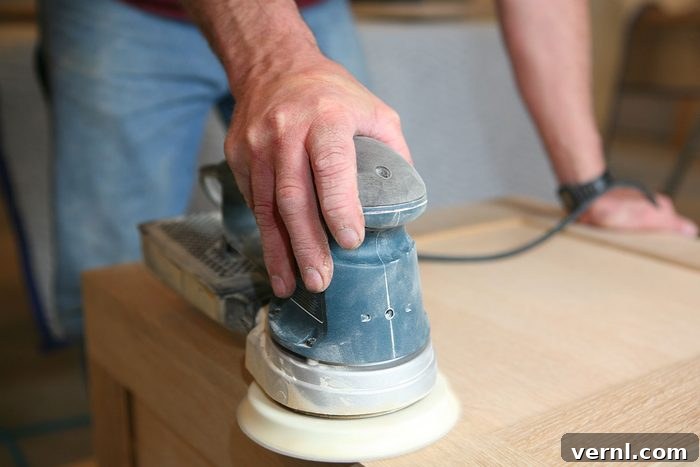
Sanding is a non-negotiable prerequisite for achieving a high-quality finish, whether you’re spraying furniture or interior woodwork. The extent of sanding and the specific grit of sandpaper you employ are directly proportional to the level of finish quality you aspire to. For utilitarian items like shelving units, rough sawn timber, or general woodwork where a perfectly smooth, glass-like finish isn’t strictly necessary, sanding to 120-grit is typically sufficient. This level of sanding removes major imperfections and provides enough tooth for paint adhesion.
However, for higher-quality pieces such as dining tables, kitchen cabinets, intricate trim, or other fine woodwork where a luxuriously smooth and refined surface is desired, it is imperative to sand to a finer grit. Progressing to 150-grit or even 220-grit sandpaper will meticulously remove finer scratches and imperfections, resulting in a significantly smoother substrate that is ideally prepared to accept a professional-grade spray finish. Always sand with the grain of the wood, and ensure all sanding dust is thoroughly removed before applying any primer or paint.
The Importance of Sealing Bare Wood for a Flawless Finish
To truly achieve the exceptional quality of finish that spray painting makes possible, it is almost always necessary to seal bare wood before applying any topcoats. This step is fundamental for several reasons: it creates a uniform surface, prevents excessive absorption of the topcoat, and helps to achieve a smoother, more durable finish.
For interior woodwork or furniture projects, a lacquer-based sanding sealer is often the top recommendation. These sealers are formulated with special soaps that make them remarkably easy to sand smooth after application. This “sandability” allows you to quickly achieve an incredibly even and slick surface, which is ideal for subsequent lacquer or enamel topcoats. The rapid drying time of lacquer-based sealers also means you can typically proceed with subsequent steps relatively quickly.
If your plan is to apply latex paint using an airless sprayer, a shellac-based primer provides an outstanding undercoat. Shellac primers are renowned for their excellent adhesion, stain-blocking properties, and ability to seal various types of wood, including those with knots or sap, preventing bleed-through. While shellac-based primers are highly effective, good quality water-based primers are also acceptable alternatives and can be a good choice for those seeking easier cleanup and lower VOCs.
For the absolute best furniture finish, the technique involves spraying multiple thin coats, rather than one thick application. Crucially, between each coat, you should lightly “scuff-sand” the surface with very fine 220-grit sandpaper. This gentle sanding removes any minor imperfections, creates a mechanical bond for the next layer, and further refines the smoothness of the finish. Solvent-based interior finishes, such as lacquers and enamels, are particularly advantageous in this regard because they dry incredibly quickly. This rapid drying time often allows you to spray several coats and complete the entire multi-coat finishing process in a single afternoon, significantly speeding up project completion while ensuring a durable, beautifully smooth result.