Are your stair spindles looking tired and in dire need of a fresh coat of paint? If you’re keen to revitalize your staircase without breaking the bank, you’re in luck. You absolutely don’t need to hire a costly professional painter for this project. Instead, you can easily tackle this transformation yourself, saving money and gaining immense satisfaction from a job well done.
The secret to successfully painting intricate stair spindles lies in adopting clever, unconventional methods. Today, we’re going to dive into a surprisingly effective and popular DIY technique: painting stair spindles with a sock! Yes, you read that right. This ingenious hack, combined with other handy painting tips, will ensure your next home improvement project goes smoothly and yields stunning results.
Revitalize Your Staircase: The DIY Guide to Painting Stair Spindles
Painting stair spindles, often referred to as balusters, is a home improvement project that can significantly refresh the look and feel of your entryway and entire home. While the thought of painting numerous individual spindles might seem daunting due to their intricate shapes and narrow profiles, it’s an entirely manageable and highly rewarding DIY task. Not only does a fresh coat of paint provide an instant aesthetic upgrade, but it also offers crucial protection to the wood, enhancing its durability and extending its lifespan. This comprehensive guide is designed to empower you with all the knowledge and techniques needed to achieve a professional-looking finish yourself. We’ll explore everything from meticulous preparation and the renowned “sock method” to selecting the right paint and maintaining your newly painted staircase, ensuring a flawless result every time.
Can You Really Use a Sock to Paint Stair Spindles? Unveiling the Viral TikTok Hack
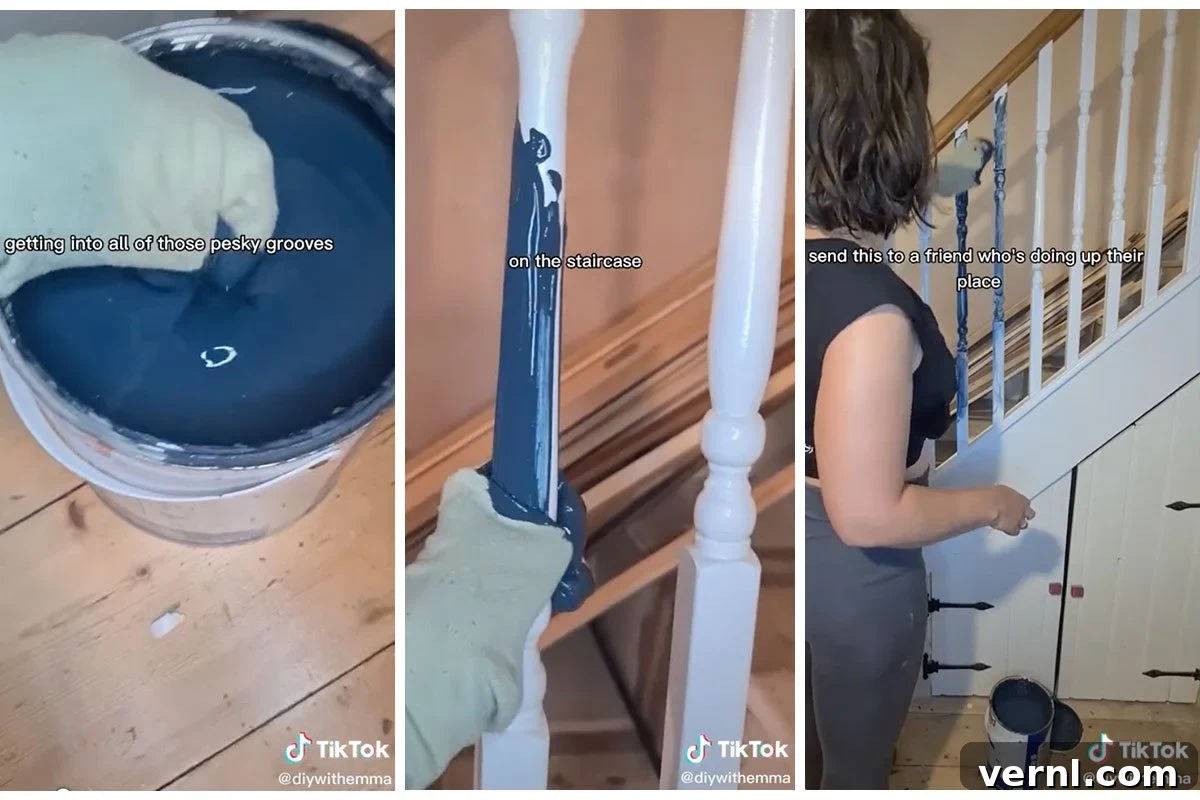
The notion of painting with a sock might initially strike you as unconventional, perhaps even a bit whimsical. However, this innovative method has garnered widespread acclaim and proven remarkably effective, especially for painting the unique contours of stair spindles. The technique gained viral status thanks to creative DIY enthusiasts, prominently showcased by TikTok creator @diywithemma. Her popular tutorial vividly demonstrated how accessible and efficient this approach can be for homeowners. When we first encountered this ingenious hack, a healthy dose of skepticism was natural. Yet, the impressive results shared by countless users undeniably confirm its efficacy. This process genuinely works, delivering excellent, even coverage and a remarkably smooth finish, particularly on the rounded, carved, or detailed surfaces of stair spindles. The inherent flexibility and conforming nature of a simple sock allow it to perfectly hug the shape of the spindle, making it an ideal applicator for those challenging curves, grooves, and tight spaces that traditional brushes often struggle to reach without leaving streaks or drips.
Adopting this DIY approach transforms what many perceive as a tedious and time-consuming painting task into a surprisingly quick, efficient, and even enjoyable endeavor. By leveraging the humble sock, you harness a common household item to achieve a high-quality, professional appearance without the necessity of investing in specialized, expensive tools or enduring hours of painstaking, repetitive brushwork. It stands as a compelling testament to the power of simple, creative innovation in the realm of home improvement, making professional-grade results attainable for every DIY enthusiast.
How to Paint Stair Spindles with a Sock: Your Complete Step-by-Step Guide
Mastering the sock painting technique for your stair spindles is remarkably straightforward, requiring only a few basic supplies and a clear understanding of the process. By following these detailed steps, you’ll be well on your way to a beautifully refreshed staircase with minimal fuss and maximum impact.
What You’ll Need for the Innovative Sock Method
Before you begin painting, gather all your materials. Having everything at hand will make the process smoother and more efficient:
- Personal Protective Equipment: A sturdy pair of plastic or nitrile gloves are absolutely essential. These gloves will provide a critical barrier, protecting your hands from direct contact with paint and ensuring hygiene. Opt for a pair that fits snugly to maintain optimal dexterity and control during application.
- The “Brush” Component: Select one or two old socks that you are perfectly fine with disposing of or recycling after the painting project is complete. Cotton socks are typically the best choice due to their excellent absorption properties and ability to distribute paint evenly without leaving behind excessive lint or fibers. Avoid synthetic or overly fluffy socks, which can create an uneven finish or shed unwanted material.
- Your Choice of Paint: Invest in a high-quality interior paint specifically designed for trim and high-traffic areas. Durable acrylic-latex paint with a semi-gloss or satin finish is often recommended for stair spindles. These finishes offer superior resilience against daily wear and tear, are easy to clean, and provide an attractive, smooth appearance.
- Crucial Preparation Essentials:
- Drop Cloths or Plastic Sheeting: These are indispensable for thoroughly protecting your floors, adjacent walls, and any nearby furniture from potential paint drips, splatters, and accidental spills. Heavy-duty plastic or canvas drop cloths offer the best protection.
- High-Quality Painter’s Tape: Essential for meticulously masking off all areas you wish to keep paint-free, such as the stair treads, risers, newel posts, and the main banister. Using a good quality tape will ensure crisp, clean paint lines and prevent bleed-through.
- Cleaning Agents: A degreaser, mild soap, and water solution are necessary for thoroughly cleaning the spindles before painting.
- Fine-Grit Sandpaper: While optional, a light scuffing with fine-grit sandpaper (180-220 grit) is highly recommended. This step is particularly beneficial if the existing finish is glossy, uneven, or if you’re painting bare wood, as it creates a better surface for the new paint to adhere to.
- Paint Stirring Stick: To ensure that all pigments and binders in your paint are thoroughly and evenly mixed, both before and periodically during application, for consistent color and finish.
Step-by-Step Application with the Sock Method
- Meticulously Prepare Your Workspace: Before opening any paint cans, dedicate ample time to preparing your painting area. Spread plastic sheeting or heavy-duty drop cloths to completely cover your floors, any furniture in the vicinity, and the lower sections of adjacent walls. Using high-quality painter’s tape, carefully mask off all surrounding surfaces that you do not intend to paint – this includes the stair treads, risers, newel posts, and any sections of the banister that meet the spindles. Diligence in this preparatory phase is paramount for achieving a clean, professional finish and significantly simplifying the post-project cleanup.
- Thoroughly Clean and Prepare the Spindles: Each stair spindle must be scrupulously cleaned to remove any accumulation of dust, dirt, grease, or grime. A degreaser or a mild soap and water solution is effective for this purpose. After cleaning, rinse the spindles thoroughly and allow them to dry completely. If the existing paint has a glossy finish or exhibits minor imperfections, lightly sand each spindle with fine-grit sandpaper (180-220 grit). This light sanding creates a slightly roughened surface, which promotes superior adhesion for the new paint. After sanding, wipe away all dust residues with a tack cloth or a slightly damp rag.
- Properly Mix Your Paint: Open your chosen paint can and use a dedicated stirring stick to mix the paint thoroughly for several minutes. This crucial step ensures that all color pigments and binders are uniformly distributed throughout the paint, which is vital for achieving a consistent color and an even finish. Remember to repeat this stirring process periodically during your painting session to maintain paint consistency.
- Don Your Protective Gear: Put on your latex or nitrile gloves, ensuring they fit snugly. A good fit provides better tactile control, which is essential for precise paint application.
- Layer the Sock Over Your Hand: Take one of your designated old socks and securely layer it over your gloved hand – specifically the hand you will be using to apply the paint. Ensure the sock completely covers your fingers and palm, forming a soft, pliant applicator that conforms to your hand.
- Carefully Dip into the Paint: With your sock-covered hand, carefully dip it directly into the paint. The goal is to achieve an even saturation of the sock without oversaturating it to the point of excessive dripping. You need enough paint to adequately cover a section of a spindle, but not so much that it oozes uncontrollably from the sock. It is always more effective and leads to better results to apply multiple thin coats rather than attempting one thick, heavy, and potentially drippy coat.
- Apply Paint to the Spindles: Grasp a stair spindle with your paint-laden, sock-covered hand. Gently wrap your hand around the spindle, applying light, even pressure, and move your hand up and down, rotating it as you progress. The inherent flexibility of the sock allows it to seamlessly conform to the intricate grooves, curves, and corners of the spindle, ensuring comprehensive coverage. Utilize a gentle, wiping motion to apply the paint smoothly and consistently. Concentrate on applying thin, even coats to prevent drips and achieve a uniform finish.
- Work Systematically in Sections: Tackle the spindles in manageable sections, ensuring each area receives complete and even coverage before moving on to the next. Remain vigilant to prevent drips, particularly at the points where the spindles connect to the stair treads and the banister. The sock method inherently minimizes dripping, but careful observation is always advisable.
- Allow for Adequate Drying Time: After completing the first coat on all spindles, allow ample drying time as specified by the paint manufacturer’s instructions. Attempting to apply a second coat prematurely can lead to an uneven finish, streaking, or peeling. Most modern latex paints are dry to the touch within 1-2 hours, but the recommended recoat time might be longer to ensure proper adhesion between layers.
- Apply Subsequent Coats: Once the initial coat is thoroughly dry, repeat steps 6-9 for a second coat. The majority of painting projects, especially on stair spindles, will benefit significantly from two thin coats for optimal color depth, coverage, and enhanced durability. For substantial color changes or if you desire an exceptionally rich and deep finish, a third thin coat may be applied.
- Meticulous Cleanup: Once you are fully satisfied with the paint application and it is dry to the touch, carefully remove the painter’s tape. For the sharpest, cleanest lines, peel the tape off slowly at a 45-degree angle. Dispose of the paint-soaked socks and gloves responsibly. Promptly clean any accidental paint splatters or drips with a damp cloth if you used latex paint, or with mineral spirits if you opted for oil-based paint.
And there you have it! This innovative DIY hack for painting your stair spindles is not only incredibly simple and budget-friendly but also consistently delivers fantastic, professional-looking results.
Beyond the Sock: Essential Tips for Painting Hard-to-Reach Stair Spindles
While the sock method is undeniably a game-changer for many spindle designs, sometimes a combination of techniques or exploring alternatives can yield even better results or be more suitable for specific spindle styles. Here are additional invaluable tips for painting stair spindles and other intricate, hard-to-reach areas, ensuring you achieve a flawless, professional finish every single time.
1. Harness the Efficiency of Mini Rollers
Given that stair spindles are often numerous and frequently feature smooth, cylindrical sections, you might find that mini rollers are exceptionally effective. They are adept at applying paint quickly and evenly to the broader, flatter segments of spindles, or even the main body of perfectly cylindrical ones. When selecting a mini roller, opt for foam rollers if you’re using water-based paints and desire a super-smooth finish, or a short-nap roller for slightly textured surfaces or when working with oil-based paints. Mini rollers excel at providing a consistent, streak-free coat and can significantly accelerate the painting process, particularly on simpler spindle designs. For intricate crevices or detailed carvings that the roller cannot reach, follow up with a small, angled brush for precise touch-ups.
2. The Rag Method: A Practical Alternative to the Sock
If you don’t have an old sock immediately available, a clean piece of cotton cloth or a lint-free rag can serve a very similar and equally effective purpose. Simply cut a piece of cotton rag to a manageable size, don your protective gloves, wrap the rag securely around your gloved hand, and proceed with the painting process exactly as you would with a sock. The critical factor here is to choose a material that is genuinely lint-free to prevent unsightly fibers from adhering to your freshly painted surface. As always, ensure you do not oversaturate the material with paint, and diligently lay down protective plastic or drop cloths to shield your floors, furniture, and other areas of your home from any potential drips or splatters.
3. Traditional Brushing Techniques for Ultimate Precision
For those who prefer a more traditional painting approach, or for dealing with highly intricate spindle designs that demand meticulous control, a high-quality angled sash brush (typically 1.5 to 2 inches in size) is an indispensable tool. The angled bristles of such a brush provide exceptional precision, making it considerably easier to “cut in” clean, sharp lines along the edges where the spindle meets the stair tread or the banister. When using a brush, load it moderately with paint, gently tapping off any excess, and apply the paint using smooth, even strokes. Always work systematically from the top of the spindle downwards, continuously watching for and catching any potential drips as you progress. For exceptionally fine details or tiny carvings, a smaller artist’s brush can be employed for precise touch-ups. While brushing can be more time-consuming than the sock or roller methods, it offers unparalleled control for detailed and intricate work.
4. When and How to Consider Spray Painting Spindles
Spray painting stands out as potentially the quickest method for painting a large number of spindles and can yield the smoothest, most professional-looking finish, completely devoid of brush marks. However, it requires a significantly greater investment in preparation and specialized equipment. If you decide to opt for spray painting, keep the following critical considerations in mind:
- Extensive Masking is Non-Negotiable: Every single surface you wish to keep paint-free must be meticulously covered and sealed with plastic sheeting and high-quality painter’s tape. This means laboriously wrapping entire stair treads, risers, surrounding walls, and any adjacent elements.
- Ensure Proper Ventilation: The fumes from spray paint can be potent and hazardous. Always work in a very well-ventilated area, preferably outdoors if possible, and wear appropriate respiratory protection, such as a respirator mask, to protect your lungs.
- Practice Makes Perfect: Spray painting has a distinct learning curve. Before applying paint to your actual spindles, practice on scrap wood or cardboard to familiarize yourself with the spray gun or aerosol can. Maintain a consistent distance from the surface and a steady, even motion to prevent drips, runs, and uneven coverage.
- Required Equipment: Depending on the scale of your project and your budget, you’ll need either an airless sprayer, an HVLP (High Volume Low Pressure) sprayer, or high-quality aerosol spray paint specifically designed for wood and trim.
While highly effective for achieving a factory-smooth finish, spray painting is generally recommended for larger projects or for individuals who already possess a degree of familiarity and comfort with the technique, due to its demanding preparation and equipment requirements.
Choosing the Right Paint for Durable Stair Spindles
The type and finish of paint you select are absolutely paramount for the longevity and aesthetic appeal of your newly painted spindles. Staircases, by their nature, are high-traffic areas, and their spindles are subjected to considerably more wear and tear than typical wall surfaces. Therefore, choosing a durable paint is essential.
- Paint Type:
- Acrylic-Latex Paint: This is a highly popular and versatile choice for interior trim. It offers numerous advantages, including a relatively quick drying time, easy water cleanup, and significantly lower odor compared to oil-based options. Modern acrylic-latex paints are formulated for impressive durability and offer excellent adhesion properties.
- Oil-Based Paint (Alkyd): Renowned for its superior durability, exceptional hardness, and a remarkably smooth, furniture-like finish, oil-based paint remains an excellent option for areas that experience very high traffic. However, it comes with a longer drying time, stronger fumes that require better ventilation, and necessitates mineral spirits for cleanup.
- Enamel Paint: This term often refers to paints that dry to a hard, exceptionally durable, and typically glossy finish, irrespective of whether their base is oil or water (acrylic enamel). This characteristic hardness makes enamel paints particularly ideal for the resilient finish required on stair spindles.
- Sheen/Finish: The sheen level you choose will impact both the durability and the visual appearance of your spindles:
- Satin: A low-sheen finish that offers a subtle, elegant look. Satin paints provide good durability and are effective at subtly concealing minor surface imperfections.
- Semi-Gloss: More durable and significantly easier to clean than satin finishes, semi-gloss paint imparts a distinct sheen that reflects light, helping to make your spindles stand out and adding a touch of sophistication. It is a very common and practical choice for trim, doors, and stair components.
- Gloss: This is the most durable and highly reflective finish available. Gloss paint is exceptionally easy to clean but has a tendency to highlight every single imperfection on the surface. Therefore, use gloss with caution on very old or less-than-perfect spindles.
- Primer: Always give serious consideration to using a high-quality primer. It is particularly necessary if you are painting bare wood, attempting a significant color transformation (e.g., from a dark stain to a light paint color), or painting over an existing glossy finish. A good primer ensures superior paint adhesion, improves the overall coverage of your topcoats, and crucially helps to prevent stains or wood tannins from bleeding through the new paint layers, which can mar the final appearance.
Essential Post-Painting Care and Maintenance for Lasting Beauty
Once your stair spindles are meticulously painted and looking their absolute best, a little ongoing care will go a long way in preserving their fresh appearance and ensuring their beauty endures for many years to come.
- Allow for Proper Curing Time: It’s important to differentiate between “dry to the touch” and “fully cured.” While your paint may feel dry within hours, it typically takes several days to several weeks (depending on the specific paint type, environmental humidity, and temperature) for the paint to fully cure and achieve its maximum hardness and durability. During this critical curing period, exercise gentleness with your staircase to prevent any accidental scratches, scuffs, or damage to the still-hardening paint film.
- Practice Gentle Cleaning: For routine cleaning and dust removal, simply wipe down the spindles with a soft, clean, and slightly damp cloth. Avoid the use of harsh abrasive cleaners, chemical solvents, or scrub brushes, as these can easily damage the paint finish, leading to dullness or premature wear.
- Keep Paint for Future Touch-Ups: It’s always a wise practice to retain a small, well-sealed amount of your chosen paint. Store it in a cool, dry place. This reserved paint will prove invaluable for seamlessly performing minor touch-ups on any small nicks, scratches, or imperfections that may occur over time, thereby maintaining the pristine, flawless look of your staircase for longer.
Final Thoughts: Transform Your Staircase with Confidence
Painting stair spindles, while appearing as a detailed and potentially complex project, becomes an incredibly achievable and profoundly satisfying home improvement task when approached with the innovative sock method and the comprehensive array of tips and techniques shared in this guide. You’ll not only realize significant cost savings by avoiding professional painters but also infuse your home with a vibrant, updated aesthetic that perfectly reflects your personal style and meticulous attention to detail. Always remember that patience in both the preparation and application phases, coupled with the judicious selection of high-quality materials, forms the bedrock of a truly successful and enduring painting project.
Whether you choose to embrace the quick and efficient viral sock hack, opt for the precision offered by a traditional brush, or leverage the speed and consistency of a mini roller, you are now equipped with the essential knowledge and newfound confidence to embark on transforming your staircase. Embrace the spirit of DIY, take pride in your craftsmanship, and revel in the stunning, refreshed results of your hard work!
Are you looking to paint something beyond just stair spindles? We have meticulously compiled an extensive list of additional painting tips designed to help you paint almost anything in your home with remarkable ease, efficiency, and expert-level results.