Mastering the Prusik Knot: The Ultimate Guide to Perfectly Tensioned Tarps
For any outdoor enthusiast, be it a seasoned camper, an avid backpacker, or a casual backyard adventurer, the challenge of a sagging tarp is all too familiar. A poorly tensioned tarp doesn’t just look untidy; it creates pockets where rainwater can pool, leading to leaks, structural instability, and ultimately, a compromised shelter. This can quickly turn a peaceful outdoor experience into a soggy ordeal, especially when faced with unpredictable weather. Imagine waking up to find your only protection against a downpour has become a water collector, dripping onto your sleeping bag and gear. Proper tarp tensioning isn’t just about aesthetics; it’s about comfort, safety, and extending the lifespan of your valuable equipment.
Fortunately, there’s an elegant and incredibly effective solution for achieving steadfast tarp tension: the Prusik knot. This simple yet ingenious friction hitch offers unparalleled adjustability and reliability, making it an indispensable skill for anyone who relies on a tarp for shelter. Far from being a complex climbing knot, the Prusik is accessible to beginners and provides a secure, easily adjustable anchor point that can adapt to changing conditions and specific needs. Its ability to hold firm under load while allowing for effortless repositioning without untying makes it a game-changer for outdoor setups.
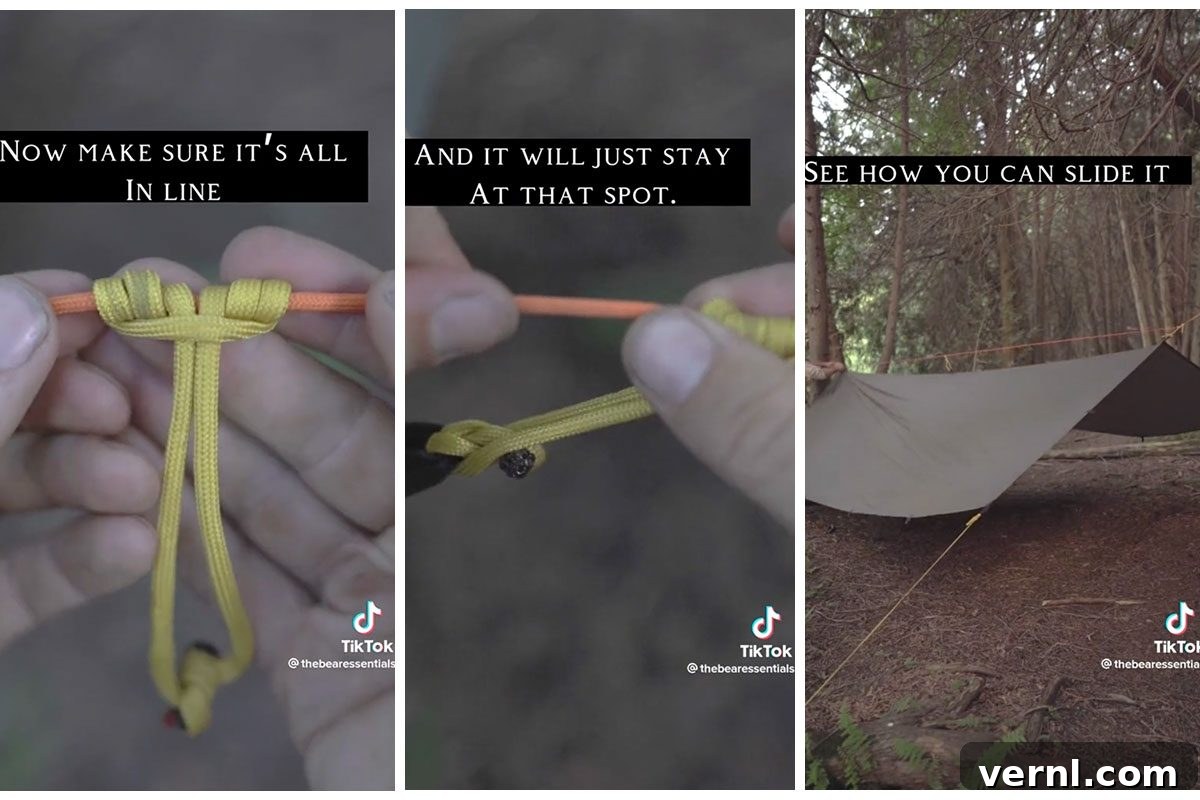
Recently, bushcraft TikToker The Bear Essentials shared a concise video demonstrating the ease and utility of the Prusik knot for tarp tensioning, highlighting its importance in various outdoor scenarios. This guide expands upon that valuable insight, providing a comprehensive overview to help you master this essential knot.
The Unsung Hero: Understanding Friction Hitches
Before we delve into the specifics of the Prusik knot, let’s establish a foundational understanding of friction hitches. At its core, a friction hitch is a type of knot designed to grip a main line (often referred to as a ‘guy line’ or ‘main rope’) securely under tension, yet allow for easy sliding and adjustment when the tension is relieved. This unique characteristic is what makes friction hitches incredibly valuable in a myriad of applications, from outdoor shelters to more technical rope work.
As The Bear Essentials aptly explains, the magic of a friction hitch lies in its dual nature: “When you pull on [a friction hitch], it’ll hold tight, but without friction it’ll freely slide.” This means you gain the significant advantage of adjustability without the tedious process of repeatedly tying and untying knots. Imagine setting up a tarp and needing to fine-tune its pitch as the wind shifts or the ground settles. With a standard knot, you’d have to untie, adjust, and re-tie each anchor point. With a friction hitch, a simple slide is all it takes.
How Friction Hitches Work
The principle behind a friction hitch is surprisingly straightforward. It involves wrapping a smaller diameter cord (the hitch cord or Prusik loop) around a larger diameter main line in a specific pattern. When weight or tension is applied to the hitch cord, the wraps constrict and bite down on the main line, generating enough friction to prevent slippage. When the tension is released, the wraps loosen slightly, allowing the hitch to be manually slid along the main line. The key factors influencing its effectiveness are the number of wraps, the diameter ratio between the two cords (the hitch cord should generally be about half to two-thirds the diameter of the main line), and the material properties of the ropes involved.
Beyond Tarps: Versatility of Friction Hitches
While invaluable for tarp tensioning, the utility of friction hitches extends far beyond securing shelters. They are widely used in:
- Climbing and Arborist Work: For ascending ropes, creating adjustable anchor systems, or in rescue scenarios.
- Bushcraft and Survival: For creating makeshift clotheslines, hanging food out of reach of animals (bear bags), securing loads, or creating adjustable traps.
- Everyday Utility: For creating adjustable tie-downs, securing items on vehicles, or even hanging pots over a campfire at an easily modifiable height.
Understanding friction hitches opens up a world of practical applications, making them a fundamental skill for anyone engaging with ropes and cordage. The Prusik knot stands out among these as one of the most reliable and widely recognized options.
The Prusik Knot: An Indispensable Outdoor Skill
Named after Austrian mountaineer Karl Prusik, who developed it in 1931, the Prusik knot has become a cornerstone of rope work, particularly in mountaineering, caving, and rescue operations. Its inherent reliability and ease of use, even under extreme conditions, have cemented its status as a must-know knot. For outdoor enthusiasts, its application in tarp tensioning translates these high-stakes attributes into practical, everyday benefits for comfort and security in the wilderness.
What makes the Prusik particularly effective for tarps is its symmetrical design, which allows it to grip equally well in either direction along the main line. This symmetry provides a secure hold regardless of the angle of pull from your tarp, offering stable and consistent tension. When properly tied, it forms a robust yet movable anchor that won’t slip under load, ensuring your tarp remains taut and functional.
Mastering the Prusik Knot: A Step-by-Step Guide
Tying a Prusik knot requires two pieces of cordage: a main line (your tarp’s guy line) and a shorter loop of paracord or similar cordage for the Prusik loop itself. The Prusik loop is typically formed by tying the ends of a short piece of cord together with a strong knot, such as a double fisherman’s knot, to create a closed loop. The Bear Essentials’ demonstration often features a loop around 8 to 10 inches long, which is a practical size for many applications. Ensure your Prusik loop cord is of a smaller diameter than your main line for optimal friction and grip – a common ratio is a 5-7mm Prusik cord on an 8-11mm main line.
Once you have your materials ready, follow these clear, step-by-step instructions to tie a perfect Prusik knot:
- Initial Setup: Take your pre-made loop of cord (the Prusik loop) and position it against your main tension line. The goal is to wrap the Prusik loop around the main line multiple times. Begin by laying one side of the Prusik loop parallel to the main line.
- First Wrap: Bring the other side of your Prusik loop around and over the main line, then thread it through the center of the loop you’ve just created. This initial pass will resemble a loose girth hitch or cow hitch. Gently snug it up so it’s neat but not yet tight. Ensure the wraps are lying flat and not twisted.
- Second Wrap: Repeat the previous step. Bring the same end of the Prusik loop over the main line again, following the exact path of your first wrap, and thread it through the center of the original loop. It is crucial that this second wrap lies neatly beside the first, creating parallel lines on both sides of the main line. This consistency ensures maximum surface contact and uniform friction.
- Third Wrap (Highly Recommended): For enhanced security, especially with slicker ropes, heavier loads, or in critical applications like tarp tensioning where sustained grip is vital, perform a third wrap. Just like the first two, bring the Prusik loop over the main line for a third time, meticulously threading it through the central opening. The key here is precision: “making sure that middle loop is coming down through the center and everything’s neat,” as emphasized by experts. All three wraps should be clean, parallel, and tightly dressed against each other.
Once you’ve completed these steps, gently pull on the two ends of your Prusik loop (or the loop itself if it’s a closed loop) to “dress” the knot, ensuring all wraps are snug and properly aligned. You will now have a perfectly tied Prusik knot that, when pulled taut, will grip the main line firmly, yet can be slid easily when relaxed.
Applying the Prusik Knot: Tensioning Tarps and Beyond
The true utility of the Prusik knot shines brightest when put into action. Its adjustability makes it “perfect for tensioning tarps or hanging up items that you want to move around later,” as described by The Bear Essentials. This could include anything from a lantern that needs to be repositioned for better light to a cooking pot that you can slide away from the direct flames once your water boils.
Tensioning Your Tarp with a Prusik Knot
Integrating the Prusik knot into your tarp setup is straightforward and highly effective. Here’s how to do it:
- Attach to the Tarp: Locate a grommeted hole on one corner of your tarp. Take one end of your Prusik loop (or squeeze the entire loop if it’s closed) and thread it through the grommet.
- Secure with a Toggle: To prevent the loop from pulling back through the grommet, the simplest method is to “put a stick on the other side” of the loop, creating a secure toggle. Alternatively, you can use a small carabiner, a pebble, or even a smaller piece of paracord tied into a toggle knot. This creates a secure attachment point between the Prusik loop and your tarp corner.
- Connect to Main Line: Once your Prusik knot is tied onto your main guy line (which should be stretched between two anchor points, like trees or stakes), and the Prusik loop is attached to your tarp corner, you’re ready for tensioning.
- Adjusting Tension: To adjust the tension of your tarp, simply hold the Prusik knot with one hand, relieve a little pressure from the tarp corner, and slide the knot along the main line until you achieve the desired tautness. Then, release the Prusik, and it will grip firmly in its new position. This allows for incredibly precise adjustments, ensuring your tarp is drum-tight and sheds water effectively.
This method offers immense flexibility. You can quickly tighten your tarp if winds pick up, or loosen it slightly for ventilation during warmer spells. It’s a dynamic solution that adapts to environmental changes, providing optimal shelter in any condition.
Beyond Tarp Corners: Other Uses for the Prusik in Tarp Setups
- Adjustable Ridgelines: Use Prusik knots to attach your tarp to a main ridgeline, allowing you to slide the tarp for perfect centering or to create an asymmetrical pitch.
- Side Tie-Outs: Instead of fixed knots, use Prusiks on side guylines to fine-tune the shape and stability of your tarp, especially useful for elaborate setups like a pyramid or lean-to.
- Hanging Gear: Attach additional bungee cord or paracord to the Prusik loop to hang items like lanterns, cooking utensils, or even small backpacks inside your shelter, keeping them off the ground and organized.
Essential Tips for Success with Your Prusik Knot
To ensure your Prusik knots perform optimally and reliably, consider these essential tips:
Cordage Selection is Key
- Diameter Ratio: As mentioned, the Prusik loop cord must be significantly smaller in diameter than the main line it’s gripping. A good rule of thumb is that the Prusik cord should be 1/2 to 2/3 the diameter of the main line. If the cords are too close in diameter, the Prusik may not grip effectively.
- Material Compatibility: Nylon on nylon or polyester on polyester generally works well. Be aware that mixing different rope materials (e.g., a very slick aramid cord on a standard nylon rope) might affect friction and grip. For tarp guylines, standard nylon or polyester cords are usually fine.
- Condition of Cordage: Always use cordage that is clean and in good condition. Frayed, worn, or dirty ropes can reduce the friction a Prusik knot generates, leading to potential slippage.
Practice Makes Perfect
While the Prusik knot is simple, developing muscle memory for tying it quickly and neatly is invaluable. Practice tying it at home until it becomes second nature. This will save you time and frustration when you’re out in the field, possibly in low light or inclement weather.
Dressing the Knot
After tying, always “dress” the knot. This means gently snugging each wrap and arranging the cordage so that it lies flat and parallel. A neatly dressed knot maximizes surface contact and ensures consistent friction, leading to a stronger and more reliable hold.
Regular Inspection
Before and after each use, especially for critical applications like shelter, inspect your cordage and the Prusik knot itself. Check for signs of wear, abrasion, or damage that could compromise its integrity. Replace worn cordage promptly.
Contextual Awareness
While the Prusik is an excellent general-purpose friction hitch for tarp tensioning, it’s important to understand its limitations, especially in high-stakes environments like technical climbing where specific applications and additional safety protocols are paramount. For tarp setups, it provides ample security and adjustability.
Elevate Your Outdoor Setup with the Prusik Knot
The Prusik knot is more than just another knot; it’s a fundamental skill that significantly enhances your capability and comfort in the outdoors. It transforms the potentially frustrating task of tarp setup into an efficient and secure process, ensuring your shelter remains steadfast against the elements. Its versatility extends to countless other applications, making it an invaluable addition to any outdoor enthusiast’s repertoire.
By mastering the Prusik knot, you gain not just a practical tool, but also a deeper understanding of rope dynamics and friction. This knowledge empowers you to create more reliable, adaptable, and efficient setups, whether you’re battling a sudden storm or simply enjoying a peaceful night under the stars. So, grab some paracord, find a suitable main line, and start practicing. Your next outdoor adventure will be all the better for it.