
The construction industry, historically seen as a male-dominated field, is undergoing a transformative shift as women increasingly take on pivotal roles. From leading major business ownership ventures to mastering intricate skilled trades, women are reshaping the landscape of building and infrastructure. Today, a significant and growing percentage of the construction workforce identifies as female, with women representing slightly more than 10 percent of the industry. This figure, though still a minority, reflects a powerful upward trend that has been consistently accelerating for decades, marking a new era of inclusivity and diverse talent in construction-related fields.
The momentum of women’s involvement in construction is undeniable. Data indicates that job growth for women in this sector is nearly five times faster than the overall job growth rate for the entire field. This rapid expansion underscores a burgeoning interest and an increasing demand for female professionals across various construction disciplines. Notably, in 2019, the proportion of women working in construction reached a remarkable 20-year high, a testament to evolving societal norms, improved opportunities, and dedicated efforts to bridge gender gaps. While these contemporary headlines celebrate the current surge, it’s crucial to acknowledge that women’s contributions to construction are far from a modern phenomenon. The rich and often overlooked history of women in construction stretches back much further than many realize, with their influence evident as early as the Middle Ages.
A Glimpse into the Past: Medieval Women in Construction
While scattered archaeological findings suggest women contributed manual labor to ancient worksites, the earliest definitive written evidence of women actively involved in construction work emerges from the 13th century. It was in Spain, specifically, where official records first documented groups of women day laborers working on stone and wood structures within the city of Navarre. This discovery provides a concrete starting point for tracing the formal recognition of female construction workers in historical records.
Further investigations by historians have uncovered a broader presence of women construction laborers and skilled tradespeople spanning from the 13th to the 17th centuries across various European nations, including England, France, Germany, and Spain. However, understanding the true extent of this female participation is challenging due to the inherent limitations of record-keeping during the Middle Ages. Documentation was often sporadic, incomplete, or biased, making it nearly impossible to ascertain precisely how widespread these practices were across different regions and social strata.
A significant barrier to comprehensive historical accounting was the prevailing social attitudes of the time. It was largely considered socially unacceptable to officially record construction labor performed by women as wage-earning work. The societal belief system held that women were physically incapable of undertaking heavy labor, and working outside the traditional domestic sphere was often viewed as immoral or inappropriate. To circumvent these ingrained prejudices and societal norms, women laborers were frequently omitted from official records altogether, or their presence was noted only by gender, without specifying a proper name or detailing their specific work role. This systemic underreporting means that much of their invaluable contribution remains unquantified and often invisible in mainstream historical narratives.
Despite these obstacles to formal recognition, historians largely agree that poor women regularly engaged in unskilled day labor on construction sites. Their tasks were vital and diverse, including carrying water, digging trenches for foundation walls, thatching roofs, and mixing mortar – all fundamental to the construction process. In contrast, women involved in skilled building trades typically belonged to the middle class. These women often acquired their expertise in masonry, carpentry, or other specialized crafts directly from their fathers or husbands, carrying on family traditions and contributing to more complex structural projects. Their skills, though less frequently documented, were crucial to the craftsmanship of the era.
The robust presence of women as both unskilled workers and skilled tradespeople experienced a severe decline during Europe’s economic crises of the 16th and 17th centuries. As widespread unemployment and destitution became rampant, menial tasks that women previously performed were increasingly taken over by unemployed and desperate men. Furthermore, the established trade guilds, which controlled access to skilled professions, began to restrict membership more stringently. Inheritance of guild membership became increasingly limited along the male line, effectively cutting out wives and daughters who, in earlier periods, might have been allowed to continue the family business and practice their inherited trades. This period marked a significant setback for women’s visibility and opportunities within the formal construction sector.
Post-Industrial Revolution: Women Resurface in Construction
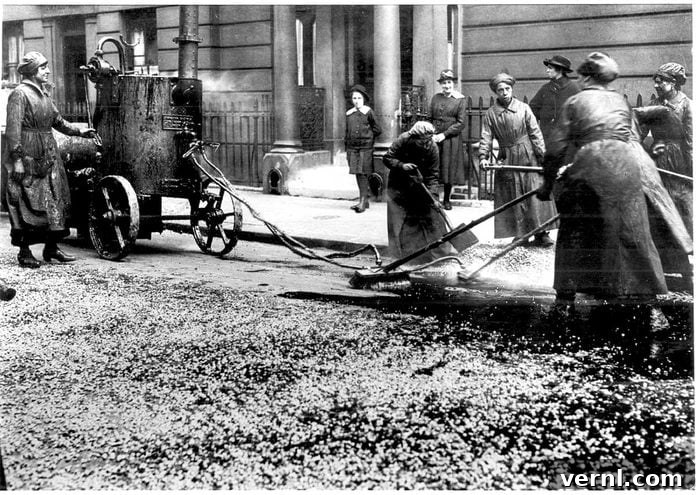
The advent of the Industrial Revolution in the mid-18th century ushered in an unprecedented economic boom across Europe and the U.S. This period of rapid industrialization and urbanization led to a massive expansion of the labor market, creating new demands for workers across countless sectors. Consequently, women began to return to construction sites, taking on roles as both laborers and tradespeople, often with significantly less social condemnation than in previous centuries. The sheer scale of development and the need for a larger workforce began to slowly erode some of the older prejudices against women in physical labor.
By the late 19th century, the first pioneering women engineers and architects began to make indelible marks on the profession. One of the most iconic figures was Engineer Emily Warren Roebling, whose extraordinary leadership was crucial to the completion of the Brooklyn Bridge. After her husband, Chief Engineer Washington Roebling, fell ill with caisson disease, Emily effectively directed the monumental construction project for over a decade. Her comprehensive knowledge of mathematics, strength of materials, and cable construction, combined with her diplomatic skills, ensured the bridge’s successful completion. Her instrumental role was recognized when the bridge officially opened in 1883; she was honored by riding across its entire length with President Chester A. Arthur, a profound symbol of her achievement.
The turn of the 20th century saw further breakthroughs for women in architecture and engineering. Ethel Charles broke barriers in 1898 by becoming the first woman to be accepted into the prestigious Royal Institute of British Architects. Across the Atlantic, American Julia Morgan distinguished herself as the first woman admitted to the highly acclaimed École Nationale Supérieure des Beaux-Arts school of architecture in Paris in 1902, and subsequently, she became the first woman architect licensed in California in 1904. Her prolific career saw her design over 700 buildings, including the iconic Hearst Castle. These early pioneers paved the way for future generations. Further solidifying women’s place in engineering, in 1926, Lillian Moller Gilbreth joined the American Society of Mechanical Engineers as its very first female member, demonstrating her significant contributions to industrial engineering and management.
World War II represented one of the most transformative periods for women in construction and, indeed, the entire labor force. As tens of thousands of men were conscripted to fight on the front lines, women stepped up to fill critical roles across industries that were previously deemed unsuitable for their physical or mental capabilities. The iconic “Rosie the Riveter” became a symbol of this era, embodying the strength and resilience of women taking on traditionally male-dominated jobs.
From operating heavy cranes and welding ships in bustling shipyards to serving as electrical engineers and mechanics in munitions factories, women suddenly dominated sectors long reserved exclusively for men. They demonstrated immense capability, adaptability, and dedication, proving beyond doubt their ability to perform demanding technical and physical work. However, this period of empowerment was short-lived. Following the war, as troops returned home, women were summarily fired from these positions, often facing pressure to return to traditional domestic roles. This widespread displacement ignited simmering dissatisfaction and contributed significantly to the burgeoning feminist movements of the 1960s, which sought to challenge gender inequality and fight for equal opportunities in the workforce.
The mid-1960s marked a pivotal moment with the passage of the first significant laws aimed at protecting women in the workforce, laying the groundwork for greater equity. However, true leadership roles in construction remained elusive for some time. It wasn’t until 1979 that Barbara Res shattered another glass ceiling, being put in charge of the construction of Trump Tower in New York City. She became the first woman foreman to oversee a major American construction project from its groundbreaking inception to its successful completion. Her achievement was not just a personal triumph but a powerful symbol of women’s increasing capability to manage and lead large-scale, complex construction endeavors.
Modern Women in Construction: Progress and Persistent Challenges
Today, women constitute a significant and increasingly vital proportion of the labor market within the construction industry. The landscape is evolving rapidly, with a noticeable surge in the number of women entering construction management, project coordination, and a diverse range of skilled trades. This positive trend can be attributed to several factors. Firstly, there’s a growing emphasis on STEM (Science, Technology, Engineering, and Mathematics) education for girls and young women, leading more female graduates into engineering, architecture, and construction-related degree programs. These academic pathways equip them with the necessary technical expertise and leadership skills to thrive in the industry.
Secondly, the construction sector stands out for having one of the narrowest gender wage gaps across all industries. While women, on average, earn approximately 81 cents for every dollar earned by men across the broader economy, that figure rises significantly to 94 cents for women working in construction. This comparatively smaller gap makes the industry a more financially attractive and equitable career path for women seeking professional growth and fair compensation, encouraging more talented individuals to consider construction as a viable long-term career.
Moreover, the ecosystem of support for women in construction has expanded dramatically. A variety of professional associations and organizations now actively offer invaluable resources, mentorship, and networking opportunities specifically tailored for women owners, managers, and tradespeople. These platforms provide crucial spaces for sharing experiences, fostering collaboration, and advocating for policies that promote inclusivity. Non-profit organizations, such as Move Over Bob, are at the forefront of empowering women, providing training, and connecting them with opportunities to enter and excel in demanding fields like construction, engineering, and demolition industries. These collective efforts are helping to dismantle historical barriers and create a more welcoming environment.
Women have undeniably come a remarkably long way from the medieval era of unrecorded ditch-digging and the “Rosie the Riveter” pushback. Their journey has been marked by perseverance, pioneering achievements, and a relentless pursuit of equality. However, despite the significant progress, more work remains to be done. Lingering discrimination, unconscious biases, and persistent challenges related to workplace culture, access to appropriate training, and adequate support for work-life balance continue to hinder women from reaching their fullest potential across all facets of the construction industry. Continued advocacy, policy reforms, and a fundamental shift in mindsets are essential to ensure that the construction industry truly leverages the diverse talents of all its workers, paving the way for a more equitable and innovative future.