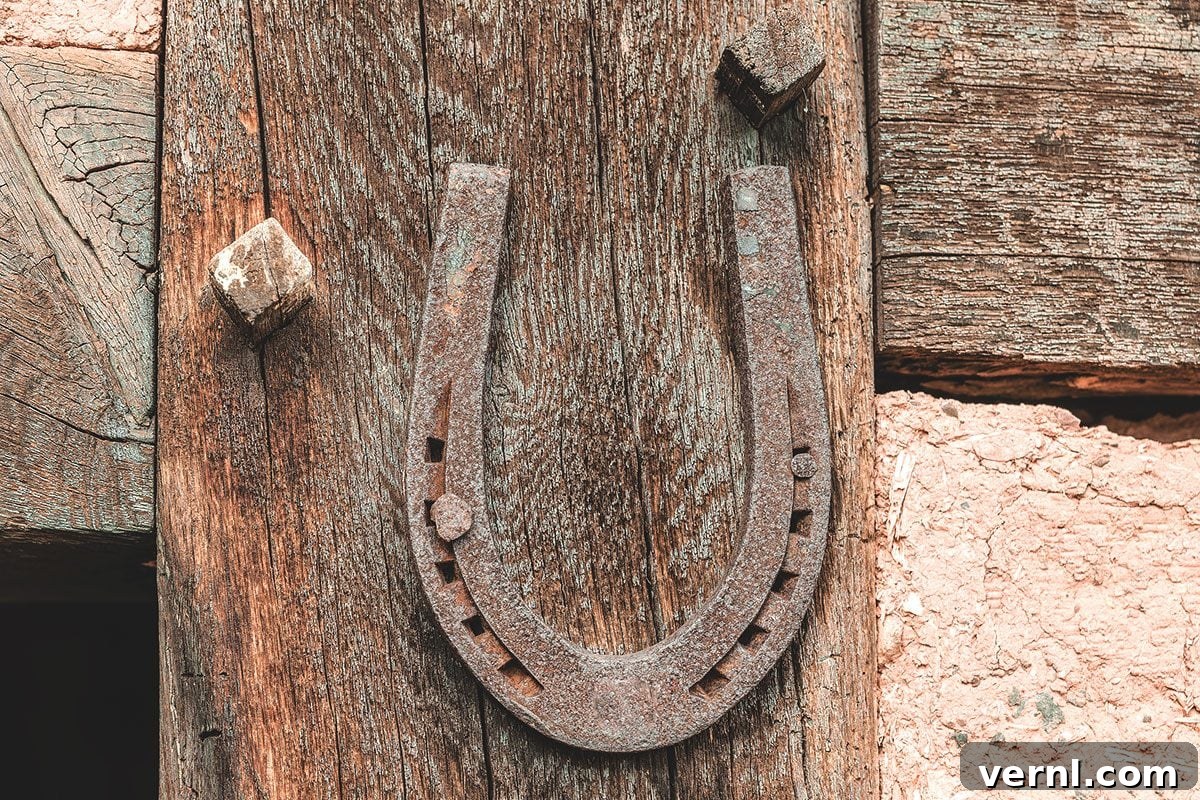
What does a horseshoe have in common with bamboo, acorns, and Beeman’s gum? If that question leaves you puzzled, let’s simplify it a bit: What does a horseshoe share with a rabbit’s foot and a four-leaf clover? That’s right, they are all cherished elements within a vast global tapestry of good luck symbols. This fascinating collection also includes the aforementioned bamboo, acorns, and even Beeman’s gum. Beeman’s gum, you ask? Indeed. Legendary early aviators, such as Chuck Yeager, famously believed that chewing this particular gum brought them good fortune during their daring flights, a belief immortalized in classic films like The Right Stuff and The Rocketeer.
So, when you spot a horseshoe adorning a barn, it’s highly probable that it’s placed there with the intention of attracting good luck. This practice isn’t merely a quaint rural custom; it’s a tradition that stretches back through centuries, deeply embedded in human belief systems. As mythologist Nitten Nair thoughtfully explains, “A horseshoe on a barn might appear to be a simple piece of folk superstition, but it is actually a profound link to centuries of belief where everyday objects transformed into powerful guardians of good fortune and safety.” It speaks to an innate human desire to harness positive energy and ward off misfortune, using tangible items as conduits for these intangible aspirations.
But what is it about a humble horseshoe that has elevated it to such an iconic status within the realm of protective and lucky charms? Let’s delve into the rich history, cultural significance, and enduring appeal of this remarkable symbol.
Unearthing the Historical Origins of the Horseshoe Symbol
The tradition of associating the horseshoe with good luck is widespread and deeply ingrained in many cultures, with its placement on barns being a prime example of this enduring custom. “From a cultural and historic perspective, this practice has been observed for centuries, particularly throughout Europe,” notes cultural scholar Joey Florez. He further elaborates, “Farmers traditionally hung horseshoes over their barns not only to invite good fortune but also to actively ward off bad luck, thereby protecting their homes, their livestock, and their livelihoods from unseen negative influences.” This wasn’t just about passive hope; it was about active protection through symbolic action.
If you’re curious about how a simple piece of iron fashioned for a horse’s hoof achieved such a revered and almost magical status, the answer primarily lies in its material: iron. In ancient and medieval Europe, iron held a potent mystique. It was believed to possess inherent properties that could repel evil spirits, witches, and various malevolent entities. Its strength, durability, and the challenging process required to forge it contributed to its powerful reputation. Complementing this, the blacksmith, the artisan who worked with this formidable material, was often perceived as a figure possessing almost magical powers. This perception stemmed from their mastery over fire and metal, processes that seemed transformative and otherworldly. Nitten Nair highlights this connection: “You can see this same profound idea reflected in mythology across various cultures. In Roman culture, for instance, Vulcan, the revered god of fire and smithing, was simultaneously seen as both a powerful creator and a fierce protector. Similarly, in Greek mythology, Hephaestus was the divine smith who forged the formidable weapons of the gods, imbuing them with immense power. And in Slavic folklore, the smith’s forge was not just a workplace but a sacred space, often regarded as a vital link that connected the human realm with the divine.” This cross-cultural reverence for iron and its shapers solidifies the horseshoe’s early symbolic power.
While some might dismiss the act of hanging a horseshoe on a barn as mere superstition, Joey Florez offers a more nuanced perspective: “Hanging a horseshoe is not solely superstition; it also profoundly serves to reinforce group identity, providing a tangible connection with the past, and fostering a quiet, yet persistent, optimism about the future.” It’s a shared cultural marker, a whisper of continuity that bridges generations and provides psychological comfort in an uncertain world.
To further amplify the good fortune a horseshoe is believed to attract, a related and equally ancient tradition involves attaching it to the barn siding or directly above the door using exactly seven nails. The number seven itself has been a powerful and pervasive good-luck symbol, cherished in both Eastern and Western cultures, dating back to at least the second millennium BC. Its significance spans across various belief systems, appearing in religious texts, natural phenomena (seven colors of the rainbow, seven days of the week), and philosophical concepts, lending an additional layer of mystical potency to the horseshoe when fastened with this sacred number of fasteners.
Does the Direction of a Lucky Horseshoe Matter?
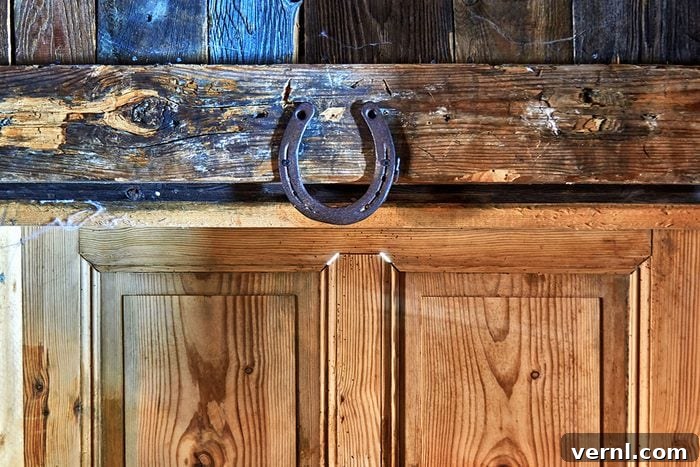
The U-shape of a horseshoe is distinctive, and the way it is oriented when hung often carries specific symbolic meanings. One prevalent traditional method is to hang it with the U-shape facing upwards, open at the top. When displayed in this manner, Joey Florez explains, the horseshoe is thought to act as a cosmic vessel or cup, designed to capture and diligently hold good luck, preventing it from escaping or “running out.” This upward orientation ensures that blessings and positive energy are collected and stored within the home or property it protects. Conversely, another popular practice involves hanging the horseshoe with the U-shape facing downward, open at the bottom. In this orientation, Florez suggests, the horseshoe is believed to “pour” its continuous stream of good luck, blessings, and protective energy over the household, the land it encompasses, and even over people passing by. It acts as a conduit, showering fortune downwards.
“Both of these methods,” clarifies Nitten Nair, “stem from the very same fundamental belief: that this seemingly simple piece of iron carries a profoundly powerful meaning, striking a delicate balance between human effort in placing it and the divine favor it is intended to attract.” The choice of direction often varies by regional folklore or personal preference, yet the underlying intention remains consistent – to invite protection and prosperity.
Modern-Day Use & Enduring Symbolism of the Horseshoe
In Western culture, the horseshoe has cemented its place as an almost universally recognized symbol of good luck and potent protection. In a world often filled with uncertainties, who among us couldn’t use a little extra dose of that? While attracting good fortune remains arguably the primary motivation for adorning a barn with a horseshoe, its symbolism extends far beyond this singular purpose. For instance, some individuals choose to hang horseshoes on their barns as a heartfelt way to memorialize beloved horses, paying tribute to their loyalty, strength, and the indelible mark they left on their lives and livelihoods. This act serves as a poignant reminder of these noble animals, acknowledging their profound connection to rural life and agricultural prosperity. Beyond this deeply personal sentiment, here are several other possible reasons and interpretations if you encounter a horseshoe on a barn today:
- It could be a general tribute to “horse culture” – celebrating the historical and ongoing importance of horses in agriculture, transportation, and daily life. It acknowledges the symbiotic relationship between humans and horses that has shaped civilizations.
- It might serve as a specific memorial to a particular horse that once inhabited the barn or was especially cherished by the family, keeping its spirit alive in a tangible way.
- In some cases, especially in areas with active farriers or blacksmiths, it could subtly function as an advertisement for the skilled smith who forges and fits these essential items. It’s a quiet testament to their craft.
- Quite simply, it could be there purely as a decorative element, chosen for its aesthetic appeal or rustic charm, without any deep underlying symbolic meaning intended by the current owner.
- From a psychological perspective, a horseshoe on a barn can also profoundly symbolize stability and grounding. As Joey Florez sagely points out, “Psychologically, this enduring symbol illustrates how humans have long utilized tangible objects as a means to provide a comforting feeling of security and exert a sense of control over the inherent uncertainties of life.” It’s a physical anchor in a changeable world.
Frequently Asked Questions (FAQ) About Horseshoes and Luck
Does the type of horseshoe matter for its symbolic power?
When it comes to invoking the traditional power and meaning of a lucky horseshoe, the material it’s made from holds significant weight. Given the historical importance and mystical associations of iron, a horseshoe crafted from iron is widely believed to carry more profound significance and protective energy than one made from lighter or more modern materials such as aluminum, titanium, plastic, or other alloys. If your goal is to honor and tap into the ancient traditions of good luck and warding off evil, opting for a genuine iron horseshoe is the most authentic choice. Furthermore, for horse lovers or those seeking a deeper connection, there’s a widely held belief that a worn horseshoe, one that has actually been used by a horse, possesses more potent energy and character than a brand-new one. This is because it is thought to carry some of the essence, spirit, and “luck” of the horse that wore it, imbuing it with a personal history and resonance.
Can I hang a horseshoe indoors or on a home door instead of a barn?
Absolutely, yes. While placing a horseshoe on a barn is a classic image, hanging one on an interior wall or, perhaps most commonly, directly above a doorway inside a home, is a very widespread and accepted practice. This allows the symbolic power of the horseshoe to extend its protective and benevolent influence directly over the residents and within the living spaces. For those who resonate with its rich tradition and symbolism, a horseshoe displayed within the home serves as a constant, comforting reminder to invite good fortune, prosperity, and positive energy into their personal sanctuary, while simultaneously acting as a ward against any form of negativity, bad luck, or unwanted influences that might seek to enter.
About Our Esteemed Experts
- Nitten Nair serves as the Chief Mythologist at Mythlok, an acclaimed platform dedicated to the comprehensive study and exploration of mythologies, legends, and folklore from diverse cultures across the globe. His insights provide a rich, historical, and cross-cultural perspective on symbolic objects.
- Joey Florez is a distinguished psychology and culture scholar, bringing a unique interdisciplinary perspective with his educational background rooted in applied and forensic psychology. He regularly shares his insightful analyses and articles on his personal academic platform, which can be found at his own website. His expertise helps unravel the psychological and societal underpinnings of cultural traditions.
Related Articles You Might Enjoy
- The Real Reason Aluminum Foil Has a Shiny Side and a Dull Side
- Think Adirondack Chairs Are Uncomfortable? You’re Using Them Wrong
- Why You Shouldn’t Crush Aluminum Cans Before Recycling