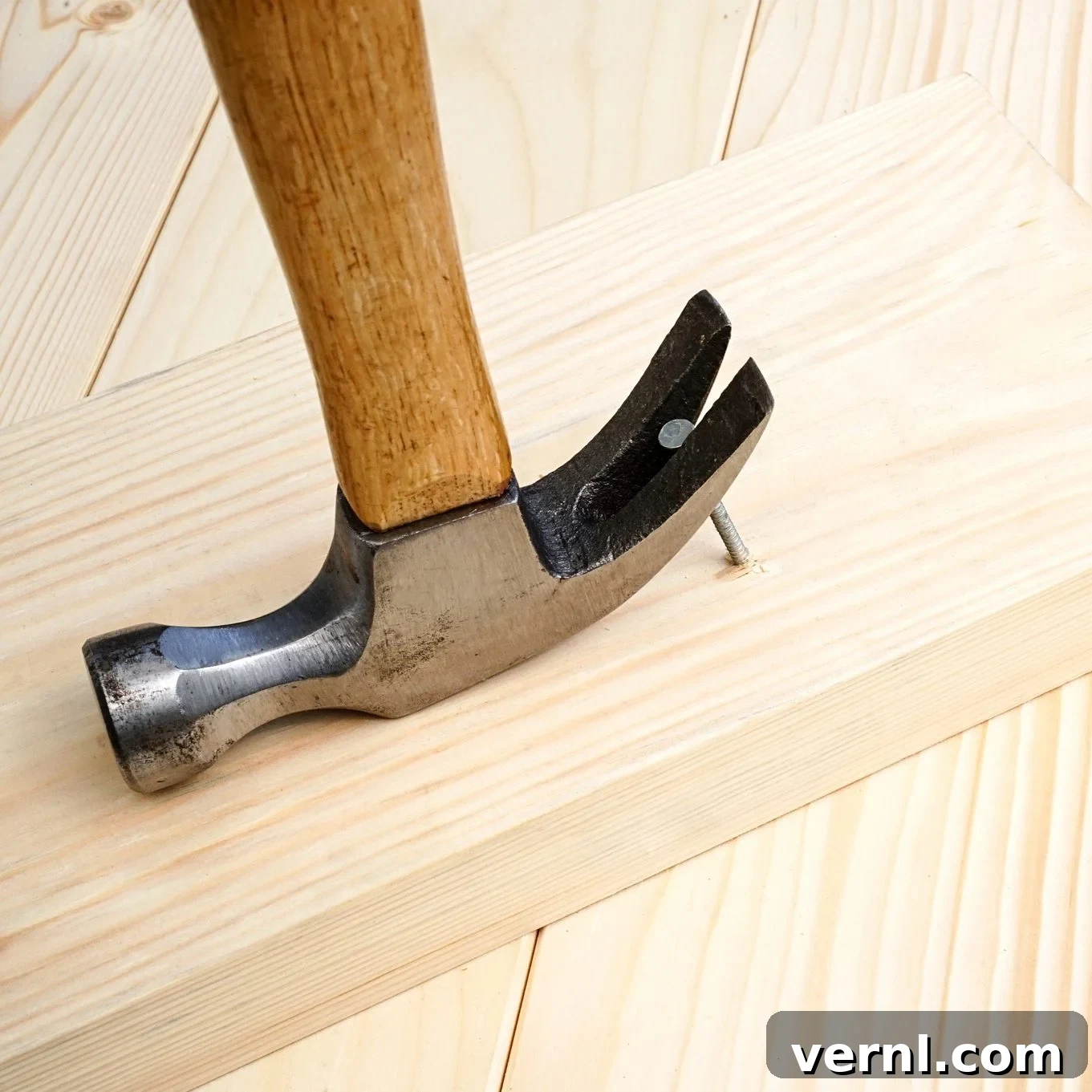
Every seasoned craftsman knows that success in any project, no matter how simple, often hinges on the proper use of the right tools. My personal journey into the world of construction began with a humbling, yet invaluable, lesson from an unexpected mentor: an 18-year-old coworker on a bustling jobsite. Fresh to the trade, I had developed a habit of grasping my claw hammer midway up its handle, believing it offered more control. My coworker, however, offered a simple yet profound piece of advice: grip it at the very end.
This seemingly minor adjustment revolutionized my hammering technique. The immediate difference in leverage and power was astonishing. What once took five or six laborious swings to sink a nail now required a mere two or three, and with far greater accuracy. This early experience underscored a fundamental truth: understanding and applying correct tool mechanics is paramount, not just for efficiency but also for safety and the quality of your work.
On that particular project, we predominantly utilized robust framing hammers. These specialized claw hammers are characterized by their significant weight and often boast serrated faces, designed to bite firmly into nail heads, preventing slippage. While these serrations could leave noticeable gouges in the lumber, this was inconsequential for our work, as the framing would eventually be concealed by drywall. However, the world of claw hammers extends far beyond this singular type, offering a surprising array of designs tailored for myriad tasks. From lighter models with bent claws perfect for finishing nails to those with elongated necks for precision work or pointed claws for meticulous nail extraction, the variety truly is extensive and specialized.
What Exactly Is a Claw Hammer?
At its core, a hammer is a rudimentary yet indispensable tool comprising a heavy head affixed to a handle. What distinguishes a “claw hammer” from its counterparts is the distinctive, forked nail-pulling appendage located at the rear of its head. This ingenious design marries the primary function of driving fasteners with the equally crucial ability to remove them, making the claw hammer a truly versatile and iconic instrument in any toolkit.
The history of hammering tools stretches back millennia, with stone hammers dating as far back as three million years. These early iterations, however, lacked handles, a crucial addition that didn’t emerge until approximately 30,000 B.C. The advent of forged-metal hammer heads marked another significant leap forward, appearing during the Bronze Age around 3,300 B.C. While evidence suggests primitive forms of claw hammers existed as early as 1514 A.D., the modern claw hammer as we know it is largely credited to American blacksmith David Maydole. In 1840, Maydole innovated a design where the hammer head tapered gracefully towards the cheek – the junction where it meets the handle. This design proved revolutionary, offering superior balance and durability. Its immense popularity led to the rapid expansion of Maydole’s workshop, and his foundational design remains the standard adopted by most manufacturers today, a testament to its enduring efficiency and ergonomic brilliance.
Contemporary claw hammer heads are predominantly crafted from high-carbon forged steel, renowned for its exceptional strength and durability. However, advanced options featuring lightweight yet incredibly robust titanium heads are also available, particularly favored by professionals for their reduced weight and superior vibration dampening. Handles, too, have evolved, with choices ranging from traditional, shock-absorbing hardwoods like hickory and ash to modern, ergonomic designs utilizing fiberglass or solid steel, often enhanced with rubber or synthetic grips for improved comfort and control. The thoughtful engineering of a claw hammer’s components ensures it remains a dependable and essential tool for both casual DIYers and seasoned tradespeople alike.
Diverse Applications: What Is a Claw Hammer Used For?
While the fundamental purpose of a claw hammer—driving and pulling nails—remains universally understood, its applications extend far beyond these basic tasks. The robust design and distinctive features of a claw hammer make it an incredibly versatile tool, indispensable across a spectrum of construction, repair, and household duties. The primary striking face, typically a circular anvil about an inch in diameter, is optimized for precise nail driving, while the claws, available in straight or curved configurations, are ingeniously designed not only for nail extraction but also for a host of other practical uses.
The utility of a claw hammer can be categorized into several key areas:
- Heavy-Duty Construction and Renovation: This includes demanding tasks such as rough framing, installing robust roofing materials, applying siding, and other structural work. For these applications, heavier hammers with milled (serrated) faces are often preferred, providing an aggressive grip on larger nails and preventing glancing blows.
- Light-Duty Construction and Finishing Work: For more delicate tasks like installing and removing doors, windows, and interior trim, a lighter claw hammer with a smooth face is typically chosen. The smooth face minimizes damage to visible surfaces, ensuring a clean finish. Its precision allows for accurate tapping and adjustment of components.
- Everyday Home Utility Purposes: A claw hammer is a staple in every homeowner’s toolbox. It’s perfect for hanging pictures, assembling furniture, building garden fencing, driving landscape stakes, or even breaking down cardboard boxes. Its omnipresence makes it the go-to tool for countless household repairs and improvements.
- Demolition Projects: The sturdy construction of a claw hammer makes it an effective tool for light demolition. Whether you’re prying apart wooden structures, dismantling old cabinets, or breaking through plasterboard, the claw can provide significant leverage. Straight claws are particularly adept at separating larger pieces of material.
- Unexpected Uses: Beyond its conventional roles, a claw hammer can be surprisingly useful for tasks such as digging small holes in soft ground for planting, prying stubborn objects, or even for uprooting persistent weeds with its claw. Its robust nature makes it a practical multi-tool in a pinch, demonstrating its adaptability in various scenarios.
Exploring the Diverse Types of Claw Hammers
While the fundamental design of a claw hammer is recognizable across the board, manufacturers have developed several specialized variations to optimize performance for specific tasks. Understanding these distinctions is crucial for selecting the most effective tool for your project, ensuring both efficiency and superior results.
Utility Hammer: The All-Around Household Hero
The utility hammer, often weighing around 16 ounces or less, is the most common type found in household toolboxes. Its lighter weight and often elongated neck make it manageable for general tasks without causing excessive fatigue. A hallmark of the utility hammer is its extremely curved claws, meticulously designed to provide optimum leverage for effortlessly pulling nails of various sizes. The handle material can vary widely, from durable steel and vibration-dampening fiberglass to traditional hardwoods such as hickory or ash, each offering a unique balance of feel, resilience, and cost. This hammer is perfect for hanging pictures, assembling flat-pack furniture, or tackling minor repairs around the house.
Framing Hammer (Rip Claw Hammer): The Contractor’s Workhorse
Framing hammers, also known as rip claw hammers, are significantly heavier than their utility counterparts, typically weighing between 20 to 24 ounces. This added mass translates directly into greater driving force, making them ideal for heavy-duty construction tasks such as framing walls, setting large joists, and working with substantial lumber. Their faces are generally larger and can be either smooth or serrated (milled). Serrated faces are preferred for rough framing as they provide superior grip on nail heads, minimizing slippage and errant strikes. Some framing hammers feature shorter necks, designed to improve pounding accuracy during repetitive, forceful blows. A defining characteristic of framing hammers is their typically straight claws, which offer maximum prying leverage for ripping apart wooden components or extracting large nails. The handle is notably longer than that of a utility hammer, further enhancing leverage for both driving and pulling, and is commonly available in steel, fiberglass, or wood, chosen for their resilience under strenuous use.
Electrician’s Hammer: Precision in Tight Spaces
Specifically designed for the unique demands of electrical work, an electrician’s hammer features straight claws, similar to a framing hammer, but is generally lighter, often weighing around 18 ounces. Its most distinguishing feature is a conspicuously long neck. This extended neck provides crucial reach and maneuverability in confined spaces, allowing electricians to accurately drive staples, secure junction boxes, or pull nails in tight corners and within wall cavities where a standard hammer might struggle. The lighter weight contributes to less fatigue during overhead work or intricate installations.
Flat-Top Hammer: The Versatile Precision Tool
A specialized variant within the framing hammer family, the flat-top hammer is forged with a distinctive smooth, straight surface on the very top of its head. This unique design offers a flat striking surface that can be incredibly useful in tight spaces or for precise tapping. It allows the user to gently nudge materials into place or work in areas where the rounded profile of a traditional hammer head would be cumbersome. It’s particularly valued in scenarios requiring controlled impacts without marring adjacent surfaces.
Long-Neck Hammer (Japanese Hammer): Craftsmanship and Finesse
Hailing from Japan, long-neck hammers present a fascinating divergence from North American designs, boasting three distinct features. Firstly, their neck is even longer than that of an electrician’s hammer, providing exceptional reach and balance. Secondly, their claws are typically pointed, offering unparalleled precision for intricate nail extraction, allowing them to dig into wood and effectively pry out deeply sunken or problematic nail heads with the finesse of a cat’s paw pry bar. Finally, the cheeks of the hammer head are often molded with additional flat faces for pounding, offering extra utility for specific tasks. These hammers embody a philosophy of precision and versatility, appealing to carpenters and woodworkers who value intricate detail and multi-functional tools.
How to Choose the Perfect Claw Hammer for Your Needs
Selecting the right claw hammer is not merely a matter of grabbing the first one you see; it’s a strategic decision that can significantly impact the efficiency, safety, and quality of your work. The ideal hammer for a heavy-duty framing job will be vastly different from one suited for delicate trim work. When you’re ready to purchase, consider the following critical factors to ensure you make an informed choice that aligns perfectly with your specific tasks and personal preferences. Thoughtful consideration is key.
- Weight: This is arguably the most crucial factor. The demarcation between a light-duty utility hammer and a heavy-duty framing hammer typically lies around 20 ounces. While it might seem counterintuitive, opting for an easier-to-swing utility hammer for demanding, heavy-duty work can actually expend more of your energy and time. A heavier hammer delivers more kinetic energy per swing, sinking nails faster and with fewer strikes, ultimately reducing fatigue for appropriate tasks. For light household tasks, however, a 16-ounce or lighter hammer offers better control and less strain.
- Handle Material and Ergonomics: While traditional wood handles (like hickory or ash) are celebrated for their natural shock absorption and classic feel, modern handles crafted from molded steel or fiberglass offer enhanced durability and often feature ergonomic designs with rubber or synthetic grips. These grips are engineered to reduce hand fatigue, absorb vibration, and provide a secure hold even in sweaty conditions. Consider the length of the handle too; longer handles provide greater leverage for pulling stubborn nails and delivering powerful blows.
- Balance: A well-balanced hammer feels like an extension of your arm. It swings smoothly, predictably, and with minimal effort, which is absolutely vital for accuracy and reducing the likelihood of missed strikes or injury. Test several hammers by holding them, feeling their weight distribution, and miming a swing to assess their natural equilibrium.
- Claw Type (Curved vs. Straight): The design of the claws dictates their primary pulling capability. Curved claws excel at extracting smaller, common nails with maximum leverage, making them ideal for finish work and household tasks. Straight (rip) claws, on the other hand, provide superior prying power, making them indispensable for demolition, separating lumber, or pulling larger 16d nails that require significant force. Pointed claws, less common but highly effective, offer precision for digging out deeply embedded nail heads.
- Face Type (Smooth vs. Milled): The striking face of a hammer comes in two primary forms. A smooth face is preferred for finishing work and general carpentry where avoiding marks on the wood is paramount. A milled (or serrated) face, common on framing hammers, features a waffle-like pattern that grips the nail head, significantly reducing slippage during powerful strikes. This aggressive grip is invaluable for speed and safety in rough construction but will leave marks on visible surfaces.
- Head Material: Most claw hammer heads are forged from high-carbon steel, offering excellent strength and durability. However, premium options like titanium heads are available. Titanium hammers are significantly lighter than steel, which reduces arm fatigue over long periods of use, yet they transfer more energy to the nail due to their unique properties. This makes them a favorite among professionals, despite their higher price point, for their efficiency and reduced strain.
- Cost: The price of a claw hammer can range dramatically. A basic, lightweight utility hammer perfectly adequate for tapping small nails to hang pictures might cost as little as $5-$10. A high-quality, professional-grade framing hammer, designed for rigorous daily use, could cost around $30-$50. Specialized hammers with titanium heads can command prices upwards of $100-$200, representing a significant investment for those who demand peak performance and durability.
Top Recommendations: Best Claw Hammers on the Market
Best Utility Hammer: Estwing 16-Ounce Curved Claw Hammer
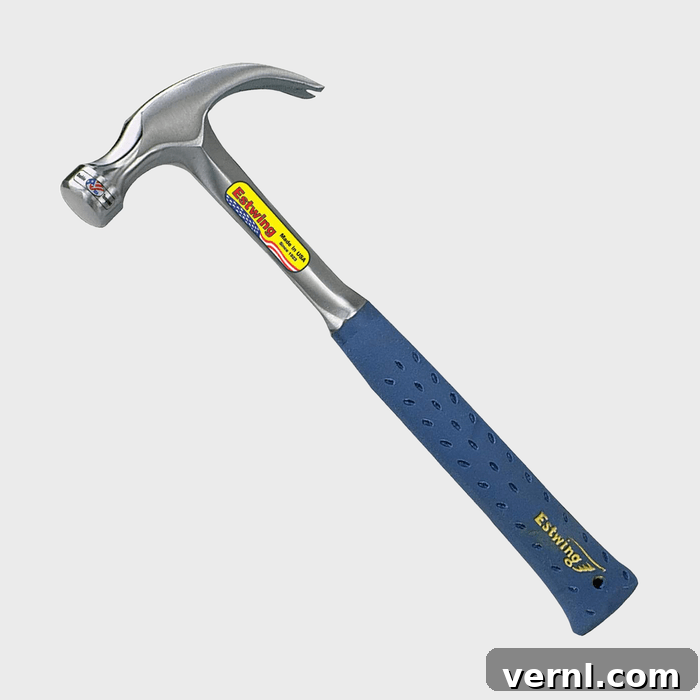
The Estwing 16-Ounce Curved Claw Hammer is an iconic tool, revered for its robust all-steel, one-piece construction that ensures unparalleled durability and longevity. Its comfortable vinyl grip not only provides excellent shock absorption, reducing impact vibrations, but also offers a secure and ergonomic hold for extended use. Featuring a classic smooth face and a perfectly curved claw, this hammer is an outstanding choice for everyday tasks around the home, general carpentry, and light-duty projects where reliability and comfort are paramount.
Shop Now
Best Framing Hammer: Real Steel Ultra Framing Hammer
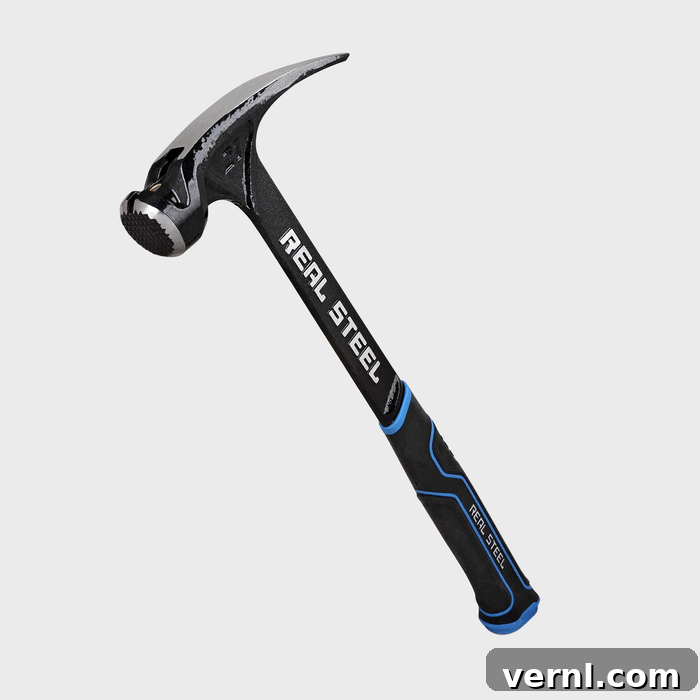
Engineered for demanding construction work, the Real Steel Ultra Framing Hammer is a formidable tool designed for efficiency and endurance. Weighing in at a balanced 21 ounces, it delivers powerful blows without leading to excessive fatigue during prolonged use. Its serrated (milled) face ensures superior grip on nail heads, minimizing mis-hits and maximizing driving power. The integrated flat top is an added benefit for working in confined spaces, while the extra-long steel handle provides exceptional leverage, making both forceful pounding and stubborn nail pulling remarkably easier. This hammer is a reliable partner for any serious framing project.
Shop Now
Best Splurge Hammer: Stiletto Smooth-Face Framing Hammer
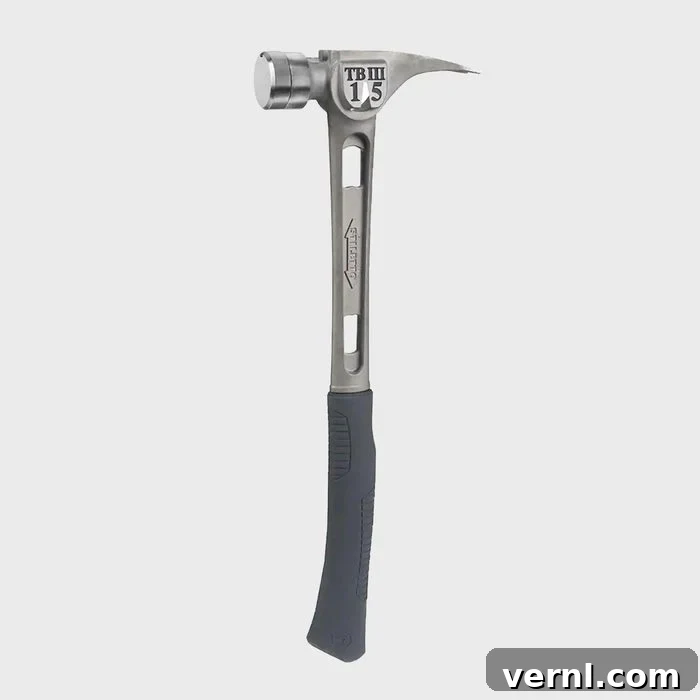
For the professional who demands the absolute best, the Stiletto 15 oz. TiBone 3 Smooth Face Framing Hammer represents the pinnacle of hammer technology. Crafted from lightweight yet incredibly durable titanium, this hammer weighs a mere 15 ounces, making it lighter than many utility hammers, yet it delivers the striking power of a much heavier steel framing hammer. The reduced weight significantly minimizes arm fatigue over long workdays, while its extra-long, curved handle provides exceptional balance and leverage. Its smooth face is perfect for finish-grade framing or applications where a clean strike is essential, making this versatile tool suitable for virtually any construction or renovation job where precision, power, and comfort are non-negotiable.
Shop Now