Enhance Your Road Safety: The Definitive Guide to Blind Spot Mirrors
For nearly six decades, spanning my career as an ASE Master Technician, vocational educator, and a lifelong vehicle owner, I’ve witnessed the remarkable evolution of automotive safety. I distinctly recall a time when passenger-side mirrors weren’t even standard equipment. As federal vehicle safety regulations progressively advanced, new standards were meticulously introduced to significantly enhance overall driver visibility and prevent accidents. The 1970s marked a pivotal moment with the widespread adoption of larger convex mirrors. While these mirrors offered a much-needed wider field of view, they inherently introduced a slight distortion in distance perception. This critical optical characteristic led to the now-familiar warning etched onto millions of mirrors: “Objects in mirror are closer than they appear.”
Today, with an unwavering focus on even greater driver, passenger, and pedestrian safety, a simple yet highly effective solution is readily available: blind spot mirrors. These small, powerful additions seamlessly integrate with your existing side-view mirrors, dramatically expanding your visual range. Ahead, a certified driver’s education instructor will illuminate the profound importance of blind spot mirrors, whether you’re navigating bustling highway traffic, executing precise parking maneuvers, or simply driving in everyday conditions.
While we delve into enhancing your vehicle’s visibility, you might also find it useful to learn how to replace a car mirror if yours ever becomes damaged.
What Exactly Are Blind Spot Mirrors?
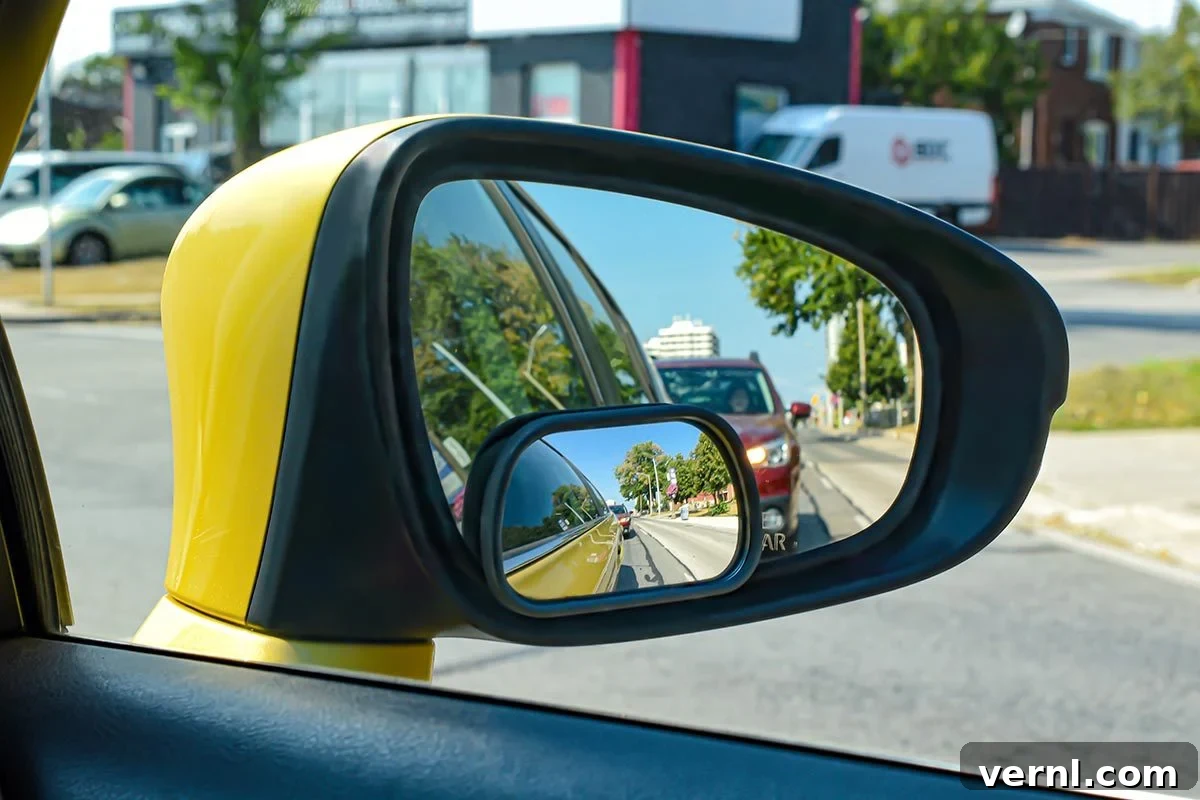
A blind spot mirror is typically a small, supplementary convex mirror designed to attach to, or sometimes be integrated within, your vehicle’s existing exterior side-view mirrors. Most commonly, these mirrors are affixed using a strong adhesive backing, making them a simple and affordable upgrade. Their primary function is to significantly augment a driver’s field of view, enabling them to perceive areas around their vehicle that would otherwise remain hidden or “blind” within the limited scope of standard rearview and side-view mirrors. By effectively eliminating these dangerous blind spots, these mirrors play a crucial role in enhancing overall driving safety, reducing the risk of collisions during lane changes, merging, or parking.
The Critical Role of Blind Spot Mirrors in Driving Safety
Blind spots are inherent dangers in any vehicle, regardless of its size or modern features. They are areas around the car that cannot be seen by the driver using the rearview mirror or the standard side mirrors. These hidden zones are notorious for concealing other vehicles, motorcycles, cyclists, or pedestrians, especially when changing lanes or turning. This is where blind spot mirrors become indispensable tools for accident prevention.
“By effectively cutting down blind spots, blind spot mirrors are instrumental in preventing accidents,” explains Steve Norman, a certified driving instructor with extensive experience. The convex design of a blind spot mirror is key to its effectiveness. Unlike flat mirrors that offer a true but narrow reflection, convex mirrors curve outwards, gathering light from a much wider angle. This curvature provides a much broader, panoramic view of the area surrounding the vehicle, giving a driver a more comprehensive understanding of adjacent lanes, parking space lines, or other obstacles, particularly when backing up.
This significantly greater visibility empowers drivers to more effectively monitor the traffic flow around them, facilitating safer lane changes and seamless merges into fast-moving traffic. It allows drivers to spot vehicles that would otherwise disappear from view in a flat mirror’s restricted scope. Norman further emphasizes, “Many modern vehicles now incorporate blind spot mirrors directly from the factory, not just to satisfy evolving safety regulations, but also to meet the growing demand from drivers for enhanced monitoring capabilities of their surrounding traffic environment.” This trend underscores the recognized importance of these mirrors in contemporary vehicle design.
Understanding the Different Types of Blind Spot Mirrors
While all blind spot mirrors share a fundamental convex design to achieve their wide-angle view, they come in various configurations, each with its own set of advantages and considerations tailored to different vehicles and driver preferences. Choosing the right type depends on your specific needs and vehicle compatibility.
1. Stick-On Mirrors
Stick-on mirrors represent the most popular and widely adopted type of blind spot mirror. Their prevalence is due to several key factors: they are incredibly versatile, available in an extensive array of shapes (round, square, rectangular) and sizes, making them suitable for almost any vehicle. Furthermore, they are highly affordable, broadly accessible in automotive stores and online, and remarkably easy to install. Utilizing a strong adhesive backing, they can be securely attached directly onto your existing side-view mirrors within minutes, requiring no special tools or expertise.
2. Clip-On Mirrors
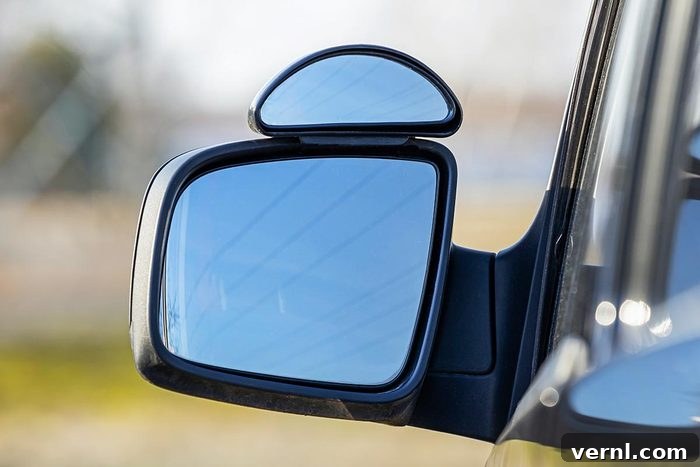
Clip-on mirrors offer an alternative to adhesive-backed options. These mirrors securely fasten to the edge of your existing side-view mirrors using integrated clips. A significant advantage of clip-on mirrors is their enhanced stability; they are generally less prone to falling off compared to some stick-on variants, especially in harsh weather or due to vibrations. They also offer the flexibility of being easily removed and repositioned if needed, though they might be slightly bulkier than their stick-on counterparts.
3. Rearview Blind Spot Mirrors
Rearview blind spot mirrors, unlike the side-mounted types, are installed over or onto the windshield, typically inside the vehicle, above or alongside the existing rearview mirror. They provide a unique and panoramic angle of the road behind and to the sides of your vehicle. While their larger size can sometimes be slightly distracting for some drivers, the expansive wide-angle view they offer effectively helps to eliminate blind spots across the rear of the car. An added benefit is the clear and unobstructed view they provide of children or pets in the back seat, making them popular with families.
4. Window-Mounted Mirrors
Window-mounted mirrors are a specialized category, typically attached to the exterior glass of your vehicle, often using suction cups or other specialty hardware. While they do not directly attach to your vehicle’s standard side-view mirrors, they offer a vastly broader view of the area surrounding your vehicle. These are particularly advantageous for specific situations, such as when you are trailering large boats, RVs, or other lengthy cargo that would otherwise severely obstruct your standard mirror view. They are designed for maximum peripheral vision in demanding scenarios.
5. Integrated Blind Spot Mirrors
Many modern, larger vehicles, particularly SUVs, trucks, and certain vans, now come equipped with integrated blind spot mirrors directly from the factory. These are not aftermarket additions but are meticulously built into the design of the main side-view mirrors. This seamless integration enhances driver safety and minimizes blind spots without the need for additional attachments, offering a sleek, OEM solution. They typically represent the most sophisticated and visually unobtrusive option.
Important Note: “Before installing any clip-on or window-mounted blind spot mirrors, it’s crucial to check with your local Department of Motor Vehicles (DMV). In many states, it is against the law to have any object or material hanging from or significantly protruding from mirrors while driving, as it could potentially obstruct your primary field of vision or create hazards,” advises Steve Norman. Always prioritize legal compliance and safety.
How to Properly Adjust Your Blind Spot Mirrors for Optimal Safety
Effective mirror adjustment is paramount for maximizing safety, and this principle applies equally to blind spot mirrors as it does to all other mirrors on your vehicle. According to Steve Norman, “all mirrors, not just blind spot mirrors, have to be properly positioned and will need to be adjusted differently for each individual driver.” This personalized adjustment ensures that blind spots are minimized for your unique seating position and driving habits. To achieve the best coverage and virtually eliminate blind spots, Norman suggests a systematic approach:
- Adjust Your Seat First: Before touching any mirrors, ensure your driver’s seat is in your optimal driving position – comfortable, with good pedal access and clear view of the road.
- Position Blind Spot Mirrors: For stick-on or clip-on types, attach your blind spot mirrors to the outer edge of your side-view mirrors. This placement typically offers the most expansive coverage of the traditionally hidden areas.
- Set Your Side-View Mirrors: Adjust your standard side-view mirrors so that you maintain a clear and comprehensive view of the road directly behind and immediately to the sides of your vehicle. The goal is to see just a sliver of your own vehicle’s rear fender, extending your peripheral vision as much as possible without creating a gap between the standard and blind spot mirror views.
- Fine-Tune Blind Spot Mirrors: Now, adjust the blind spot mirrors independently. Position them so they show the areas that are just outside the field of view of your regular side-view mirror. The aim is to create a continuous, overlapping field of vision, eliminating any gaps between the two mirror types.
- Perform a Visual Check: To ensure a full and seamless field of vision around your entire vehicle, Norman recommends a practical test: “Have someone walk around your vehicle while you remain in the driver’s seat, making sure you can see them continuously in your mirrors as they pass from your rearview mirror, to your side-view mirror, and then into your blind spot mirror.” Adjust the mirrors incrementally until you achieve this seamless visibility all around your vehicle.
While blind spot mirrors undeniably offer excellent visibility in areas that regular side-view mirrors cannot reach, it’s crucial to understand their inherent characteristic: due to their convex shape, images in blind spot mirrors will appear distorted and objects will seem further away than they actually are. Although this distortion is a deliberate design choice to achieve a wider view, Norman strongly suggests that “[especially new] drivers should practice how blind spot mirrors enhance, but do not replace, [their regular side view] mirrors and the vital practice of shoulder checks.” Regular practice will help you adapt to this distortion and use these mirrors effectively as supplementary safety tools.
Should You Equip Your Car with Blind Spot Mirrors?
In almost all scenarios, adding blind spot mirrors to your vehicle is a highly recommended and beneficial decision for several compelling reasons, significantly enhancing your safety and situational awareness on the road.
- Towing and Obstructions: They become exceptionally helpful when you are towing objects like trailers, boats, or RVs, or when transporting items that obstruct your normal field of view from standard mirrors or the rear window. They provide critical lateral visibility that would otherwise be lost.
- Larger Vehicles: Due to their inherent physical size, SUVs, trucks, and vans (especially cargo vans without rear windows) naturally possess larger and more challenging blind spots. Blind spot mirrors are therefore particularly useful for these types of vehicles, offering an indispensable visual aid where it’s needed most.
- Navigating Busy Traffic: In bustling highway traffic, during high-speed lane changes, or when merging onto and exiting ramps, blind spot mirrors provide that crucial split-second confirmation of clear adjacent lanes, allowing for safer and more confident maneuvers in dynamic driving environments.
- Older Vehicles: Many older cars and trucks lack the sophisticated, integrated modern blind spot monitoring systems found in newer models. By adding inexpensive blind spot mirrors, owners of these vehicles can significantly and cost-effectively increase their field of view, bridging a crucial safety gap without major modifications.
- Parking and Maneuvering: Beyond highway driving, these mirrors are invaluable for precise parking, especially parallel parking, and navigating tight spaces. They help you see curbs, parking lines, and other obstacles that might be invisible in standard mirrors, preventing costly scrapes and minor collisions.
Frequently Asked Questions About Blind Spot Mirrors
Do blind spot mirrors eliminate the need for shoulder checks?
No, absolutely not. While blind spot mirrors are incredibly effective at significantly increasing your visibility and reducing blind spots, they cannot — and should not — totally replace the critical practice of physically looking over your shoulder (the “shoulder check”) before changing lanes. Blind spot mirrors enhance visibility, but there may still be small areas not fully visible to the driver due to a combination of mirror placement, vehicle design, varying lighting conditions, adverse weather, or other environmental factors. A comprehensive approach to safety always includes the shoulder check as a final verification.
Are blind spot mirrors required by law?
Generally, no, blind spot mirrors are not specifically mandated by law for most passenger vehicles in the United States. However, Federal Motor Vehicle Safety Standard (FMVSS) No. 111 is a crucial regulation that mandates “currently…vehicles be equipped with rearview mirrors to provide drivers with a view of objects that are to their side or to their side and rear.” This standard has evolved significantly, particularly in response to manufacturers petitioning to install “Camera Monitor Systems” as potential replacements for traditional inside and outside mirrors. It’s worth noting that the European Union (EU) has implemented a directive specifically requiring “certain vehicles be fitted with mirrors to cover the blind spot at the front of the vehicle and on the passenger side of the vehicle,” indicating a more direct legal requirement for some vehicle categories there.
Are blind spot mirrors actually effective?
Yes, numerous studies and practical experience confirm their effectiveness. Data from a significant 2020 study published by the Journal of the Society of Automotive Engineers (SAE) demonstrated conclusively that “usage of a circular convex mirror does increase the driver’s field of view.” Furthermore, an older European Union study indicated that blind spot mirrors are effective in reducing accidents, specifically in instances of vehicles turning left or in cases involving cyclists, highlighting their particular utility in vulnerable road user safety. The scientific evidence supports their value as a safety enhancement.
RELATED ARTICLES
- Do You Know What That Little Button on Your Seat Belt Is For?
- What Those Lines on Your Backup Camera Really Tell You
- Here’s What The Small Panel On Your Car’s Front Bumper Is For
About Our Expert
Steve Norman, M.Ed., is a highly experienced educator who has dedicated over 15 years to teaching driver’s education in both the public and private sectors. He holds certifications from the Pennsylvania Department of Education (PDE) and the PA Department of Transportation (PennDOT) as a classroom and behind-the-wheel driving instructor. Additionally, Steve is a certified PA driver’s license examiner. He currently teaches physical education at Manavon Elementary School within the Phoenixville Area School District, demonstrating his continued commitment to education and safety.
Resources and Further Reading
- GovInfo: “National Highway Traffic Safety Administration, DOT §571.111 Standard No. 111; Rearview mirrors” Apr 13, 2025
- Journal of the Society of Automotive Engineers Malaysia: “Does a Circular Convex Blind Spot Mirror Increase the Driver’s Field of View?” Jan 2020
- National Highway Traffic Safety Administration: “Interpretation ID: 571-111 – Driver Mirror Flat or Convex – Magna Mirrors – 13-001216” Aug 15, 2013
- National Highway Traffic Safety Administration: “Analysis of Lane-Change Crashes and Near Crashes” Jun 2009
- Pennsylvania Department of Transportation: “Pennsylvania Driver’s Manual” Apr 2021
- Transport Research Laboratory: “Implementation of Directive 2007/38/EC on the retrofitting of blind spot mirrors to HGVs” 2011
- U.S. Code of Federal Regulations: “§ 571.111 Standard No. 111; Rear visibility” Apr 10, 2025