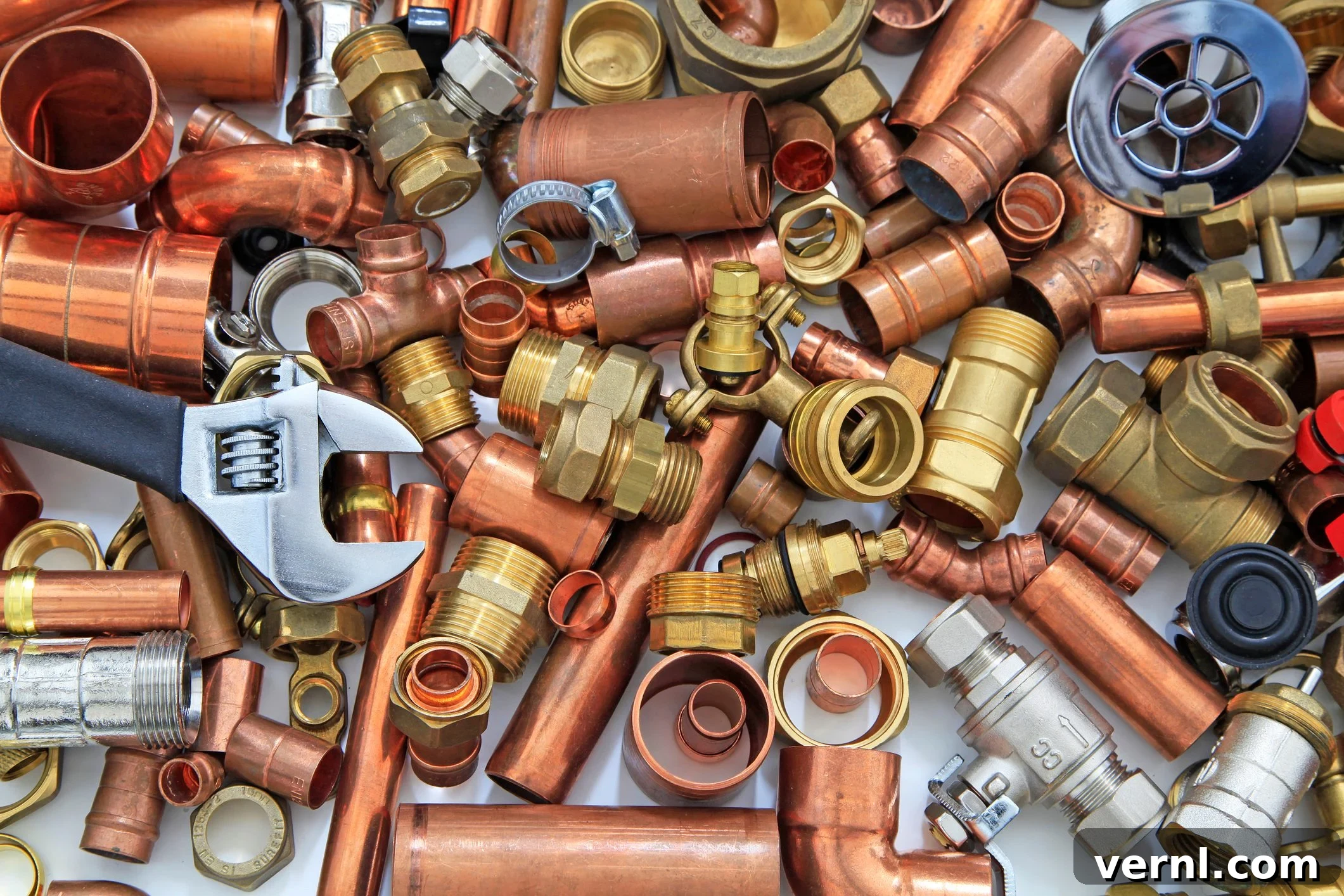
Every homeowner who has tackled a plumbing repair or installation project knows the unique challenges it presents. The frustration of multiple trips to the hardware store, searching for that one specific fitting to complete a seemingly simple task, is a common rite of passage for DIY plumbers. It often feels less like a repair and more like assembling an intricate puzzle, where each piece—a specific pipe fitting—must connect perfectly to form a functional network.
Plumbing systems are complex, involving a diverse array of pipes of varying diameters and materials. Understanding the different types of fittings is paramount, as they vary significantly by size, purpose, and the material they are designed to connect. The modern plumbing landscape utilizes a wide range of materials, including copper, PVC (Polyvinyl Chloride), CPVC (Chlorinated Polyvinyl Chloride), PEX (Cross-linked Polyethylene), ABS (Acrylonitrile Butadiene Styrene), galvanized steel, and cast iron. Crucially, these disparate materials often need to be connected using specialized transition fittings to ensure a leak-free and code-compliant system.
Navigating the sheer variety of pipe sizes and materials can be bewildering for anyone without extensive experience. Fittings for pressure-bearing water supply lines are distinct from those used for gravity-fed drain and waste lines, each engineered for specific flow characteristics and structural demands. This complexity underscores why professional plumbers always arrive with a well-stocked vehicle, essentially a “magic cupboard” of fittings, enabling them to tackle any installation or repair with efficiency and expertise, a stark contrast to the trial-and-error approach many amateurs might face. This comprehensive guide aims to demystify the world of plumbing fittings, providing DIY enthusiasts with the knowledge needed to choose the right connection every time and minimize those frustrating extra trips to the store.
Understanding Water Line Fittings
Water supply lines are critical for delivering potable water throughout your home, operating under pressure. Over the years, materials have evolved, with PEX quickly emerging as a preferred choice for water lines due to its flexibility and ease of installation. However, PVC, CPVC, and copper pipes remain in widespread use, each with its unique advantages and specific fitting requirements. Galvanized steel, while less common for interior water lines today, is still found in older homes and for certain outdoor applications.
PEX piping’s surging popularity can be attributed to several key factors. Its inherent flexibility allows it to bend around corners and through tight spaces, significantly reducing the number of fittings required compared to rigid piping materials. It boasts impressive durability, resisting bursts from freezing much better than rigid pipes. Most notably for DIYers, PEX offers ease of assembly; connections are typically made by simply pushing PEX pipes and their compatible fittings together, or by using crimp or expansion tools. This contrasts sharply with the gluing required for PVC and CPVC, the meticulous soldering for copper, or the laborious threading for galvanized steel. Understanding these material-specific connection methods is crucial for selecting the correct fitting.
Here’s a breakdown of the most essential fittings you’ll likely encounter and need when working on water supply lines, each playing a vital role in directing flow, making connections, or adapting sizes:
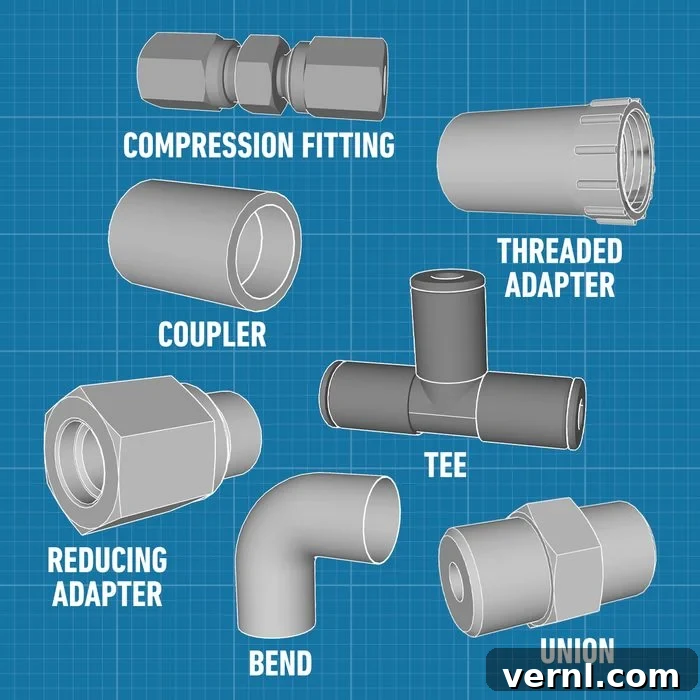
- Coupler (or Coupling): This fundamental fitting serves a singular purpose: to join two lengths of pipe in a straight line, creating a continuous run. Whether you’re extending a pipe or repairing a section by cutting out damaged material, a coupler is indispensable for rejoining the two ends. They come in various materials (copper, PVC, CPVC, PEX) and methods of connection (solvent weld, crimp, push-fit, solder). Reducing couplers are also available to connect two pipes of different diameters in a straight line.
- Bend (or Elbow): When the path of your water line needs to change direction, a bend, commonly known as an elbow, is the fitting of choice. The most prevalent angles are 90 degrees (for sharp turns) and 45 degrees (for softer, gradual changes). These fittings are generally made from the same material as the pipe they connect to, ensuring material compatibility and a secure joint. However, PEX bends often differ, utilizing brass or rigid plastic PEX elbows, or sometimes flexible PEX tubing itself can be bent with support to form a wide-radius curve, reducing the need for an elbow. Specialized “street elbows” have a male thread on one end and a female thread on the other, allowing them to connect directly into another fitting without needing a nipple.
- Tee: True to its name, a tee fitting is shaped like the letter “T,” featuring two parallel ports and a perpendicular one. Its primary function is to add a branch line to an existing main water line, allowing water to flow in three directions simultaneously. Tees are crucial for distributing water to fixtures or appliances. When the branch line requires a different diameter than the main line, a “reducing tee” is used, effectively connecting pipes of three different sizes (two main line sizes, one branch size) or two main line sizes and a smaller branch.
- Reducing Adapter: When pipes of different diameters need to be joined, a reducing adapter provides a clean and efficient solution, distinct from a reducing tee which introduces a branch. These adapters come in several forms. A “bell adapter” is typically bell-shaped, common for copper and galvanized pipes, where the larger end fits over or into the smaller pipe. A “reducing bushing,” more common for plastic pipes, fits inside the larger pipe, reducing its opening to accommodate a smaller pipe. Both types ensure a smooth transition in water flow and maintain system pressure.
- Union: A union is a specialized type of coupler designed for situations where a section of pipe may need to be temporarily or periodically disassembled. Unlike standard couplers that create a permanent joint, a union consists of three parts: two threaded end pieces and a large threaded nut that draws them together. This design allows for easy disconnection and reconnection without cutting the pipe, making it invaluable for connecting appliances, water heaters, or sections of pipe that might require future maintenance or replacement.
- Threaded Adapter: This fitting is essential for transitioning between different connection methods, specifically from a slip joint (designed for glue or solder) to a threaded connection. Threaded adapters can have either male or female threads on one end, with the other end designed to be glued (for plastic pipes) or soldered (for copper pipes). They are critical for connecting plastic pipes to each other via threaded connections, or copper pipes to brass valves, fixtures, or other threaded components. This versatility makes them a staple in many plumbing configurations, facilitating connections where direct soldering or gluing isn’t feasible or desired.
- Compression Fitting: Offering a glueless and solderless solution, compression fittings are a favorite for connecting plastic or copper pipes, especially in applications requiring easy maintenance or installation. Most compression fittings comprise a body, a compression nut, and a compression ring (ferrule). The ring slips over the pipe, and as the nut is tightened onto the fitting body, it compresses the ring into the gap between the pipe and the fitting, creating a watertight seal. This method is particularly useful for quick repairs and is commonly found on modern faucet supply lines and toilet shutoff valves, providing a reliable and accessible connection point.
Waste and Drain Fittings
Drain and waste lines operate on a different principle than water supply lines; they rely on gravity to carry wastewater away from fixtures to the main sewer line or septic system. Therefore, the fittings used in these systems are designed to facilitate smooth, unobstructed flow and prevent clogs, rather than withstand high pressure.
In the early 20th century, cast iron was the dominant material for drain pipes, known for its durability and sound-dampening qualities. These heavy-duty pipes are typically connected with specialized couplers featuring robust rubber gaskets enveloped by stainless steel sheathing, providing a flexible and secure seal. Today, however, most residential drain systems are constructed using lighter, easier-to-install PVC or ABS plastic. Plastic drain fittings are predominantly joined using solvent cement (glued), creating strong, permanent bonds. However, certain components that may require periodic removal, such as cleanout plugs or traps, utilize threaded connections for accessibility.
While standard couplers and ordinary 90-degree elbows are also used in drain systems, their applications are more restricted due to the need for smooth flow. The following list highlights common drain fittings that have specific designs and uses to ensure proper waste removal and prevent blockages:
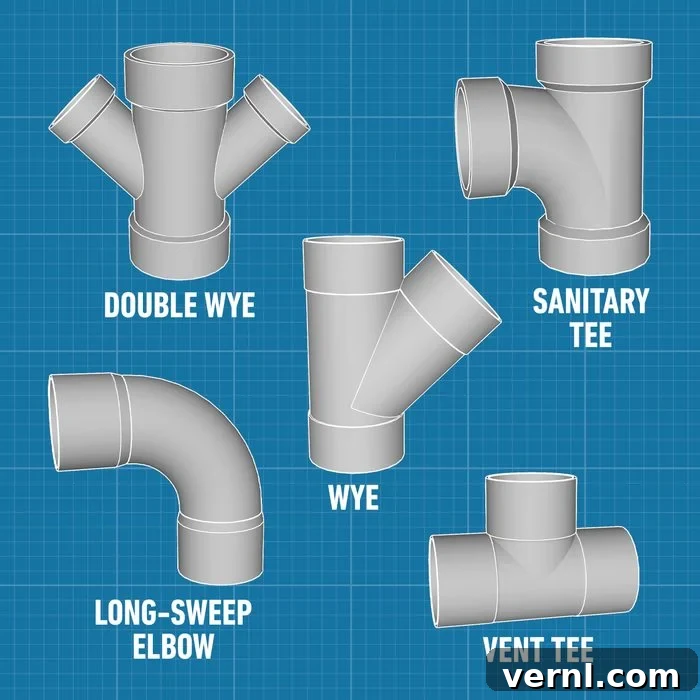
- Long-Sweep Elbow: Unlike a standard 90-degree elbow which has a tight radius, a long-sweep elbow makes a 90-degree turn over a much longer, more gradual arc. This extended curve allows wastewater to flow more smoothly, minimizing turbulence and reducing the likelihood of clogs, especially in changes from a vertical to a horizontal drain line. It is commonly used for connecting vertical drain stacks to horizontal branch lines, ensuring gravity can efficiently carry waste away without impedance.
- Straight Tee: While a common fixture in water supply lines, a standard straight tee has limited use in drain and waste lines, primarily because its sharp, perpendicular junction can impede flow and cause blockages with solid waste. Therefore, straight tees are seldom used for connecting horizontal waste lines. Their primary application in drainage systems is for connecting horizontal vent pipes to vertical stacks, allowing air to enter the system and equalize pressure, preventing siphonage of P-traps.
- Sanitary Tee (or Santee): The sanitary tee is specifically designed for drain, waste, and vent (DWV) systems to promote proper flow. It features a gentle sweep on its perpendicular port, guiding wastewater in the direction of the main flow. This sweep prevents waste from backing up into the branch line and ensures solids are carried away effectively. It is correctly used to connect a horizontal waste line (e.g., from a sink) to a vertical drain line. However, due to its design, a sanitary tee should *not* be used to connect a vertical drain line to a horizontal one, as it would create a shelf for solids to accumulate.
- Wye (or Y-fitting): Shaped like the letter “Y,” a wye fitting provides a much more gradual angle than a sanitary tee, typically a 45-degree angle. This less abrupt junction significantly reduces the chance of backflow and clogs, making it superior for connecting branch lines to main drain lines, particularly where solids are present. A wye is the preferred fitting for connecting a vertical drain from a fixture like a sink or toilet to a horizontal sewer or main drain line. It can also be effectively used to connect a horizontal waste pipe to a vertical one, offering greater versatility and flow efficiency than a sanitary tee in many situations.
- Double Wye: As its name suggests, a double wye features two inlet ports, symmetrically positioned, rather than just one. This fitting is specifically engineered for situations where two separate branch lines need to connect to a single main drain line at the same point. A very common application is connecting a double-basin kitchen sink to a single P-trap, allowing both sinks to drain efficiently into one common pipe. It streamlines plumbing underneath fixtures and saves space by consolidating connections.
Essential Transition Fittings
In many plumbing projects, especially in renovations or repairs involving older systems, you’ll inevitably encounter situations where you need to connect pipes made of different materials. This could involve joining modern PVC or CPVC pipes to existing copper lines, connecting an old cast iron drain to new ABS plastic, or even bridging galvanized steel pipes to copper. Directly joining dissimilar metals or materials can lead to problems like galvanic corrosion (especially between certain metals), leaks, or code violations. This is where specialized transition fittings become indispensable.
While in some limited cases, you might achieve a transition by simply threading two different-material adapters together, it is often more reliable and easier to use an adapter specifically engineered for the coupling. These dedicated transition fittings are designed to ensure compatibility, prevent chemical reactions, and create a durable, leak-proof seal. Always ensure the chosen transition fitting is approved for the specific materials you are joining and for the type of system (pressure or drainage) it will be used in.
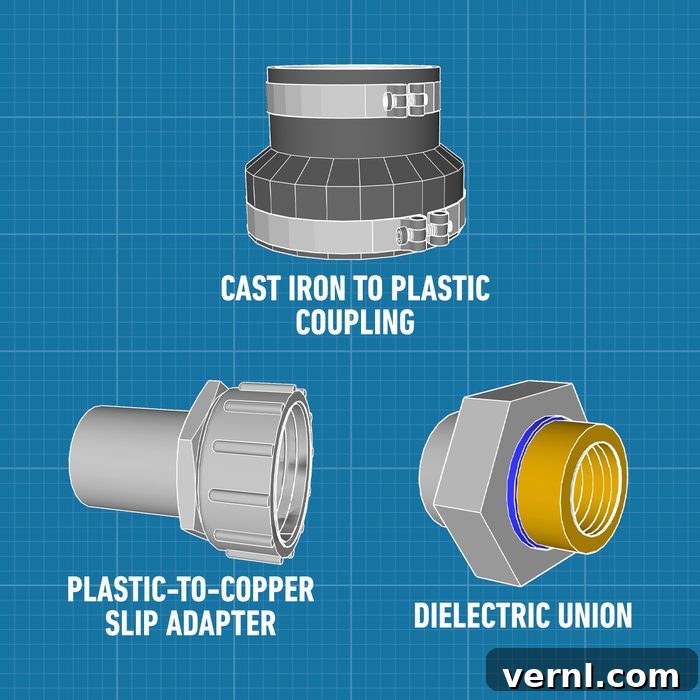
- Plastic-to-Copper Slip Adapter: This fitting provides a robust solution for connecting plastic piping (PVC or CPVC) to copper. It typically features male copper threads on one end and a solvent weld (slip) joint designed for plastic pipe on the other. The process often involves soldering a female threaded adapter onto the existing copper pipe, then screwing in the plastic-to-copper adapter, and finally, solvent-welding (gluing) the plastic pipe to the slip joint end. This creates a secure, permanent transition from a rigid metal pipe to a plastic one, common in water supply upgrades.
- Dielectric Union: One of the most critical transition fittings, a dielectric union is specifically designed for mating copper or brass pipes to galvanized steel. Its primary function is to prevent galvanic corrosion, an electrochemical reaction that occurs when two dissimilar metals are in contact in the presence of an electrolyte (like water), leading to the deterioration of the less noble metal (galvanized steel in this pairing). The union incorporates an insulating washer or sleeve that physically separates the metals, preventing the corrosive reaction. Dielectric unions are commonly mandated by plumbing codes and are a standard component when installing water heaters, which often involve connections between galvanized nipples and copper supply lines.
- Cast Iron to Plastic Coupling (Fernco Coupling): Widely recognized by the brand name “Fernco coupling,” these flexible transition fittings are the go-to solution for connecting rigid cast iron pipes to plastic pipes (PVC or ABS) in drain, waste, and vent (DWV) systems. They consist of a flexible rubber cylinder that fits over the ends of the two pipes, reinforced by a stainless steel sheath. Two or more threaded pipe clamps, tightened with a screwdriver or nut driver, securely compress the rubber against the pipes, creating a watertight and gas-tight seal. Fernco couplings are favored for their ease of installation, ability to accommodate minor misalignments, and versatility in joining various pipe materials and sizes within drainage systems.
Mastering the intricacies of plumbing fittings is a cornerstone of successful DIY plumbing. By understanding the purpose, material, and proper application of each type of fitting—whether for water supply, waste and drain, or critical transitions—you can approach your plumbing projects with confidence and precision. Always remember to consult local plumbing codes for specific requirements and consider seeking professional advice for complex installations. Armed with this knowledge, you’re now better equipped to choose the right connection, minimize wasted trips, and achieve durable, leak-free results in your home plumbing system.