
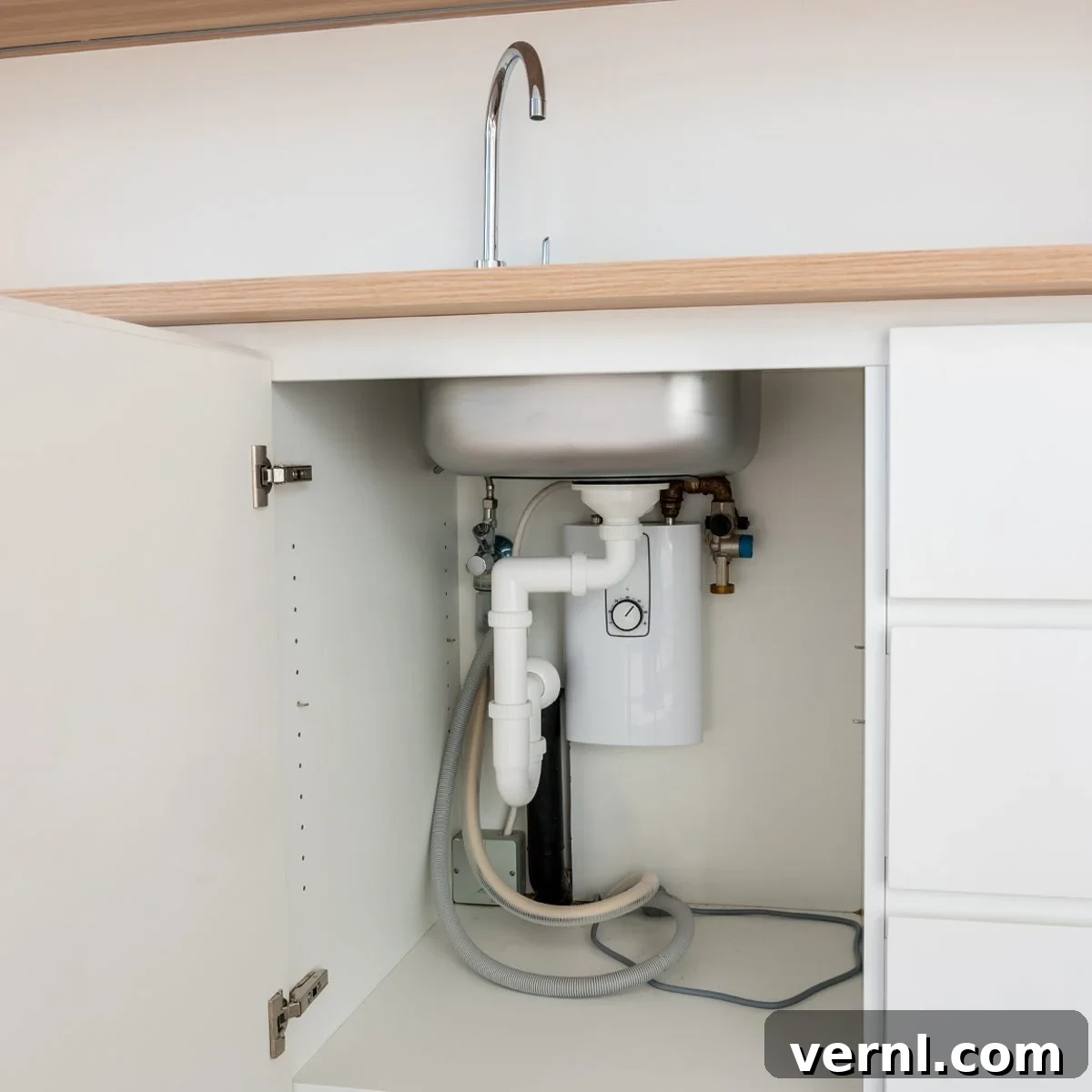
Imagine a world where hot water is always at your fingertips, without the frustrating wait or the wasteful trickle down the drain. Twenty years ago, living in Japan, I experienced this daily convenience with on-demand water heaters installed right at the kitchen sink. This wasn’t a luxury; it was a standard feature, making dishwashing, cooking, and general cleaning effortlessly efficient. These compact units were not just common household fixtures; they were considered essential appliances, revolutionizing the way people interacted with their plumbing.
For homeowners in North America seeking a similar level of immediate hot water access, the solution often lies in investing in an under-sink water heater. These ingenious devices are precisely what we call “point-of-use” heaters, a term coined because they are specifically designed to serve a single fixture, right at its location. As Jessie Cannizzaro, a distinguished master plumber and the owner of Milestone Plumbing, explains, their purpose is to provide hot water exactly where and when it’s needed most, eliminating the delays associated with central heating systems.
A common question arises: if you already have a central water heater for your entire home, isn’t an under-sink unit redundant? The answer, while nuanced, largely depends on the distance between your main water heater and the specific faucet you wish to service. If your main heater is close, perhaps an under-sink unit isn’t strictly necessary. However, for sinks located far from the central hot water source, a point-of-use heater becomes an invaluable asset, not just for convenience, but as a significant water-saving tool.
Consider the cumulative impact of waiting for hot water. If your kitchen faucet has a typical flow rate of two gallons per minute, and you endure a 30-second wait for hot water to arrive, you’re inadvertently wasting a full gallon of water with each use. If this scenario plays out just three times a day – for washing dishes, preparing food, or cleaning hands – you could be sending an astonishing 600 gallons of perfectly good water down the drain every single month. An under-sink water heater acts as a powerful preventative measure against this excessive water wastage, delivering instant hot water and preserving a precious resource.
When selecting an under-sink water heater, you have the primary choice between a traditional tank-style model or a modern tankless unit. Tankless options further offer a choice between two common voltages, impacting their power and installation requirements. To help you navigate the myriad of choices, we’ve meticulously researched and curated our top picks for the best under-sink water heaters currently available on the market, balancing performance, efficiency, and user satisfaction.
Best Under-Sink Water Heaters for Your Home
Bosch Electric Mini-Tank Water Heater Tronic 3000 T (2.5 Gallon ES2.5)
Best Tank-Style Option for Quick Recovery

Image credit: via merchant
The Bosch Tronic 3000 stands out as an exceptional choice for those seeking the reliability of a tank-style under-sink water heater. While remarkably compact to fit effortlessly into small, confined spaces, this model boasts a generous four-gallon capacity. This is often more substantial than many comparable mini-tank water heaters, providing a larger reserve of hot water for sustained use.
Crafted for longevity, it features a premium glass-lined tank that significantly enhances durability and resistance to corrosion, ensuring a long service life. Complementing this robust construction is its thick, CFC-free foam insulation, meticulously designed to achieve maximum energy efficiency by minimizing heat loss. Installation is made simple with a long power cord that plugs into a standard 120-volt outlet, allowing for independent setup or integration with an existing larger hot water source. For ultimate convenience and adaptability, the Bosch Tronic 3000 offers flexible mounting options, allowing it to be placed on a shelf, directly on the floor, or securely on a wall, suiting various under-sink configurations.
- Pros:
- Provides hot water quickly, minimizing wait times.
- Lightweight and compact design fits in tight spaces.
- Affordable, offering excellent value for its features.
- Easy to install, reducing professional costs.
- Premium glass-lined material ensures a long service life.
- Cons:
- Some customers have reported isolated issues with leakage.
Dimensions: 13.75 by 13.75 by 13.5 in. | Weight: 17.3 lbs. | Power source: Electric
Shop on Home Depot |
Shop on Amazon
Eemax Electric Tankless Water Heater
Best 120V Tankless Option for Flexible Installation

Image credit: via merchant
The Eemax electric model offers a remarkably lightweight and compact solution for on-demand hot water, weighing in at just under four pounds. Its diminutive size and minimal weight allow for highly flexible installation; it can be mounted discreetly on the side of a reasonably sized cabinet, freeing up valuable under-sink space. This particular tankless water heater operates by drawing 3,000 watts at 120 volts when active – a significant power draw, but it’s crucial to remember that it only consumes electricity precisely when hot water is being demanded. For added convenience, if your under-sink area already features a power outlet for appliances like your garbage disposal, this Eemax unit can often be simply plugged into it, simplifying the electrical setup.
- Pros:
- Mounts in any orientation, offering highly flexible installation options.
- Compact size means it fits almost anywhere, even in tight spaces.
- Silent operation ensures a peaceful kitchen environment.
- Advanced control system activates the heater only on demand, saving energy.
- High-temperature limit switch enables safe and worry-free operation.
- Cons:
- Comes with a relatively short one-year warranty on parts.
Dimensions: 9.75 by 5.25 by 3 in. | Weight: 3.94 lbs. | Power source: Electric
EcoSmart Eco 11 Tankless Water Heater
Best 240V Tankless for Higher Performance

Image credit: via merchant
The EcoSmart Eco 11 Tankless Water Heater is designed for those who require a more robust hot water flow, delivering between 1.3 and 3.1 gallons per minute. This flow rate intelligently adjusts based on the incoming water temperature, ensuring consistent performance. With compact measurements of approximately 7.9 by 11.4 by 3.7 inches, this energy-efficient unit is perfectly sized to fit snugly inside most standard sink cabinets or to be mounted discretely on the wall adjacent to the sink. A standout feature of the EcoSmart Eco 11 is its advanced self-modulating technology. This intelligent system precisely heats the water only when a demand is detected, preventing energy waste and ensuring maximum efficiency. It also includes a digital control, allowing users to set their desired temperature in precise one-degree increments, offering unparalleled control over your hot water experience.
- Pros:
- Compact size saves valuable space under the sink.
- Digital control allows precise temperature setting in one-degree increments.
- Backed by a limited lifetime warranty for peace of mind.
- No venting required, simplifying installation.
- Highly energy-efficient, reducing utility costs.
- Cons:
- Requires connection to a robust 60-amp double-pole breaker, potentially necessitating electrical upgrades.
Dimensions: 7.9 by 11.4 by 3.7 in. | Weight: 6.5 lbs. | Power source: Electric
Shop on Home Depot |
Shop on Amazon
Understanding the Types of Under-Sink Water Heaters
While all under-sink water heaters operate electrically, they come in distinct varieties that cater to different needs and preferences. Understanding these fundamental differences is key to choosing the right model for your specific application.
Tank vs. Tankless: The Core Distinction
- Tank-Style Units: These are essentially miniature versions of traditional whole-house water heaters. They feature an insulated tank that holds a pre-heated supply of hot water, typically ranging from 2.5 to 7 gallons. The primary advantage here is instant hot water delivery as soon as you open the faucet, as the water is already heated and stored. However, these units may occasionally cycle on, even when not in use, to maintain the water within the tank at a set temperature, potentially consuming a small amount of “standby” energy. They offer a limited capacity, meaning if you exhaust the hot water supply, you’ll need to wait for the tank to reheat.
- Tankless On-Demand Models: Also known as instantaneous water heaters, these units heat water only as it flows through them, eliminating the need for a storage tank. When you turn on the hot water tap, cold water enters the unit, is rapidly heated by an electric element, and then delivered to the faucet. This design means there’s no standby energy loss, as the heater only activates on demand. While highly efficient in terms of energy use (they only consume power when heating water), tankless models typically require a higher instantaneous power draw than tank-style units when they are actively heating, due to the need for rapid temperature increase.
Voltage: Powering Your Point-of-Use Heater
- These water heaters are available in two primary voltage configurations: 120-volt and 240-volt models. The choice of voltage directly impacts the unit’s heating capacity and installation requirements.
- 120-Volt Models: Often associated with tank-style under-sink heaters, these units can usually plug into a standard household electrical outlet (like those used for your kitchen appliances). They are generally easier to install from an electrical perspective and are suitable for applications where lower flow rates or less intense heating is required.
- 240-Volt Models: Many tankless under-sink water heaters, particularly those designed for higher flow rates or greater temperature rises, require 240 volts. This is because they need more instantaneous power to heat water rapidly. Such models are typically hardwired directly into your home’s electrical system, often necessitating a dedicated circuit and professional installation by a qualified electrician to ensure safety and compliance with local codes.
Standing vs. Hanging: Installation Flexibility
- Standing Units: Tank-style under-sink water heaters, due to their internal tank, are generally designed to rest securely on the bottom of the cabinet or a sturdy shelf. Their weight and design make them stable when placed on a flat surface.
- Hanging Units: Conversely, many compact tankless on-demand models are designed to be wall-mounted or hung from the side walls of a cabinet. This offers greater flexibility for installation in very tight spaces and can help free up floor space within the cabinet, which might be critical for storage.
What to Look for When Buying an Under-Sink Water Heater
Choosing the ideal under-sink water heater requires careful consideration of several key factors to ensure optimal performance, efficiency, and suitability for your home. Jessie Cannizzaro provides essential guidance on what to prioritize during your purchase decision:
1. Sizing: The Foundation of Performance
- For truly optimal performance, it is imperative to diligently review the sizing chart that accompanies both point-of-use and tankless water heaters. These charts provide crucial information on flow rates and temperature rise capabilities.
- Your goal is to identify a unit that can consistently deliver the required gallons per minute (GPM) to achieve your desired temperature rise for your specific water usage needs. This means considering how quickly and how hot you need the water to be.
- In regions experiencing significantly lower ground temperatures, larger or more powerful heaters may be absolutely necessary. This ensures that the unit can still achieve the appropriate temperature rise and maintain adequate water pressure at your fixtures, preventing a lukewarm trickle instead of a steady stream of hot water.
2. Climate: The Unseen Variable
- Contrary to a common but often misleading misconception, under-sink water heaters may not be practical or efficient for attempting to serve multiple fixtures simultaneously, especially in colder climates. Their design is inherently for single-point use.
- The colder the incoming groundwater temperature, the more energy the heater must expend to raise it to the desired temperature. This directly impacts the achievable GPM of hot water the heater can produce. Consequently, extreme cold can significantly reduce the heater’s ability to effectively support multiple plumbing systems or provide high flow rates.
3. Power Availability: The Electrical Connection
- Before making any purchase, it is absolutely vital to assess the available power supply in the location where you intend to install the under-sink water heater.
- For models requiring 240 volts or a dedicated circuit, a consultation with a certified electrician is highly recommended to determine compatibility and ensure your home’s electrical infrastructure can safely support the unit. This proactive step can prevent costly issues with installation and ensure seamless functionality.
4. Drain Receptor: A Code Requirement
- Many under-sink water heater models are equipped with a temperature and pressure relief (T&P) valve. According to most local plumbing codes, this valve requires a designated receptor for proper discharge in the event of overpressure or overheating.
- It is crucial to proactively assess this requirement during your planning phase to account for proper installation and to ensure full compliance with all local building codes and safety regulations. Ignoring this can lead to safety hazards and inspection failures.
Why You Can Trust Our Expertise
Our commitment to providing reliable, practical, and expert advice stems from decades of hands-on experience in the building trades. With over 30 years dedicated to construction, plumbing, carpentry, and even furniture refinishing, I’ve gained firsthand knowledge that informs every recommendation. My selection of the best under-sink water heaters is rooted in this extensive practical background, ensuring that the products highlighted are not just popular, but truly perform.
Since 2010, I’ve been sharing this expertise through comprehensive DIY articles and serving as an online consultant for platforms like Home Depot’s Pro Referral service. My insights have also graced the pages of Landlordology, Apartments.com, and Hunker, establishing me as a trusted voice in home improvement. This article specifically benefited from the invaluable insights of Jessie Cannizzaro, a highly respected master plumber and the owner of Milestone Plumbing. Jessie’s journey in plumbing began at the tender age of seven, learning to solder alongside her father. She founded her residential and small commercial plumbing business in Wauwatosa, Wisconsin, in 2011, leveraging her bachelor’s and MBA from UW-Milwaukee. Beyond managing 16 employees, Jessie passionately advocates for organizations that encourage high school students to enter the trades and even authored a charming coloring book to introduce elementary-aged children to the rewarding world of plumbing. The content of this piece was further meticulously updated by Caitlyn Fitzpatrick, an experienced editor and content strategist specializing in commerce journalism since 2017, ensuring its accuracy and relevance.
Frequently Asked Questions (FAQs) About Under-Sink Water Heaters
What exactly is an under-sink water heater?
An under-sink water heater, also widely known as a point-of-use water heater, is essentially a scaled-down version of a whole-house water heater. Its primary function is to deliver a convenient and immediate supply of hot water directly at a specific fixture, typically a kitchen or bathroom sink. Designed to fit into often cramped quarters, tank-style under-sink water heaters have a limited storage capacity, usually ranging from 2.5 to 7 gallons. While the exact flow rate can be influenced by your main plumbing system, most units are capable of handling up to 3 gallons per minute, which is ample for typical sink-related tasks.
These versatile units can be connected to either your main hot water supply line or your cold water supply. If the under-sink heater is intended to be the sole source of hot water for that particular faucet, it should be connected to the cold supply. However, if its purpose is to expedite the arrival of hot water from a distant central heater, it is typically linked to the existing hot water supply line, acting as a booster to eliminate lag time.
How much does an under-sink water heater typically cost?
The cost of an under-sink water heater itself generally ranges from $50 to $300, depending on the brand, type (tank or tankless), capacity, and features. However, it’s important to factor in installation costs. Professional installation can add another $100 to $200 to the total expense, though this can vary significantly based on your plumber’s hourly rate and the complexity of the job. Beyond the unit and labor, you might encounter a few extra costs. Supply hoses are typically inexpensive, but if your under-sink area lacks an appropriate electric circuit, you may need to hire an electrician to install a new one, which can be a more significant and costly addition to the overall project budget.
Are under-sink water heaters a worthwhile investment?
The convenience of instant hot water from an under-sink heater offers a compelling balance of benefits and potential drawbacks. On the positive side, these units significantly reduce water wastage by eliminating the need to run the tap while waiting for hot water to arrive. They provide immediate hot water, making tasks like cooking, cleaning, and handwashing much more convenient and efficient. Many models are also relatively inexpensive to purchase and can be quite easy to install for a DIY enthusiast with basic plumbing skills. Furthermore, most require low-to-no maintenance, offering a hassle-free solution.
However, there are potential downsides to consider. Operating an under-sink heater might lead to a slight increase in your electric bill, especially for tank-style models that maintain a hot water reserve, or for tankless models that draw substantial power when active. Tank-style units will also occupy some valuable storage space under the sink. You might also experience fluctuating water temperature, particularly with some on-demand (tankless) models if flow rates vary. Lastly, tank-style models, by definition, offer a limited supply of hot water at any given moment, which might be a consideration for higher-demand uses.
How do you install an under-sink water heater?
Installing an under-sink water heater can be a manageable DIY project if you possess basic plumbing skills and have a clear understanding of the necessary steps. However, two crucial prerequisites must be met before you begin: ensuring you have adequate space within your under-sink cabinet for the unit, and confirming the availability of a suitable power source. If your cabinet requires modification or remodeling, you can certainly tackle that yourself. But if a new electric circuit is needed, it is strongly recommended to hire a qualified electrician to ensure safety and compliance with electrical codes. Once these conditions are satisfied, you can proceed with the following installation steps:
- Position the Device: Carefully place the water heater in its designated location, ensuring it rests on a solid, level base for tank-style units, or securely hang it using the provided brackets for wall-mounted or hanging models.
- Connect Inlet to Faucet Hot Supply: Disconnect the existing hot water supply line from your faucet. Connect this line to the designated ‘inlet’ port on your new under-sink water heater. This is where the water (either cold or pre-heated from a central system) will enter the unit for heating.
- Connect Faucet to Heater Outlet: Use a new, flexible supply hose to connect the ‘outlet’ port of the under-sink water heater to the hot water inlet of your faucet. This completes the hot water path from the heater to your tap.
- Power the Unit: Plug the unit into a suitable 120-volt outlet if it’s a plug-in model, or have your electrician hardwire it directly into the dedicated 240-volt circuit if required.
If your sink currently only has a cold water supply, an additional step is required. You will need to install a tee fitting into the cold water pipe. This tee will create two branches: one branch will continue to supply cold water to the faucet, while the other branch will divert cold water to the inlet of the water heater. The heater will then connect to the faucet with a separate hose, providing hot water.
Which is better: a tankless or a tank under-sink water heater?
The choice between a tankless and a tank under-sink water heater hinges on your specific needs, budget, and priorities, as both types come with distinct advantages and disadvantages. A tankless under-sink water heater generally operates with greater energy efficiency because it only heats water on demand, eliminating standby heat loss. However, these units often have a higher upfront installation cost, particularly if a new 240-volt dedicated electrical circuit is required. They may also necessitate more regular maintenance, such as descaling, especially in areas with hard water, to maintain optimal performance.
Conversely, a tank under-sink water heater typically has a lower upfront purchase price and easier installation, often simply plugging into a standard 120-volt outlet. The primary drawback, however, is its limited storage capacity. Unlike the seemingly “endless” hot water supply from a continuously operating tankless model, a tank unit can only provide a certain amount of hot water before it needs time to reheat. This means if you use too much hot water in a short period, you might experience a temporary depletion until the tank refills and reheats. Your decision should weigh the convenience of endless hot water and long-term energy savings against initial costs and the need for a continuous, but limited, hot water supply.
How to Choose the Perfect Water Heater for Your Home
Beyond under-sink models, the world of water heaters offers a diverse range of options, from highly efficient tankless systems to reliable traditional tank-style units. Making the right choice involves understanding your household’s demands, your budget, and the available energy sources. Our expert tips and comprehensive guides are designed to help you navigate these choices, ensuring you find a water heater that perfectly aligns with your home’s needs and financial considerations. Explore the following resources for a deeper dive into selecting the ideal hot water solution:
- Top Water Heater Brands: Discover leading manufacturers known for quality and innovation.
- Top Rated Gas Hot Water Tanks: Find highly recommended gas-powered tank heaters.
- How to Choose a New Water Heater: A comprehensive guide to making an informed decision.
- New Homeowner’s Guide to Water Heaters: Essential information for first-time buyers.
- Most Recommended Electric, Gas, and Tankless Water Heaters, According to Experts: Expert-backed recommendations across all categories.
- Best Tankless Water Heaters: Our top picks for on-demand hot water solutions.
- Why You Should Invest in a Tankless Water Heater: Explore the benefits of going tankless.
- The Pros and Cons of Tankless Water Heaters: A balanced look at what tankless systems offer.