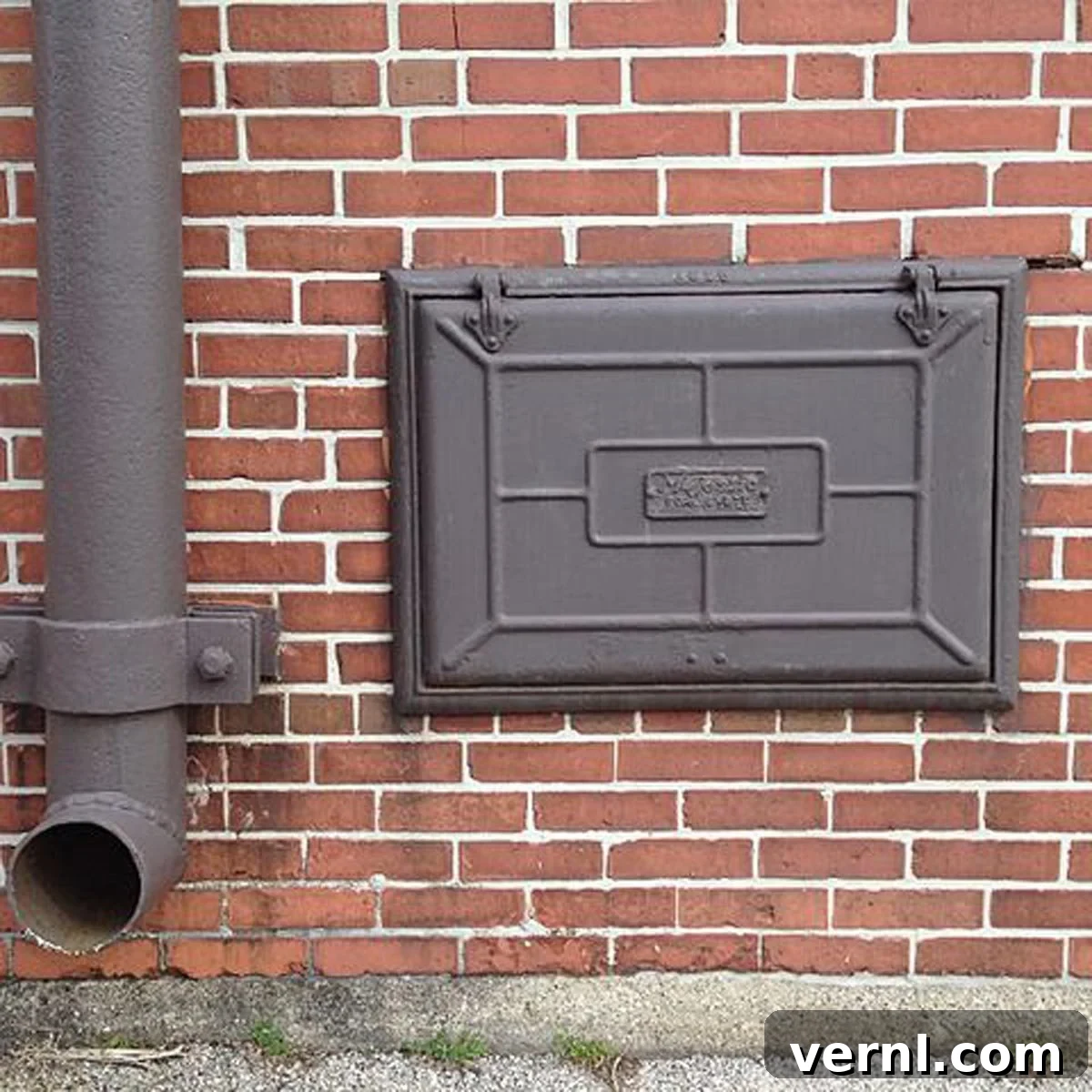
Many people are drawn to the timeless allure of older homes, captivated by their intricate architectural details, robust craftsmanship, and the rich tapestry of history woven into their very foundations. These charming dwellings often stand as tangible testaments to eras long past, each brick and beam holding stories of previous generations. However, choosing to reside in such a home can also mean embarking on an exciting journey of discovery, where one might encounter fascinating attributes that, while once essential, no longer serve their original purpose in contemporary living. Among these intriguing relics, a particular feature frequently piques the curiosity of new homeowners and history enthusiasts alike: that curious, often sturdy metal door nestled discreetly on the exterior of the house, typically at ground level, which opens into the basement below.
For many, this mysterious portal presents a charming enigma. Its robust construction and unusual placement hint at a utilitarian past, yet its function remains obscure to modern eyes. This humble metal door, often found on homes built before the mid-20th century, is far more than a mere architectural quirk. It is a direct link to a fundamental aspect of daily life and home management from a bygone era – an age when heating a home involved a significantly different process than simply adjusting a thermostat. Understanding the origins and decline of this feature unlocks a fascinating chapter in residential history, revealing how homes were kept warm and comfortable before the advent of modern energy infrastructure.
The History: Heating Homes in a Bygone Era
Before the widespread availability and adoption of natural gas and fuel oil, which are the heating fuels of choice for most contemporary homes, American families relied almost exclusively on a more labor-intensive and readily available resource: coal. Up until approximately 1940, coal was the undisputed king of home heating, powering the furnaces that kept families warm through frigid winters. This reliance on coal necessitated a robust system for its delivery and storage, giving rise to the very feature that puzzles homeowners today: the coal chute.
The daily rhythm of life in a coal-heated home revolved around maintaining the furnace and ensuring a steady supply of fuel. This was a far cry from the effortless warmth provided by today’s automated systems. Homeowners would carefully monitor their coal levels, anticipating the need for a fresh delivery. This is where the local coal deliverymen played a crucial role. These hardworking individuals were an indispensable part of the community, traveling door-to-door, often with large horse-drawn wagons or early trucks laden with tons of raw coal. Their job was to provide families with the fuel necessary to power their furnaces, a service that was as vital as food delivery.
Upon arrival, the deliveryman would position his vehicle near the exterior metal door – the coal chute door. He would then shovel the rough, black lumps of coal from his wagon or truck, directing them through this small, specially designed opening. The coal would then slide down a chute, typically a sturdy metal or wooden channel, which angled downwards into a dedicated storage bin or area within the basement. Once deposited in the basement, it became the homeowner’s responsibility to periodically shovel the coal directly into the hungry maw of the furnace, ensuring a continuous burn and consistent heat throughout the house. This entire process, while efficient for its time, was inherently dusty, demanding, and required significant physical effort from both the deliveryman and the homeowner.
The design of the coal chute itself was a marvel of practicality. The exterior door, often made of cast iron or steel, was built to withstand harsh weather and repeated impact from incoming coal. It typically featured a latch or lock to secure the opening, preventing unwanted access or drafts when not in use. Inside, the chute funneled the coal efficiently, minimizing spillage and directing it precisely where it needed to go. The coal bin in the basement was often a partitioned-off section, designed to hold several tons of coal, providing enough fuel to last weeks or even months depending on the size of the home and the severity of the winter. This entire system was a testament to the ingenuity and practical engineering of a time when energy resources and delivery methods were vastly different from what we know today.
Coal Production: A Bygone Era of Energy Dominance
The ascendancy of coal as the primary energy source in the Western world was a defining feature of the industrial revolution and its aftermath. In the second half of the 19th century and extending well into the first quarter of the 20th century, coal was not just abundant; it was the lifeblood of modern society. Its dual utility for both residential heating and powering burgeoning industrial processes made it an unparalleled resource. Factories, railways, and homes alike ran on the energy derived from burning coal, creating a vast industry around its extraction, transportation, and distribution. Coal mining towns flourished, and complex railway networks were developed specifically to move this vital fuel from mines to cities and homes across the nation.
However, this era of coal dominance was not without its challenges, and external pressures began to sow the seeds of its eventual decline. World War I, in particular, created significant disruptions and shortages in coal production and supply chains. The immense energy demands of the war effort, coupled with labor shortages and logistical hurdles, meant that residential coal supplies became unreliable and expensive. This period of scarcity forced a re-evaluation of energy sources and spurred innovation in alternative heating solutions. Consumers and industry alike began to look for more stable and efficient alternatives to coal, which was prone to volatile market fluctuations and supply chain vulnerabilities.
By the mid-1930s, significant technological advancements had made fuel oil burners not only viable but also considered safe and reliable options for residential heating. These new systems offered distinct advantages over coal-fired furnaces. They were cleaner, producing less ash and soot, and required far less manual labor for fuel management. Homeowners no longer had to shovel coal or deal with the messy byproducts of combustion. Furthermore, oil delivery could be more automated and less disruptive than coal delivery. The convenience and efficiency of fuel oil rapidly gained traction, and by the onset of World War II, fuel oil burners had largely taken the place of traditional coal-fired furnaces for residential heating in many parts of the country. The war further accelerated this transition, as the strategic importance of oil reserves grew, and new infrastructures were developed to support its distribution. While coal continued to play a role in industrial applications, its reign in the American home was effectively over.
Following World War II, the advent of natural gas truly sealed coal’s fate as a residential heating fuel. With the expansion of vast natural gas pipeline networks across the nation, homeowners gained access to an even cleaner, more efficient, and incredibly convenient heating option. Natural gas required no on-site storage, no physical deliveries, and furnaces could be fully automated, providing instant and consistent heat with minimal effort. This marked a profound shift in home heating, moving from a labor-intensive manual process to the automated, hands-off systems we largely take for granted today. The era of the coal chute and the daily ritual of coal management passed into history, leaving behind intriguing architectural remnants of a bygone age.
Today: Preserving a Piece of History and Character
In modern homes, the need for a coal chute is, of course, entirely obsolete. As heating technologies evolved and cleaner fuels became dominant, these practical openings gradually lost their utility. Today, most of these original coal chutes have been permanently sealed, often filled with concrete, bricked over, or simply covered to prevent drafts, moisture intrusion, or pest entry. Despite the sealing of the interior chute, you will still frequently encounter the distinctive iron doors on the exterior of countless older homes, particularly in established neighborhoods or historic districts. These doors, once a bustling gateway for fuel, now stand as silent sentinels, enduring reminders of a different time.
For current homeowners of historic properties, these coal chute doors present an interesting dilemma and opportunity. While they no longer serve their original function, their presence adds undeniable character and a unique historical dimension to the home’s exterior. Many choose to preserve these doors as architectural features, appreciating their rustic charm and the story they tell. They represent a tangible link to the home’s past, sparking curiosity and inviting conversations about the history of heating and daily life from a century ago. They transform from a mere functional part of the house into a fascinating conversation starter and an impromptu history lesson for visitors and passersby.
During renovation projects, homeowners often face decisions regarding these old features. Some opt to restore the metal door, stripping away layers of paint and rust to reveal its original craftsmanship, while ensuring the interior chute is properly sealed and insulated to improve energy efficiency. Others might choose to remove the door entirely, seeking a more uniform exterior aesthetic, though this can sometimes detract from the home’s authentic historical appeal. For those who appreciate historical preservation, retaining and maintaining the coal chute door is an important gesture that honors the home’s heritage and contributes to its unique identity.
Beyond simple preservation, some creative homeowners have found ingenious ways to repurpose these dormant features. While the interior chute should always remain sealed for practical reasons, the exterior door can sometimes be incorporated into decorative garden elements, transformed into a small, secure outdoor storage nook for very shallow items (if structurally sound and waterproofed), or simply left as an intriguing piece of outdoor art that hints at the home’s deep roots. Regardless of the approach, the continued presence of these coal chute doors stands as a powerful testament to the adaptability of residential architecture and the enduring appeal of homes that carry the weight and beauty of history within their walls. They remind us that every old house has a story to tell, often in the most unexpected and charming ways.