Cleaning gutters is one of the most dreaded, yet critical, home maintenance tasks. As seasons change, your gutters inevitably become receptacles for leaves, twigs, shingle grit, and other debris. In spring, the remnants of winter storms and early budding trees fill them up. Then, as autumn arrives, a fresh deluge of falling leaves ensures you’re back on the ladder, often multiple times. This chore becomes even more frequent and challenging if you have tall, messy trees towering over your house, casting their foliage directly into your rain gutters.
Beyond being a time-consuming and messy job, manual gutter cleaning poses significant safety risks. Climbing ladders can lead to serious falls, especially for older homeowners or those with health conditions. The discomfort of reaching into clogged, often slimy gutters, teeming with insects and decomposing organic matter, is an experience few enjoy. This demanding task often leads homeowners to wonder: isn’t there a better, easier way? Have you considered entrusting this unpleasant work to a specialized device, perhaps a gutter cleaning robot?
While the idea of an automated solution for gutter maintenance is highly appealing, it’s essential to understand the technology, its current limitations, and how it compares to traditional methods. This comprehensive guide will explore the world of gutter cleaning robots, delving into their functionality, current market availability, and whether they genuinely deliver on their promise to simplify your home upkeep.
For a broader perspective on maintaining your home’s exterior, explore these 25 hints for fixing roof and gutter issues.
Who Benefits Most from a Gutter Cleaning Robot?
The concept of a robotic assistant for gutter cleaning isn’t just a futuristic fantasy; it addresses several real-world challenges faced by homeowners. While the technology is still evolving, certain individuals and situations make the prospect of a gutter cleaning robot particularly attractive. Consider if any of these compelling reasons resonate with your home maintenance experience:
- Safety Concerns and Physical Limitations: For many, the primary driver for considering a gutter robot is safety. Climbing ladders, particularly to significant heights, presents a substantial risk of falls, which can result in severe injuries. This risk is amplified for elderly individuals, those with balance issues, or anyone with pre-existing health conditions that make physical exertion or heights dangerous. A robot eliminates the need for you to leave solid ground, providing peace of mind and protecting your well-being.
- Hard-to-Reach Gutters: Modern home designs often incorporate features that make manual gutter cleaning a logistical nightmare. Gutters situated multiple stories above ground, extending over tricky architectural elements like carports, sunrooms, or intricate landscaping features, become extremely difficult and hazardous to access with a ladder. A robot, designed to navigate these confined spaces, offers a practical solution where manual access is limited or unsafe.
- Fear of Heights: Acrophobia, or the fear of heights, is a common and legitimate concern that can turn gutter cleaning into an overwhelming ordeal. For individuals who experience anxiety or discomfort at elevated levels, hiring professionals or investing in automation becomes a necessity rather than a luxury. A gutter cleaning robot allows you to manage the task from the safety and comfort of the ground.
- The Sheer Unpleasantness of the Task: Let’s be honest – cleaning gutters is a disgusting job. It involves reaching into murky, often putrid mixes of decaying leaves, mud, stagnant water, and sometimes even nests of insects or rodents. The grime and stench are off-putting, and the physical effort required to scoop out compacted debris is considerable. If you’ve ever tackled this chore, you understand the strong desire to outsource it, and a robot offers a hands-off approach to this messy business.
- Time Constraint and Convenience: In today’s busy world, free time is precious. Gutter cleaning can consume hours, especially for larger homes or properties with numerous trees. A robot, even if it requires some supervision, promises to significantly reduce the active time you spend on this chore, freeing you up for more enjoyable activities or other essential home projects.
For these reasons, the appeal of a device that can autonomously or semi-autonomously tackle this dirty, dangerous, and time-consuming job is undeniable.
How Does a Gutter Cleaning Robot Work?
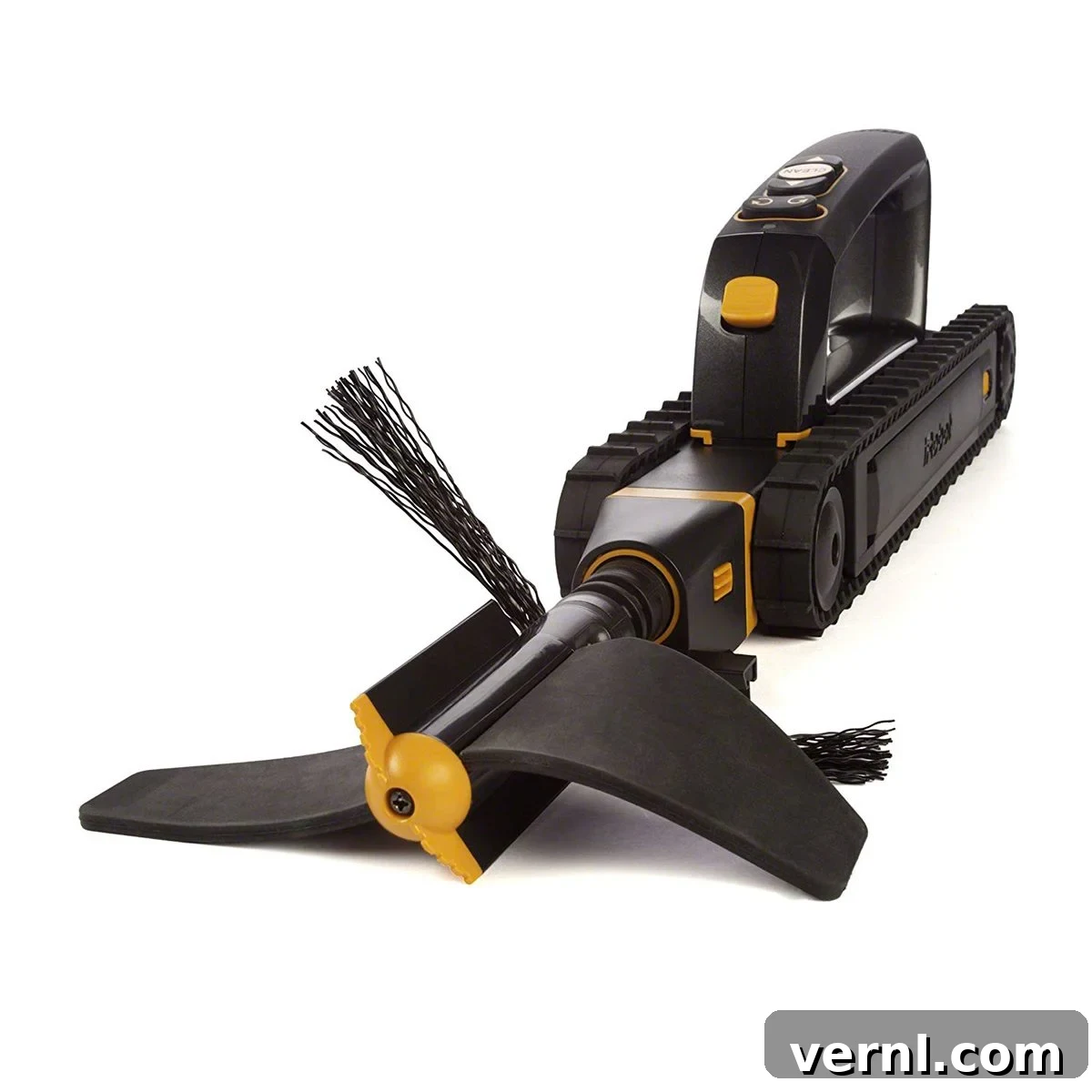
At its core, a gutter cleaning robot is a specialized remote-controlled device designed to navigate the narrow confines of your home’s rain gutters and clear out accumulated debris. While specific models may vary in their exact mechanisms, the general operational principles are consistent across these innovative gadgets.
Typically, you initiate the process by carefully placing the compact robot directly into the gutter trough at one end. Once positioned, the robot, often controlled via a handheld remote, begins its journey. It travels along the gutter on durable, rubberized tracks or wheels, which provide excellent traction on the damp, often slippery surfaces within the gutter. These tracks allow it to move smoothly, even over minor imperfections or debris.
The primary cleaning action is performed by a robust cleaning tool integrated at the front of the robot. The most common mechanism involves an auger system. This auger is equipped with soft, spinning blades designed to aggressively break up compacted clumps of twigs, wet leaves, shingle grit, and other organic debris. As the robot advances, these blades churn through the muck, pushing the larger debris forward and dislodging it from the gutter walls and bottom. The design of the auger is crucial; it must be powerful enough to clear stubborn blockages yet gentle enough not to damage the gutter material.
Behind the main auger blades, many gutter cleaning robots feature a set of brushes. These brushes serve a vital secondary function: they sweep up the finer, remaining bits of debris that the auger might have missed. This ensures a more thorough clean, preventing the accumulation of smaller particles that could still impede water flow or lead to future clogs. The combined action of the auger breaking up major obstructions and the brushes performing a final sweep aims to leave your gutters clear and ready to channel rainwater effectively.
Power for these devices usually comes from a rechargeable battery, providing enough runtime to clean a significant section of gutter before needing a recharge. Some advanced concepts might even incorporate sensors for obstacle detection or intelligent navigation, although current market offerings are generally more straightforward, relying on user guidance via remote control.
Beyond cleaning, understanding the structure of your gutters can significantly aid in their maintenance. Learn how to install gutters to create stronger, better-looking systems.
Does a Gutter Cleaning Robot Truly Deliver? A Reality Check
The promise of an automated gutter cleaning solution is incredibly appealing, but how do these devices perform in the real world? When we ask, “What’s the best gutter cleaning robot?” the answer, surprisingly, is not as straightforward as one might hope. As of now, only one prominent gutter cleaning robot has made a significant foray into the consumer market: the iRobot Looj 330.
iRobot, a well-known name in home robotics, responsible for the popular Roomba vacuum cleaners and the Terra robot lawn mower, introduced the Looj 330 with much anticipation. However, despite the innovative spirit of its creator, the iRobot Looj 330 was discontinued in 2017. This discontinuation highlights the significant challenges faced by this particular niche in the home robotics market.
The primary hurdle for gutter cleaning robots like the Looj 330 lies in the highly variable and often harsh environment they operate in. Gutters are not flat, open spaces like floors, nor are they uniform. They encounter:
- Heavy, Wet Debris: Unlike dry leaves, wet, compacted leaves, mud, and decaying organic matter are incredibly dense and heavy, posing a significant challenge for a small, battery-powered device.
- Varying Gutter Conditions: Gutters can have irregular shapes, tight corners, downspout guards, or even screws and hangers that protrude into the trough, acting as obstacles.
- Battery Life: Clearing heavy debris requires considerable power, often leading to limited battery life and the need for frequent recharging, especially for longer gutter runs.
- User Supervision: Even with remote control, these robots often require active user supervision to get unstuck, redirect, or ensure thorough cleaning, diminishing the “hands-off” appeal.
If you’re still curious and wish to experience this pioneering device for yourself, the discontinued iRobot Looj 330 can sometimes still be found on Amazon or other online marketplaces from third-party sellers. However, it’s crucial to manage expectations, as user reviews remain decidedly mixed. With an average rating of 3.3 out of 5 stars on Amazon, the feedback offers a clear picture of its capabilities and shortcomings.
One positive review highlighted its potential: “I bought this robot with the hope of helping my husband with the gutter cleaning chore. We are very very pleased with it. When the gutters and flashing have been installed correctly, there is enough room under the gutter hanging straps for the robot to proceed through the gutters without any problem. It successfully removed leaves and other tree litter, as well as sections of dirt and moss that had colonized the hard-to-reach segments of the gutter.” This suggests that under ideal conditions, with well-maintained and properly installed gutters, the robot can be effective.
However, a negative review sheds light on its common frustrations: “As other reviewers have said, not quite ready for prime time. I really wanted this to work because I hate climbing the ladder multiple times to clean the gutters. I ensured it was fully charged before starting. I also tied the string on it in case it got stuck (glad I did). I started with the bigger blades to see how they did and immediately switched to the smaller blades as it got stuck easily. I tried the rotation as directed so it didn’t spray the gunk up under the shingles but then it threw everything back up on the roof. So I reversed the rotation and had it spew gunk up under the shingles but out of the gutter. It was messy and not a great job when it was working. It bogged down and got stuck often. It ran out of juice after one and a half gutters. Probably 50 linear feet. Thank you Amazon for easy returns.” This candid feedback underscores issues with power, effectiveness against heavy clogs, debris disposal, and overall reliability—factors that ultimately contributed to its discontinuation.
While the iRobot Looj 330 was a valiant effort, its market performance indicates that the technology for fully autonomous and highly effective gutter cleaning robots has not yet fully matured to meet consumer expectations for all gutter conditions. The challenges are significant, but the demand for such a solution remains high, suggesting that future innovations might eventually overcome these hurdles.
You can still find the iRobot Looj 330 on Amazon.
Every product is independently selected by our editors. If you buy something through our links, we may earn an affiliate commission.
Effective Alternatives to Robotic Gutter Cleaning
Given the current limitations of gutter cleaning robots, many homeowners continue to rely on a range of established and evolving alternatives to keep their gutters clear. These methods vary in cost, effort, and effectiveness, offering solutions for different needs and budgets.
1. Manual Gutter Cleaning (The Traditional Approach)
This is the most common method, involving a ladder, gloves, and a scoop or trowel. While labor-intensive and carrying inherent risks, it allows for a thorough, hands-on removal of all types of debris. If opting for manual cleaning, prioritize safety:
- Always use a sturdy, properly secured ladder.
- Have a helper hold the ladder for stability.
- Wear heavy-duty gloves to protect against sharp debris and bacteria.
- Use safety glasses to prevent debris from falling into your eyes.
- Never overreach; always reposition the ladder instead.
- Clean frequently to prevent stubborn clogs.
2. Gutter Guards and Screens
Gutter guards are designed to prevent large debris like leaves and twigs from entering the gutter while allowing rainwater to flow through. There are several types:
- Mesh Screens: Affordable and easy to install, these screens physically block larger debris. However, they can still accumulate small particles, shingle grit, and pine needles on top, requiring occasional brushing or blowing.
- Surface Tension/Reverse Curve Systems: These systems use the principle of surface tension to guide water into the gutter while leaves fall off the curved edge. They are more expensive but generally more effective at keeping debris out. They can, however, struggle with very heavy rainfall or fine sediment build-up.
- Fine Micro-Mesh Guards: Offering the best filtration, these guards are designed to block almost all debris, including pine needles and shingle grit. They are the most expensive but dramatically reduce the frequency of cleaning. However, the mesh itself can occasionally become clogged with pollen or extreme amounts of grit, requiring minimal maintenance.
While gutter guards significantly reduce cleaning frequency, they are not entirely maintenance-free. They still need periodic inspection and cleaning to remove accumulated debris from their surface or clear any internal blockages that might occur.
3. Specialized Gutter Cleaning Tools and Attachments
Several tools extend your reach and simplify the task without climbing directly into the gutter:
- Telescoping Wands: These long poles can attach to a garden hose or pressure washer, allowing you to blast debris out of the gutter from the ground or a lower ladder position. While effective for loose debris, they can be messy and might not dislodge heavy, compacted clogs.
- Leaf Blower Attachments: Some leaf blowers offer curved nozzle attachments specifically designed to blow debris out of gutters. These work best for dry leaves and lighter debris but can create a significant mess.
- Gutter Scoopers on Poles: These tools feature a scooping mechanism at the end of an extendable pole, allowing you to physically remove debris from a distance. They offer more control than water or air blasts but can be cumbersome.
4. Professional Gutter Cleaning Services
For those who prefer a completely hands-off approach or have particularly challenging gutter systems, hiring professionals is often the best solution. Professional services offer:
- Expertise and Equipment: They have the right ladders, safety gear, and specialized tools to efficiently and safely clean all types of gutters, including those at great heights or with complex designs.
- Thoroughness: Professionals often clear downspouts, inspect for damage, and can even offer minor repairs or advice on maintenance.
- Insurance: Reputable companies are insured, protecting you from liability in case of an accident on your property.
- Convenience: You simply schedule the service, and they take care of everything.
While typically the most expensive option, the peace of mind, safety, and thoroughness provided by professional services often justify the cost, especially for multi-story homes or those surrounded by heavy foliage.
Choosing the right method depends on your personal comfort level, budget, the design of your home, and the amount of debris your gutters typically collect. Each alternative offers distinct advantages over the currently limited robotic options.
Making an Informed Decision: Is a Gutter Cleaning Robot in Your Future?
Maintaining clean gutters is a non-negotiable aspect of responsible homeownership. Neglected gutters can lead to a cascade of costly problems, including fascia and soffit damage, roof leaks, foundation erosion, basement flooding, and even pest infestations. The importance of this task is undeniable, which naturally fuels the desire for easier, safer solutions, such as gutter cleaning robots.
As we’ve explored, the journey of the gutter cleaning robot has been a pioneering one, with the iRobot Looj 330 leading the charge, albeit for a limited time. While the promise of automation—enhanced safety, unparalleled convenience, and time-saving—remains incredibly attractive, the current reality of this technology reveals significant challenges. Factors such as battery life, effectiveness against dense, wet debris, navigation over varied gutter landscapes, and the need for user supervision have historically limited their widespread adoption and performance.
For homeowners contemplating a gutter cleaning robot, it’s crucial to weigh the aspirational benefits against the current technological limitations. Ask yourself:
- What is the nature of the debris in my gutters? If it’s primarily light, dry leaves, a robot might perform better. If it’s heavy, wet, and compacted, current models may struggle.
- How complex is my gutter system? Straight, open gutters are more amenable to robot navigation than those with tight corners, numerous downspout openings, or protruding hardware.
- What is my budget? While manual cleaning is “free” in terms of direct cost (barring tools), professional services and advanced gutter guard systems represent a significant investment, much like a niche robot would.
- How much time and effort am I willing to invest? Even with a robot, some level of setup, monitoring, and potential intervention is usually required.
Looking ahead, the future of gutter cleaning robots holds exciting possibilities. As robotics, battery technology, and sensor capabilities continue to advance, it’s entirely plausible that more sophisticated, autonomous, and reliable models will emerge. These future devices might feature improved power, better navigation, advanced debris-sensing algorithms, and perhaps even self-cleaning capabilities for their own mechanisms.
Until then, the most reliable approaches remain a combination of diligence, smart preventative measures like gutter guards, and for those who prefer to avoid ladders entirely, the trusted expertise of professional cleaning services. Regardless of the method you choose, prioritizing clean gutters is an investment in the long-term health and structural integrity of your home, preventing minor seasonal inconveniences from escalating into major, costly repairs.