
Standby Power: Unmasking the Energy Vampires in Your Home
It’s a common scenario: you switch off an appliance, yet it seems to linger in a state of readiness. This persistent state, often referred to as “standby power,” is a significant, yet often overlooked, contributor to your energy bill. Many devices continue to draw power even when seemingly off, silently consuming electricity around the clock. This article delves into the world of standby power, exploring which appliances are the biggest culprits and, most importantly, what you can do to minimize this hidden energy drain.
Standby power, sometimes called “phantom load” or even “vampire energy,” allows devices to remain operational in a reduced-power state, waiting for a signal to spring back to life. From internal clocks in microwaves to the always-on thermometers in your refrigerator, these features consume energy 24/7. While the amount consumed by a single device might seem insignificant, the cumulative effect across all the appliances in your home can be substantial, leading to higher electricity bills and a larger carbon footprint.
When we think of household appliances, we often envision the workhorses like toasters, washing machines, and dryers. However, the landscape of the modern home is changing, with smart TVs, computers, and a myriad of other electronic devices now commonplace. These sophisticated devices, packed with features and connectivity, contribute significantly to the overall standby power consumption in your home.
To fully understand the scope of the problem and how to mitigate it, let’s adopt a broad definition of “appliance”: any instrument or device designed for a particular use or function. Using this definition, it becomes clear that a wide range of devices, from entertainment systems to kitchen gadgets, contribute to your home’s total standby power usage. The good news is that by identifying these energy-guzzling devices and implementing some simple strategies, you can significantly reduce your energy consumption and save money.
Which Appliances Consume the Most Standby Power?
Let’s take a closer look at some of the most common appliances that contribute to standby power consumption and examine their average energy usage.
Cable Boxes: A Major Energy Hog
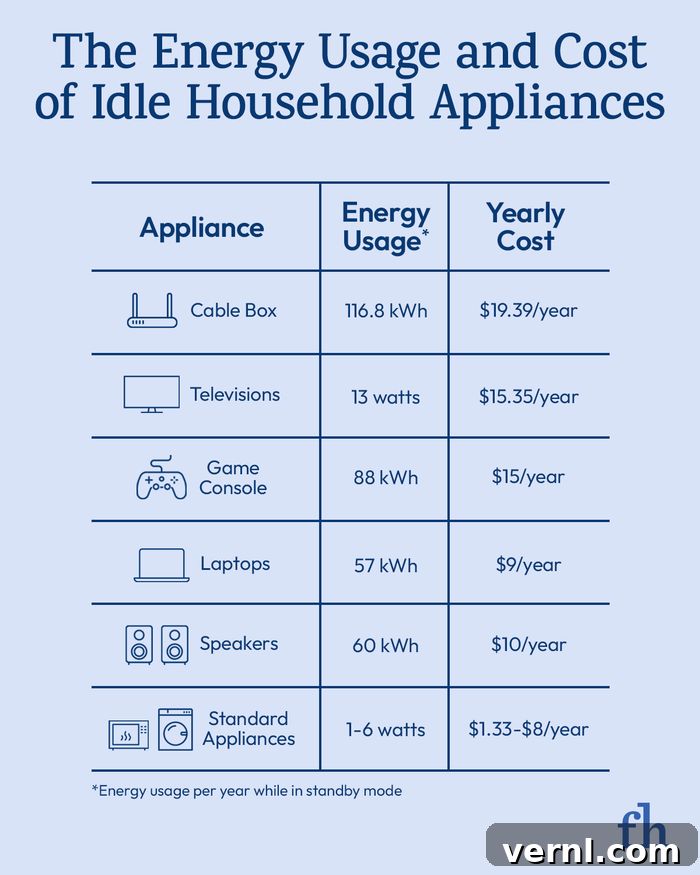
Cable boxes are often among the biggest consumers of standby power in the average household. According to Ron Shimek, president of Mr. Appliance, a Neighborly company, “Cable boxes are one of your biggest standby users.” Their constant need to update cable guides, download software, and keep internal drives active means they’re always drawing power.
A study by the Natural Resources Defense Council (NRDC) found that cable boxes consumed an average of 16 watts while in standby mode. If a cable box sits idle for 20 hours each day, it can consume a significant amount of energy annually. Based on the average U.S. electricity price of $0.166 per kilowatt-hour (kWh), the standby power usage of a single cable box can add a considerable amount to your annual electricity bill. And remember, many homes have multiple cable boxes, further increasing the total cost.
Televisions: Always Ready to Entertain
Televisions also contribute significantly to standby power consumption. The NRDC study showed an average standby power usage of 13 watts per TV. Televisions consume energy in standby mode because they must be ready to respond to the remote control and instantly power on. This “always-on” functionality ensures a seamless viewing experience, but it comes at a cost.
While the study’s average may apply to older models, modern TVs are often designed to be more energy-efficient. Newer televisions typically have much lower standby power wattage, often in the range of one-half to three watts. If you own a newer television, your standby power costs will likely be lower than the study’s average. However, it’s still worth checking the standby power consumption of your TV and considering ways to reduce it.
Game Consoles: The Instant-On Convenience
Game consoles are another category of devices that contribute to standby power consumption. Often, game consoles are set to an “instant-on” mode by default, which allows them to quickly resume gaming sessions but also keeps them drawing power constantly.
Fortunately, many game consoles offer energy-saving modes. For example, some models consume significantly less power in standby mode compared to the instant-on setting. Adjusting your console’s settings to utilize the energy-saving mode can significantly lower its standby power consumption and reduce your electricity bill. This simple adjustment can lead to meaningful savings over the course of a year.
Computers: Always Working in the Background
Computers, both laptops and desktops, are designed to enter a standby or sleep mode to conserve energy when idle. However, even in these modes, the computer still consumes power. In standby, the computer maintains memory refresh and allows users to quickly wake the device.
The NRDC study found that laptops used an average of 7.1 watts in standby, while desktops consumed 9.5 watts. Even when in sleep mode, a computer that’s never fully turned off can contribute a noticeable amount to your annual electricity bill. If you’re someone who leaves your computer on all the time, consider configuring it to enter a deeper sleep state or shutting it down entirely when not in use.
Audio/Video Devices: The Home Entertainment Ecosystem
Audio/Video (AV) devices, such as soundbars and home theater speakers, also contribute to standby power consumption. These devices use vampire power to power clocks, keep their remotes active, and await incoming signals.
The NRDC study found that AV equipment consumed an average of 7.5 watts in standby mode. This constant drain can add up over time, resulting in wasted energy and higher electricity bills. Even if you don’t actively use your AV equipment, it can silently consume power.
Standard Appliances: The Traditional Culprits
Traditional appliances like clothes washers, dryers, and microwaves typically use less standby power compared to the devices mentioned above. Shimek notes that these appliances often consume only 1 to 6 watts in standby mode. While the power consumption of a single appliance may seem small, the total standby power consumption of all your appliances can add up significantly.
What You Can Do to Reduce Standby Power Consumption
While individual appliance standby loads may seem small, the combined effect across all households is substantial. According to the Lawrence Berkeley National Laboratory, standby power accounts for about 1% of global carbon emissions. Fortunately, there are several simple strategies you can implement to reduce your standby power consumption and lower your energy bills:
Check the Energy Star Rating
When it’s time to replace old appliances, look for Energy Star-certified models. These appliances are designed to meet strict energy-efficiency guidelines, including reduced standby power consumption. As Shimek says, “The best advice to save money is to look for the appliance that suits your needs and has the best Energy Star rating.”
Unplug Appliances When Not in Use
The simplest way to eliminate standby power is to unplug appliances when you’re not using them. For appliances that are infrequently used, like toasters or guest room televisions, this is a straightforward solution. For other appliances, like washing machines, unplugging may not be practical.
Consider unplugging these items to make a significant impact:
- Televisions and cable boxes in guest bedrooms or rooms rarely used.
- Empty battery chargers.
- Infrequently-used kitchen gadgets like rice cookers and bread makers.
- Office equipment like scanners and printers.
- Seasonal items like room air conditioners, dehumidifiers, and e-bike chargers.
Use Power Strips for Convenience
Unplugging individual appliances can be cumbersome. Power strips offer a convenient solution. You can plug multiple devices into a power strip and then switch off the strip when the devices are not in use. This makes it easy to cut off power to multiple devices with a single action.
Group common electronics together on power strips. For example, you can put computer accessories and office equipment on one strip and entertainment devices on another. This approach allows you to easily control the power supply to these devices, reducing standby power consumption and saving you money.
Monitor Your Power Usage
If you’re unsure which appliances are consuming the most standby power, consider using an electrical usage monitor. These devices plug into a standard outlet, and you plug the appliance you want to monitor into the monitor. The monitor then tells you how much energy the appliance is using, whether it’s on or off.
Electrical usage monitors can also help you determine the most and least energy-efficient cycles on appliances like dryers and dishwashers.
By understanding the concept of standby power and implementing these simple strategies, you can take control of your energy consumption and reduce your electricity bill. Every small step you take towards energy efficiency contributes to a more sustainable future.