
Navigating the complex world of car insurance can often feel overwhelming, especially when your primary objective is to secure the most affordable coverage without compromising essential protection. While gaining insight into the average car insurance costs by state offers a valuable starting point, many drivers are intensely focused on uncovering the absolute cheapest car insurance options tailored to their specific needs. Due to the multitude of personalized factors influencing pricing, pinpointing a single “cheapest” quote that applies universally to every individual in every state is virtually impossible. However, it is entirely feasible to identify the leading insurance providers renowned for offering competitive rates and exceptional affordability across different states and for diverse driver profiles. This comprehensive guide aims to demystify the intricate factors that shape your insurance premium, highlight the companies consistently offering some of the lowest rates nationwide, and empower you to make an informed decision for your financial well-being and peace of mind on the road.
Understanding Car Insurance Pricing: Key Factors That Influence Your Premium
Car insurance premiums are not arbitrary figures; they are meticulously calculated based on a complex algorithm that takes into account a broad spectrum of variables. Bankrate, a highly respected financial resource, has extensively analyzed the landscape of car insurance, detailing many of the critical elements that insurers scrutinize when determining the cost of your policy. Understanding these underlying factors is paramount for any driver aspiring to secure the most budget-friendly coverage possible.
Personal Driving Profile and Vehicle Characteristics: What You Control (Mostly)
At the forefront of premium calculations are factors directly related to you as a driver and the vehicle you choose to operate. These elements provide insurers with an initial assessment of your risk profile:
- Your Driving Record: This is arguably one of the most significant determinants of your insurance premium. A clean driving record, free of accidents, speeding tickets, or other moving violations, is a strong indicator of low risk to insurers, almost always translating into lower premiums. Conversely, a history of infractions, particularly severe ones like DUIs or multiple accidents, signals a substantially higher risk and will almost certainly lead to significantly elevated rates. Even minor traffic citations can impact your premium for several years, depending on your state and insurer. Maintaining a pristine driving history is one of the most effective ways to keep your insurance costs down.
- The Car You Drive: The make, model, year, and inherent safety features of your vehicle play a substantial role. Insurers consider several aspects:
- Repair and Replacement Costs: Vehicles that are more expensive to repair (e.g., luxury cars with specialized parts, vehicles with advanced but costly technology) or replace (high-value cars) will naturally cost more to insure.
- Theft Risk: Models frequently targeted by thieves will carry higher comprehensive coverage costs.
- Safety Ratings: Cars with excellent safety ratings and advanced driver-assistance systems (like automatic emergency braking or lane-keeping assist) often qualify for discounts, as they reduce the likelihood and severity of accidents.
- Engine Size and Performance: Sports cars or high-performance vehicles, often associated with higher speeds and increased accident risk, typically incur higher insurance costs.
- Level of Protection You Choose: Your coverage selections directly impact your premium. Opting for basic liability-only coverage, which meets minimum state requirements, will always be cheaper than a full coverage policy that includes collision and comprehensive insurance. Choosing higher deductibles (the amount you pay out-of-pocket before your insurance kicks in) can lower your premium, but requires you to pay more in the event of a claim. The specific limits you choose for liability, uninsured/underinsured motorist coverage, and other add-ons (like roadside assistance, rental car reimbursement, or personal injury protection) also significantly affect the final price. Balancing adequate protection with affordability is key here.
Demographic and Credit-Related Factors: Personal Elements Beyond the Wheel
Beyond your driving habits and vehicle, certain personal characteristics and financial behaviors can also influence your car insurance rates:
- Age and Experience: Younger, less experienced drivers, particularly teenagers and those under 25, statistically pose a higher risk due to a greater likelihood of accidents. Consequently, their premiums are often significantly higher than those for older, more seasoned drivers. Rates typically begin to decrease for drivers in their mid-20s and tend to remain stable through middle age, before potentially rising slightly again in very advanced years.
- Credit Score (where permissible): In a majority of states, insurance companies use a credit-based insurance score as a predictive tool for how likely you are to file a claim. Studies often suggest a correlation between a lower credit score and a higher likelihood of filing claims. Therefore, a good credit score can often lead to lower premiums, while a poor credit score may result in higher rates. It’s important to note that some states, such as California, Hawaii, Massachusetts, and Michigan, prohibit or severely restrict the use of credit scores in determining insurance rates, recognizing potential fairness issues.
- Marital Status: Married individuals statistically tend to be involved in fewer accidents than single drivers, leading some insurers to offer slightly lower rates to married policyholders. This discount is often attributed to the perception of greater stability and responsibility among married couples.
- Occupation: Some insurers consider certain occupations to be lower risk than others, potentially offering discounts to professionals like teachers, engineers, or first responders.
Geographic and Environmental Factors: Where You Live Matters
Your location and the specific conditions of your environment are also critical in premium calculations, as highlighted by a second Bankrate article focusing on state-by-state average costs. These are largely external factors, but understanding them helps explain regional variations:
- Road Conditions and Traffic Density: Urban areas with poorly maintained roads, higher traffic congestion, or complex intersections often experience more accidents, leading to higher premiums for residents. More cars on the road simply increase the statistical probability of an incident, whether minor or severe. Rural areas, with less traffic, often benefit from lower rates.
- Number of Licensed Drivers and Uninsured Driver Statistics: States or regions with a higher percentage of uninsured motorists may see increased premiums for insured drivers, as the cost of covering accidents involving uninsured drivers (through uninsured motorist coverage) is effectively spread among all policyholders. Areas with a higher number of drivers per capita can also influence rates due to increased exposure to risk.
- Cost of Living, Repair, and Labor Costs: In metropolitan areas or states with a higher cost of living, the expenses associated with vehicle repairs, replacement parts, and labor for claims are significantly higher. This directly translates into higher potential payouts for insurers, which is then reflected in the premiums charged to local drivers.
- State Laws and Regulations: Each state has specific laws dictating minimum insurance requirements, no-fault versus at-fault systems, and other regulatory frameworks that can profoundly impact overall insurance costs. For instance, states with robust no-fault laws often have different premium structures to cover medical expenses regardless of who caused the accident. Mandated coverage levels also vary widely, directly affecting the base cost.
- Local Claims History and Weather Conditions: Insurers meticulously analyze the historical frequency and severity of claims in a particular zip code, county, or state. Areas prone to frequent severe weather events (e.g., hurricanes, tornadoes, hailstorms, heavy snowfall, floods) or regions with a high incidence of vehicle theft or vandalism will likely have higher comprehensive coverage premiums, as the risk of these incidents occurring is elevated.
By understanding this intricate web of personal, demographic, geographic, and environmental factors, drivers can gain a clearer perspective on why their insurance premiums are structured the way they are, and what proactive steps they might take to potentially reduce their costs. Comparing quotes from multiple providers, even those known for being the “cheapest,” is always the best strategy.
Finding Affordable Car Insurance for Diverse Driver Profiles and Special Cases
While a perfectly clean driving record, a low-risk vehicle, and an ideal credit score are advantageous for securing low insurance rates, not every driver fits this mold. Many individuals face unique circumstances that can make finding affordable car insurance a greater challenge. Fortunately, certain automotive insurers specialize in offering competitive rates for these “special cases” where other companies might levy significant surcharges. ValuePenguin, a leading financial analysis site, has extensively researched these companies, noting that their top picks for affordability each provide coverage in at least 25 states. Identifying an insurer that understands and caters to specific needs can lead to significant savings for these driver demographics.
- American Family: Ideal for Full Coverage or Drivers with Poor Credit
For drivers seeking comprehensive protection for their vehicle or those who have faced financial challenges impacting their credit score, American Family frequently emerges as a top contender. While a poor credit history can often lead to significantly higher premiums in many states (where credit scores are used in underwriting), American Family demonstrates a strong ability to offer more favorable rates for this demographic. They may utilize alternative risk assessment models or offer specific programs to help these drivers. Additionally, they are noted for providing competitive pricing on full coverage policies, balancing extensive protection with affordability. - Auto-Owners: Excellent for Liability-Only, Teen Drivers, and Those with Driving Infractions
Auto-Owners stands out as a versatile insurer, proving particularly beneficial for younger drivers and those with recent marks on their driving record. They are often recognized for their highly competitive rates on liability-only policies, which is a common choice for budget-conscious drivers or owners of older vehicles. Crucially, Auto-Owners shows particular strength in offering more forgiving rates for teen drivers, including those who have accumulated speeding tickets or even been involved in an accident. This can be a huge relief for families facing the notoriously high costs of insuring young, inexperienced drivers. - State Farm: A Strong Choice for Drivers with Prior Accidents
Having an at-fault accident on your record can significantly hike your insurance premiums for several years, as it signals increased risk to insurers. State Farm has consistently proven to be one of the most forgiving and affordable options for drivers who have an accident in their history. Their extensive network, vast customer base, and robust financial standing allow them to absorb some of the perceived risk associated with past incidents more effectively than smaller competitors, often translating into more manageable rates for those looking to move past a prior claim. - Progressive: Top Pick for Drivers with DUIs
A DUI (Driving Under the Influence) conviction is one of the most severe marks on a driving record, leading to dramatically increased insurance costs, potential license suspension, and often requiring specialized SR-22 or FR-44 filings. Progressive is frequently cited as one of the best options for drivers in this challenging situation. While premiums will still be considerably higher than for a clean record, Progressive is known for offering some of the most competitive rates available to individuals with a DUI, helping them meet legal requirements and get back on the road as affordably as possible given their circumstances. - USAA: Exclusively for Military Families, Offering Unbeatable Rates
USAA consistently receives accolades for its exceptional customer service and highly competitive rates, specifically for military members, veterans, and their eligible family members. If you or someone in your immediate family has served in the U.S. armed forces, USAA is almost always the unparalleled choice for the cheapest and best car insurance. Their deep understanding of military life, dedication to their members, and unique operational model allow them to offer tailored policies, specialized discounts, and superior rates that are often unmatched by other providers.
For individuals falling into these “special cases,” actively seeking quotes from these specific insurers, along with others, can significantly improve their chances of finding truly affordable and appropriate car insurance coverage that meets their unique needs.
Cheapest Car Insurance by State: A Detailed Breakdown Across the U.S.
The cost of car insurance can fluctuate dramatically from one state to another, influenced by a unique combination of local laws, traffic patterns, population density, accident rates, uninsured motorist statistics, and even prevalent weather conditions. While the factors discussed above determine your personal rate, the median costs for the “cheapest” providers reveal significant regional disparities. Understanding these state-specific trends and identifying the most affordable insurer in your area is a crucial step towards securing optimal coverage at the lowest possible price. It’s important to remember that the figures presented here represent median annual rates for the cheapest insurer in each state, as compiled by Nerdwallet. Your exact quote will still be personalized based on your individual driving profile, vehicle, chosen coverage limits, and any applicable discounts, but this data offers an excellent starting point for your research and comparison shopping.
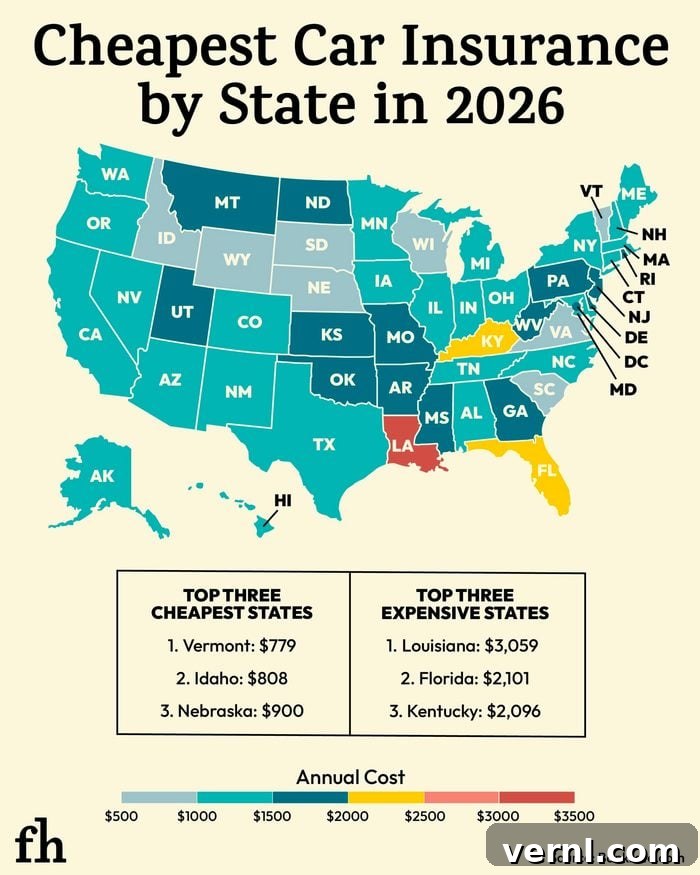
Analyzing the data in the table below reveals a wide spectrum of annual costs. States like Vermont and Idaho consistently offer some of the lowest median premiums, often attributed to factors such as lower population densities, fewer traffic incidents, and favorable local regulations that keep insurance costs in check. Conversely, states such as Louisiana, Florida, and Kentucky tend to have significantly higher average costs, often due to a combination of high rates of uninsured motorists, frequent severe weather events, higher litigation rates, and specific state-mandated coverage requirements that elevate baseline premiums. This pronounced geographical variation underscores the critical importance of researching local providers and thoroughly understanding the state-specific insurance landscape where you reside.
| State | Insurance Company | Annual Cost |
| Vermont | Union Mutual | $779 |
| Idaho | Travelers | $808 |
| Nebraska | American National | $900 |
| South Carolina | American National | $904 |
| Virginia | Virginia Farm Bureau | $940 |
| South Dakota | Kemper | $950 |
| Wyoming | American National | $956 |
| Wisconsin | Travelers | $991 |
| Ohio | Central Insurance | $1,068 |
| Maine | Progressive | $1,081 |
| Washington | Kemper | $1,097 |
| Alabama | Travelers | $1,199 |
| North Carolina | Progressive | $1,174 |
| Massachusetts | GEICO | $1,209 |
| Tennessee | Travelers | $1,209 |
| Minnesota | Travelers | $1,277 |
| Oregon | State Farm | $1,287 |
| Iowa | Progressive | $1,297 |
| Hawaii | GEICO | $1,317 |
| Indiana | American Family | $1,321 |
| Michigan | GEICO | $1,321 |
| Texas | Texas Farm Bureau | $1,321 |
| Colorado | American National | $1,327 |
| Connecticut | Travelers | $1,349 |
| California | GEICO | $1,358 |
| New Hampshire | GEICO | $1,389 |
| New York | Progressive | $1,391 |
| Nevada | Progressive | $1,414 |
| Arizona | American Family | $1,419 |
| Alaska | GEICO | $1,455 |
| Maryland | GEICO | $1,457 |
| New Mexico | Central Insurance | $1,464 |
| Illinois | Travelers | $1,490 |
| Pennsylvania | Encova | $1,506 |
| Arkansas | Travelers | $1,535 |
| Utah | Nationwide | $1,550 |
| North Dakota | Nationwide | $1,576 |
| Montana | State Farm | $1,603 |
| Georgia | Georgia Farm Bureau | $1,605 |
| New Jersey | GEICO | $1,648 |
| Kansas | Travelers | $1,691 |
| Missouri | Shelter | $1,700 |
| Rhode Island | Travelers | $1,770 |
| West Virginia | Encova | $1,772 |
| Washington D.C. | Erie | $1,870 |
| Delaware | Travelers | $1,950 |
| Mississippi | Travelers | $1,961 |
| Oklahoma | American Farmers and Ranchers | $1,996 |
| Kentucky | Shelter | $2,096 |
| Florida | State Farm | $2,101 |
| Louisiana | Louisiana Farm Bureau | $3,059 |
When reviewing this table, prospective buyers should use it as a highly valuable guide to kickstart their search. It effectively highlights which companies are consistently performing well in terms of affordability within specific states. Drivers are strongly encouraged to obtain personalized quotes from these listed providers, as well as any other reputable local or national insurers, to find their truly cheapest and most suitable option. Remember, the “cheapest” premium isn’t always the best if it means inadequate coverage, so always balance cost with sufficient protection for your assets and peace of mind.
RELATED ARTICLES
- Do You Know What That Little Button on Your Seat Belt Is For?
- What Those Lines on Your Backup Camera Really Tell You
- Here’s What The Small Panel On Your Car’s Front Bumper Is For
Sources and Further Reading
The information presented in this comprehensive guide is based on extensive research and data provided by leading financial and insurance analysis platforms. We recommend consulting these original sources for the most up-to-date figures and in-depth analyses:
- Cheapest Car Insurance in February 2026, Bankrate, January 2026.
- Car Insurance Rates by State for February 2026, Bankrate, 2026.
- Top 10 cheapest car insurance companies, ValuePenguin.
- Cheap Full Coverage Car Insurance for 2026, Nerdwallet, 2026.