
For decades, the rumble of a gasoline engine has been synonymous with summer lawn care. Reviews and expert opinions frequently lauded gas-powered lawn mowers for their raw power and ability to tackle challenging landscapes, often placing them ahead of their electric or battery-operated counterparts. However, the landscape of lawn maintenance is evolving rapidly. As technology advances, battery-powered mowers are increasingly demonstrating capabilities that rival, and sometimes even surpass, traditional gas models in convenience, performance, and environmental impact. This shift is becoming undeniable.
I recently had the unique opportunity to directly compare my personal brand-name, self-propelled, 163cc gas mower against the innovative 80-volt, battery-operated Atlas Lawn Mower from Harbor Freight. The results were not just surprising; they were genuinely impressive. This wasn’t merely a casual trial but a rigorous test conducted under less-than-ideal conditions, designed to truly push the limits of what a battery-powered machine could achieve.
The Atlas mower proved itself remarkably versatile, easily matching my gas machine’s capabilities while offering more than enough run-time to effortlessly manage my compact yard. Its performance was particularly notable during its inaugural spring mow, following an unusually harsh winter that left behind a multitude of trouble spots, dense patches of matted leaves, and stubborn debris. Far from being a gentle introduction, this was a baptism by fire, and the Atlas emerged victorious.
In this comprehensive review, we’ll delve into the specifics of how the Atlas mower tackled these tough challenges, highlight its standout features and the aspects I particularly appreciated, and honestly assess areas where there might be room for improvement. Prepare to reconsider your assumptions about battery-powered lawn care.
Unveiling the Atlas Mower: A New Standard for Electric Lawn Care
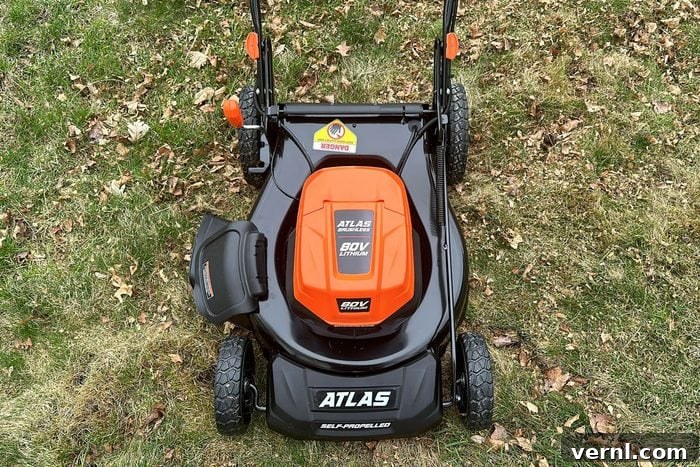
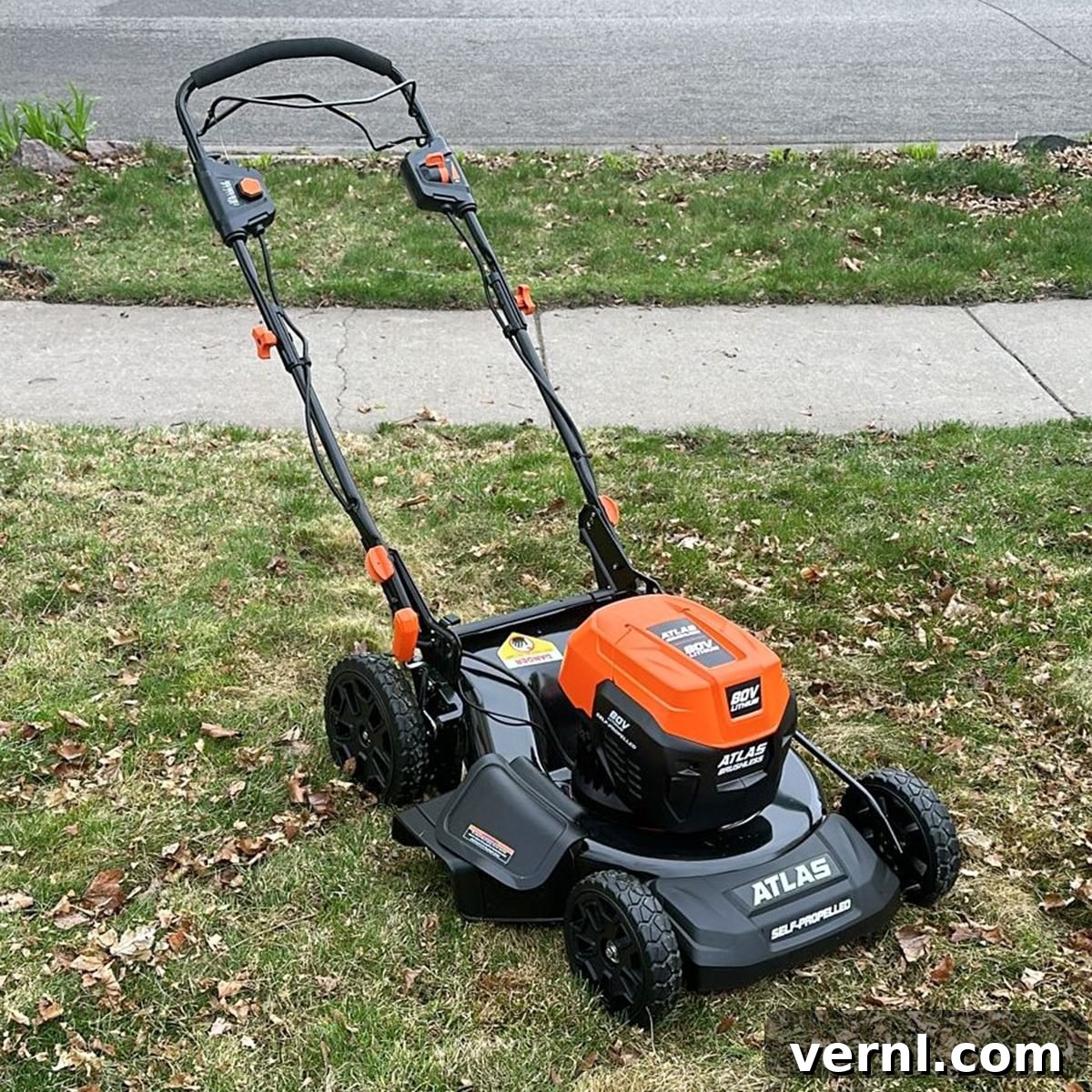
The Atlas Lawn Mower isn’t just another battery-powered machine; it’s a professional-grade, 80-volt, cordless, 21-inch wide, self-propelled lawn mower engineered with a suite of features meticulously designed to transform yard work into a quiet, efficient, and environmentally friendly experience. While it doesn’t offer the hands-off autonomy of the best robot lawn mowers, the Atlas masterfully balances an attractive price point with exceptional user convenience and highly adaptable controls, making it a compelling choice for a broad spectrum of homeowners.
During my extensive testing, I discovered that this machine truly lives up to the increasing hype surrounding battery-powered lawn mowers. The enthusiasm from the online community is palpable, with customer reviews consistently averaging over 4.5 stars. After putting it through its paces, I wholeheartedly concur with the majority of these positive assessments, though I did note a few additional observations and minor concerns.
To gain a broader perspective on the industry’s shift, I engaged in a discussion with Scott McLeod, the owner of McLeod Landscaping, a business with three decades of experience. He confirmed that his professional landscaping team is also increasingly impressed with the robust performance of similar battery-operated models as they strategically transition towards more sustainable and eco-friendly technologies. This corroborates the growing sentiment that electric is not just a niche, but the future.
Setting up the Atlas right out of the box was as straightforward as assembling any other walk-behind mower. The process was intuitive, with one minor exception: the handle height adjustment. It took me a mere thirty seconds to understand its mechanism, but this initial, brief discovery was well worth the effort. The ability to quickly and easily customize the handle height for optimal ergonomics is a welcome and highly valuable feature, enhancing comfort and control during operation.
It’s important to note a crucial detail regarding the purchase: the Atlas Lawn Mower is sold as a “tool only,” meaning batteries are not included. Harbor Freight is commendably transparent about this fact. However, this also implies that the advertised price is significantly less than the total investment required to get the mower operational. Atlas batteries typically start at roughly half the cost of the mower itself, with an additional $50 to $80 needed for a compatible charger. For my small yard, which spans approximately 1,100 square feet, I opted for a single battery and charger, finding it more than sufficient for my needs.
We Tried It: Atlas Lawn Mower
This professional self-propelled mower powers through thick, tall, or wet grass with remarkable ease.
Image Credit: VIA MERCHANT
Shop on Harbor Freight
Key Features of the Atlas Mower: Designed for Efficiency and User Comfort
As both a seasoned product reviewer and a passionate writer about tools, I meticulously cataloged the numerous features of the Atlas Lawn Mower that contribute to its outstanding convenience and robust performance. Here’s a detailed breakdown:
- Versatile 3-in-1 Capabilities: The Atlas offers mulching, side-discharge, and bagging options all in one purchase, providing flexibility for various lawn care preferences and conditions. Switching between these modes is quick and straightforward.
- Effortless Deck Height Adjustment: Featuring seven distinct deck heights, this mower allows for precise control over your grass length. A single, easily accessible lever adjusts all four wheels simultaneously, ensuring an even cut across your entire lawn.
- Dynamic Variable-Speed Drive Control: The self-propelled drive system boasts variable speed control, which can be released for detailed trimming around obstacles or in tight spaces. This offers unparalleled control, adapting to your pace and the demands of the terrain.
- Advanced 40/80V Dual Voltage Battery System: The Atlas utilizes innovative dual-voltage batteries (40V or 80V) that are compatible across the entire Atlas 80V lawn tool ecosystem. This means you can use the same battery for your Atlas string trimmer, leaf blower, and other tools, offering significant cost savings and convenience.
- Flexible Battery Operation: For smaller yards or lighter tasks, the mower can operate efficiently on a single battery. For extended run-time or more demanding jobs, it accommodates two batteries, seamlessly switching between them to maximize power and duration without interruption.
- Enhanced Safety Features: To prevent accidental starts, the blades require a two-hand operation to engage, providing an extra layer of safety during use.
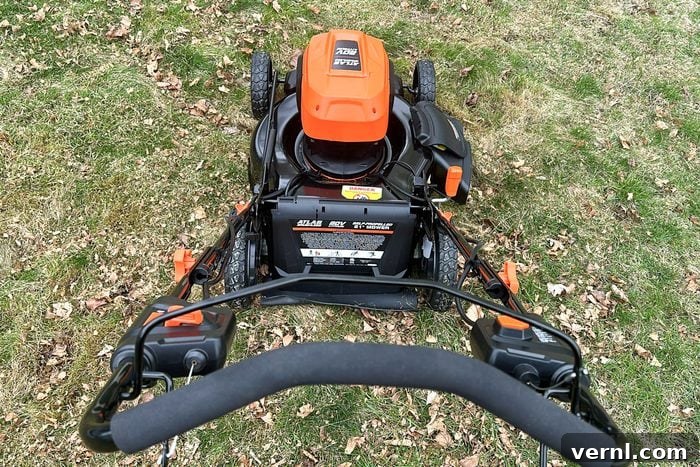
- Ergonomic and Space-Saving Design: The handles are not only height-adjustable to suit users of different statures but also foldable, greatly simplifying storage in compact garages or sheds. This design prioritizes both user comfort and practical storage solutions.
- Intelligent Automatic Load-Sensing Capability: This smart technology automatically detects the thickness and density of the grass, adjusting the motor’s power output accordingly. This ensures optimal cutting performance and efficiently conserves battery life, especially when transitioning between thick and sparse areas.
Beyond the official specifications, as a dedicated lawn and tool enthusiast, I noticed a couple of additional nuanced features and minor drawbacks during my hands-on experience. Firstly, the inclusion of a safety key within the battery compartment is a brilliant, understated feature. I quickly discovered its utility: by removing the key, I could completely cut power to the machine, eliminating any chance of accidentally bumping the always-on drive control bar. This not only enhanced safety but also provided peace of mind, allowing me to leave the battery in place for extended periods without fear of unexpected discharge or accidental activation.
The second feature that truly stood out, despite not being prominently highlighted in the product literature, was the mower’s incredibly responsive and precise drive speed control. My gas-powered machine, while offering speed control, is quite limited in its adjustments, often requiring me to awkwardly modify my walking pace to match the mower’s. The Atlas Lawn Mower, by contrast, allowed for effortless, on-the-fly adjustments to its speed, seamlessly synchronizing with my stride. This subtle yet significant improvement dramatically enhanced the comfort and efficiency of the mowing experience, especially when navigating varied terrain or tight corners.
However, no product is without its minor imperfections, and I identified two drawbacks that might resonate with other yard owners. The first was what I can only describe as a distinct “bounciness” from the front wheels. My yard, established over a century ago, possesses a high clay content, resulting in an inherently bumpy and uneven surface. While this characteristic didn’t adversely affect the quality of the grass cut, the mower did feel as if it was jostling around quite a bit. This sensation might be attributed to the Atlas’s comparatively lighter weight compared to my heavier gas-powered mower, making it more susceptible to surface irregularities.
Secondly, when testing the bagging functionality, I found myself inadvertently kicking the collection bag more than once. This issue, however, may be less a flaw in the mower’s design and more a consequence of my naturally long stride. Interestingly, when I increased the drive speed slightly, the problem largely subsided, suggesting a minor adjustment in technique could easily mitigate this concern.
How We Tested It: Pushing the Atlas to Its Limits
Living in a northern state, I’m accustomed to brutal winters. Typically, the autumn season provides ample time for thorough yard cleanups before the first snowfall. However, the past year proved to be an anomaly. Autumn lingered unusually long, enticing both my neighbors and me to postpone essential lawn care until it was unfortunately too late. Compounding this, the winter was uncharacteristically mild, leading to widespread dead grass spots and leaving behind globs of unraked, moisture-laden leaves that wreaked havoc on the lawn throughout the colder months. This combination created a truly formidable challenge for any lawn mower.
When I was presented with the opportunity to test the Atlas Lawn Mower, I admit I felt a pang of concern. I knew its inaugural test would be exceptionally demanding, challenging even my robust gas-powered machine. It hardly seemed like a fair introduction for a new mower. Yet, to my profound surprise and satisfaction, the Atlas not only rose to the challenge but conquered it with remarkable ease and efficiency.
The battery arrived with a partial charge, a common practice for shipping. After a mere hour and a half on the charger, it was fully powered and ready for action. Once I effortlessly dropped the charged battery into its dedicated port on the mower, it took just seconds to engage the machine and begin the daunting task at hand. The instant power-on, free from priming or pull-starts, was a refreshing change.
I began in the backyard, an area where the grass always seems to grow with stubborn exuberance. The Atlas faced everything from dense, six-inch-tall patches of overgrown grass to sparse, bare spots – a true testament to its versatility. While the Atlas never once bogged down or struggled in the thickest sections, I did observe that the very first pass over an exceptionally tall, uneven patch resulted in a slightly less uniform cut. Learning from this, on subsequent tall spots, I wisely slowed the drive speed down to just under half-rabbit (a useful visual on the control knob). This minor adjustment made all the difference, resulting in a perfectly clean and even cut.
My front yard presents a different challenge, largely dedicated to decorative flower and rock gardens, leaving very little grass, which typically grows poorly for most of the year. The initial mowing of the season here is usually a quick trim, primarily to maintain consistency with the more vigorous backyard. It was in this front yard that I truly appreciated the nuanced versatility of the Atlas Lawn Mower.
While the self-propelled drive control was an excellent asset for tackling the open spaces of the backyard, the ability to disengage the drive for much of the front yard proved invaluable. This allowed me to meticulously maneuver the mower close to the delicate gardens and intricate rock arrangements without feeling rushed, or, more importantly, without fearing a loss of control. There was a minor learning curve initially; I discovered that the drive wheels could sometimes remain locked after disengaging the drive, requiring a slight forward push of a few inches to release them. However, with a little practice, this quickly became an almost instinctive action, integrating seamlessly into my mowing routine.
In total, the entirety of my yard, including the challenging backyard and the detail-oriented front, took approximately 25 minutes to complete. During this rigorous session, the Atlas not only powered through dense grass and debris but also effortlessly chewed up an unnoticed ¾-inch thick rogue tree branch – a clear testament to its robust motor and blade strength. Throughout this demanding test, the mower showed absolutely no signs of slowing down, and a quick glance at the battery power indicator revealed a remarkable half of the battery power still remaining. This indicates exceptional efficiency and runtime for a typical small-to-medium-sized property.
Pros of the Atlas Mower
- Effortless Height-Adjustable Handle: Customization for user comfort and greatly reduces strain during longer mowing sessions.
- Responsive Drive Speed Control: Allows for seamless adjustment to different walking paces and terrain, enhancing user control and reducing fatigue.
- Disengageable Drive Control for Detail Work: Provides precise manual control for navigating tight spaces, around obstacles, and near delicate landscaping.
- Easy Storage with a Foldable Handle: Maximizes garage or shed space, making it ideal for homeowners with limited storage.
- Robust Mostly Metal Housing for Durability: Contributes to a sturdy build that can withstand the rigors of regular use and minor impacts.
- Four-Wheel Height Adjustment with One Control Lever: Simplifies setting the cutting height evenly across all wheels, ensuring a consistent and professional-looking lawn.
- Advanced Safety Features: Includes a safety key to prevent accidental starts and a two-hand blade starting mechanism, prioritizing user protection.
- Flexible Battery System (One or Two Batteries): Offers adaptable run time options, catering to both smaller yards and larger properties or more demanding tasks.
Cons of the Atlas Mower
- Front Wheels Bouncy on Uneven Terrain: Experienced a “bouncy” sensation on my old, hard, clay-heavy yard, which could be noticeable on similar uneven surfaces.
- Front Plastic Piece Susceptible to Damage: The front plastic component could potentially suffer damage if the mower is mishandled or encounters significant impacts, suggesting careful operation is advised.
- Mowing Very Tall Grass Evenly Requires Slowed Speed: Achieving an even cut in exceptionally tall or dense grass necessitates reducing the drive speed, which might extend mowing time in such conditions.
- Battery Not Included in Mower Purchase: Requires a separate and often significant investment in batteries and a charger, increasing the overall initial cost of ownership.
Frequently Asked Questions About the Atlas Lawn Mower
Where can I purchase an Atlas mower?
The Atlas Lawn Mower, along with its full ecosystem of battery-operated Atlas lawn tools, is primarily available at Harbor Freight stores across the nation. Beyond the 80V lawn mower, Harbor Freight also offers a range of complementary Atlas tools, including powerful lawn edgers, efficient string trimmers, and robust leaf blowers. The key advantage here is that all these tools operate seamlessly using the same interchangeable 80V battery system, allowing users to build a comprehensive, eco-friendly yard care arsenal while maximizing battery compatibility and reducing overall cost.
How many cutting height adjustments does the Atlas mower offer?
The Atlas Lawn Mower provides exceptional versatility in grass length management, featuring a single, conveniently located lever that adjusts the mowing height of all four wheels simultaneously. This intuitive control allows you to choose from any of seven distinct settings, ranging from a close trim to a higher cut, suitable for various grass types and seasonal requirements. During my extensive testing, I found the setting in the number three position to be ideal for maintaining my lawn’s health and appearance, providing a balanced and aesthetically pleasing cut.
What Other Experts and Users Are Saying
Scott McLeod, with his three decades of experience in professional landscaping, offered invaluable insights into the broader transition towards battery-operated lawn mowing equipment. “I’ve witnessed the profound evolution of lawn care technology firsthand,” he stated, “especially the accelerating transition towards more sustainable options like battery-operated electric lawn mowers. These mowers have become increasingly vital, not just for their environmental benefits but also for their reduced noise pollution and significantly lowered operating costs.”
He elaborated on the practical advantages for his business: “In our operations, we’ve observed that electric mowers can drastically cut down on emissions, making them an overwhelmingly popular choice for our residential and commercial clients who are committed to maintaining their green spaces more sustainably. One specific aspect where electric lawnmowers truly shine is their unparalleled efficiency and remarkable ease of use. For instance, eliminating the need for gasoline storage, frequent oil changes, and spark plug replacements means that maintenance becomes infinitely simpler and far cleaner. This translates directly into more invaluable time spent on meticulously crafting beautiful landscapes and considerably less time consumed by tedious equipment upkeep.”
McLeod passionately encouraged a wider adoption of battery-powered lawn tools: “I strongly encourage both landscaping professionals and discerning homeowners alike to genuinely consider the substantial long-term benefits of investing in electric lawn equipment. It extends far beyond the immediate savings in fuel costs; it’s a critical investment in the enduring health of our planet and a positive legacy for future generations.”
This expert endorsement aligns perfectly with the overwhelmingly positive sentiment from current Atlas Lawn Mower owners, who give the product an impressive average rating of 4.6 out of 5 stars. Positive reviews frequently echo my own initial surprise at the mower’s robust performance, particularly for those with smaller to medium-sized yards. Reviewers consistently praise the Atlas mower’s intuitive ease of use, appreciating the minimal maintenance requirements that primarily involve simply ensuring the batteries are properly stored and charged. The instant start-up and quiet operation are also commonly cited as major advantages.
However, it’s crucial to acknowledge that not all reviews are entirely positive. A small percentage of less favorable reviews cited quality concerns on models that were eventually returned. I specifically found two reviews mentioning instances where the battery became too overheated to immediately recharge after heavy use, a common challenge with some lithium-ion batteries under strenuous conditions. Another review noted that the bagging feature, while functional, seemed somewhat weak when it came to effectively collecting all of the grass clippings or finely mulched leaves, suggesting a potential area for design refinement.
Atlas Mower vs. Ego Mower: A Head-to-Head Comparison
When comparing the Atlas Lawn Mower to the popular Ego Power+ 21 mower, a direct competitor in the premium battery-powered segment, numerous striking similarities emerge. The Ego mower, like the Atlas, is a battery-operated machine (though it operates at 56 volts compared to the Atlas’s 80V). It also boasts seven cutting heights, a versatile variable-speed drive, and the essential three-function capability, including bagging, side-discharge, and mulching, mirroring the Atlas’s offerings. Both machines clearly aim to provide a comprehensive and convenient mowing experience.
The primary distinction between these two excellent mowers lies in their approach to power management and, consequently, their run time capabilities. While the Atlas mower’s battery operates at a higher 80-volt peak, its standard battery is typically rated for 4 amp-hours (Ah) at full power. On the other hand, the Ego battery, at a slightly lower 56V, often boasts a higher capacity of 10 amp-hours. In practical terms, while higher voltage can indicate more immediate power for cutting through tough grass, amp-hours are a direct indicator of how long that power can be sustained.
These differences in power management translate to distinct advantages for different user needs. Although the Ego mower might exhibit slightly less instantaneous peak power compared to the 80V Atlas in extremely dense conditions, its higher amp-hour battery means it is generally more geared towards homeowners with larger lawns that demand extended run times to complete the entire job without the need for mid-mow battery recharges. The Atlas, however, cleverly counters this by offering the option to use a second battery for significantly increased runtime, a flexibility that the Ego mower currently doesn’t provide. This allows Atlas users to scale their battery capacity according to their property size.
From a pricing perspective, the Ego Power+ 21 mower typically retails anywhere between approximately $430 and $750, with the price largely dependent on the specific battery capacity included with the purchase. The Atlas mower falls into a similar pricing bracket, varying based on whether you opt for the tool only, a single battery, or multiple batteries for enhanced power and run time. Ultimately, the choice between the two often comes down to individual preferences regarding voltage vs. amp-hours, the flexibility of dual battery usage, and existing tool ecosystems.
Final Verdict: Is the Atlas Mower Right for Your Lawn?
My yard presents a somewhat unique challenge: it’s just a tad too expansive for me to comfortably rely on a reel mower, yet it’s certainly not sprawling enough to justify the investment in a riding mower option. In fact, I’ve often felt that my heavy-duty, gas-powered mower was a bit of an overkill for the property’s size. The Atlas 80V Lawn Mower, to my genuine delight, emerged as the perfect, precisely tailored solution for my specific situation—a moderately sized yard characterized by numerous tight corners, intricate flower beds, and frequent interruptions that demand nimble maneuverability and precise control.
Based on my comprehensive testing and ongoing experience, I wholeheartedly recommend the Atlas mower to yard owners who find themselves in a similar predicament: those with small to medium-sized properties (roughly up to ¼ acre) that feature diverse landscaping, obstacles, or simply require an agile and quiet mowing solution. It excels in these environments, offering unmatched convenience and robust performance.
However, for owners of truly vast properties (e.g., ½ acre or more), I would exercise a degree of hesitation and, instead, steer them towards considering a bulkier riding option or a more specialized, heavy-duty battery mower designed for exceptionally long run times and expansive areas. Additionally, if you are the type of homeowner who prefers to let your lawn grow considerably long between mowings, or if your grass tends to be particularly thick and dense, I strongly advise purchasing a second Atlas battery. While the single battery performs admirably, its run time will inevitably diminish when consistently forced to work harder than it did in my relatively well-maintained lawn, ensuring you can complete the job without interruption.
Where to Buy the Atlas Mower and Accessories
The Atlas 80V Brushless Cordless 21-inch Self-Propelled Lawn Mower is readily available at Harbor Freight stores nationwide. The mower itself is priced at an attractive $269.99, but it is important to remember that this price is for the “tool only,” without a battery included. To get your mower operational, you’ll need to purchase a compatible battery and charger separately.
Harbor Freight offers several battery options to suit different needs and budgets: a standard 80V battery is available for $139.99 each, while an extended run time option, ideal for larger yards or more demanding tasks, is priced at $249.99. For charging, you can choose between a standard charger, costing $49.99, or a rapid charger, available for $79.99, which significantly reduces downtime between mowing sessions. This modular purchasing approach allows you to customize your investment based on your specific yard size and performance requirements.
We Tried It: Atlas Lawn Mower
The 80V, brushless, and cordless 21-inch mower features automatic load sensing technology to power through any job, small or large.
Image Credit: DEANE BIERMEIER FOR FAMILY HANDYMAN
Shop on Harbor Freight