
Choosing the Perfect Bathroom Sink: A Comprehensive Guide to Sizes, Styles, and Installation
The journey of transforming a house into a home often involves countless projects, big and small. From minor home repairs you can do yourself to ambitious renovations, each task contributes to the overall comfort and functionality of your living space. Having spent over a decade consistently tending to the quirks of a 1970s tract home, I’ve come to appreciate the profound impact that quality materials and thoughtful design have on a home’s longevity and daily usability. My background in the plumbing and home improvement industries has offered a unique perspective, highlighting how well-chosen components enhance reliability, simplify use, and ultimately boost resale value.
Currently, I’m deep into planning a complete bathroom remodel, a project that naturally brings the critical decision of sink replacement to the forefront. Far more than just a functional basin, the bathroom sink is a central design element, impacting both the aesthetic and practical flow of the space. Selecting the right size and type of sink is paramount, influencing everything from daily routines to the overall harmony of your bathroom’s design. This guide will walk you through the myriad options, ensuring you make an informed choice that perfectly suits your home and lifestyle.
Understanding Bathroom Sink Types and Their Impact on Design and Functionality
Before diving into specific dimensions, it’s essential to understand the different types of bathroom sinks available. Each style offers unique advantages in terms of aesthetics, installation, and space utilization. Knowing these distinctions will significantly streamline your decision-making process.
Top-Mount (Drop-in) Sinks
Top-mount, or drop-in, sinks are among the most common and easiest to install. They are designed to sit on top of the countertop, with their rim resting on the surface. Installation typically involves cutting an appropriately sized hole in the countertop and dropping the sink into place, then securing it with clips from below. The rim often prevents spills from flowing directly onto the countertop, offering a practical advantage. They are available in a vast array of shapes, sizes, and materials, making them a versatile choice for many bathrooms.
Undermount Sinks
Undermount sinks are installed beneath the countertop, creating a seamless transition from the counter surface to the basin. This design not only offers a sleek, minimalist aesthetic but also makes cleaning countertops incredibly easy, as spills can be simply wiped directly into the sink. Undermount sinks require a solid surface countertop (like granite, quartz, or marble) for proper installation and typically demand more complex installation than drop-in models. They can also create the illusion of more counter space due to the absence of a visible rim.
Pedestal Sinks
Pedestal sinks are freestanding units that feature a basin supported by a slender column (pedestal) that extends to the floor. They are highly favored for their classic elegance and ability to save space, particularly in smaller bathrooms or powder rooms where a vanity might feel too bulky. By exposing the floor space beneath, they create an open, airy feel. While they offer a distinct aesthetic, the trade-off is a lack of counter space and storage, which may necessitate alternative storage solutions.
Wall-Mount Sinks
Wall-mount sinks are exactly as they sound: they attach directly to the wall without the need for a vanity or pedestal. Similar to pedestal sinks, they are excellent space-savers, freeing up floor space and contributing to a minimalist, modern aesthetic. They are particularly suitable for very small bathrooms, ADA-compliant designs (as they allow wheelchair access underneath), or commercial settings. Installation requires careful planning to ensure adequate wall blocking for support and precise plumbing connections.
Vessel Sinks
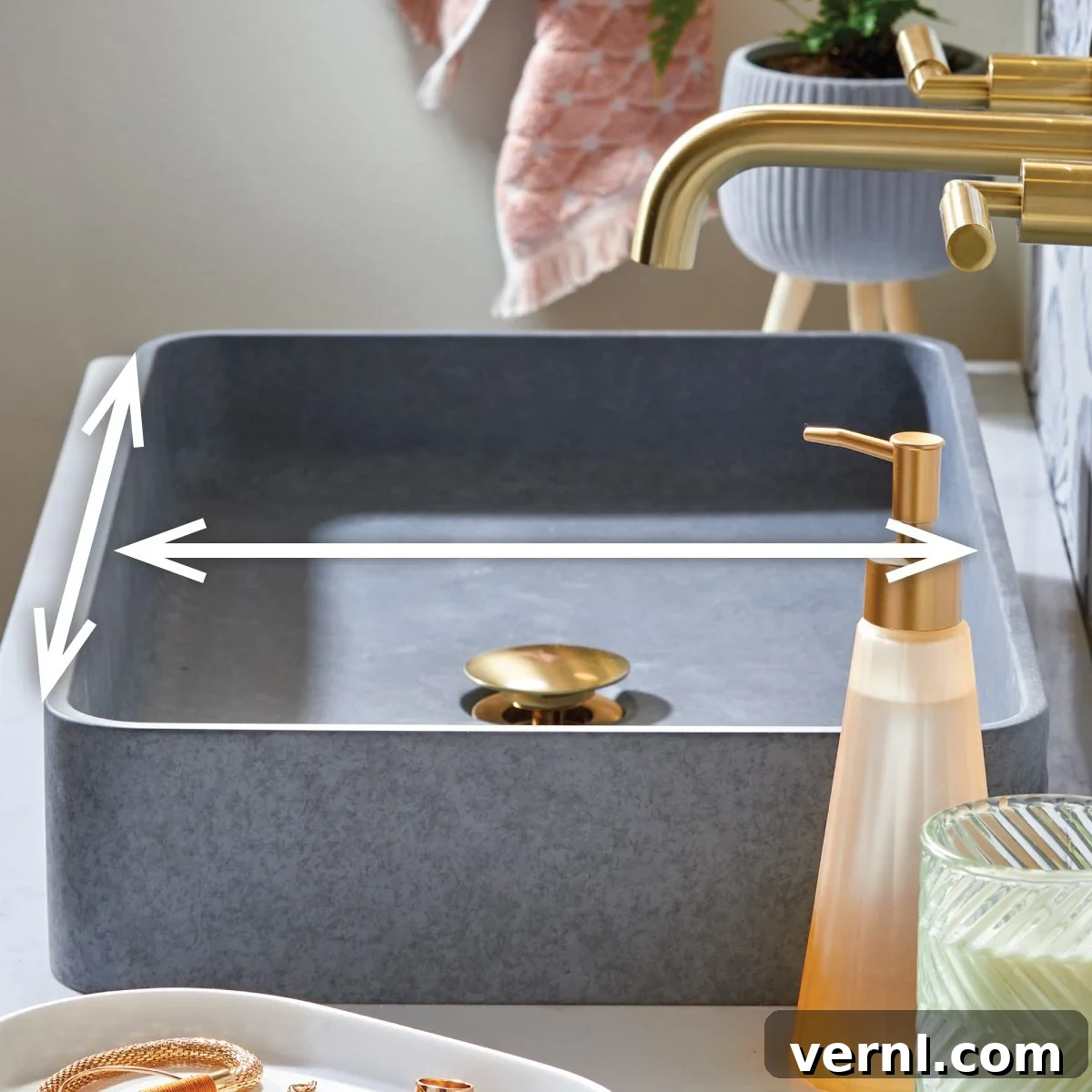
Vessel sinks are designed to sit entirely on top of the countertop, resembling a decorative bowl. These sinks are often chosen for their striking visual impact, acting as a focal point in the bathroom. They come in an incredible variety of materials, shapes, and finishes, from smooth ceramic to rugged natural stone or intricate glass. Because of their height, vessel sinks often require taller faucets (vessel faucets) and can dictate a slightly lower vanity height to ensure comfortable use. They add a touch of artistic flair and luxury to any bathroom design.
Deciphering Common Bathroom Sink Dimensions and Their Applications
Once you understand the different types, the next crucial step is to consider sizes. While many standard-sized bathrooms easily accommodate common sink dimensions, specific needs—such as a compact powder room, a historical conversion from a closet, or an expansive family bathroom requiring a super-long countertop—might necessitate exploring non-standard options. Thankfully, manufacturers offer a wide range of sizes to fit almost any scenario, though practical limitations exist, particularly regarding depth and width, which are often constrained by countertop dimensions or local plumbing codes. Sink length, however, offers more flexibility, limited primarily by the available countertop space and vanity design.
Rectangular and Oval Sinks: Versatility in Shape
Rectangular and oval sinks are perhaps the most popular shapes, offering a timeless appeal and efficient use of space. Their dimensions can vary significantly:
-
Compact & Space-Saving Options (Small Rectangular/Oval)
Typically ranging from 15 to 20 inches long and 9 to 12 inches wide, with a depth between 5-3/4 inches and 7 inches. These smaller sinks are ideal for powder rooms, half-baths, or guest bathrooms where space is at a premium. They fit neatly into compact vanities and allow for more countertop space on either side, even in tight quarters. Their efficient footprint ensures functionality without overwhelming the room.
-
Standard & Functional Choices (Medium Rectangular/Oval)
Generally measuring from 20 to 30 inches long, 19 to 24 inches wide, and about 7 inches deep. This category represents the workhorse of bathroom sinks, fitting comfortably into most standard-sized vanities (24-inch to 36-inch wide). They offer ample basin space for daily tasks, from handwashing to face washing, striking a balance between usability and counter space. Medium-sized sinks are perfect for primary bathrooms and family bathrooms.
-
Luxurious & Statement Pieces (Large/Trough Rectangular/Oval)
These larger sinks can span from 30 to 50 inches long, 19 to 24 inches wide, and are typically about 5 inches deep. Often referred to as “trough-style” or double-basin sinks, they are designed for expansive bathrooms or shared spaces. While they make a grand statement, fitting these larger sinks on a standard countertop can be challenging. They are best suited for custom-built vanities or as striking wall-mount installations in spacious bathrooms, providing ample room for multiple users simultaneously.
Round Sinks: Classic Elegance and Soft Lines
Round sinks introduce a softer aesthetic, often chosen to complement curved fixtures or to add a touch of classic elegance. Their sizes vary:
-
Small Round Sinks: Ideal for Powder Rooms
With diameters ranging from 7 to 10 inches, these are the smallest round options. They are excellent for tiny powder rooms or corner installations where every inch counts, providing essential functionality without encroaching on valuable space. Despite their small size, they can be quite impactful visually.
-
Medium Round Sinks: Everyday Utility
Typically 11 to 15 inches in diameter, these are standard choices for most bathrooms. They offer a comfortable basin size for daily use and pair well with various vanity sizes. Their circular shape provides a pleasing contrast to angular bathroom elements.
-
Large Round Sinks: A Bold Design Statement
Measuring 16 to 20 inches in diameter, large round sinks are less common but can be a deliberate design choice for spacious bathrooms. They offer a generous basin and can serve as a focal point, especially when paired with a unique countertop material or a striking faucet. Depth for round sinks typically ranges from 5 to 8 inches across all sizes.
Pedestal Sinks: Timeless Charm and Open Space
Pedestal sinks are valued for their slender profile and ability to maximize floor space. They commonly measure between 22 and 28 inches long, though variations can range from a compact 15-1/2 inches to over 30 inches. The width usually falls between 17 and 20 inches. These dimensions ensure they fit well in most compact bathrooms while providing adequate washing space. Their elegance often comes at the cost of countertop and storage space, making them a design-driven choice.
Wall-Mount Sinks: Modern Minimalism and Maximized Floor Space
Designed for ultimate space-saving, wall-mount sinks typically range from 16 to 23 inches long, 15 to 18 inches wide, and 5 to 8 inches deep. However, their primary advantage is adaptability, with models available under 10 inches long specifically engineered for extremely tiny bathrooms or even specialized applications. The flexibility in length allows them to be incorporated into narrow spaces, providing essential handwashing facilities where no other sink type would fit.
Vessel Sinks: Artistic Flair Above the Counter
Vessel sinks, by their nature, add height and visual interest. Round vessel sinks typically have a diameter of 14 to 20 inches and are 4 to 7 inches deep. Rectangular and square vessel sinks tend to be shallower, with lengths from 15 to 25 inches and widths of 16 to 20 inches. Because they sit atop the counter, their open design allows for wider basin openings compared to top-mount or undermount sinks. The key consideration for vessel sinks is ensuring the overall height (countertop + sink rim) remains at a comfortable, usable level, which often means selecting a lower vanity.
Crucial Factors for Selecting Your Ideal Bathroom Sink
Choosing the right sink involves more than just picking a favorite style or the right dimensions. A holistic approach considers several interconnected factors to ensure your selection perfectly integrates with your bathroom’s design, functionality, and your daily needs.
Assessing Your Bathroom’s Layout and Size
The physical constraints of your bathroom are the primary determinants. A small powder room will demand a compact pedestal or wall-mount sink, or a small drop-in, to maintain an open feel. A large master bathroom, conversely, might accommodate a grand trough sink or a double vanity with two medium-sized undermounts. Consider the flow of traffic, door swings, and the proximity of other fixtures like toilets and showers.
Matching Your Vanity and Countertop
The sink and vanity are an inseparable pair. If you’re keeping an existing vanity or purchasing a new one, its dimensions will dictate the maximum sink size. For undermount sinks, you’ll need a solid-surface countertop like granite or quartz, while top-mounts are more forgiving with laminate or tile. The countertop material also influences how easily you can cut a custom opening for an irregular sink shape.
Considering Usage and Functionality
Who will be using this bathroom, and for what purposes? A busy family bathroom requires a durable, easy-to-clean sink with ample splash protection. A guest bathroom might prioritize aesthetics and unique design. If children will be using the sink, consider basin depth to minimize splashing and overall height for accessibility (perhaps incorporating a small stool). For an ADA-compliant bathroom, specific dimensions for wall-mount or open-base sinks are crucial.
Embracing Style and Aesthetic Harmony
Your sink should complement your bathroom’s overall design aesthetic. A sleek, minimalist bathroom might benefit from an undermount or wall-mount sink with clean lines. A traditional or farmhouse-style bathroom could feature a classic pedestal sink or an elegant top-mount. Vessel sinks offer a contemporary or even rustic focal point. Ensure the sink’s material, color, and shape harmonize with your chosen faucets, hardware, lighting, and tilework.
Material Matters: Durability and Maintenance
Bathroom sinks are available in a variety of materials, each with its own characteristics. Porcelain and ceramic are popular for their durability, ease of cleaning, and classic look. Glass offers a modern, translucent appeal but can show water spots more readily. Natural stone (marble, granite) provides a luxurious feel but requires more specialized care to prevent staining. Stainless steel offers an industrial, robust aesthetic. Consider how much maintenance you’re willing to commit to and the material’s resistance to chips, scratches, and stains.
Budgeting for Your Bathroom Sink Investment
Sink prices can vary widely based on type, material, brand, and size. Setting a realistic budget early in your remodel planning will help narrow down your options. Remember to factor in not just the cost of the sink itself but also associated expenses like a new faucet (especially for vessel sinks), installation supplies, and potential professional labor costs if you’re not DIYing.
Addressing Accessibility and Special Needs
If accessibility is a concern, particularly for those with mobility challenges, look for ADA-compliant sinks. These are typically wall-mounted or integrated into vanities that allow for wheelchair clearance underneath, often with specific height requirements and faucet types for ease of use. Planning for accessibility from the outset ensures a comfortable and safe bathroom for all users.
Accurate Measurements: The Key to a Perfect Fit
Even the most stunning sink can disappoint if it doesn’t fit correctly or doesn’t comply with local building codes. Precise measurements are not just important for the sink itself, but also for the surrounding fixtures and required clearances. Always use a reliable tape measure and double-check your figures.
- Total Space Available: Measure the length and width of the countertop area where the sink will be installed. This provides your absolute maximum dimensions.
- Faucet Allowance: Remember to allow adequate space for your faucet installation. You’ll typically need at least 2 inches from the back of the sink to the back wall (or backsplash) to accommodate most faucet bases and handles. For vessel sinks, consider the spout reach and handle clearance in relation to the basin.
- Side Clearances: According to plumbing codes, you generally need to maintain a minimum of 30 inches from the centerline of the sink to the centerline of any adjacent fixture, such as a toilet or another sink in a double vanity. This ensures comfortable elbow room and accessibility.
- Front Clearances: Furthermore, allow at least 21 inches from the front edge of the sink to the facing wall or obstruction (like a shower door or opposite vanity). This provides comfortable standing room and prevents a cramped feeling.
- Depth Considerations: While depth primarily relates to splash control, ensure the sink’s depth doesn’t interfere with any drawers or shelving within the vanity below, especially for undermount installations where the basin extends into the cabinet.
- Local Code Compliance: Always, without exception, refer to your local municipality’s building and plumbing codes to ensure full compliance. These codes are in place for safety, functionality, and resale value, and they can vary significantly by region. A quick call to your local building department can save you significant headaches and costly reworks later on.
Frequently Asked Questions About Bathroom Sinks
As you plan your bathroom renovation, various questions are bound to arise. Here are answers to some of the most common inquiries regarding bathroom sinks:
What are the standard heights for bathroom sinks?
While many bathroom sinks are traditionally installed with the rim at about 32 inches from the floor, modern trends often see sinks installed higher, up to 34 to 36 inches. Many adults find this taller height more comfortable, reducing the need to bend over excessively. However, for households with children, a standard height (or even a step stool) might be more practical. Always consider the primary users of the bathroom when deciding on the installation height.
Is P-trap placement always directly below the drain?
In most standard installations, yes, the P-trap (the U-shaped pipe that holds water to prevent sewer gases from entering the home) must be directly below the sink drain. This configuration ensures proper drainage flow and effective trapping of those unwanted sewer gases. While plumbing codes sometimes permit combination traps—allowing a single trap to serve multiple sinks—these are limited to specific circumstances and often require consultation with your local plumbing inspector to ensure compliance and proper function.
Why is ensuring a level sink crucial?
Absolutely, a bathroom sink must be installed perfectly level. This isn’t just for aesthetic reasons; it’s critical for proper drainage. An unlevel sink will cause water to pool in one corner or along one edge of the basin, leading to unsightly water stains, potential mildew growth, and an inefficient draining system. Always use a spirit level during installation to ensure the sink is perfectly horizontal in all directions.
What’s the difference between a drop-in (top-mount) and undermount sink?
The primary difference lies in their installation method and visual appearance. A **drop-in (top-mount)** sink has a visible rim that sits on top of the countertop, making it generally easier to install and often more budget-friendly. An **undermount** sink is installed underneath the countertop, creating a seamless, sleek look and making countertop cleaning effortless as crumbs and liquids can be wiped directly into the basin. Undermount sinks typically require solid surface countertops and more complex installation.
Can I replace my bathroom sink without changing the vanity?
Yes, often you can replace your sink without replacing the entire vanity, but it depends on the type of sink you currently have and the type you want to install. If you’re replacing a top-mount with another top-mount of the same or very similar dimensions, it’s often straightforward. Replacing an undermount can be more complex due to how it’s secured to the countertop. Changing sink types (e.g., from top-mount to vessel) will definitely require modifications to the countertop and possibly the plumbing, and careful measurement is crucial to ensure the new sink fits the existing cutout or can be accommodated by a new cut.
How do different sink materials affect my choice?
The material of your sink influences its durability, aesthetic, maintenance requirements, and cost. Ceramic and porcelain are common, affordable, and easy to clean. Natural stone (granite, marble, travertine) offers luxury and unique patterns but requires sealing and more careful cleaning. Glass provides a modern, translucent look but can be prone to scratching and showing water spots. Stainless steel is durable and modern, often seen in industrial or minimalist designs. Consider your lifestyle, maintenance tolerance, and desired aesthetic when choosing a material.
What should I consider for faucet compatibility?
Faucet compatibility is crucial. Sinks come with various pre-drilled faucet holes: a single hole for a monoblock faucet, three holes for a widespread faucet (handles separate from spout), or a center-set faucet (handles and spout on a single plate). Vessel sinks often require a taller, wall-mounted or counter-mounted vessel faucet. Always check the number and spacing of faucet holes on your chosen sink and ensure it matches the faucet you intend to install. Also, consider the spout reach to ensure water flows comfortably into the basin without splashing.
Final Thoughts on Your Sink Selection Journey
Choosing the right bathroom sink is a decision that balances aesthetics, functionality, and practical constraints. By understanding the various types of sinks, their common dimensions, and the crucial factors that influence your choice—from bathroom size and style to local codes and personal preferences—you can confidently select a sink that not only looks fantastic but also serves your needs for years to come. Remember, careful planning, precise measurements, and a clear vision for your bathroom remodel are the cornerstones of a successful project. Invest the time now to research and measure, and you’ll be rewarded with a beautiful, functional bathroom that enhances your home’s comfort and value.