The Slim Jim: A Retro Tool for Unlocking Cars (and Why It’s Obsolete Today)
The memory of a locked-out car is a universally frustrating experience, often leading to a frantic search for a solution. For many, including myself, it evokes a vivid recollection of quick thinking and unexpected success. My first encounter with a Slim Jim happened during one such predicament: my keys were securely ensconced inside my ’81 Subaru. I was just sixteen, and luck would have it that a stranger in the parking lot possessed this intriguing tool. Despite his lack of expertise, my fascination with ’80s action movies, where master car thieves wielded Slim Jims with effortless success, spurred me to try. To my genuine astonishment, it worked precisely as advertised, a thin strip of metal granting access to an otherwise impenetrable vehicle.
Alex Black, chief marketing officer at EpicVIN, shares a similar sentiment regarding the tool’s historical relevance: “I’ve certainly employed a Slim Jim in my repo days, particularly with older units where keys would disappear halfway through transport. It was such a sort of coming-of-age experience for anyone working at repo lots or with tow trucks.” However, he quickly adds a crucial caveat reflecting modern realities: “Now, however, it’s a relic more than a tool.”
While the Slim Jim’s heyday might be long gone, its legacy endures. For enthusiasts of classic automobiles or those seeking a touch of Miami Vice or Grand Theft Auto nostalgia, understanding this iconic tool remains fascinating. This guide will delve into how Slim Jims were once used, discuss their profound limitations on modern vehicles, and explore contemporary alternatives for car lockouts, ensuring you’re prepared whether you drive a vintage gem or a state-of-the-art machine.
What Exactly Is a Slim Jim? Unpacking a Classic Car Entry Tool
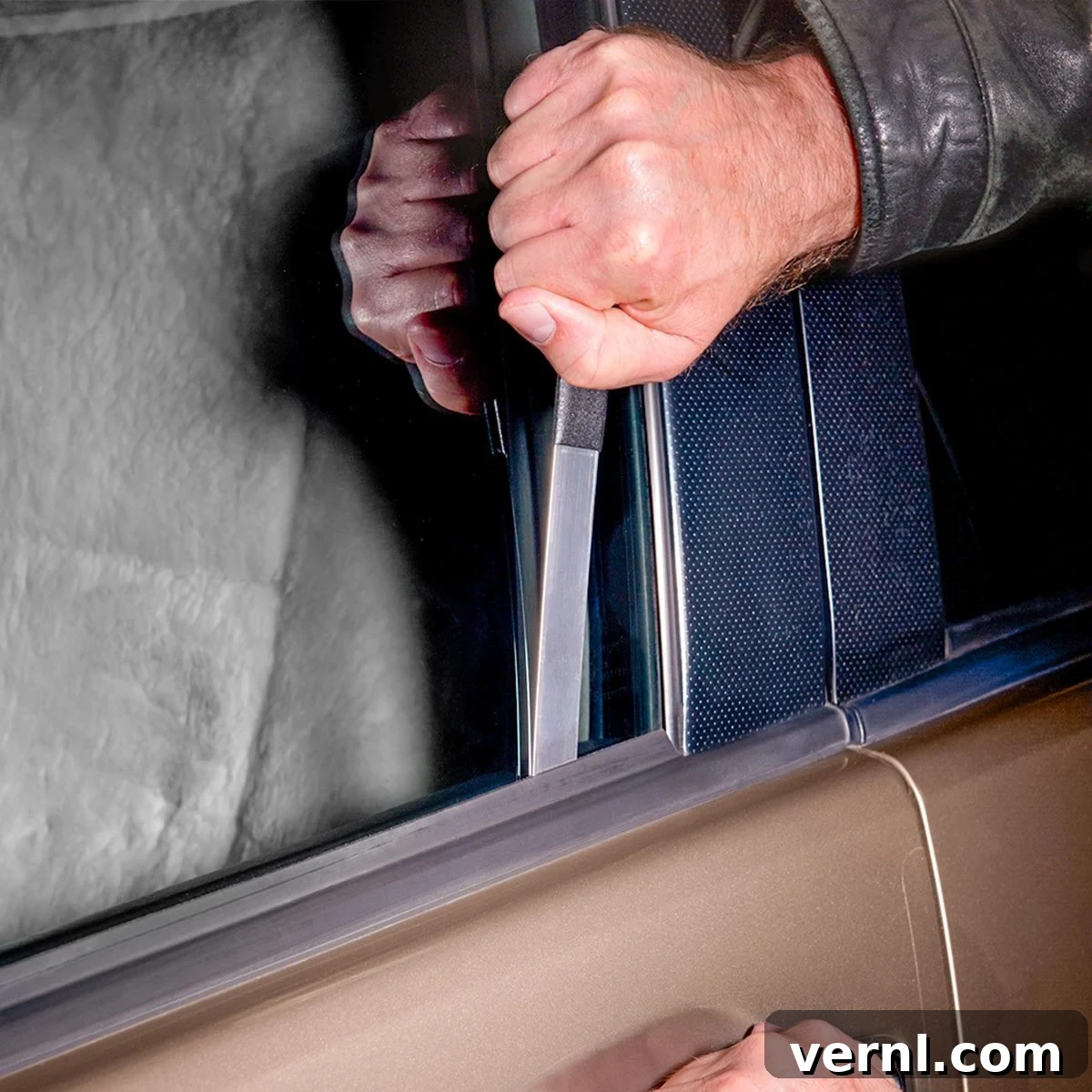
At its core, a Slim Jim is a deceptively simple device: a thin, flat strip of metal, typically crafted from durable stainless steel or spring steel. These specialized tools usually measure between one and two feet in length and one to two inches in width. Its ingenious design allows it to be inserted discreetly into the narrow gap between a car window and its rubber weatherstripping, granting a user a crucial pathway into the door’s inner workings. Once inside, its primary purpose is to manipulate the internal locking mechanism, specifically targeting the rods or linkages that connect the interior door handle to the latch, ultimately triggering the unlock function of the car door.
Master auto mechanic Chris “Moose” Pyle, a seasoned expert with decades of experience, explains the foundational principle that made the Slim Jim so effective: “Decades ago, cars were built with rods that went from the car’s interior door handle to the latch. If you could grab that rod and pull it, the door would unlock. That’s why the Slim Jim was invented.” This straightforward mechanical design was commonplace in vehicles for generations, making cars of that era vulnerable to this relatively simple bypass technique. Pyle emphasizes the stark shift in automotive engineering that occurred: “On newer cars, give or take above 2000, this tool will not work.” This statement encapsulates the profound changes in vehicle security that have rendered the classic Slim Jim largely obsolete in today’s automotive landscape.
Historically, the widespread success of the Slim Jim as an unauthorized entry tool spurred significant innovations in car security. Automakers recognized the inherent vulnerability posed by easily accessible mechanical linkages and began designing internal door mechanisms that were far more difficult to access and manipulate externally. This evolution marked a critical turning point, transitioning from purely mechanical locking systems to increasingly complex electronic and integrated security features that characterize modern vehicles.
A Step-by-Step Guide: How to Use a Slim Jim to Open Your Classic Car
Before attempting to use a Slim Jim, it’s imperative to understand that this technique is almost exclusively applicable to vehicles manufactured before the early 2000s, which feature exposed locking rods within the door panel. Modern vehicles have entirely different internal structures and security measures. Always ensure you have legitimate permission and proof of ownership before attempting to unlock any vehicle, as improper use can lead to serious legal consequences and potential damage.
- Positioning the Tool: Begin by carefully inserting the Slim Jim into the narrow gap between the car window and the rubber weatherstripping. Aim for a spot approximately two to three inches away from the door lock assembly itself. This initial placement is crucial for gaining optimal access to the internal mechanisms without causing undue friction or damage.
- Navigating the Interior: Gently slide the Slim Jim downwards into the door compartment. This step requires a delicate touch and a keen sense of feel, as you are essentially “fishing” blind for internal components. Your objective is to locate the vertical locking rod or the horizontal latch mechanism that directly activates the lock. For improved visibility, especially in dimly lit conditions, a small flashlight can be immensely helpful to peer into the narrow gap and identify the components you’re trying to target.
- Engaging the Mechanism: Once you’ve successfully identified the target rod or latch, carefully maneuver the Slim Jim to hook onto it. This often involves a slight twist or rotation of the tool to ensure a secure grip without slipping. The precise technique will vary slightly depending on the specific car model and its internal door architecture, as manufacturers had different designs.
- Actuating the Lock: With the Slim Jim securely hooked, it’s time to apply pressure. Depending on the car’s setup, you might need to pull the rod upwards to disengage a vertical locking pin, or pull or push the mechanism sideways to release a latch. You will invariably encounter some resistance, as you are manipulating a spring-loaded or tensioned part. Apply strength steadily and firmly, but never resort to brute force. Excessive force can easily damage critical internal components, such as door cables or electrical wiring, or even bend the Slim Jim itself.
- Patience and Precision: This process is rarely instantaneous. It requires significant patience, a meticulous approach, and often, several attempts to find the correct point of engagement and apply the right amount of pressure. Listen carefully for the distinct “click” sound that signifies the lock has been successfully disengaged.
“It takes a lot of practice to get the hang of it and develop the feel and technique,” says Alan Gelfand, an auto shop owner and mechanic with more than three decades of experience. “What seems to be quite simple requires the knowledge of the inner workings of each vehicle model. I have been practicing the technique for years and still have to deal with difficult cases.” His words underscore that while the concept is simple, the successful execution demands skill honed through extensive experience and an understanding of automotive mechanics.
Essential Pro Tips for Effective Slim Jim Usage
- Lubrication for Smoothness: Applying a light, thin layer of a general-purpose lubricant, such as WD-40, onto the Slim Jim’s surface can significantly reduce friction. This allows the tool to slide more easily and smoothly between the window and weatherstripping, minimizing the risk of damage to either the car’s delicate seals or the tool itself, and making the entire process less cumbersome.
- Slow and Steady Wins the Race: Rushing the process is a common pitfall and a recipe for failure and potential damage. “If you hurry, you will overlook the mechanism or break something,” warns Alex Black. Adopt a deliberate approach, pacing yourself and moving the tool slowly and steadily. This careful movement significantly increases your chances of correctly identifying and engaging the locking mechanism without causing inadvertent harm.
- Maintain Tool Integrity: Always hold the Slim Jim flat and parallel to the window’s surface as you insert and manipulate it. This technique is crucial for preventing the tool from bending, twisting, or warping, which could render it ineffective for future use. More importantly, maintaining this orientation minimizes the risk of scratching the car’s glass or damaging the delicate weatherstripping and paintwork around the window frame.
- Practice on an Unlocked Car: If you have access to an older, unlocked vehicle with exposed internal rods, utilize it as a practice ground. This hands-on experience allows you to develop a crucial “feel” for the internal components, understand how the tool interacts with them, and refine your technique in a low-stakes environment, without the added pressure of an emergency lockout.
Common Pitfalls and Mistakes When Using a Slim Jim
Using a Slim Jim incorrectly can lead to more significant problems than the initial lockout itself. Awareness of these common mistakes can save you considerable time, money, and frustration.
- Excessive Force: Applying too much force is perhaps the most common and damaging mistake. This can easily bend or even break the Slim Jim itself, rendering it useless. Far more critically, it risks causing severe damage to the car’s internal components such as door cables, electrical wiring, window regulators, or the weatherstripping. In some rare and unfortunate scenarios, applying force in the wrong area can even inadvertently deploy airbags, leading to extremely costly repairs and potential injury.
- Blindly Fishing Around: Without a clear understanding of the internal mechanism you are targeting, aimlessly probing inside the door cavity is a futile exercise. “It’s a waste of time and may result in damage to the components,” cautions Alan Gelfand. This haphazard approach significantly increases the risk of snagging and severing wires, disconnecting crucial linkages, or scratching painted surfaces within the door panel, creating new problems.
- Lack of Familiarity with Locking Mechanisms: Different car models, even from the same era, can have slightly varied locking mechanisms and internal layouts. Attempting to unlock a car without at least a basic understanding of its specific internal setup is a significant disadvantage and greatly reduces your chances of success. Researching or practicing on similar models can help mitigate this.
- Using a Slim Jim on Modern Vehicles: As repeatedly emphasized throughout this guide, the classic Slim Jim tool is not designed for contemporary cars. Attempting to use it on a modern vehicle is not only ineffective but almost guaranteed to cause damage, given the complex electronics, wiring harnesses, and reinforced structures within newer car doors. This is a common and costly mistake.
Legal Considerations: Is Owning or Using a Slim Jim Legal?
Beyond the technical challenges and potential for vehicle damage, there are crucial legal ramifications to consider regarding Slim Jims. In many jurisdictions across various states and cities, Slim Jims are categorized as “burglarious tools.” This classification means that merely possessing one, or attempting to use one, especially in proximity to a vehicle that is not verifiably your property, can be deemed a criminal offense, potentially leading to arrest and charges.
“Having a Slim Jim near a car that is not your property will get you arrested in a hurry,” warns Alex Black. He further advises, “Even at your car, a policeman witnessing you do this will think that the car is not owned by you. Always be prepared to provide proof of ownership.” This highlights the critical importance of always carrying your vehicle registration, driver’s license, or other identification that explicitly proves you are the rightful owner, should you ever find yourself in this situation. When in doubt about legalities or facing a lockout, it is always safer, and often legally prudent, to contact a professional locksmith or roadside assistance rather than attempting self-entry with a potentially suspicious tool.
The DIY Approach: Crafting Your Own Slim Jim
For those interested in the mechanical ingenuity of the tool, or perhaps needing a last-resort option for an older vehicle where commercial Slim Jims are unavailable, crafting a basic version is surprisingly straightforward. The core requirement is a thin, strong, and flexible piece of steel that can be shaped. Common starting materials include readily available steel stock from hardware stores, a repurposed hacksaw blade, a sturdy metal ruler, or even the steel spine from a broken windshield wiper – emphasizing the improvisational nature of this tool’s origins.
- Shaping the Hook: The most critical part of a Slim Jim is its working end – the precisely shaped curved hook designed to snag internal rods. Using appropriate metal cutting tools (such as aviation snips, a Dremel with a cutting disc, or a file), carefully shape one end of your chosen steel strip into a gentle, upward-curving hook. This hook needs to be precise enough to catch a rod but not so sharp or angular as to damage it or get stuck.
- Smoothing Edges: Once the hook is formed and the overall shape is achieved, use sandpaper or a metal file to meticulously smooth down all sharp edges. This step is absolutely vital to prevent scratching the car’s paint, glass, or internal wiring during use, and to make the tool significantly safer and more comfortable to handle.
- Enhancing Grip: For better ergonomics, improved control, and to prevent slippage during delicate manipulation, wrap the opposite end (the handle) with several layers of electrical tape. This creates a more comfortable and secure grip, especially when applying upward or sideways pressure.
While a DIY Slim Jim can be functional, remember that commercially produced versions are typically manufactured from specific grades of spring steel, engineered for optimal flexibility, durability, and a smooth finish. Exercise caution and realistic expectations when relying on a homemade tool, as its performance may vary.
The End of an Era: Why Slim Jims Fail on Modern Cars
The dawn of the 21st century brought about a radical transformation in automotive security, rendering the traditional Slim Jim almost entirely obsolete. This monumental shift wasn’t due to a single innovation but rather a multifaceted evolution in vehicle design and engineering. Most modern cars feature a sophisticated array of security measures that collectively thwart the simple mechanical bypass method of a Slim Jim.
- Side-Impact Protection Bars: A primary physical barrier in contemporary vehicles is the integration of robust side-impact protection bars within the door structure. These heavy-duty steel beams are designed to protect occupants in a collision, but they also inadvertently create an impenetrable shield, blocking any access to the internal locking rods that a Slim Jim would typically target.
- Complex Electronic Locking Systems: Modern cars predominantly rely on advanced electronic locking systems. Instead of a direct mechanical linkage from the handle to the latch, a signal from the key fob, interior button, or remote app sends an electronic command to a solenoid or actuator that operates the lock. There are simply no mechanical rods for a Slim Jim to manipulate. Even if illicit access were gained into the door cavity, there’s no physical, manipulable component to snag.
- Advanced Sensors and Alarms: Many newer vehicles are equipped with an array of sensitive sensors, including those designed to detect intrusion, tampering, or even pressure changes. Inserting a Slim Jim could easily trigger the car’s sophisticated alarm system, drawing unwanted attention and potentially disabling other crucial vehicle functions.
- Integrated Door Panels and Wiring Harnesses: The interior door panels of modern cars are far more intricate and densely packed. They often contain complex wiring harnesses for power windows, side mirrors, speakers, door modules, and various other electronic components. Attempting to force a Slim Jim into these tightly packed spaces risks damaging expensive electrical systems, leading to far greater repair costs than a simple lockout service.
- Double Locking Mechanisms: Some advanced security systems employ a “double locking” or “deadlocking” feature. This means that even if an internal door handle is pulled or an interior button is pressed after an initial breach, the door remains securely locked. This adds another formidable layer of defense against forced entry attempts.
“So the Slim Jim became obsolete,” confirms Chris “Moose” Pyle. However, he notes an interesting linguistic phenomenon: “New tools have been invented, and they too have been named Slim Jim. Although not made by the original inventor, most people locked out of their cars still say they need a ‘Slim Jim tool.'” This highlights how deeply ingrained the name became as a generic term for any car-unlocking tool, even as the underlying technology and methods of vehicle entry have changed dramatically.
Modern Solutions: Effective Alternatives to the Slim Jim
If you find yourself locked out of a modern vehicle, reaching for a Slim Jim is likely a fruitless and potentially damaging endeavor. Fortunately, contemporary problems often have contemporary solutions. While the methods vary, the goal remains the same: safe, efficient, and damage-free entry.
- The Coat Hanger Method (Limited Use): For a small subset of vehicles, typically older models with an interior unlock button situated prominently on the top of the door armrest (a design choice less common in very new cars), a straightened coat hanger or other long, rigid wire can sometimes be effective. The technique involves carefully sliding the hanger through a slightly wedged-open door or window gap and attempting to depress the unlock button. Chris Pyle recommends a V-shaped rod for this, suggesting it “will slip beside the glass and then turn to get better leverage for pushing the button.” This method requires considerable precision and patience, and success is far from guaranteed, often risking paint or weatherstripping damage.
- Plastic and Inflatable Door Wedges with Long-Reach Tools: Professional locksmiths often employ specialized tools specifically designed for newer vehicles with tight tolerances between doors and frames. They might use non-marring plastic wedges or inflatable “air wedge” bags to gently and safely pry open the top rear corner of the driver’s door, creating a small, secure gap without damaging the paint or frame. Through this gap, they can then insert a long, flexible metal rod (often referred to as a “long reach tool”) with a specialized tip to manipulate interior handles, buttons, or even the door latch itself. “With the right tools, you can get into a car in about three minutes,” says Pyle, underscoring the efficiency of professional equipment. “The tools are available online, and YouTube has videos showing how to use them on many vehicles.”
- Remote Unlock Services: Many modern automakers, including Ford, Tesla, General Motors (via OnStar), BMW, and Mercedes-Benz, offer sophisticated telematics services that can remotely unlock your car via a smartphone app or a direct call to their customer service center. This is often the safest, quickest, and most damage-free option for subscribers, provided your car has an active subscription, cellular connectivity, and you have access to your account.
- Spare Keys and Key Fobs: The simplest and most frequently overlooked solution is often a spare key. Keeping a spare key in a secure location, with a trusted family member, or even in a magnetic hide-a-key box (if you’re comfortable with the minor security implications) can prevent countless lockout situations before they even begin. Consider this a primary preventative measure.
- Calling a Professional Locksmith or Roadside Assistance: For the vast majority of modern car lockouts, especially if time is of the essence, your vehicle has complex electronic systems, or you’re unfamiliar with specialized tools, your best and safest course of action is to call a professional locksmith or your roadside assistance provider. They possess the necessary expertise, specialized training, and purpose-built equipment to gain entry without damaging your vehicle’s complex and often expensive systems. While their services will incur a fee, it is invariably far less expensive than repairing damage caused by improper or forced DIY attempts.
Meet Our Automotive Experts
The invaluable insights and expert advice provided in this comprehensive article are made possible by the generous contributions of these seasoned automotive professionals:
- Chris “Moose” Pyle: A master-certified technician boasting over 20 years of extensive automotive experience across a wide range of vehicles. Since 2006, he has also served as a trusted expert for JustAnswer, a prominent expert-on-demand platform, sharing his wealth of knowledge and practical advice with a global audience.
- Alan Gelfand: The dedicated owner of German Car Depot for more than three decades. His establishment in Hollywood, Florida, is an independent automotive service center renowned for its specialized expertise in the service and meticulous repair of German vehicles, earning a reputation for precision and quality.
- Alex Black: As the chief marketing officer at EpicVIN, Alex brings over 15 years of comprehensive experience as a car expert. His diverse background includes significant roles at car auctions, with vehicle history providers, and across various other facets of the dynamic automotive industry.
Related Articles for Automotive Enthusiasts:
- Do You Know What That Little Button on Your Seat Belt Is For?
- What Those Lines on Your Backup Camera Really Tell You
- Here’s What The Small Panel On Your Car’s Front Bumper Is For