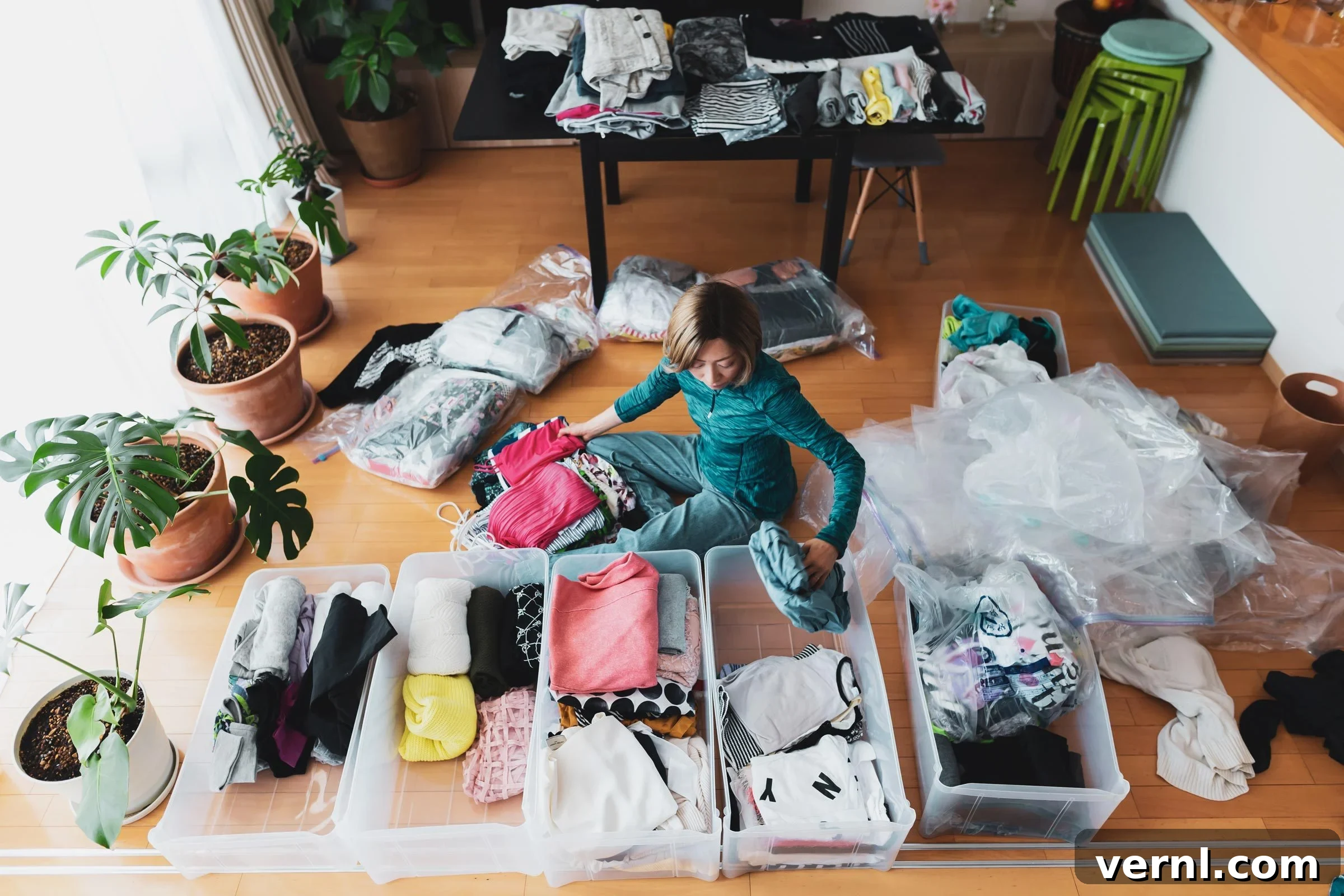
Do you often find yourself drowning in a sea of forgotten mail, overflowing junk drawers, or a closet that seems to swallow possessions whole? You’re not alone. For many, the aspiration of a tidy, organized home remains a distant dream, often topping New Year’s resolutions and spring-cleaning lists only to be met with procrastination and overwhelm.
The thought of tackling years of accumulated belongings can indeed feel daunting. But what’s the real impact of living amidst chaos? Is a messy living space truly that bad? According to researchers at DePaul University, the answer is a resounding yes. Our homes are often seen as an extension of ourselves, an outward reflection of our inner state. When our living environments are cluttered and chaotic, we tend to internalize that disarray, transforming spaces that once brought us comfort and joy into sources of psychological stress. This constant visual noise can contribute to feelings of anxiety, fatigue, and a diminished sense of control over our own lives. Understanding how to start decluttering, even when you feel completely overwhelmed, is the first step towards reclaiming your peace of mind.
Fortunately, achieving a serene and organized home is more attainable than you might think. We’re here to guide you through a proven methodology that simplifies the entire process. Michele Vig, the insightful founder and chief organizer at Neat Little Nest, has distilled the art of decluttering into three straightforward yet profoundly effective steps. By following her expert advice, you can transform your living spaces and, by extension, cultivate a calmer, more focused lifestyle. This comprehensive guide will walk you through each step, providing practical insights and actionable strategies to help you tackle clutter for good.
Step 1: Group by Category – The Foundation of Effective Decluttering
So, you’ve made the pivotal decision to embark on your decluttering journey. Congratulations! This initial commitment is often the hardest part. Now, the natural inclination for many is to tackle one room at a time, moving from the kitchen to the bedroom, then to the living room. While this approach might seem logical for simple tidying, Michele Vig, a seasoned expert in home organization, cautions against it when it comes to true decluttering. Her reasoning is both practical and insightful: “When you go room by room, it’s difficult to get a full picture of how much you have because you might have similar items scattered throughout the home.”
Imagine trying to pare down your wardrobe by just looking at your bedroom closet, only to remember you have seasonal clothes in the attic, old sweaters in the guest room, and workout gear in the laundry room. This fragmented view makes it impossible to accurately assess your inventory, often leading to keeping duplicates or items you no longer need simply because you haven’t seen all of them together. The power of decluttering lies in making informed decisions about your possessions, and that requires seeing the complete picture.
Vig’s superior approach is to declutter by category. This means focusing on one type of item at a time, regardless of where it resides in your home. This could be anything from books, toys, kitchen gadgets, sentimental items, or indeed, clothes. This method allows you to truly understand the volume of what you own and compare similar items directly, making the decision-making process far more efficient and effective. When you gather all items from a specific category, such as all your cooking utensils or all your cleaning supplies, you gain a holistic perspective that a room-by-room approach simply cannot provide. It’s a powerful strategy for reducing clutter comprehensively.
To begin, select a category that feels manageable or one that causes you the most stress. If your closet is overflowing, clothes might be a good starting point. However, remember that your clothes might not be confined to just one closet. They could be in storage bins in the basement, boxes in the attic, or even a forgotten drawer in another room. Vig emphasizes the importance of collecting *all* items belonging to your chosen category from *all* their various hiding places. Create a central “sorting station” – a bed, a table, or even a clear floor space – where you can lay out every single item from that category. This visual compilation can be surprising, even shocking, but it’s an essential step towards gaining control over your possessions. By bringing everything together, you eliminate the guesswork and can make truly decisive choices about what stays and what goes.
Step 2: Make Decisions – Cultivating Clarity with Joy and Service
Once you’ve diligently gathered all items from your chosen category into one central location, you stand at the threshold of the most crucial stage: making decisions. This step often proves to be the biggest hurdle for many, as it requires confronting not just physical items, but also the emotional attachments, memories, and “what if” scenarios tied to them. How do you objectively decide what to keep and what to let go? Is it finally time to part ways with those skinny jeans that haven’t fit in years? (The answer is likely a resounding yes for most!).
Michele Vig, drawing inspiration from her training with organization guru Marie Kondo, offers a brilliant and actionable framework for this decision-making process: the filters of “Joy” and “Service.” This dual approach allows for a balanced evaluation, ensuring that your home is filled with items that either uplift your spirit or genuinely contribute to the functionality of your daily life.
First, consider the “Joy” filter. As a certified organizing expert, Vig recommends putting your items “through a filter of joy will help you focus your energy on keeping what you love.” This isn’t about fleeting happiness, but a deeper sense of appreciation, aesthetic pleasure, or a positive emotional connection. Does the item bring a smile to your face? Does it evoke cherished memories? Do you truly love its design or feel? This filter encourages you to surround yourself with things that resonate with your authentic self and contribute to a positive atmosphere in your home. For example, a cherished photograph, a beautiful piece of art, or a beloved book might not have a practical “service,” but its ability to spark joy is undeniable and valuable.
However, we live in the real world, and not every essential item can fill our lives with resounding joy. Sometimes, you simply need a plunger to unclog a sink drain, or a reliable mixing bowl for baking. This is where the “Service” filter becomes indispensable. Items passing through this filter are those that serve a vital, practical purpose in your home. They might not be beautiful or sentimental, but they are necessary for daily living, maintenance, or specific tasks. Vig explains, “Items like a mixing bowl and a plunger ‘might not bring you resounding joy, but do provide an important role of service in your home.'” This filter helps you identify and retain tools, appliances, cleaning supplies, and other functional necessities that keep your household running smoothly.
By applying both the “Joy” and “Service” filters to each item in your category, you create a robust decision-making matrix. You will be left with a curated collection of possessions that either bring you genuine happiness or fulfill an essential role. This methodical process empowers you to confidently let go of items that no longer serve either of these purposes – whether they are broken, unused, outdated, or simply don’t align with your current lifestyle. Remember, decluttering is not about deprivation; it’s about intentional living and creating space for what truly matters.
Step 3: Organize – Creating Lasting Order and Accessibility
After the rigorous process of filtering your belongings for joy and service, you’ll find yourself with a significantly reduced and more meaningful collection of items. But the journey to a truly clutter-free and functional home isn’t complete without the final, crucial step: organizing. What’s the point of meticulously deciding what to keep if you can’t easily find or access what’s left? Effective organization transforms your curated collection into a system that supports daily living, reduces stress, and saves precious time.
When it comes to organizing any space, regardless of its size – from a sprawling walk-in closet to a compact bathroom drawer – Michele Vig advocates for a foundational principle: always put like with like. This might seem intuitive, but its consistent application is key to creating systems that are easy to understand, maintain, and navigate. The goal is to create designated homes for everything, making it effortless to retrieve items when needed and, just as importantly, to put them back where they belong.
Vig suggests starting at the macro level and then progressively subdividing. For instance, if you’re organizing your wardrobe, the macro level dictates that all clothes belong in the closet. From there, you begin to subdivide: long-sleeved shirts go together, tank tops go together, pants in one section, skirts in another. Vig advises continuing this process down to the micro level: “Put white tanks with white tanks and red tanks with red tanks.” This granular approach ensures that similar items are grouped together, preventing you from rummaging through unrelated items to find what you need. Think about your kitchen pantry: all baking ingredients together, all spices together, then further refined into baking powders, extracts, and different types of flour.
Once you’ve grouped like with like, the next step is to get creative and implement storage solutions that help maintain this order. “Use bins and storage items to help contain subcategories when it helps,” Vig advises. These organizational tools are not merely decorative; they serve a vital function in defining boundaries and preventing items from reverting to disarray. Drawer dividers are excellent for organizing socks, underwear, or office supplies, keeping small items neatly separated. Upcycling old mason jars provides an eco-friendly and stylish solution for storing cotton swabs, Q-tips, or tweezers in a bathroom. For larger items, consider robust shelves, clear containers, or even custom DIY drawer dividers made from wood to maximize space and efficiency.
It’s also important to recognize that different spaces require different organizational approaches. As Vig notes, “Some spaces, like a garage, might need a completely new storage system.” Garages often benefit from heavy-duty shelving, wall-mounted racks for tools, and clearly labeled opaque bins for seasonal items. Conversely, “Other spaces, [like] a kids’ room, might need less design work. A few bins or baskets might solve the problem at hand.” For children’s rooms, accessible, open bins encourage kids to put away their toys independently, promoting good habits from an early age. The key is to choose storage solutions that are appropriate for the items being stored, the space available, and the habits of the people using the space.
By investing time in thoughtful organization, you’re not just tidying up; you’re creating an intuitive system that makes daily life smoother, more efficient, and significantly less stressful. A well-organized home means less time searching for lost items, less visual clutter, and more mental clarity to focus on what truly matters.
Embarking on a decluttering journey is an investment in your well-being. By following these three powerful steps – grouping by category, making decisive choices based on joy and service, and thoughtfully organizing your remaining possessions – you can transform your home from a source of stress into a sanctuary of calm. Start today, even with just one small category, and experience the profound benefits of a decluttered life. Your organized home awaits, ready to support a clearer mind and a more peaceful existence.