
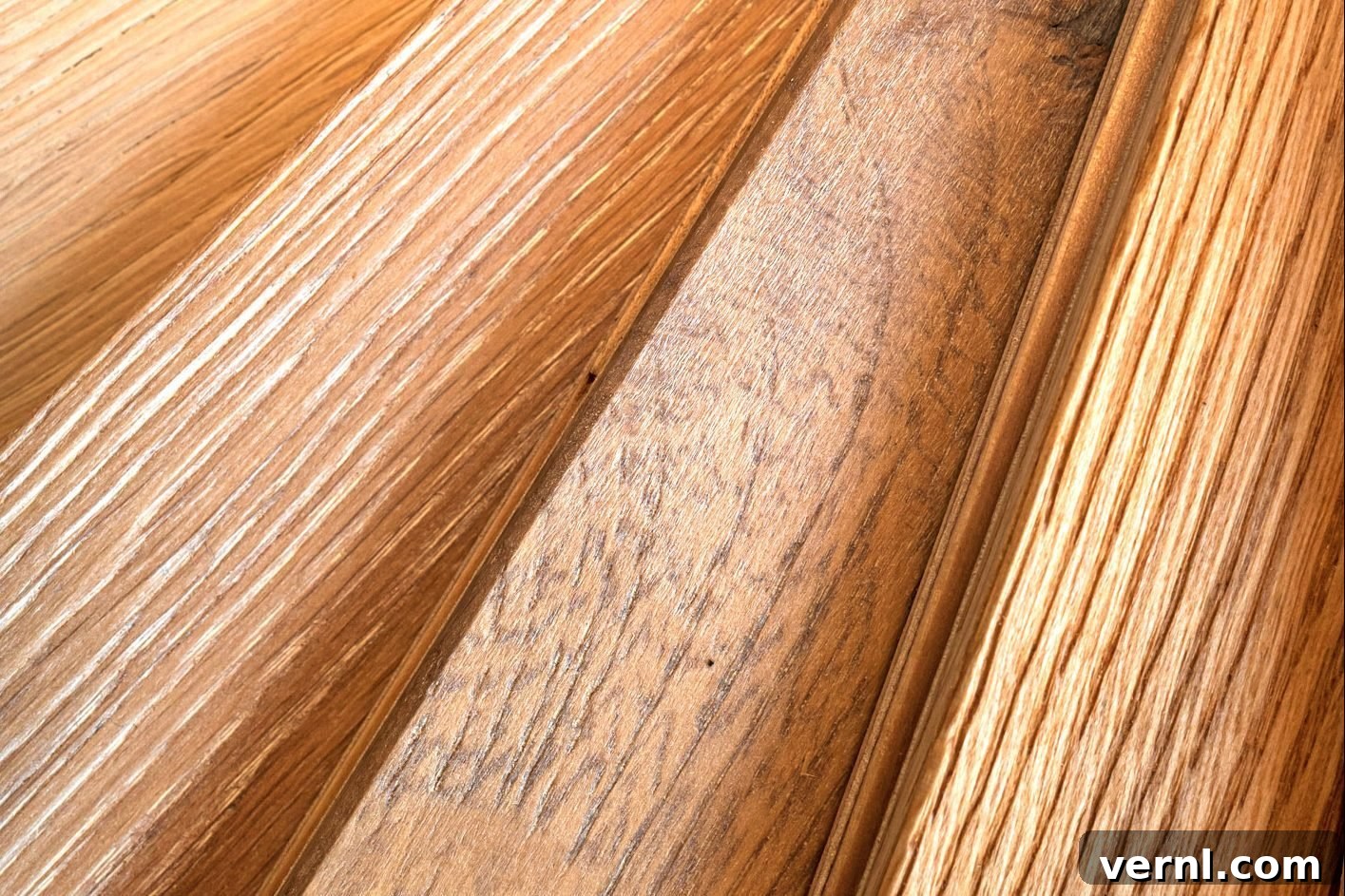
While the term “engineered wood” might evoke images of a high-tech bio-lab, rest assured—there’s no genetic modification involved. Instead, it refers to real wood that has been transformed through innovative manufacturing processes into versatile products. These products often surpass the strength, stability, and durability of the raw timber from which they originate, making them a cornerstone of modern construction and design.
It’s highly probable that you are currently surrounded by engineered wood. From the sturdy framework of your home to the elegant finishes in your kitchen, its presence is ubiquitous. The table you’re working at and the chair you’re sitting on might very well incorporate engineered wood components. Look around your kitchen or bathroom, and you’ll likely find it in the cabinets and shelves. Furthermore, if you’re inside virtually any building, the roof, walls, and subflooring almost certainly integrate engineered wood products. It’s also a highly popular and practical flooring material, offering both aesthetic appeal and robust performance.
Plywood stands as one of the earliest and most recognizable examples of engineered wood, with its origins tracing back to the 1920s. Today, engineered wood is widely celebrated as a green building material, primarily due to its sustainable production methods. Many engineered wood products are crafted from recycled wood fibers, chips, and veneers, optimizing the use of every part of a tree. This innovative approach has been instrumental in the construction industry’s efforts to remain sustainable, particularly in the face of dwindling lumber resources and the increasing demand for resilient building solutions. Its ability to maximize timber usage, reduce waste, and provide superior performance has solidified its vital role in eco-conscious building practices.
What Is Engineered Wood?
At its core, engineered wood products (EWPs) are advanced materials created by bonding various forms of wood, such as fibers, strands, or veneers, with resins or adhesives. The wood components can be sourced directly from freshly cut logs, or more commonly, recovered as byproducts like sawdust and wood chips from sawmills, promoting efficient resource utilization. The resins typically used are synthetic, carefully selected for their bonding strength and durability. The engineering process employs a combination of heat and pressure to compress and consolidate this mixture into a stable, usable form. This precise manufacturing allows for the creation of wood products with specific performance characteristics tailored to diverse applications.
Often referred to as man-made wood, manufactured board, or composite wood, engineered wood retains many of the desirable qualities of solid wood, including its workability, inherent resilience, and excellent thermal insulation properties. However, through the meticulous engineering process, it often significantly improves upon these natural characteristics. For instance, the controlled manufacturing environment minimizes natural defects like knots and warps, leading to a more consistent and reliable product.
The Engineered Wood Association, originally established in 1933 as the American Plywood Association (and still widely recognized by its APA acronym), plays a crucial role in the advancement and promotion of EWPs. Its extensive web resources, such as detailed product guides, highlight the myriad ways engineered wood is integrated into both residential and commercial construction. Beyond structural applications, this versatile product finds common use in a vast array of other areas, from furniture and cabinetry to specialized industrial components, continuously expanding its footprint in modern material science.
The Diverse Landscape of Engineered Wood Types
Plywood, as mentioned, is the original and arguably most ubiquitous example of engineered wood, setting the stage for future innovations. However, the field has expanded dramatically, now encompassing a wide array of engineered construction panels, robust structural members, and sophisticated cabinetry materials. Each type is designed with specific applications and performance requirements in mind, offering a tailored solution for almost any project.
- Plywood: Manufacturers create plywood by carefully slicing thin sheets, known as veneers, from various softwood trees like Douglas fir, pine, and spruce. These veneers are then laminated together with strong adhesives, typically in criss-crossing layers. This cross-graining technique is key to plywood’s exceptional dimensional stability and strength, as it distributes stress and minimizes expansion or contraction. Initially developed in the 1920s for niche applications like door panels and automobile running boards, plywood’s true potential was unlocked with the invention of waterproof adhesives in 1934. Its production skyrocketed during World War II, where it became an essential material for military housing and transport, and further solidified its importance during the post-war building boom, becoming a staple for wall sheathing, subflooring, and roof decking. Modern plywood varieties also include hardwood plywood for cabinetry and marine-grade plywood for moisture-intensive environments.
- Laminated Veneer Lumber (LVL): Fabricated using a process similar to plywood, LVL boards are distinguishable by their much greater thickness, allowing them to serve as direct substitutes for traditional dimensional lumber. LVL is produced by laminating multiple thin wood veneers with adhesives, all oriented in the same direction, which grants it superior strength and consistency compared to solid wood. This makes LVL an ideal material for high-stress applications such as I-joists, headers over windows and doors, rim boards, large beams, and trusses. Its high strength-to-weight ratio also makes it suitable for specialized uses, including skateboards and durable truck bed liners, showcasing its versatility beyond conventional construction.
- Oriented Strand Board (OSB): OSB is manufactured by bonding precisely engineered, rectangular strands of wood together with wax and synthetic resins under immense pressure and heat. These strands are strategically oriented in layers—typically cross-oriented in alternating layers—to maximize the panel’s strength and stiffness. OSB panels are available in the same standard sizes as plywood and have become a highly cost-effective and structurally stable material. It is widely used for subfloors, wall sheathing, and roof decking, offering excellent performance and moisture resistance (especially newer varieties) that often rivals or exceeds that of plywood in many applications. Its efficient use of smaller, fast-growing trees also makes it a highly sustainable choice.
- Glue Laminated (Glulam) Timber: Glulam timber represents a sophisticated form of engineered wood, where multiple smaller pieces of lumber are glued together with durable, moisture-resistant adhesives to form larger, custom-dimensioned structural members. This process allows for the creation of beams, columns, and arches that are significantly larger, stronger, and more uniform than what could be obtained from a single tree. Glulam dimensional members are an essential engineered staple in heavy timber construction, enabling long clear spans and complex architectural designs. The Glulam process is inherently sustainable as it utilizes smaller, more readily available timber resources, minimizing wood waste and allowing for the efficient use of the entire log.
- Particleboard: Particleboard is an economical engineered wood product made by compressing sawmill waste—primarily sawdust, wood chips, and planer shavings—with synthetic resins under high temperature and pressure into plywood-like sheets. While it lacks the structural integrity and resistance to moisture of plywood or OSB, particleboard is a very common material for the core of cabinets and is frequently used as a substrate for plastic laminate countertops and other veneer applications. Its smooth surface makes it suitable for laminates, but its susceptibility to swelling and degradation when exposed to moisture means it’s generally best suited for interior, low-moisture environments.
- Composite Boards: Similar in concept to particleboard, composite boards are engineered materials created by blending wood fibers or chips with resins and often a higher concentration of plastic polymers. This combination results in a product with enhanced durability, moisture resistance, and often, low-maintenance properties. These boards are particularly well-suited for exterior projects like decking, fencing, and railing systems, where resistance to rot, insects, and weathering is paramount. Wood-plastic composites (WPCs) are a prominent example, offering an attractive, long-lasting alternative to traditional lumber in outdoor applications.
- Medium Density Fiberboard (MDF): Like particleboard, MDF is produced from wood waste, but with a crucial difference in the processing of the wood particles. The wood is broken down into individual wood fibers, which are then combined with wax and resin binders under intense pressure and heat to form dense, uniform panels. MDF is significantly denser and smoother than both plywood and particleboard, making it an excellent material for applications requiring a fine finish, precise machining, or intricate profiles. It is commonly found in high-quality cabinets, shelving, furniture components, and decorative trim, readily accepting paint and veneers due to its homogeneous structure.
- Engineered Flooring: Engineered wood flooring is a sophisticated product designed to offer the aesthetic appeal of solid hardwood with enhanced stability. It is manufactured with a top wear layer of real solid wood (which can be any species, including exotic hardwoods) securely bonded to a multi-layered core of plywood or MDF. This construction mimics the cross-grain stability of plywood, making the flooring far less susceptible to warping, gapping, or cupping due to changes in temperature and humidity compared to solid wood. Because the top layer can be relatively thin—typically from 1/8-inch to 3/16-inch—it allows for the use of rare or expensive hardwoods that would be prohibitively costly if milled into solid wood boards. Engineered flooring can be installed in areas where solid hardwood is not recommended, such as basements or over radiant heating systems, and can often be refinished multiple times depending on the thickness of its wear layer.
Key Features and Considerations of Engineered Wood
The innovative manufacturing processes, coupled with the inclusion of advanced synthetic resins, endow engineered wood products with distinct advantages over traditional solid timber. However, like any material, they also come with certain limitations that project planners and builders must consider.
Advantages of Engineered Wood:
- Exceptional Dimensional Stability: One of the most significant benefits of engineered wood, particularly products manufactured with criss-crossing layers like plywood and engineered flooring, is their superior dimensional stability. The controlled manufacturing process and the multi-directional grain patterns significantly reduce the material’s tendency to warp, twist, swell, or shrink in response to fluctuations in temperature and humidity. This makes EWPs highly reliable in various climates and environments, ensuring structures and finishes remain consistent over time, minimizing callbacks and maintenance.
- Enhanced Sustainability: Engineered wood plays a pivotal role in promoting sustainable building practices. By efficiently utilizing timber resources, EWPs help preserve raw forest products. They are often made from rapidly renewable, smaller-diameter trees or from wood waste like chips, sawdust, and veneer scraps that would otherwise be discarded. This maximizes the yield from each tree and reduces the demand for old-growth timber, contributing to healthier forests and a lower environmental footprint compared to exclusive reliance on solid timber.
- Greater Size Availability and Consistency: Because EWPs are fabricated rather than simply cut from individual trees, they can be produced in much larger and more consistent sizes than solid wood products. This allows for longer spans in structural applications (e.g., LVL and Glulam beams), wider panels for sheathing (e.g., OSB and plywood), and custom dimensions tailored to specific project requirements. Furthermore, the manufacturing process controls for natural defects like knots, splits, and voids, resulting in a product with predictable strength and uniform quality throughout.
- Improved Strength-to-Weight Ratio: Many engineered wood products, particularly LVL and Glulam, offer an impressive strength-to-weight ratio. This means they can provide equivalent or even superior structural performance to solid timber while potentially being lighter or requiring less material. This characteristic can simplify handling, reduce foundation loads, and allow for more efficient and expansive structural designs.
- Cost-Effectiveness: While initial costs can vary, engineered wood products are often more cost-effective than their solid wood counterparts, especially for structural applications or large-scale projects. Their efficient use of raw materials and streamlined manufacturing processes contribute to competitive pricing, making high-performance wood construction more accessible.
Disadvantages of Engineered Wood:
- Variable Weight: While some engineered products offer good strength-to-weight ratios, certain types, especially MDF and some composite boards, are notably heavier than solid wood. This added weight can sometimes complicate handling, transportation, and installation, potentially requiring more robust support structures or additional labor.
- Aesthetic Limitations for Certain Types: Not all EWPs are created equal in terms of aesthetics. OSB, particleboard, and lower grades of plywood are primarily designed for structural or hidden applications and do not possess the natural grain patterns or visual appeal of solid wood. While they can be covered with veneers or finishes, their raw appearance is generally considered less attractive, limiting their use in exposed architectural elements without significant surface treatment.
- Variable Moisture Resistance: Moisture resistance is a critical factor, and it varies significantly among engineered wood products. Some EWPs, particularly particleboard and standard MDF, are highly susceptible to moisture absorption. When exposed to water or high humidity, they can swell, delaminate, and rapidly lose their structural integrity, making them unsuitable for wet environments. While early versions of some composite boards also suffered from swelling after prolonged exposure to the elements, later generations and specialized formulations have vastly improved, offering weather resistance comparable or even superior to natural wood for outdoor applications. It’s crucial to select the right EWP for the moisture conditions of the intended application.
- Variable Workability and Fastening Challenges: While nearly all EWPs can be cut with standard woodworking tools, their workability varies. Some products, like MDF, are excellent for routing and machining precise profiles, but others may be difficult to shape or sand effectively without specific tools. A significant drawback for materials like particleboard and MDF is their poor nail-holding capacity; screws or adhesives are generally preferred for fastening these materials to ensure a strong, lasting connection. Composite boards can also present unique challenges for fastening and finishing, often requiring specialized screws or installation techniques.
- Potential for VOCs (Volatile Organic Compounds): Historically, some engineered wood products used resins containing formaldehyde, which could off-gas VOCs into indoor environments. However, significant advancements in adhesive technology have led to the widespread availability of low-VOC and no-added-formaldehyde (NAF) EWPs. Modern regulations and manufacturing practices prioritize healthier indoor air quality, making it possible to specify engineered wood products that meet stringent environmental and health standards.
In summary, engineered wood products offer a compelling blend of strength, stability, sustainability, and versatility, making them indispensable in contemporary construction. Their ability to address the limitations of solid wood while maximizing resource efficiency ensures their continued evolution and widespread adoption across diverse applications.