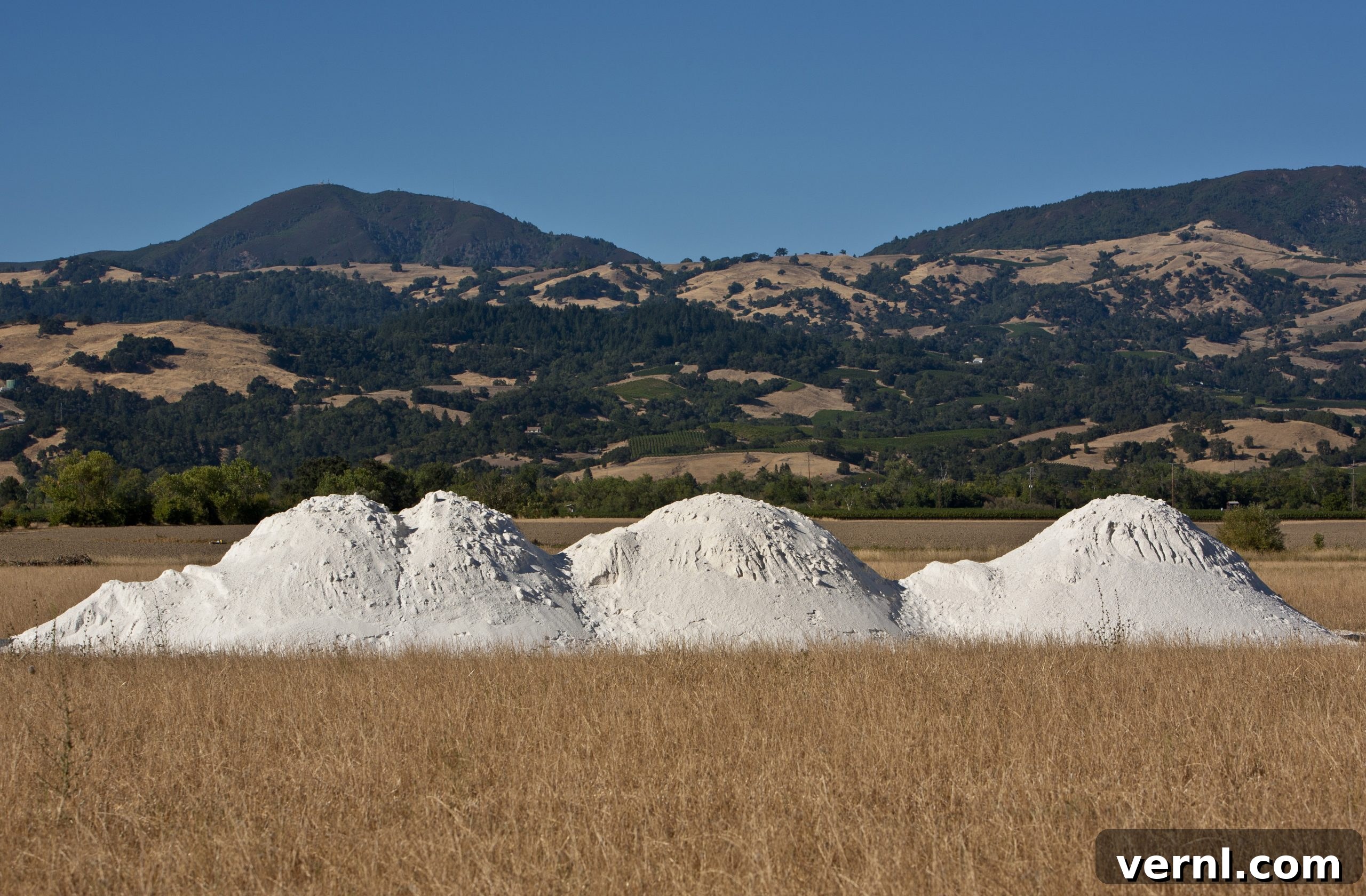
For many gardeners, the challenge of working with heavy clay soil is a familiar one. This dense, often sticky soil can hinder plant growth, impede water drainage, and make cultivation a strenuous task. While traditional soil amendments like rich compost are invaluable for enhancing overall soil health and tilth, there are specific situations where another powerful mineral, gypsum, can offer a targeted solution. If your soil pH is near neutral or higher, and you’re battling issues like excessive hardness, stickiness, poor drainage, or salinity, gypsum might be the game-changer your garden needs. It’s crucial to understand that gypsum works differently from lime and will not change soil acidity, making it suitable for particular soil conditions.
However, it’s equally important to recognize that gypsum isn’t a universal panacea. For those blessed with naturally mellow loam or sandy soil, consistent additions of compost and other organic matter remain the cornerstone of good garden soil management. These soil types typically boast excellent structure and drainage, rendering gypsum unnecessary. Understanding your soil’s specific needs through testing is the first step in determining if gypsum is the right amendment for your gardening goals.
Understanding Gypsum: Composition and Sources
At its core, gypsum is a naturally occurring mineral primarily composed of calcium sulfate dihydrate (CaSO4·2H2O). This chemical makeup is key to its effectiveness as a soil amendment. It’s a compound that plays a vital role in various industries, from construction (plasterboard) to agriculture. Gypsum is extracted from the earth through surface mining, but it can also be a byproduct of industrial processes, such as the scrubbing of coal plant emissions, where it’s recovered during flue gas desulfurization. While both sources yield calcium sulfate, naturally mined gypsum, depending on its origin, might contain trace contaminants like heavy metals. This distinction becomes particularly relevant for gardeners committed to organic practices.
It’s vital not to confuse gypsum with lime, which is ground limestone (calcium carbonate). While both introduce calcium to the soil, their primary functions differ significantly. Lime is used to raise soil pH, making acidic soils more alkaline. Gypsum, on the other hand, does not significantly alter soil pH. If your soil analysis indicates a need to increase pH, addressing that with lime should be your first step. Only once your soil pH reaches 5.8 or higher should you consider adding gypsum, ensuring optimal conditions for its intended purpose.
Navigating Different Sources: Organic Certification and Purity
The origin of gypsum can be a significant consideration, especially for those adhering to organic gardening principles. Some retailers market naturally mined gypsum as suitable for organic production, arguing for its natural provenance. However, others take a more conservative stance, acknowledging that its extraction and potential for contaminants classify it as a manufactured product, irrespective of its natural origin. This divergence highlights the importance of discerning product labeling.
For gardeners who prioritize organic certification, vigilance is key. Look specifically for the OMRI (Organic Materials Review Institute) or Ecocert label on the gypsum bag. These certifications provide assurance that the product meets stringent organic standards, including limitations on contaminants and processing methods. It’s important to be aware that not all mined gypsum is created equal; certain deposits are found in areas with higher concentrations of heavy metals, which can be transferred to the final product. Choosing a certified product minimizes this risk, providing peace of mind that you’re introducing beneficial, uncontaminated material into your garden ecosystem.
The Mechanism: How Gypsum Transforms Difficult Clay Soil
Gypsum often appears to work miracles on stubborn clay soil, particularly when dealing with specific challenges. The magic of gypsum lies in its ability to facilitate a process called flocculation. In certain clay soils, especially those with high sodium content, sodium ions bind tightly to the clay particles. This causes the clay particles to repel each each other, or “disperse,” leading to a breakdown in soil structure. The result is a soil that compacts easily, becomes incredibly sticky when wet (clinging to boots and tools), forms hard crusts when dry, and drains extremely slowly. Plant roots struggle to penetrate, and water struggles to infiltrate.
When gypsum is introduced, its calcium ions (Ca²⁺) become the heroes. Calcium, having a stronger positive charge, replaces the sodium ions (Na⁺) on the surface of the negatively charged clay particles. This ion exchange is crucial. Once sodium is displaced, it can be leached away by water, effectively removing the problem element. The calcium then acts as a bridge, allowing the individual clay particles to clump together into larger, more stable aggregates. This process, flocculation, creates microscopic pore spaces within the soil. These new pores dramatically improve soil structure, enhancing drainage, increasing aeration, and making the soil significantly less sticky and easier to work. It’s a physical transformation that opens up the soil, creating a more hospitable environment for roots and beneficial soil organisms.
Practical Application: How to Use Gypsum in Your Garden
Effective application of gypsum begins with proper soil preparation. If your soil requires tilling or cultivation, it’s best to perform these tasks before applying gypsum. This ensures that the amendment can be incorporated into the soil effectively. Gypsum is available in various forms, most commonly as a fine powder or as little granules or beads, also known as prills or pellets. Each form has its advantages and considerations.
Powdered gypsum, much like powdered lime, is extremely fine. While it dissolves quickly and can act rapidly, it can also become airborne during application, creating dust that irritates the eyes and respiratory system. When using powdered gypsum, wearing appropriate personal protective equipment, such as gloves, a dust mask, and eye protection, is highly recommended to minimize discomfort and potential health risks.
Pelletized or granular gypsum offers a much more user-friendly experience. These forms are significantly less dusty, making them easier and safer to spread. For even distribution over larger areas, a drop-spreader or broadcast spreader can be used. For smaller garden beds, hand scattering (always with gloves) is sufficient. The key is to distribute the gypsum evenly over the garden soil surface at the rate suggested on the product packaging. This rate can vary based on the specific product and your soil’s condition, so always refer to the manufacturer’s instructions. After application, irrigation or rainfall is essential to dissolve the gypsum and allow its calcium and sulfate ions to penetrate the soil profile, initiating the beneficial flocculation process. Regular watering will continue to move the dissolved gypsum deeper into the clay, improving its structure over time.
When is Gypsum the Right Choice? Identifying Ideal Scenarios
Gypsum is not a universal soil amendment; its benefits are specific to particular soil conditions. You should definitely consider using gypsum if a comprehensive soil test reveals that your clay soil is at or near neutral pH (typically 6.0-7.0) and exhibits a high level of available sodium. High sodium content is a primary indicator for gypsum’s effectiveness. Visually, if you observe a white, powdery crust forming on the surface of your clay soil, this is a strong sign of excess sodium accumulation, often indicating a sodic soil condition that gypsum can ameliorate.
Furthermore, gypsum proves highly beneficial in dry clay soils that become exceptionally hard and difficult to work, often forming a thick, impenetrable crust on top. This hardened surface can be a significant impediment for emerging seedlings in the spring, making it challenging for them to push through and establish themselves. By improving the soil structure, gypsum softens this crust, creating a more favorable environment for germination and early plant growth. It enhances water penetration, which in turn reduces surface runoff and allows moisture to reach plant roots more effectively. This makes hard, compacted clay soils more permeable and workable, easing the physical demands of gardening.
When to Avoid Gypsum: Understanding Its Limitations
While gypsum offers remarkable benefits for specific soil issues, it is crucial to understand that it is not a cure-all and is often unnecessary or even ineffective for other soil types. If your garden consists of sandy, loamy, silty, or other non-clay soils that already possess good drainage and a healthy structure, there’s generally no reason to apply gypsum. These soil types typically don’t suffer from the same sodium-induced dispersion problems that clay soils do, and adding gypsum would likely yield negligible benefits. For instance, on sandy soil, where drainage is often too rapid, gypsum won’t improve its water retention capabilities or add significant organic matter.
It’s also imperative to remember that adding gypsum alone does not replace the fundamental benefits provided by other vital soil amendments, particularly organic matter such as compost or well-rotted manure. These organic amendments are essential for building long-term soil fertility, improving water retention across all soil types, providing a slow release of nutrients, and fostering a healthy microbial ecosystem. Gypsum primarily addresses a specific structural issue related to sodium in clay; it doesn’t enrich the soil with humus or provide the broad spectrum of benefits that organic matter does. Many experienced gardeners advocate for a layered approach: focusing on foundational soil amending with organic materials first, and then strategically incorporating gypsum as a targeted treatment for specific clay soil challenges. This holistic approach ensures comprehensive soil health, leading to more resilient plants and a thriving garden.