In the ever-evolving landscape of modern home design, innovation often leads to improvements in functionality, hygiene, and convenience. Among the standout advancements in bathroom technology are **touchless bathroom faucets** and **sensor-operated plumbing fixtures**. While these fixtures might seem like a recent phenomenon in residential settings, their journey began much earlier, appearing in commercial spaces like airports and hospitals as far back as the 1970s. It wasn’t until the 1980s that their presence in public restrooms introduced most Americans to the concept of operating water flow without physical contact.
Today, the benefits of touchless faucets are widely recognized and highly sought after by homeowners. From significant **water conservation** and enhanced **germ prevention** to improved user accessibility and sleek aesthetics, these modern fixtures offer a compelling upgrade for any bathroom. What was once considered a luxury or a niche commercial product is now an affordable and readily available option at home improvement retailers nationwide. As Mark Snell, founder and owner of Polestar Plumbing, aptly puts it, “Touchless faucets, known for their ease of use, ergonomic design, and sleek aesthetics, are an ideal enhancement for any bathroom, blending seamlessly into contemporary and traditional decor alike.”
Deane Biermeier, a long-time home improvement expert with over three decades of field experience, underscores this sentiment: “Once touchless faucets moved from novelty to commercial and then into residential use, they quickly became an essential fixture. The rapid adoption speaks volumes about their practical advantages. Now, with the advent of smart models featuring voice activation, homeowners can enjoy even greater convenience at increasingly reasonable prices, truly bringing the bathroom into the smart home ecosystem.” This widespread acceptance highlights a growing consumer demand for smarter, more hygienic, and efficient home solutions.
Why Choose a Touchless Bathroom Faucet? The Benefits Unveiled
Beyond the immediate “cool factor,” touchless bathroom faucets offer a multitude of tangible benefits that make them a smart investment for any homeowner. Understanding these advantages can help you appreciate why these fixtures are quickly becoming a staple in modern bathrooms.
Superior Hygiene and Germ Prevention
One of the most compelling reasons to switch to a touchless faucet is the dramatic improvement in hygiene. In an age where health and cleanliness are paramount, minimizing contact with frequently touched surfaces is crucial. Traditional faucets, with their handles and knobs, are hotspots for germs, bacteria, and viruses. Every time someone touches a handle with dirty hands, they transfer microbes, creating a breeding ground for pathogens. A touchless faucet eliminates this point of contact entirely. By simply placing your hands under the spout, the water flows, and when you remove them, it stops, significantly reducing the spread of germs and ensuring a more sanitary environment for everyone in your household.
Exceptional Water Conservation
Beyond hygiene, touchless faucets are champions of **water conservation**. Traditional faucets are often left running unnecessarily while scrubbing hands, brushing teeth, or performing other tasks, leading to significant water waste. Touchless faucets, by their very design, prevent this. As Jason Brady, owner of Above and Beyond Service Company, explains, “These touchless faucets are designed to be water-efficient and can save roughly 30% to 50% more water compared to their manual counterparts.” This automatic shut-off feature ensures that water only flows when actively needed, leading to noticeable reductions in your monthly water bill and contributing to a more environmentally conscious home.
Enhanced Accessibility and Convenience
For households with children, the elderly, or individuals with limited mobility, touchless faucets offer unparalleled accessibility and ease of use. Young children can struggle with turning traditional handles, while those with arthritis or other physical limitations may find them difficult to operate. A touchless faucet removes these barriers, providing effortless water access for everyone. The sheer convenience of not having to touch anything, especially when your hands are full or dirty, also streamlines daily routines and adds a touch of modern luxury to your bathroom experience.
Sleek Aesthetics and Effortless Maintenance
Modern touchless faucets are designed with sleek, minimalist aesthetics that can elevate the look of any bathroom. Their streamlined profiles contribute to a clutter-free and sophisticated ambiance. Furthermore, their touch-free operation inherently means fewer fingerprints, smudges, and water spots on the fixture itself. This translates to less frequent cleaning and easier maintenance, allowing your faucet to retain its polished, pristine appearance with minimal effort.
What Features to Look for in Touchless Bathroom Faucets
Just like their traditional counterparts, touchless faucets come in a wide variety of designs and feature sets. To ensure you’re investing in the best touchless faucet for your specific needs and bathroom aesthetic, consider these critical factors:
High-Quality, Responsive Sensors
The heart of any touchless faucet is its sensor system. You’ll want a faucet equipped with high-quality, reliable sensors that strike the perfect balance between responsiveness and accuracy. Longtime plumber and HVAC technician Al Fagundes emphasizes this point: “It’s vital to find a sensor bathroom faucet that can turn on precisely when hands are placed under the spout, but isn’t so sensitive that it activates every time someone simply walks past it.” Overly sensitive sensors can be frustrating and wasteful, while under-sensitive ones defeat the purpose of touchless operation. Look for models that utilize advanced infrared technology for consistent detection and offer adjustable sensitivity settings if possible, allowing you to fine-tune its performance to your bathroom’s environment and your personal preference.
Convenient and Advanced Activation Options
Beyond standard motion activation, many smart touchless faucets offer a range of sophisticated settings and options that enhance both convenience and functionality. Some models feature an “auto-flush” capability, which periodically clears the water line of stagnant water, ensuring fresh water delivery and preventing bacterial buildup. Others include customizable timer settings, allowing you to control the precise duration the valve remains open – a fantastic feature for reducing water waste during quick tasks. For those seeking ultimate integration, features like leak detection, which can alert you to potential issues before they become major problems, and voice command compatibility, enabling hands-free operation through smart home assistants, are also available. Take some time to consider which of these advanced features would offer the most convenience and value for your household’s unique lifestyle.
Reliable Temperature Adjustment
While the primary function of a touchless faucet is water flow, temperature control is equally important for comfort and safety. Most motion sensor faucets will feature discreet under-sink temperature adjustment levers, allowing you to set a preferred temperature for the automatically dispensed water. More advanced or expensive options might integrate a small lever directly on the side of the faucet itself for easier, on-the-fly adjustments. Regardless of placement, ensure that the model you choose provides a clear and intuitive way to control the hot and cold water mix, ensuring a comfortable and safe experience for all users.
Stable and Accessible Power Source
All touchless bathroom faucets require a power source to operate their sensors and valves. The two primary options are battery packs or adapters that plug into an electrical outlet. Battery-powered options are generally less expensive upfront and simpler to install, as they don’t require an existing outlet. However, they necessitate occasional battery replacement, which can be an inconvenience if not easily accessible. Plug-in options offer continuous power without the need for battery changes, providing greater peace of mind. The trade-off is that you’ll likely need an existing electrical outlet under your sink, or you may need to install one, which might require professional electrical work. Additionally, remember that plug-in faucets will not function during a power outage, whereas battery-powered units will continue to work.
Deane Biermeier highlights an often-overlooked aspect of battery-powered faucets: “While battery changes may be infrequent, ensure adequate access below your sink if your chosen model’s battery-changing process requires performing the task below the vanity countertop. If space is tight, consider purchasing a plug-in faucet and taking the extra step of adding an outlet now instead of regretting your model choice down the line.” Planning for maintenance accessibility is just as important as the initial installation.
Durable and Easy-to-Maintain Finish
While touchless faucets inherently stay cleaner than manual ones due to reduced contact, they are not immune to splashes, toothpaste, soap residue, and general cosmetic grime. Choosing an easy-to-maintain finish is crucial for long-term satisfaction. Popular choices like chrome, stainless steel, and brushed nickel are excellent for their durability, resistance to corrosion, and ease of cleaning. Angela Rubin, an expert author for Canadian cleaning company Hellamaid, affirms this: “These finishes are excellent for low-maintenance cleaning. They resist water spots and fingerprints, providing a polished look with minimal effort and helping to maintain the faucet’s aesthetic appeal for years.”
How Do Touchless Faucets Work? A Glimpse into the Technology
The underlying technology behind residential touchless bathroom faucets is remarkably similar to the commercial versions found in high-traffic areas like hospitals or airports. The core mechanism relies on an **infrared sensor** strategically placed on the faucet body. This sensor continuously emits a beam of infrared light. When you place your hands within the sensor’s detection range, the infrared light reflects off your hands and back to the sensor. This reflection triggers an electronic signal, which is then sent to a solenoid valve located within the faucet’s body or under the sink. The solenoid valve, acting as an electronic gate, opens, allowing water to flow. Crucially, once you remove your hands from the sensor’s field, the reflected light is no longer detected. This absence of a signal causes the solenoid valve to close, immediately shutting off the water flow.
This precise on-demand operation offers several functional advantages. As Michael Green, vice president of operations at Benjamin Franklin Plumbing, notes, “This means less wear and tear on your fixtures and fewer components to maintain compared to traditional mechanical handles.” He further adds that this design simplifies faucet cleaning, “since there’s less area for unwanted residue to accumulate, and no handles to meticulously scrub.” The simplicity and efficiency of this system make touchless faucets both reliable and hygienic.
How To Install a Touchless Bathroom Faucet: A Step-by-Step Guide
Installing a touchless bathroom faucet can be a straightforward DIY project for the average homeowner, especially for battery-powered or plug-in models where an existing outlet is already present. However, as mentioned earlier, if you opt for a plug-in model and lack an under-sink outlet, you may need to add one. This particular task involves electrical work and can be complex and potentially hazardous if not done correctly. Green strongly recommends consulting with a professional electrician before attempting any DIY wiring projects. If you have any doubts about your electrical skills, hiring a licensed electrician is always the safest and most reliable option.
Once any necessary electrical work is completed (or if you’re installing a battery-powered model), you can proceed with the faucet installation. The process generally mirrors that of a traditional faucet, with a few key differences:
-
Turn Off the Water Supply: Before you begin any plumbing work, locate the hot and cold water supply valves under your sink. Turn both valves clockwise until they are fully closed to shut off the water flow to the faucet. Open the old faucet to release any remaining water pressure.
-
Remove the Old Faucet: Disconnect the existing hot and cold water supply lines from the old faucet. You may need a basin wrench to access and loosen the locknuts that secure the old faucet to the sink or countertop. Once detached, carefully pull the old faucet assembly away from the sink. Clean any residue or sealant from the mounting surface.
-
Place the New Touchless Faucet: Position the new touchless faucet base onto the sink’s mounting hole(s). Depending on your sink’s configuration, you might need to use a deck plate (also known as an escutcheon) to cover any additional holes if your new faucet requires only one. Secure the faucet firmly in place according to the specific installation instructions provided by the manufacturer. This usually involves threading a washer and mounting nut from underneath the sink and tightening them securely.
-
Connect the New Supply Lines: Attach the new flexible hot and cold water supply lines from the touchless faucet to the corresponding supply valves under the sink. Generally, the hot water line connects to the left valve, and the cold water line connects to the right valve. Ensure all connections are hand-tight, then use a wrench to gently tighten them another quarter to half turn, being careful not to overtighten and damage the lines.
-
Connect the Power Supply: This crucial step varies depending on your faucet’s power source. For battery-powered models, install the specified batteries into the battery pack and connect the pack’s cable to the faucet’s control box. For plug-in models, simply plug the adapter into the newly installed or existing electrical outlet under the sink. Secure the control box in an accessible location under the sink according to the instructions.
-
Turn On the Water Supply: Slowly turn the hot and cold water supply valves counter-clockwise to open them back up. Check for any leaks around the supply line connections and tighten them if necessary.
-
Set Up and Test the Faucet: Most touchless faucets require a brief calibration or setup process to optimize sensor performance. Follow the manufacturer’s instruction manual carefully for this step. This might involve allowing the water to run for a few seconds, or waving your hand a few times to help the sensor detect its environment. Some advanced models may have programming options for sensitivity or flow duration. Once setup is complete, test the faucet thoroughly to ensure it turns on and off correctly and that the temperature adjustment works as desired.
The Best Touchless Bathroom Faucets for Every Need
While touchless bathroom faucets often come with a slightly higher price tag than traditional models, the market now offers a wide array of options to fit various budgets and preferences. Here’s a curated selection of top-performing touchless faucets that deliver on hygiene, efficiency, and style.
- Best Single-Hole: Vibrant Bath Sink Bathroom Faucet
- Best Overall: Charmingwater Touchless Bathroom Sink Faucet
- Best Budget: WOWOW Touchless Bathroom Sink Faucet
- Best Splurge: Kohler Insight Touchless Commercial Bathroom Sink Faucet
- Best Commercial: Delta Commercial Battery-Powered Bathroom Faucet
Best Single-Hole Touchless Bathroom Faucet: Vibrant Bath Sink Bathroom Faucet
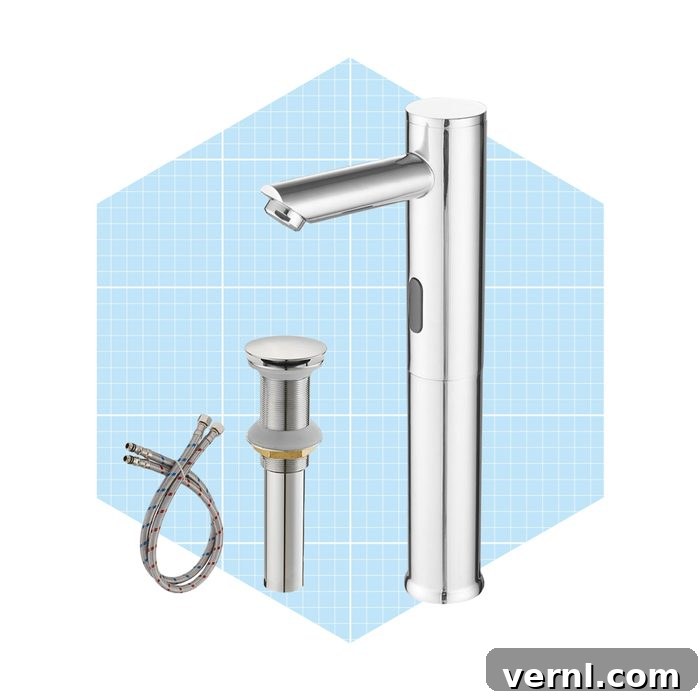
For those with single-hole vanities, the Vibrant Bath Sink Bathroom Faucet offers an elegant and sophisticated solution. Its sleek design and a relatively tall spout height of 10.7 inches make it an eye-catching focal point. Despite its height, the motion sensor is robust and precisely calibrated, ensuring accurate hand detection across a wide range of heights. This intelligent sensing capability helps alleviate common concerns about overfilling, a frequent regret associated with vessel sink faucets. The Vibrant faucet delivers exceptional value, boasting solid-brass construction that promises years of reliable performance. According to Kansas City-based Polestar Plumbing, Heating & Air Conditioning, solid brass is one of the most durable and long-lasting materials for bathroom faucets, ensuring your investment stands the test of time.
Best Overall Touchless Bathroom Faucet: Charmingwater Touchless Bathroom Sink Faucet
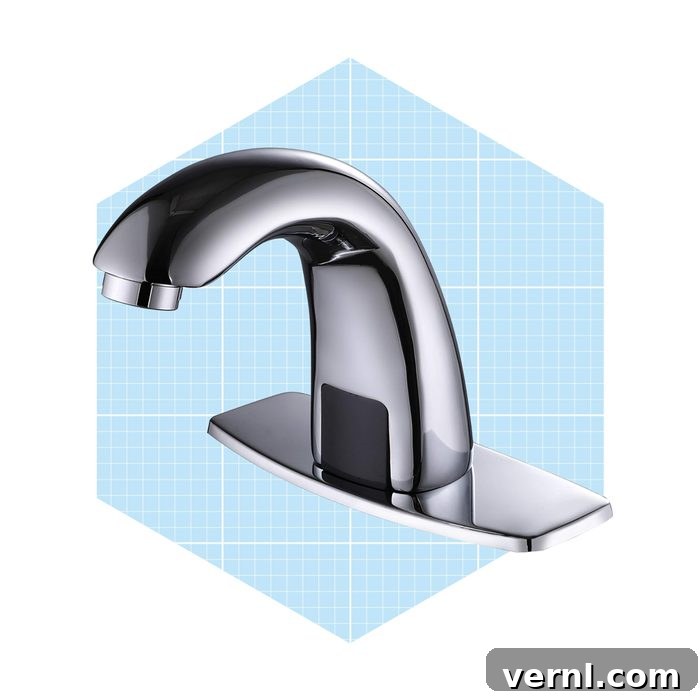
Balancing performance, aesthetics, and affordability, the Charmingwater Touchless Bathroom Sink Faucet earns its spot as the best overall choice. This battery-powered model is remarkably easy to install, making it an ideal upgrade for DIY enthusiasts. It stands out with its high-quality sensors that are specifically designed to prevent false triggers, ensuring water flows only when intended. Available in five versatile finishes, it offers aesthetic flexibility to match various bathroom decors. With over 750 five-star customer reviews, many users laud it as the perfect addition to their bathroom remodeling projects. As five-star reviewer Efrain states, “The water flow rate is excellent, allowing me to easily wash away foam from my hands. The sensor is highly responsive, releasing water as soon as I approach it. After using it for some time now, I’m extremely satisfied with its performance.” Its combination of reliable technology, diverse styles, and user satisfaction makes it a standout choice for most homes.
Best Budget Touchless Bathroom Faucet: Wowow Touchless Bathroom Sink Faucet
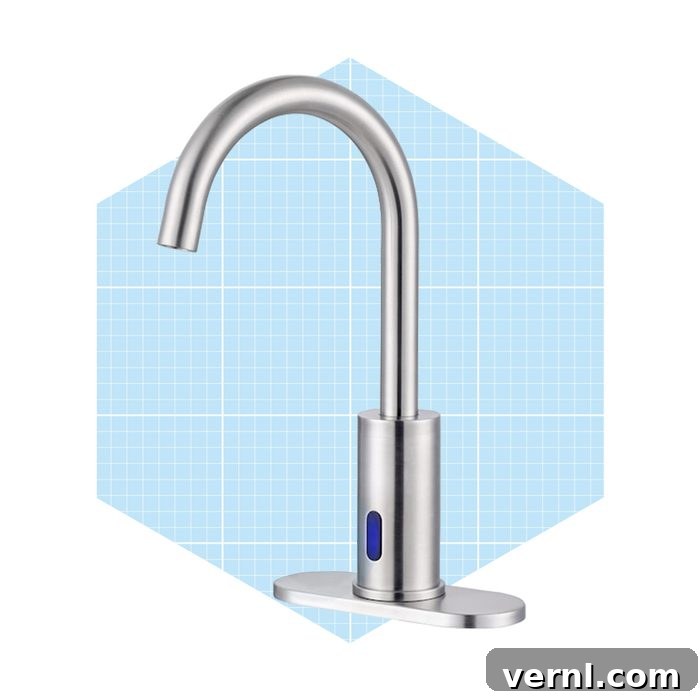
Proving that quality doesn’t always have to come with a hefty price tag, the Wowow Touchless Bathroom Sink Faucet delivers exceptional value. Despite its budget-friendly cost, it features a highly sensitive yet accurate hand sensor, offering superior hygiene compared to a standard manual faucet. A key safety and convenience feature are its color-coded temperature control levers, which are intuitively designed for easy adjustment. The faucet boasts a brushed nickel finish, which, according to 20-year plumbing and HVAC technician Al Fagundes, is one of the easiest to maintain. Fagundes elaborates, “Brushed nickel effectively resists the visibility of spots and fingerprints. Not only is it affordably priced, but it also maintains its resistance to corrosion over time, ensuring lasting beauty and functionality.” Additionally, a clever sensor light blinks when the batteries are running low, providing a timely reminder for replacement and preventing unexpected interruptions.
Best Splurge Touchless Bathroom Faucet: Kohler Insight Touchless Commercial Bathroom Sink Faucet
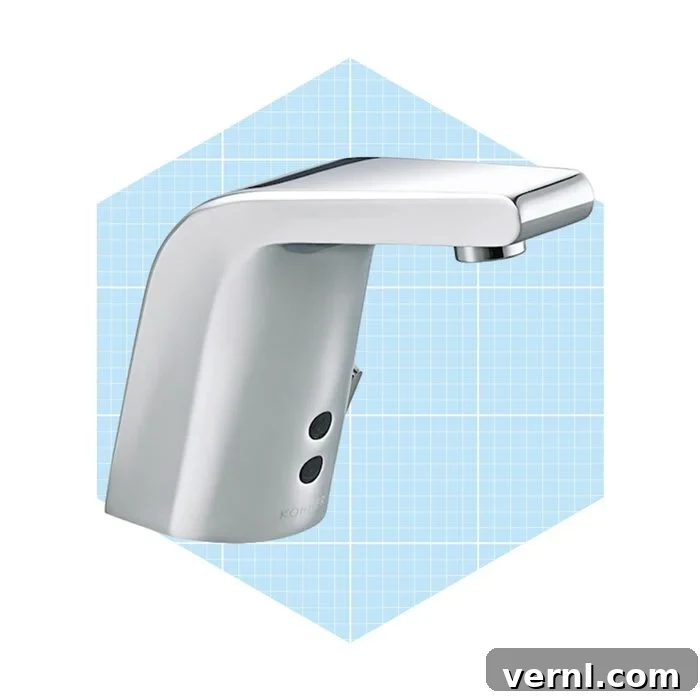
For those willing to invest in premium performance and a truly hassle-free experience, the Kohler Insight Touchless Bathroom Faucet stands out as an excellent splurge. While it carries a higher price point than many other touchless options, its sophisticated technology justifies the investment. Upon installation, this intelligent faucet actively scans its surrounding area, gathering essential environmental information to calibrate its sensors. This proactive adjustment prevents false triggers and ensures the faucet operates with maximum efficiency and precision at all times. Designed for longevity, it runs on just two AAA batteries, which are reportedly rated to last “at least” three years, minimizing maintenance. Its polished chrome finish is not only stunning but also exceptionally resistant to fingerprints and residue, making it effortless to keep sparkling clean and maintaining its luxurious appearance.
Best Commercial Touchless Bathroom Faucet: Delta Commercial Battery-Powered Bathroom Faucet
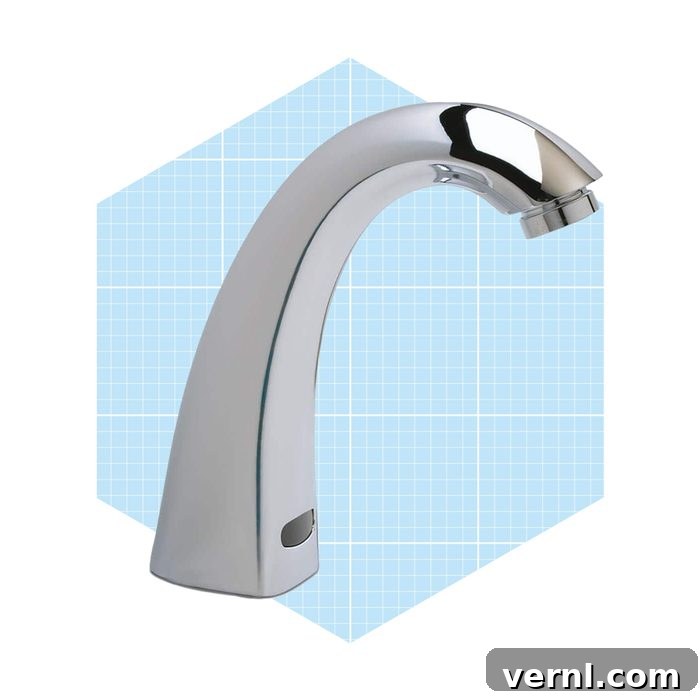
If you appreciate the robust construction and minimalist, high-performance design typically found in commercial-grade fixtures, the Delta Commercial Battery-Powered Touchless Bathroom Faucet is an excellent choice. Engineered to perform reliably in demanding environments, its advanced sensors are adept at overcoming common issues that can confound less sophisticated models, such as challenging light reflections or varying skin conditions (e.g., dry hands). While the installation of this battery-powered faucet is slightly more involved than some residential options – requiring temperature and other settings to be adjusted below the sink – its exceptional durability and consistent performance make the effort worthwhile. For those with the necessary DIY expertise or a willingness to hire a professional, this faucet provides commercial-grade reliability and a sleek, industrial aesthetic perfect for a variety of sink types.
Why You Should Trust Us
This comprehensive review was meticulously verified for accuracy by Deane Biermeier. With over 30 years of invaluable field experience in home construction, remodeling, and repair, Deane brings a wealth of practical knowledge to his role as a DIY home products and services expert for several reputable publications. His extensive background and discerning eye enable him to thoroughly examine the products and information presented in this review, critiquing the author’s findings with a keen focus on the details that matter most to consumers. His insights ensure that the recommendations and advice provided are not only accurate but also highly practical and relevant for homeowners.
Frequently Asked Questions About Touchless Bathroom Faucets
Are touchless bathroom faucets worth the investment?
Absolutely. The value of touchless bathroom faucets extends far beyond mere convenience. Jason Brady, owner of Above and Beyond Service Company, highlights the financial and practical benefits: “There are many compelling reasons to consider a touchless bathroom faucet, such as saving money on your water bill. These touchless faucets are meticulously designed to be water-efficient, capable of saving roughly 30% to 50% more water compared to their manual counterparts.” Beyond the cost savings, the inherent lack of contact dramatically reduces the accumulation of fingerprints and smudges, translating into less frequent cleaning and a consistently pristine appearance. For hygiene, water conservation, and reduced maintenance, they represent a sound investment.
What are the potential drawbacks or cons of touchless faucets?
While the advantages are numerous, it’s important to consider potential drawbacks. Milly McEwan, product and design manager at RJ Living, points out that touchless faucets often come with a higher upfront cost compared to traditional manual faucets. This initial investment can be a deciding factor for some homeowners who might prefer to allocate their budget to other bathroom or home upgrades. “If the convenience and hygiene benefits of a touchless faucet are paramount to you, then it’s a worthwhile investment,” she advises. “However, if budget is a primary concern or you don’t prioritize these specific features, sticking with a manual option allows you to spend that money on upgrades that better align with your values and needs.” Other minor cons might include occasional battery replacement for certain models or the need for an electrical outlet during installation.
What brands of faucets do plumbers typically recommend for touchless models?
When it comes to touchless faucets, particularly for commercial-grade applications where durability and reliability are crucial, Delta is frequently cited as a highly recommended brand. Deane Biermeier adds valuable insight regarding reputable brands for residential use: “Moen, Kohler, and American Standard also consistently stand out as durable, trusted brands known for their quality and innovation.” However, he also emphasizes that the market offers a wide range of quality faucets from other manufacturers that might be more budget-friendly. “Customer reviews can be an excellent source to learn which brands offer great value and performance, even if they’re not the household names,” he advises. It’s always beneficial to research and compare specific models and their track records.
What is the fundamental difference between touchless and touch-on faucets?
The distinction between touchless and touch-on faucets lies in their activation method. **Touchless faucets**, the focus of this article, utilize sensors (typically infrared) to detect motion, allowing water to flow without any physical contact. The water automatically turns on when hands are placed under the spout and shuts off when they are removed. This hands-free operation is designed to maximize hygiene, reduce germ transmission, and minimize water waste by ensuring water only runs when actively needed. **Touch-on faucets**, on the other hand, require a light tap or touch to the faucet body or spout to activate and deactivate the water flow. While they still offer a level of convenience by not requiring the use of a lever, they still involve physical contact, which means they don’t provide the same level of germ-free operation as truly touchless models.
Sources:
- Mark Snell, founder and owner of Polestar Plumbing
- Al Fagundes, experienced plumber and HVAC technician
- Angela Rubin, author at Canadian cleaning company Hellamaid
- Michael Green, vice president of operations at Benjamin Franklin Plumbing
- Jason Brady, owner of Above and Beyond Service Company
- Milly McEwan, product and design manager for RJ Living