
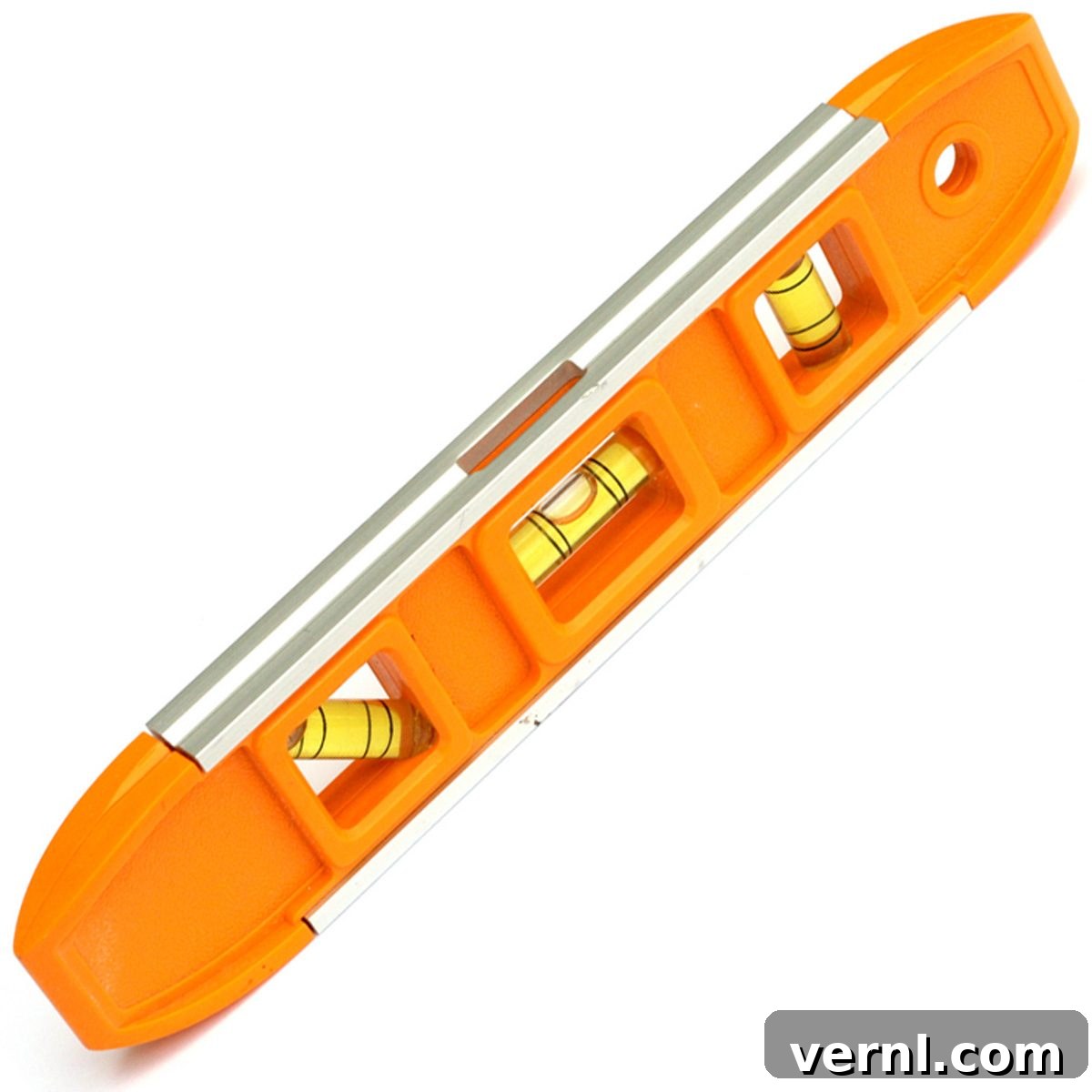
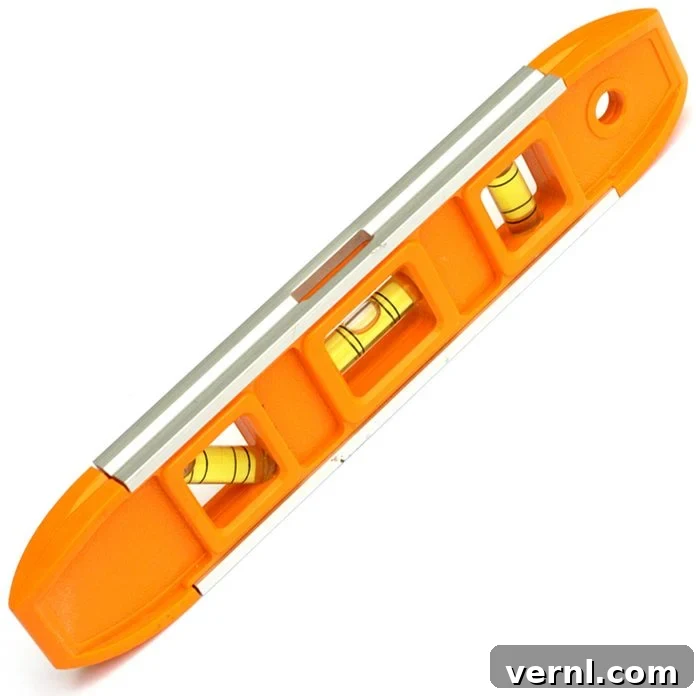
What is a Torpedo Level?
In the vast world of tools designed for precision and accuracy, the torpedo level stands out as a compact yet incredibly versatile instrument. As its name subtly suggests, most torpedo levels feature a distinctive tapered or torpedo-shaped body, setting them apart from their longer, rectangular counterparts. While its unique form might be the first thing one notices, what truly makes this tool indispensable is the surprising array of uses people discover for it across various trades and DIY projects.
A torpedo level is fundamentally a small spirit level, typically ranging from a mere 6 inches to 12 inches in length. Its core function, like any level, is to indicate whether a surface is perfectly horizontal (level) or perfectly vertical (plumb). To achieve this, it houses multiple vials, usually at least three: one for plumb, one for level, and often a third for indicating a 45-degree angle. This trio of vials makes it exceptionally adaptable for tasks requiring different angular measurements.
Due to its diminutive size and ergonomic shape, the torpedo level is perfectly suited for working in confined or hard-to-reach spaces where larger levels would be cumbersome or impossible to use. Furthermore, many modern torpedo levels come equipped with magnetic edges. This feature is a game-changer, especially for plumbers, electricians, and anyone working with metallic parts, as it effectively provides a “third hand” by allowing the level to securely attach to pipes, conduits, or steel studs, freeing up the user’s hands for other tasks. Beyond professional applications, the torpedo level’s compact design means it fits neatly into a tool belt, a kitchen junk drawer, or even a glove compartment, making it incredibly handy for everyday tasks like leveling pictures, determining the slope of pipes, or ensuring shelves are perfectly straight over short distances. It’s truly a small tool with a giant impact on accuracy and efficiency.
The Distinctive Design and Essential Components of a Torpedo Level
The ingenuity of the torpedo level lies not just in its size but also in its thoughtful design. The tapered ends are not merely aesthetic; they contribute to the tool’s ability to fit into tight spots and navigate obstacles. The body is typically robust, crafted from durable materials such as high-grade aluminum, ABS plastic, or even solid wood for some traditional models, ensuring it can withstand the rigors of a construction site or a busy workshop.
Central to its operation are the acrylic or glass vials, precisely manufactured to contain a slightly curved liquid (often an alcohol-based solution with a fluorescent dye for better visibility) and a single air bubble. When the tool is placed on a surface, gravity pulls the liquid downwards, and the bubble floats to the highest point. For a surface to be level or plumb, the bubble must rest perfectly between the two indicator lines on the vial. The clear, durable vials are often shock-resistant and sometimes even illuminated for use in low-light conditions.
The magnetic strip, commonly found along one edge, is usually a rare-earth magnet, offering strong adhesion to ferrous metal surfaces. This magnetic capability significantly enhances the tool’s utility, allowing hands-free operation in many scenarios, which is a major time-saver and safety feature. Some advanced models may also include additional features like metric and imperial ruler markings, hanging holes for storage, or even digital displays for incredibly precise angle measurements.
Why a Torpedo Level is an Indispensable Tool in Any Toolbox
While larger spirit levels have their place, the torpedo level carves out its niche by offering a unique set of advantages that make it indispensable for professionals and DIY enthusiasts alike. Its primary benefit is undoubtedly its portability. Being able to slip a reliable level into a pocket or tool belt means constant access to precision without the bulk. This ease of transport translates directly into efficiency, as there’s no need to constantly retrieve a larger tool from a toolbox.
Secondly, the torpedo level excels in maneuverability. Imagine trying to level a small appliance in a cramped cabinet or checking the slope of a pipe nestled against a wall with a 2-foot or 4-foot box beam level – it would be nearly impossible. The torpedo level’s compact form factor allows it to navigate these tight spaces with ease, providing accurate readings where other levels simply cannot reach. Its magnetic capabilities further augment its utility, transforming it from a simple measuring device into a hands-free helper, dramatically speeding up tasks like installing electrical boxes or aligning metal studs.
Beyond these practical benefits, the torpedo level is remarkably versatile. It’s not just for construction workers or plumbers; artists use it to hang artwork perfectly straight, homeowners use it to install shelves, and even hobbyists find it useful for various craft projects. Its simple operation also makes it accessible to beginners, while its precision makes it a trusted tool for seasoned professionals. For an essential guide to levels and plumb bobs, which are crucial for any serious DIYer or tradesperson, you can explore resources like this comprehensive guide.
Versatile Applications: Where Torpedo Levels Shine
The true testament to a torpedo level’s value lies in its extensive range of applications across various trades and everyday tasks. Its adaptability makes it a go-to tool for precision in situations where larger levels are impractical.
- Plumbing: This is perhaps one of the most common applications. Plumbers frequently use torpedo levels to ensure pipes have the correct slope for drainage, to align plumbing fixtures, and to set water heaters level. The magnetic edge is particularly beneficial here, allowing the level to cling to metal pipes while the plumber makes adjustments.
- Electrical Work: Electricians rely on these levels for installing electrical boxes, ensuring conduits are plumb and level, and mounting light fixtures straight. Again, the magnetic feature is invaluable for hands-free positioning on metal components.
- Carpentry and Woodworking: While larger levels handle big framing jobs, torpedo levels are perfect for smaller carpentry tasks. They’re ideal for leveling shelves, cabinets, small picture frames, and even checking the alignment of furniture components. When building custom pieces, it helps ensure all surfaces are true.
- DIY Projects and Home Improvement: For the average homeowner, a torpedo level is essential for a myriad of tasks. Hanging pictures and mirrors, installing curtain rods, leveling appliances (like washing machines or refrigerators), mounting televisions, or even installing grab bars in a bathroom all benefit from its precise measurements. It’s also great for small tiling jobs to ensure a level surface.
- Framing and Drywall: Though not the primary tool for large-scale framing, a torpedo level is excellent for checking the plumb of individual studs or the level of short header pieces, especially in awkward corners or when working around existing structures.
- HVAC Installation: Technicians use torpedo levels to ensure ductwork is installed with the proper pitch for condensation drainage and that units are mounted level for optimal operation.
The convenience and accuracy offered by this compact tool make it a fixture in virtually every professional’s toolkit and an essential item for any homeowner serious about tackling projects correctly.
Exploring Different Types and Modern Innovations in Torpedo Levels
While the basic function of a torpedo level remains constant, manufacturers have introduced various types and innovations to cater to specific needs and enhance user experience. Understanding these variations can help you choose the best tool for your particular tasks.
- Standard Torpedo Levels: These are the most common, featuring the three essential vials (plumb, level, and 45-degree) and often a magnetic edge. They are highly durable, typically made from aluminum or high-impact plastic, and are suitable for general use.
- Lighted Torpedo Levels: Designed for dimly lit environments, these levels incorporate small LED lights that illuminate the vials, making the bubble highly visible in dark basements, attics, or behind walls. This feature significantly reduces strain and improves accuracy in poor lighting conditions.
- Digital Torpedo Levels: Representing a leap in precision, digital torpedo levels provide an exact numerical display of the angle, often to one or two decimal places. Many can measure angles in degrees, percentages, or even inches per foot. They often come with a backlit screen, hold functions, and sometimes an audible tone to indicate level or plumb, making them invaluable for highly precise work.
- Heavy-Duty/Professional Grade Torpedo Levels: These are built to withstand extreme job site conditions. They feature thicker frames, reinforced end caps for drop protection, and extra-strong magnets. Their vials are often more securely seated and protected, ensuring long-term accuracy.
- Mini Torpedo Levels: Even smaller than standard models, mini torpedo levels are designed for ultra-tight spaces or highly specific tasks where even a 6-inch level might be too large. They are incredibly portable and often feature strong magnets.
- Torpedo Levels with Rotating Vials: Some specialized models include a vial that can rotate, allowing users to measure custom angles beyond the standard 45 degrees. This offers greater flexibility for unique applications.
These innovations showcase how a simple tool can evolve to meet the growing demands for precision and convenience in various fields, ensuring there’s a torpedo level perfectly suited for almost any task.
How to Select the Perfect Torpedo Level for Your Needs
Choosing the right torpedo level involves considering several factors beyond just its basic function. Investing a little time in research can ensure you acquire a tool that precisely meets your requirements and will serve you reliably for years to come.
1. Accuracy and Vial Quality: The primary purpose of any level is accuracy. Look for vials that are clearly marked and easy to read. High-quality vials are typically made from durable acrylic or glass, resistant to fogging, leaking, and UV damage. Some manufacturers specify the level of accuracy (e.g., 0.5 mm/m), which is a good indicator of precision.
2. Durability and Material: Consider the environment in which you’ll be using the level. For heavy-duty use on construction sites, a level made from robust aluminum with shock-absorbing end caps is ideal. For lighter DIY tasks, a high-impact plastic model might suffice. Ensure the frame feels solid and well-constructed.
3. Magnetic Strength: If you frequently work with metal surfaces (e.g., plumbing, electrical, metal fabrication), a strong magnetic edge is non-negotiable. Test the magnet’s strength if possible to ensure it holds securely without slipping. Rare-earth magnets are generally preferred for their superior holding power.
4. Vial Visibility: Ease of reading is crucial. Look for vials with highly visible liquid (often fluorescent green or yellow) and clear, well-defined indicator lines. Some levels offer larger vials or magnifying lenses for enhanced visibility. For low-light conditions, consider models with built-in illumination.
5. Size and Ergonomics: While torpedo levels are inherently small, they still come in a range of sizes (e.g., 6-inch, 9-inch, 12-inch). Choose a length that best suits your typical applications. An ergonomic design with comfortable grips can also make a difference during extended use.
6. Additional Features: Digital displays offer unparalleled precision for specific tasks, while ruler markings can add extra utility. A hanging hole is a small but useful feature for storage. Evaluate which extra features genuinely enhance your workflow versus those that add unnecessary cost.
7. Brand Reputation and Warranty: Opting for reputable brands often ensures better quality control, accuracy, and customer support. Check for warranties that cover manufacturing defects or calibration issues.
By carefully weighing these factors, you can confidently select a torpedo level that not only fits your budget but also elevates the precision and efficiency of your work.
Mastering the Torpedo Level: Tips for Precision and Accuracy
Even the most advanced torpedo level is only as good as the user operating it. To achieve consistent and reliable results, understanding a few best practices is essential:
- Calibrate and Test Regularly: Before starting any critical task, it’s wise to test your level for accuracy. Place it on a relatively flat surface and note where the bubble rests. Flip the level 180 degrees end-to-end and place it in the exact same spot. If the bubble reads differently, your level may be out of calibration or damaged. For precision work, a slight discrepancy can make a big difference.
- Clean Surfaces and the Level: Dust, debris, or even small metal shavings on the surface you’re leveling or on the bottom of the level itself can throw off your readings. Always ensure both surfaces are clean and free of obstructions for true contact.
- Use Both Ends for Critical Work: For maximum accuracy, especially on longer spans where a torpedo level is being used for spot checks, measure once, then rotate the level 180 degrees (flipping end-for-end) and measure again. If both readings are identical, you can be confident in the measurement. If they differ slightly, take the midpoint between the two readings.
- Proper Surface Contact: Ensure the entire base of the level is making firm, flat contact with the surface. Avoid tilting or rocking the level, as this will lead to inaccurate readings. For pipes or rounded surfaces, specialized levels with V-grooves are best, but a torpedo level with a strong magnet can often adapt.
- Read the Bubble Correctly: Always view the bubble straight on, directly in front of the vial. Looking at it from an angle (parallax error) can cause it to appear centered when it’s not. The bubble should sit perfectly between the two indicator lines for a truly level or plumb reading.
- Protect from Extreme Temperatures: While most levels are designed to be durable, extreme heat or cold can affect the liquid in the vials, potentially causing the bubble to behave erratically. Store your level in a moderate environment.
- Don’t Drop It: Repeated drops, especially on hard surfaces, can damage the vials or throw the level out of calibration. Treat your level with care to maintain its precision.
By adhering to these simple tips, you can maximize the accuracy and longevity of your torpedo level, ensuring your projects are consistently professional and precise.
Maintaining Your Torpedo Level for Long-lasting Accuracy
Proper maintenance is key to ensuring your torpedo level remains an accurate and reliable tool for years to come. While these tools are generally robust, a little care can significantly extend their lifespan and preserve their precision.
1. Regular Cleaning: After each use, especially on a dusty or dirty job site, wipe down your level with a soft, damp cloth. Remove any drywall dust, sawdust, metal filings (especially from the magnet), or grease. Avoid harsh chemical cleaners that might damage the plastic vials or painted surfaces. For magnetic levels, regularly check and clean the magnetic strip, as accumulated debris can reduce its holding power and cause inaccurate readings.
2. Proper Storage: Store your torpedo level in a safe place where it won’t be subjected to accidental drops or impacts. A dedicated slot in your toolbox, a tool belt pouch, or hanging it on a pegboard are ideal options. Avoid tossing it loosely into a box with heavy, sharp tools that could scratch the vials or bend the frame.
3. Protect from Impacts: While many modern torpedo levels feature shock-absorbing end caps, repeated drops onto hard surfaces can still lead to damage. The vials, despite being durable, can crack or lose their seal, allowing liquid to leak or affecting the bubble’s movement. A severe impact can also bend the frame, permanently throwing the level out of calibration.
4. Avoid Extreme Temperatures: Storing your level in direct sunlight for prolonged periods or in extremely cold conditions can potentially affect the properties of the liquid in the vials, leading to inaccurate readings. Keep it in a moderate environment whenever possible.
5. Inspect Periodically: Take a moment to visually inspect your level from time to time. Check for any cracks in the vials, signs of liquid leakage, bent edges, or weakened magnets. Early detection of issues can prevent critical errors in your work.
By incorporating these simple maintenance practices into your routine, you’ll ensure that your torpedo level remains a trustworthy tool, providing accurate measurements for all your future projects.
Conclusion: An Essential Tool for Every Toolbox
The torpedo level, with its distinct shape and compact design, is far more than just another measuring device; it is an unsung hero in the world of tools. Its diminutive size belies its immense utility and versatility, making it an indispensable asset for a diverse range of applications, from the most intricate professional tasks to simple home improvement projects. Whether you are a seasoned plumber meticulously ensuring proper pipe slope, an electrician aligning conduits, a carpenter installing custom cabinetry, or a homeowner hanging a prized family photograph, the torpedo level offers a precise and convenient solution.
Its ability to fit into tight spaces, coupled with the invaluable “third hand” provided by magnetic edges, revolutionizes efficiency and accuracy in challenging environments. The continuous innovations, including lighted and digital models, further extend its capabilities, catering to an ever-evolving demand for precision and ease of use in various working conditions.
Investing in a high-quality torpedo level, and understanding how to use and maintain it correctly, empowers you to achieve professional-grade results in all your endeavors. It embodies the principle that sometimes the smallest tools make the biggest difference, proving itself to be a truly essential item in every toolbox, guaranteeing that your work is always perfectly plumb, level, and true.