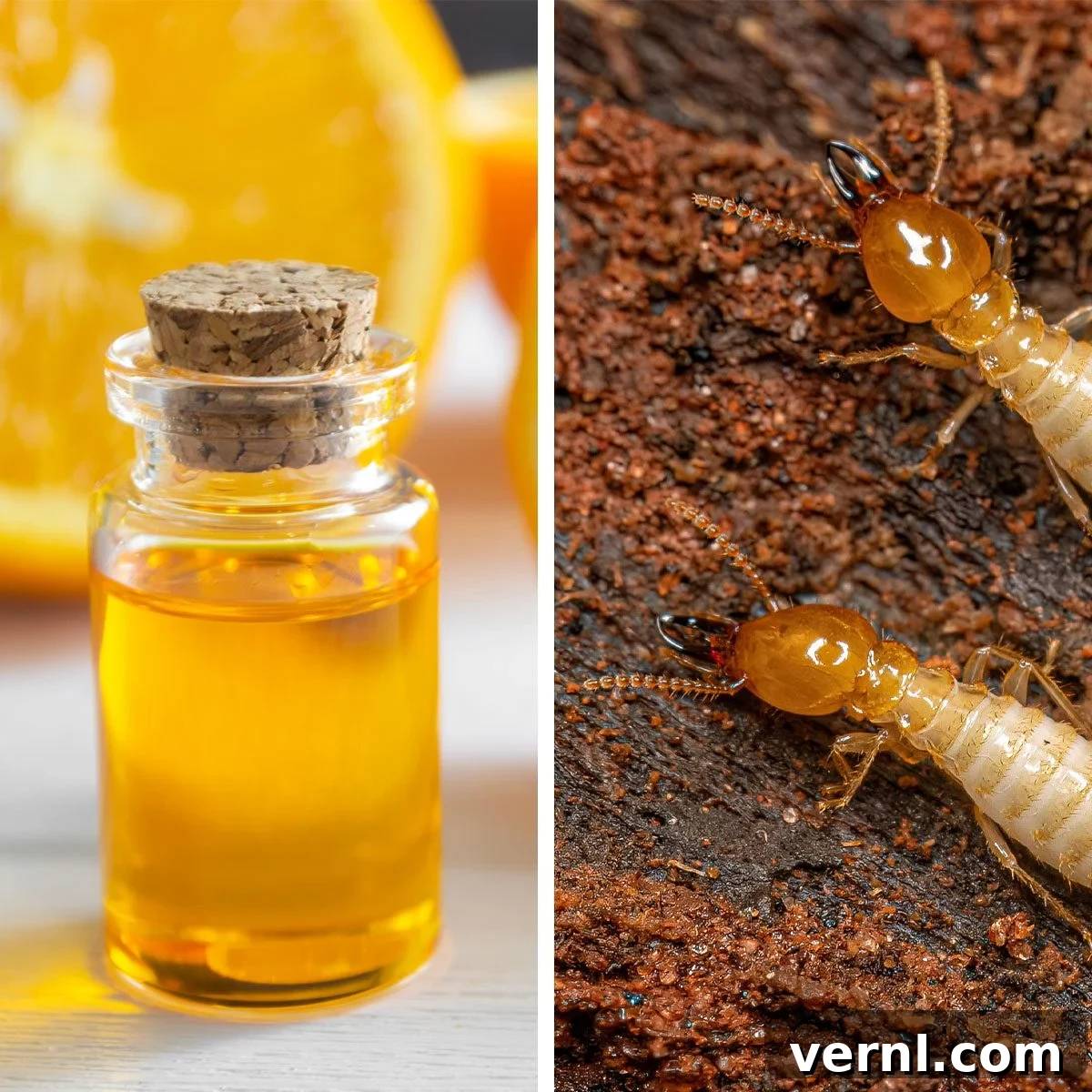
Termites. Just the word can send shivers down a homeowner’s spine. These tiny, relentless insects are not merely a nuisance; they are a serious threat to the structural integrity and financial well-being of countless homes. The Environmental Protection Agency (EPA) paints a grim picture, reporting that termites inflict billions of dollars worth of damage annually in the U.S. alone. Beyond the costly repairs, homeowners shell out an additional $2 billion each year for various termite treatments.
For decades, the go-to solution has been chemical treatments, known for their potency and widespread use. However, a growing consciousness about environmental impact and potential health risks associated with synthetic pesticides has sparked a significant shift. More and more homeowners are now exploring natural alternatives, with products like orange oil gaining considerable attention. But amidst this quest for eco-friendlier options, a critical question arises: Is orange oil truly an effective solution for a problem as formidable as termites?
Understanding Orange Oil: A Natural Pest Control Agent
Orange oil is a natural extract derived from the peels of oranges, a byproduct of the citrus industry. This powerful, water-insoluble substance has found its way into various applications, from general cleaning products to specialized pest control solutions. Its distinctive, fresh citrus scent is often perceived as pleasant, especially when compared to the harsh odors of many chemical pesticides.
The secret behind orange oil’s efficacy lies in its active chemical ingredient: d-limonene. This naturally occurring compound is a potent insecticide known for its ability to target a wide spectrum of pests, including ants, fleas, and notably, termites. When d-limonene comes into contact with an insect, it works by dissolving the waxy coating on their exoskeleton, leading to dehydration and ultimately, death. It can also disrupt the insects’ nervous systems. For homeowners considering this option, various orange oil formulations specifically designed for pest control are readily available on the market.
Orange Oil for Termites: A Closer Look at Its Effectiveness and Limitations
As an advocate for natural treatments whenever feasible, the appeal of orange oil for termite control is undeniable. Its natural origin and relatively low toxicity make it an attractive alternative to synthetic chemicals. However, a realistic assessment reveals that orange oil, used in isolation, is unlikely to offer a long-term, comprehensive solution for most termite infestations.
Effectiveness Against Drywood Termites
Orange oil can indeed be effective against drywood termites, a species that lives entirely within the wood it infests, without needing soil contact. When applied directly to their galleries – the intricate tunnels and chambers these termites excavate within wooden structures – the d-limonene can penetrate and kill termites on contact. For successful eradication, however, the application must be incredibly thorough. You need to saturate every single part of the galleries, ensuring the oil reaches all termites present. If any section of the colony or its tunnels remains unaffected, the surviving termites will continue their destructive work, potentially leading to ongoing damage and re-infestation.
Furthermore, orange oil’s residual effect is limited. Unlike many synthetic termiticides, which provide a protective barrier for years, orange oil does not offer lasting protection. This means that regular, repeated reapplications are necessary to maintain its efficacy against drywood termites, making it a labor-intensive and potentially inconsistent solution for extensive infestations.
Limitations Against Subterranean Termites
The challenges with orange oil become even more pronounced when dealing with subterranean termites, which are the most destructive and common type in the U.S. Subterranean termites build vast colonies underground and require contact with soil to survive. They forage for food by creating mud tubes and tunnels, often traveling considerable distances from their main nest to reach wooden structures. Orange oil simply cannot penetrate deeply enough into the soil to reach these extensive subterranean colonies or create a lasting barrier against them. Its application is primarily surface-level, rendering it largely ineffective against the deeply entrenched nature of subterranean termite activity.
Rachel Maccini, an urban entomologist and pesticide education coordinator at the University of New Hampshire, offers a critical perspective on repellent termiticides, a category that orange oil effectively falls into due to its contact-killing nature. “Repellent termiticides are really not used much anymore,” Maccini states. She emphasizes that no termiticide application, whether natural or synthetic, is 100% foolproof. “There are always gaps in the soil. Termites are excellent at finding these gaps around repellents and breaking containment of the treatment.” Most modern, effective termite products, she explains, are non-repellent and transferable. This means termites unknowingly pass the active ingredient to other members of the colony, leading to widespread eradication. Regarding orange oil specifically, Maccini cautions, “Most of these products do not last very long, so will not provide any kind of effective barrier to protect the structure for any length of time.” This lack of long-lasting residual effect is a significant drawback compared to synthetic termiticides, which are engineered for extended protection.
Comprehensive Termite Management: Beyond Orange Oil
While the allure of DIY pest management is strong, especially for proactive homeowners, termites present a unique challenge that often warrants professional intervention. As Rachel Maccini aptly puts it, “I am all for homeowners doing their own pest management. But termites are one pest that I always recommend to be controlled by a professional [who] is familiar with the current products on the market.”
The decision to tackle a termite infestation yourself or hire a professional can be complex. If you’re dealing with a very localized drywood termite infestation, it’s not too extensive, and you are committed to a natural, pet-safe approach, a combination strategy might be considered. This could involve using orange oil as a direct contact killer and repellent, applied regularly and meticulously. However, pairing it with another natural agent like food-grade diatomaceous earth can enhance its effectiveness significantly.
Diatomaceous Earth: A Natural Desiccant
Diatomaceous earth, or DE, is another powerful natural product derived from the fossilized remains of diatoms, which are microscopic aquatic organisms. Sold as a fine, soft powder, DE works as a mechanical insecticide rather than a chemical one. When an insect, such as a termite, comes into contact with DE, the razor-sharp microscopic edges of the diatom fossils abrade its exoskeleton. This creates countless tiny incisions, causing the insect to rapidly dehydrate and die. Diatomaceous earth can be injected into termite galleries for drywood infestations or dusted around the base of a structure, in attics, basements, and crawl spaces where termites might travel. It is generally considered safe for pets and humans when used as directed.
However, similar to orange oil, both orange oil and DE face significant limitations when combating subterranean termites. A study from the University of Hawaii, for instance, has demonstrated their lower efficacy against these deeply entrenched pests, underscoring the challenge of reaching and eradicating entire subterranean colonies with these methods.
Prioritizing Pet-Safe Termite Treatment Options
For many homeowners, the safety of pets is a paramount concern when choosing pest control methods. If you have beloved animals in your home, it’s crucial to investigate pet-safe options, whether you opt for a commercial DIY product or hire a professional exterminator. Always inquire about the specific chemicals used and their safety protocols regarding pets.
One commercial product that often features on lists of effective termite treatments, and is deemed pet-safe when application instructions are rigorously followed, is Control Solutions Taurus SC Insecticide Termiticide. Its active ingredient, fipronil, is the same substance found in many flea and tick spot-on treatments for pets. When used externally and allowed to dry according to manufacturer guidelines, it poses minimal risk to household pets.
Professional Solutions and Preventative Measures
When facing a serious termite infestation, especially from subterranean species, the most reliable course of action often involves professional expertise. Termite exterminators employ a range of sophisticated products, tools, and methodologies designed to effectively eliminate current infestations and establish robust barriers to prevent future invasions. These methods include:
- Liquid Barrier Treatments: Creating a treated zone in the soil around your home’s foundation using non-repellent termiticides like fipronil or neonicotinoids. Termites unknowingly tunnel through these treated zones, picking up the insecticide and transferring it throughout the colony.
- Bait Systems: Strategically placed bait stations around the perimeter of your property attract foraging termites. The bait contains a slow-acting insect growth regulator or toxicant that termites carry back to their colony, eventually leading to its collapse.
- Fumigation: For severe drywood termite infestations where localized treatments are insufficient, whole-structure fumigation might be necessary. This involves tenting the entire building and introducing a gaseous pesticide to eliminate all termites.
Beyond active treatment, proactive preventative measures are indispensable for long-term termite control. Homeowners should focus on:
- Moisture Control: Repair leaky pipes, maintain proper drainage, and ensure gutters are clean. Termites are attracted to moisture.
- Reducing Wood-to-Soil Contact: Keep wood structures, fences, and firewood away from direct soil contact.
- Sealing Cracks and Gaps: Seal all cracks in foundations, around utility entry points, and any other potential entry points into your home.
- Regular Inspections: Periodically inspect your home’s foundation, crawl spaces, and attic for signs of termite activity like mud tubes, discarded wings, or damaged wood.
- Landscaping: Avoid dense vegetation near your foundation, as it can trap moisture and obscure termite activity.
In conclusion, while orange oil presents an intriguing natural option for very specific, localized drywood termite issues, its broad-spectrum efficacy is limited. For comprehensive and long-lasting termite control, particularly against the more prevalent and destructive subterranean species, a balanced approach combining informed DIY efforts with professional consultation and treatment is often the most prudent path. Prioritizing pet safety and implementing consistent preventative measures will ultimately provide the most robust defense against these pervasive pests.