Precision Deck Framing: The Essential Guide to Leveling Joists and Beams
Embarking on a deck construction project, particularly when working alone, presents a unique set of challenges. One of the most critical, yet often underestimated, hurdles is accurately leveling long joists and beams. These structural components form the very backbone of your deck, and any deviation from a perfectly level plane can lead to a host of issues down the line, from unsightly uneven surfaces to compromised structural integrity.
The struggle is real: imagine trying to hoist a heavy, flexible joist, align it perfectly, and then secure it—all with just two hands. It’s a task that can test the patience of even the most seasoned DIY enthusiast. However, with the right techniques and a bit of ingenuity, achieving professional-grade precision is well within your grasp. This comprehensive guide will delve into effective strategies for leveling joists and beams, focusing on smart, solo-friendly methods that promise stability and a flawless finish for your outdoor oasis.
The Challenge of Leveling Long Joists and Beams Solo
Long structural members, such as deck joists and beams, have a tendency to sag under their own weight or resist rigid positioning. When you’re working without an extra set of hands, holding one end in place while simultaneously trying to adjust and secure the other can feel like a feat of superhuman strength and coordination. Traditional methods often require multiple people, using specialized clamps or temporary supports that can be cumbersome and slow for a single builder. The consequences of not achieving a truly level frame are significant:
- Structural Weakness: Uneven loading can stress fasteners and lumber incorrectly, potentially shortening the lifespan of your deck.
- Aesthetic Flaws: A visible slope or unevenness in your decking planks is immediately noticeable and detracts from the overall beauty of your project.
- Installation Difficulties: Laying decking, railings, or even future additions like pergolas becomes far more challenging and less precise when the foundation is not perfectly level.
- Water Pooling: Slight depressions can collect rainwater, leading to premature rot, mold growth, and a slippery surface.
The Clever Car Jack Method: Your Solo Leveling Solution
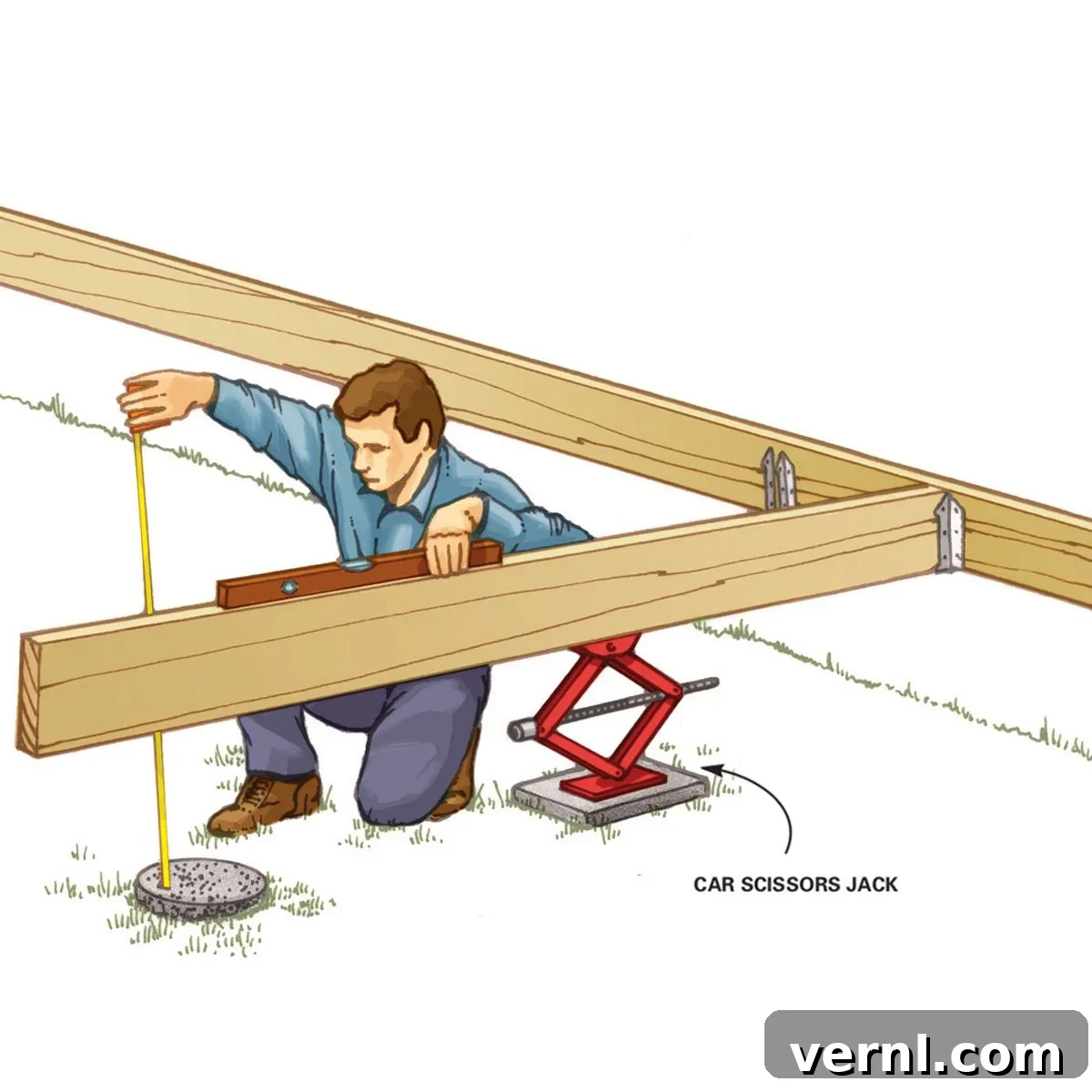
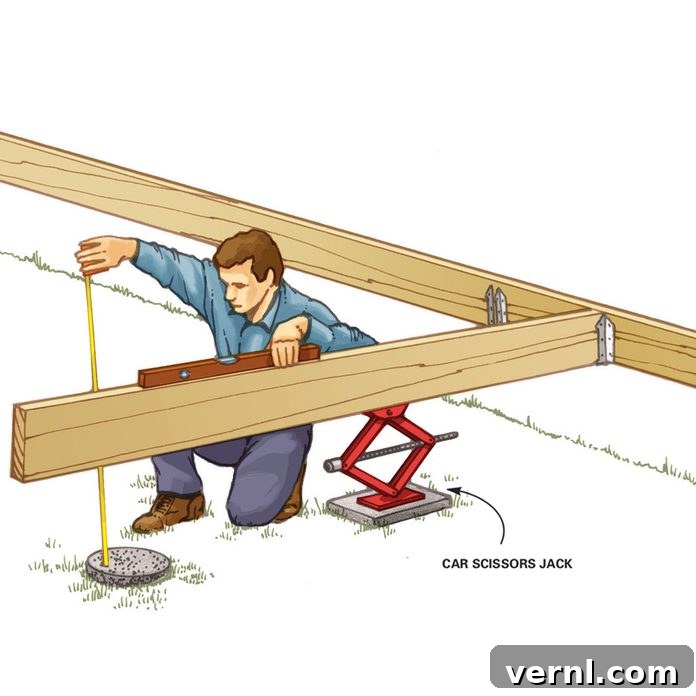
Fortunately, there’s an ingenious and surprisingly simple method that empowers solo builders to achieve precise leveling with minimal effort: utilizing a car scissors jack. This humble automotive tool transforms into an invaluable ally in your deck-building arsenal, offering controlled, fine-tuned adjustments that make leveling long joists a breeze. Here’s how to implement this highly effective technique:
Step-by-Step Guide to Using a Car Jack for Joist Leveling:
- Preparation is Key: Before you even think about lifting, ensure you have all your tools ready: the joist or beam, a reliable spirit level (preferably a long one, or a laser level), measuring tape, a sturdy car scissors jack, suitable blocking or temporary supports, and your chosen fasteners. Safety first: always wear appropriate personal protective equipment (PPE) like gloves and safety glasses.
- Secure One End: Begin by securely attaching one end of the joist or beam to its ledger board, support post, or rim joist, ensuring it’s at the correct height and plumb. This fixed point will serve as your reference for the entire leveling process. Double-check its position and stability.
- Position the Car Jack: Move to the unsecured end of the joist or beam. Place the car scissors jack underneath the joist, somewhere near the middle or closer to the unsupported end, depending on the joist’s length and flexibility. You might need to place a scrap piece of wood between the jack and the joist to protect the lumber and distribute the weight, especially if the joist is heavy or soft. Ensure the jack is on a stable, flat surface to prevent it from shifting or tipping.
- Crank to Level: Begin slowly cranking the car jack up or down. As you make adjustments, continuously check the joist’s levelness using your spirit level. For very long spans, consider using a string line stretched taut between the secured end and a temporary support at the other, or a laser level projected along the joist for maximum accuracy. Adjust the jack incrementally until the joist registers as perfectly level. This method allows for micro-adjustments that are nearly impossible to achieve by hand.
- Secure the Other End: Once the joist is perfectly level, hold it in that precise position (the jack does this for you!). While the jack supports the joist, you can now securely fasten the other end to its corresponding support structure. Use appropriate fasteners and techniques to ensure a strong and lasting connection.
- Verify and Repeat: After securing both ends, carefully remove the car jack. Double-check the joist’s levelness one last time. This is also a good opportunity to check for any twisting or bowing that might have occurred. Repeat this process for all subsequent joists and beams, maintaining consistency across your entire frame.
This method works because it leverages mechanical advantage, providing the controlled lifting and lowering power that a single person simply cannot replicate manually. It’s cost-effective, using a tool many homeowners already own, and offers unparalleled precision for critical structural elements.
Beyond the Jack: Advanced Leveling Techniques and Tools
While the car jack method is excellent for individual joists, comprehensive deck building often benefits from a combination of leveling techniques. Understanding how to use the level over long distances is paramount for achieving a truly flat and uniform deck surface. Discover how to master long-distance leveling here.
Complementary Tools and Methods:
- Laser Levels: For ultimate precision over long distances, a self-leveling laser level is invaluable. It projects a perfectly straight line, allowing you to quickly check the height of multiple joists simultaneously and set benchmarks for your entire frame.
- String Lines: A traditional and highly effective method for checking levelness over long spans. Stretch a tightly pulled string line between two fixed points at the desired height. Then, measure from the string down to the top of each joist to ensure uniformity.
- Water Levels: An old-school but accurate method, particularly useful for transferring heights around corners or obstructions. It relies on the principle that water seeks its own level, providing precise measurements over varying terrain.
- Long Spirit Levels: While a shorter level is good for individual checks, a 4-foot or even 6-foot spirit level helps verify the levelness of a wider section of your joist or beam, identifying subtle bows or dips.
The Unwavering Importance of a Level Deck Frame
Investing time in precise leveling during the framing stage is not merely about aesthetics; it’s about building a safe, durable, and enjoyable outdoor living space. A level frame:
- Ensures Structural Integrity: Distributes weight evenly across all supports, preventing localized stress and potential failure points.
- Simplifies Decking Installation: Flat joists mean your decking boards will lay perfectly flush, making fastening easier and resulting in a professional-looking finish with tight, consistent gaps.
- Prevents Water Damage: Eliminates low spots where water can pool, which is a primary cause of wood rot, mildew, and pest infestations.
- Enhances Safety: A smooth, level surface reduces tripping hazards and provides a stable foundation for furniture, grills, and foot traffic.
- Increases Longevity: A well-built, level deck will stand the test of time, requiring less maintenance and offering years of enjoyment.
Modern Deck Building Tips and Shortcuts for Success
Beyond the fundamental leveling techniques, modern deck building incorporates various strategies to improve efficiency, durability, and visual appeal. From foundation layout to choosing the right materials, every step contributes to the final outcome. For a deeper dive into contemporary approaches, consider these 15 Modern Deck Building Tips and Shortcuts, which cover everything from efficient fastening systems to clever layout tricks.
When planning your deck, always remember to factor in local building codes and regulations. These guidelines ensure your structure is safe, compliant, and built to withstand local environmental conditions. Proper ledger board attachment, correct post footings, and adequate joist spacing are non-negotiable elements of a sound deck design.
Essential Tools for Your Deck Building Toolkit:
- Impact Driver/Drill: Indispensable for quickly and securely driving fasteners.
- Circular Saw: For precise cuts on joists, beams, and decking.
- Chalk Line: For snapping straight lines for cuts and layouts.
- Framing Square/Speed Square: For ensuring perfectly square corners and precise angles.
- Measuring Tape: A durable, accurate tape measure is your constant companion.
- Clamps: Various types of clamps can temporarily hold pieces in place, freeing up your hands.
- Safety Gear: Always wear safety glasses, gloves, and hearing protection.
Troubleshooting Common Framing Issues
Even with the best intentions, you might encounter challenges. Here are a few common issues and how to address them:
- Sagging Joists: If a joist sags slightly after being secured, you might need to add a small shim underneath it at the support point or temporarily re-engage the car jack to lift it while adding extra fasteners or support blocking.
- Twisted Lumber: Lumber can sometimes arrive twisted. For minor twists, strong fasteners and the weight of decking might pull it straight. For severe twists, it’s often better to replace the board.
- Uneven Terrain: If your deck site has significant slopes, ensure your footings are excavated to the proper depth and your support posts are cut to varying lengths to bring the beam level. The car jack method helps fine-tune these variations.
Conclusion: Build Smart, Build Level
Building a deck is a rewarding endeavor, and achieving a perfectly level frame is a hallmark of quality craftsmanship. While the prospect of leveling long joists and beams single-handedly might seem daunting, tools like the car scissors jack, combined with meticulous planning and smart techniques, empower you to tackle this critical phase with confidence. By prioritizing precision, utilizing efficient methods, and understanding the core principles of deck construction, you’ll lay a solid foundation for a beautiful, durable, and safe outdoor space that will be enjoyed for years to come. Embrace these strategies, and your solo deck-building journey will be much smoother and more successful.