
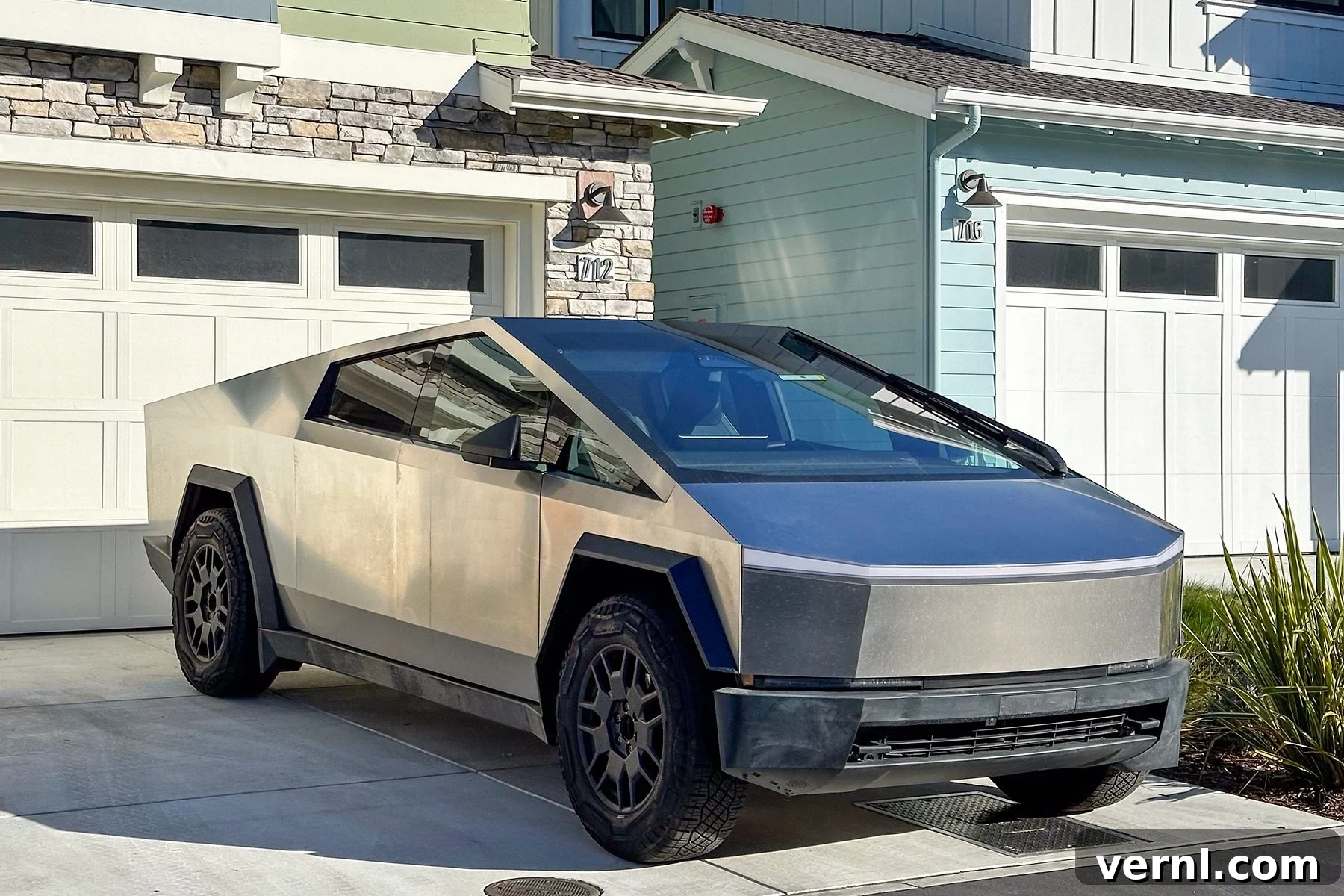
Demystifying Cybertruck Insurance: Separating Fact from Fiction
Tesla’s groundbreaking Cybertruck, with its futuristic design and robust capabilities, captivated the automotive world since its reveal. However, the journey from concept to consumer has been far from smooth, marked by highly publicized production delays and, more recently, a spate of controversies. From safety recalls impacting over 27,000 vehicles, as reported by Reuters, to owner complaints regarding the susceptibility of its stainless steel body to rust, the Cybertruck has frequently found itself in the headlines for less than ideal reasons. The latest challenge to surface, and perhaps one of the most concerning for potential and current owners, involves claims that major insurance companies are refusing to cover these unique electric trucks.
This escalating narrative has generated significant anxiety within the Cybertruck community. The prospect of owning a vehicle, particularly one as high-profile and expensive as the Cybertruck, only to find it uninsurable, presents a formidable hurdle. This article delves deep into these claims, aiming to separate widespread rumors from the documented realities of insuring Tesla’s polarizing pickup.
The Spark: Social Media Claims Ignited Insurance Panic
The recent wave of concern was largely catalyzed by an Oct. 5 X post (formerly Twitter) from an individual identified as Robert Stevenson, an apparent Cybertruck owner. In his post, Stevenson claimed to have received an email from GEICO informing him of the termination of his insurance coverage for his 2024 Tesla Cybertruck. His frustration was palpable: “@GEICO said they can no longer insure my Cybertruck. It makes no sense, as there are other, riskier cars out there. Let me know if you recommend any insurer for the truck. I have eight cars with an amazing record. I will be canceling my entire Geico policy!! Bye-bye!”
The screenshotted email, which quickly circulated across social media platforms including Reddit’s anti-Cybertruck subreddit CyberStuck, stated, “After a careful review of your policy records, we have determined that we are unable to continue your insurance coverage for the 2024 TESLA CYBERTRUCK. We have taken this action for the following reason(s): We are unable to insure your 2024 TESLA CYBERTRUCK xxxxxxx because this type of vehicle doesn’t meet our underwriting guidelines.” While the authenticity of this specific email has not been independently confirmed, its content struck a nerve, prompting widespread speculation and alarm among the growing ranks of Cybertruck enthusiasts and those on reservation lists.
The term “underwriting guidelines” became a focal point of discussion. What exactly about the Cybertruck could cause it to fall outside these guidelines? Was it its unconventional design, its stainless steel exoskeleton, its sheer weight, or perhaps its advanced technology? The vacuum of official information allowed conjecture to thrive, fueling fears that insuring a Cybertruck might be an insurmountable obstacle for many, or at least come at an astronomical cost.
Dispelling the Myth: Insurers Clarify Their Stance on Cybertruck Coverage
Amidst the escalating rumors and social media fervor, major insurance providers were compelled to issue official statements to clarify their position on insuring Tesla Cybertrucks. The overwhelming message from these companies is a direct contradiction to the initial claims: they do, in fact, offer coverage for the Tesla Cybertruck. However, their clarification also highlighted the intricate factors that determine an individual’s eligibility and premium.
In an email statement to The Verge, Ross Feinstein, a spokesperson for GEICO, emphatically stated, “Geico has coverage available nationwide for the Tesla Cybertruck.” This official response directly addresses and refutes the narrative sparked by Robert Stevenson’s post. Similarly, in June, State Farm’s spokesperson Roszell Gadson conveyed to The Verge that they, too, provide coverage for Cybertrucks. Gadson further elaborated, explaining that, “It is important to remember that every customer’s situation is unique and the type of vehicle a person owns is only one factor in determining eligibility for coverage.”
This nuanced explanation from prominent insurers underscores a critical point: while the Cybertruck itself is not inherently “uninsurable,” the process of securing coverage, and the terms of that coverage, are subject to a comprehensive evaluation of various individual and vehicle-specific factors. Simply owning a Cybertruck does not automatically guarantee or deny insurance; it initiates a detailed assessment that is common to all vehicle insurance applications.
Further insights from The Verge’s report indicate that while GEICO generally offers private passenger automobile (PPA) insurance to most Cybertruck owners, some customers have indeed been transitioned to commercial insurance policies. This reclassification isn’t arbitrary; it stems from specific attributes of the Cybertruck, such as its gross vehicle weight rating (GVWR) and the potential complexities associated with sourcing parts and undertaking repairs. This distinction between PPA and commercial insurance is a crucial element in understanding why some owners may encounter unexpected challenges or different policy structures.
Unpacking Underwriting Guidelines: Why Some Cybertruck Owners Face Hurdles
So, if major insurance companies confirm they do cover Cybertrucks, why are some owners reportedly denied or switched to commercial policies? The answer lies in the complex web of underwriting guidelines that insurers employ to assess risk. These guidelines consider a wide array of factors, extending far beyond the make and model of a vehicle. When a Cybertruck owner faces denial or unique policy terms, it’s typically due to one or more of these contributing elements:
1. Driver-Specific Factors
- Driving History: An individual’s past driving record, including accidents, moving violations, and claims history, is a primary determinant of insurance risk. A spotless record generally leads to better rates and easier coverage, while a history of incidents can complicate securing any type of vehicle insurance, regardless of the car.
- Age and Experience: Younger, less experienced drivers are statistically associated with a higher risk of accidents, leading to higher premiums or more stringent coverage requirements.
- Location: Where a driver lives and parks their vehicle significantly impacts rates. Areas with high theft rates, vandalism, or frequent natural disasters (like hail or floods) carry higher risks for insurers.
- Usage of Vehicle: The intended use of the Cybertruck—whether for daily personal commuting, business operations, off-roading, or infrequent leisure drives—influences the risk profile. Commercial use, for instance, typically demands a different, often more expensive, insurance policy.
- Insurance Score/Credit History: In many jurisdictions, an individual’s credit score or a proprietary “insurance score” is used as a predictor of future claims likelihood. A lower score can indicate higher risk.
2. Vehicle-Specific Factors Particularly Relevant to the Cybertruck
- High Vehicle Value: One of the most significant factors impacting Cybertruck owners is the vehicle’s substantial price tag. The base model of the Cybertruck, for example, starts roughly at $100,000. Many standard insurance policies, particularly those offered by mainstream providers, have internal thresholds for vehicle value. As Threads user KCharlesRoss highlighted, “Many insurers do not insure high dollar specialty vehicles. My Geico policy even says it will not cover a vehicle worth more than $100k as a non-owned or temporary substitute vehicle.” This threshold means that for some insurers, a vehicle exceeding this value automatically falls outside their standard underwriting guidelines, requiring a specialized policy or a different provider.
- Unique Construction and Repair Complexity: The Cybertruck’s groundbreaking design, particularly its stainless steel “exoskeleton,” presents unique challenges for repairs.
- Specialized Materials and Tools: Unlike traditional stamped steel or aluminum body panels, the Cybertruck’s ultra-hard stainless steel requires specialized equipment and expertise for repairs. Body shops need specific training and tools to work with this material, making the pool of qualified repair centers much smaller.
- Gigacasting Technology: Tesla employs gigacasting, which involves casting large sections of the vehicle’s underbody in a single piece. While efficient for manufacturing, it means that damage to one part of a gigacast component often necessitates replacing the entire, massive section, which can be incredibly costly and time-consuming.
- Lack of Crumple Zones: The Cybertruck’s rigid exterior, while robust, may transfer more impact forces directly to the internal structure and occupants in certain collisions, potentially leading to more severe internal damage or higher repair bills compared to vehicles designed with traditional crumple zones.
- Limited Aftermarket Parts: As a relatively new and unique vehicle, aftermarket parts for the Cybertruck are scarce. This dependence on potentially expensive OEM (Original Equipment Manufacturer) parts from Tesla can significantly drive up repair costs and extend repair times.
- Advanced Technology and Sensors: Modern vehicles, especially Teslas, are packed with complex sensors, cameras, and software systems that power advanced driver-assistance features. Any collision, even minor, can necessitate costly recalibration or replacement of these integrated systems, further inflating repair expenses.
- Gross Vehicle Weight Rating (GVWR): The Cybertruck’s substantial weight has implications for its classification. For some insurers and in certain states, its GVWR can push it into a category that requires commercial vehicle insurance, even if used for personal purposes. This explains why some owners might be “switched to commercial insurance,” as mentioned by The Verge. Commercial policies often come with different coverages, limits, and higher premiums reflecting the perceived higher risk associated with heavier vehicles or those used for business.
- Novelty and Lack of Historical Data: As a brand-new vehicle unlike anything else on the road, insurers have limited historical data regarding the Cybertruck’s real-world accident rates, theft risk, and average repair costs. This lack of actuarial data often leads to a more conservative approach, resulting in higher initial premiums or more restrictive underwriting until sufficient data becomes available.
The Broader Context of EV Insurance
It’s also important to view the Cybertruck’s insurance challenges within the broader context of insuring electric vehicles (EVs). Many EVs, due to their advanced battery technology, specialized powertrains, and integrated electronics, often incur higher repair costs compared to their internal combustion engine counterparts. Battery pack damage, in particular, can be extremely expensive to repair or replace, sometimes leading to a vehicle being deemed a total loss even after a relatively minor accident. The Cybertruck, with its unique construction and high-tech features, amplifies these existing EV insurance considerations, making it an extreme example within this category.
Guidance for Current and Prospective Cybertruck Owners
Given these complexities, what should current and prospective Cybertruck owners do? The key takeaway is that Cybertrucks are insurable, but securing the right policy requires diligence and awareness of the factors involved:
- Shop Around Extensively: Do not settle for the first quote. Contact multiple insurance providers, including those specializing in high-value or specialty vehicles. Larger, established insurers may have more flexibility.
- Be Transparent About Usage: Clearly communicate how you intend to use the Cybertruck – personal, commercial, etc. Misrepresenting usage can lead to policy cancellation or denied claims.
- Understand Your Policy Limits: Pay close attention to coverage limits, deductibles, and any specific exclusions related to high-value vehicles or unique construction.
- Inquire About Repair Networks: Ask insurers if they have approved repair networks equipped to handle Cybertruck-specific repairs. This can streamline the claims process should an incident occur.
- Get Quotes Before Purchasing: If you are considering buying a Cybertruck, obtain detailed insurance quotes beforehand. This foresight can prevent sticker shock and ensure you factor insurance costs into your overall budget.
- Consider Telematics/Usage-Based Insurance: Some insurers offer discounts for telematics programs that monitor driving habits. While not always a solution for high-value vehicle challenges, good driving can still impact premiums.
Conclusion: Navigating the Nuances of Cybertruck Coverage
In conclusion, the widely circulated rumors suggesting that major insurance companies are outright refusing to cover Tesla Cybertrucks are largely unfounded. Leading insurers like GEICO and State Farm have confirmed that they do provide coverage for these vehicles. However, the path to insuring a Cybertruck is not always as straightforward as it might be for a conventional vehicle. The unique combination of the Cybertruck’s high value, specialized stainless steel construction, advanced technology, and substantial gross vehicle weight introduces complexities that can lead to higher premiums, specific underwriting requirements, or even a reclassification to a commercial policy for some owners.
Ultimately, the ability to secure insurance for a Cybertruck, and the cost associated with it, hinges on a holistic assessment that considers both the individual driver’s profile and the distinctive characteristics of the vehicle itself. It serves as a powerful reminder that while innovation drives automotive design forward, the insurance industry continuously adapts, evaluating new technologies and materials to accurately assess and price risk. For Cybertruck owners, understanding these nuances is key to navigating the insurance landscape successfully and enjoying their distinctive electric truck with peace of mind.
Sources
- Reuters.com: “Tesla recalls over 27,000 Cybertrucks in fifth callback this year” (2024)
- TheVerge.com: “Geico insists it ‘has coverage’ for the Cybertruck after owners complain of dropped policies” (2024)
- FamilyHandyman.com: “Can Stainless Steel Rust?” (General information on stainless steel properties)
- TheVerge.com: “Cybertruck price goes up, cheaper RWD model disappears from configurator” (2024 – information on Cybertruck pricing)
- Threads.net: Post by KCharlesRoss (User experience regarding high-value vehicle insurance)