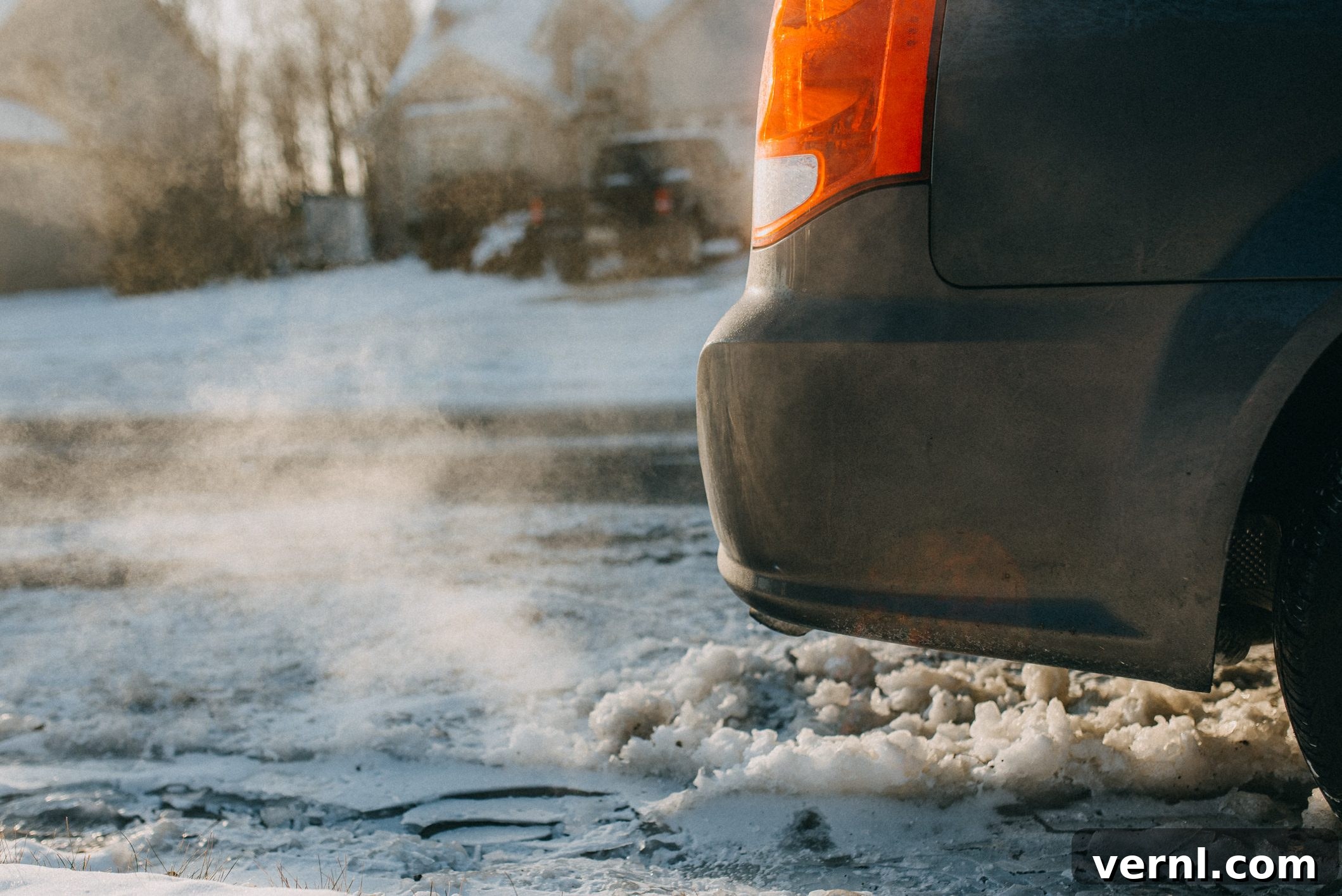
Next time you’re contemplating warming up your car on a chilly morning, letting it sit and run while you finish your coffee, you might want to reconsider. What seems like a harmless routine could actually be against the law, detrimental to your vehicle, and harmful to the environment. The practice of prolonged car idling, once a common habit, is now widely recognized as an unnecessary and often regulated activity with significant negative impacts.
According to automotive expert Jon Vorisek, founder of Repair Surge, “It’s considered idling if the vehicle sits in one spot with the engine running for more than a few seconds. Brief moments of idling are completely normal and expected as a part of typical vehicle use, such as at a stoplight or in slow-moving traffic.” However, the issue arises when drivers intentionally let their engines run for extended periods without moving, often to warm up the cabin or defrost windows.
This seemingly innocuous habit carries a heavy cost, primarily for our planet and our health. The exhaust fumes released during idling contribute significantly to air pollution. Consequently, a growing number of jurisdictions are implementing strict anti-idling laws. Currently, at least 30 states and the District of Columbia have regulations prohibiting drivers from letting their vehicles idle unnecessarily. Beyond state-level mandates, numerous cities and counties have also enacted their own specific ordinances to curb this practice.
Understanding Anti-Idling Laws: More Than Just an Inconvenience
The primary motivation behind anti-idling statutes isn’t to make your winter mornings less comfortable or to inconvenience drivers. Rather, these laws are a crucial component of broader efforts to combat air pollution and protect public health. Vehicle exhaust is a complex cocktail of harmful chemicals, fine particulate matter (soot), and gases such as nitrogen dioxide, carbon monoxide, volatile organic compounds, and sulfur dioxide. When these pollutants are released into the atmosphere, they can have severe consequences.
Exposure to these emissions can exacerbate respiratory conditions like asthma and allergies, leading to more frequent and severe attacks. It also contributes to a range of cardiovascular and respiratory diseases, impacting the overall quality of life for residents, especially in densely populated areas. If you’ve ever experienced a city under an air quality advisory or witnessed a persistent layer of smog, you can deeply appreciate the critical intent behind these anti-idling regulations.
Beyond immediate health concerns, cars and trucks are major contributors to greenhouse gas emissions, which are the primary drivers of climate change. These gases contribute to ground-level ozone formation and haze regionally, while globally, they fuel the larger crisis of global warming. The Environmental Protection Agency (EPA) highlights a stark reality: every gallon of gasoline burned releases approximately 20 pounds of greenhouse gases, predominantly carbon dioxide, into the atmosphere. Idling wastes fuel, and every wasted drop contributes directly to this environmental burden.
Navigating the Patchwork: States and Localities with Anti-Idling Regulations
It’s vital for drivers to understand that anti-idling laws are not uniform across the United States. The specifics, including allowable idling durations, penalties for violations, and specific exceptions, can vary significantly from one jurisdiction to another. For instance, the penalty for excessive idling in Washington, D.C., can be as substantial as a $5,000 fine for letting your vehicle run for more than three minutes. Conversely, Pennsylvania offers a more lenient approach, permitting vehicles to idle for up to 20 minutes if the ambient temperature falls below 40 degrees Fahrenheit. This stark difference underscores the importance of local awareness.
The following list, compiled from the EPA’s website, includes states and the District of Columbia that have enacted some form of anti-idling legislation:
- Arizona
- California
- Colorado
- Connecticut
- Delaware
- District of Columbia
- Georgia
- Hawaii
- Idaho
- Illinois
- Kansas
- Maine
- Maryland
- Massachusetts
- Michigan
- Minnesota
- Missouri
- Nevada
- New Hampshire
- New Jersey
- New York
- North Carolina
- Ohio
- Oregon
- Pennsylvania
- Rhode Island
- South Carolina
- Texas
- Utah
- Vermont
- Virginia
- West Virginia
Because these regulations are subject to frequent updates and can include nuanced distinctions for different vehicle types (e.g., commercial trucks vs. passenger cars, school buses), drivers are strongly advised to consult their local Department of Motor Vehicles (DMV) or equivalent state/city environmental protection agencies to ascertain the precise statutes applicable to their area of residence and frequent travel. Ignorance of the law is generally not considered a valid defense against penalties.
The Myth Debunked: Do Modern Cars Really Need to Warm Up?
The notion of “warming up” a car before driving is largely a relic of automotive history, harkening back to the days of carbureted engines. In those older vehicles, a brief period of idling was indeed helpful to ensure proper fuel mixture and lubrication before the engine could operate smoothly. However, automotive technology has advanced dramatically since then.
Today’s vehicles are equipped with sophisticated electronic fuel injection systems and advanced engine management computers. These systems meticulously regulate the air-fuel ratio and timing, ensuring optimal performance almost immediately upon ignition. Modern engine oils are also formulated to flow efficiently even at very low temperatures, rapidly circulating throughout the engine to provide crucial lubrication within seconds. Most contemporary cars require only about 30 seconds for the oil to circulate adequately – roughly the time it takes you to fasten your seatbelt, adjust your mirrors, and perhaps cue up your favorite podcast or playlist.
In fact, the most effective and efficient way to warm up a modern car is by simply driving it. While the cabin heater and defrost might not be at full blast in the very first minute, the engine will reach its optimal operating temperature much faster when under light load from driving than it ever would sitting idle. Furthermore, driving allows the catalytic converter to heat up quickly, enabling it to effectively reduce harmful emissions from the exhaust, a process that is much slower during idling.
Idling: An Unnecessary Drain on Your Wallet
Beyond environmental concerns and legal implications, there’s a compelling financial reason to avoid prolonged idling: it wastes fuel. This point alone should be enough to convince even the most ardent advocates of “warming up.” The fact is, an idling engine consumes fuel without providing any actual locomotion or utility. While the rate of consumption might seem small on a minute-by-minute basis, it adds up significantly over time.
Consider this: idling for just 10 seconds typically burns more fuel than turning off your engine and restarting it. If you spend just 10-15 minutes a day idling, whether waiting for someone, warming up, or sitting in a drive-thru, you could be wasting dozens of gallons of fuel over a year. With gasoline prices constantly fluctuating and generally trending upwards, every saved gallon translates directly into tangible savings in your pocket. This efficiency benefit extends beyond individual drivers; widespread reduction in idling contributes to national fuel conservation efforts and reduces reliance on foreign oil.
Does Idling Really Damage Your Engine?
While idling doesn’t typically cause immediate catastrophic engine failure, it undeniably contributes to accelerated wear and tear over the long term. Each minute spent idling adds to the cumulative operational hours on your engine, much like driving miles, but often under less ideal conditions. Here’s how:
- Ineffective Lubrication: At idle, engine oil pressure is lower than when the car is in motion. This means lubrication to critical engine components might be less optimal, leading to increased friction and wear.
- Incomplete Combustion: Engines run at cooler temperatures and lower RPMs during idling. This can lead to incomplete combustion, causing fuel to wash down cylinder walls, diluting the engine oil, and potentially leading to carbon buildup on spark plugs, valves, and in the exhaust system.
- Increased Moisture and Acid Buildup: At cooler temperatures, moisture and corrosive acids can build up in the exhaust system and engine oil, accelerating corrosion and degradation of components.
- Accelerated Oil Degradation: The conditions during idling can cause engine oil to degrade faster, reducing its effectiveness and requiring more frequent oil changes.
- Stress on Ancillary Components: Components like the cooling system and alternator are still working during idling but may not be operating at their most efficient, contributing to their wear.
Essentially, those minutes spent idling accumulate, potentially shortening the lifespan of various engine components and increasing the frequency of maintenance, such as oil changes, to mitigate these effects. It’s an invisible cost that drivers often overlook until a repair bill arrives.
FAQs: Common Questions About Car Idling
Is idling different from remote starting my car?
From a legal and mechanical standpoint, remote starting your car often falls under the definition of idling if the vehicle remains stationary with the engine running for an extended period. Idling simply refers to the engine running without the vehicle moving. So, if you remote start your car and let it run for 10-15 minutes before you get in, it’s considered idling and subject to the same regulations. However, if you remote start your car as you walk towards it, get in, and start driving within a minute or two, the car didn’t idle for a significant duration, and it’s less likely to be an issue.
Is there an alternative way to warm up my car without idling?
Absolutely. The best alternative is to simply start driving, but gently. “You can accelerate lightly for the first couple minutes of driving. This is actually better at warming up the engine in modern vehicles. The engine will warm up faster without wasting fuel,” advises Jon Vorisek. Additionally, you can ensure your car is ready for cold weather by clearing snow and ice efficiently (using a scraper and brush instead of relying on the defroster alone while idling) and dressing warmly for the initial part of your drive until the cabin warms up. For extreme cold, a block heater, which warms the engine coolant or oil while the car is off, can be an excellent pre-warming solution without idling.
What are common exceptions to anti-idling laws?
Most anti-idling laws include specific exceptions. Common exemptions typically include:
- When idling is necessary for traffic conditions (e.g., stop signs, traffic lights, traffic jams).
- Emergency vehicles (police, fire, ambulance) in the course of duty.
- Vehicles requiring power for auxiliary functions (e.g., refrigeration units, utility vehicles performing work, power lifts for disabled passengers).
- Vehicles undergoing maintenance or diagnostic testing.
- When idling is required by law (e.g., for certain commercial vehicles undergoing inspections).
- Extreme weather conditions (some jurisdictions allow longer idling in very low or very high temperatures).
- Armored vehicles occupied by a person.
It’s crucial to check your local regulations for the exact list of permissible exceptions.
Does turning off and restarting my engine wear out the starter faster?
This is a common concern, but for modern vehicles, the impact is minimal. Starters are designed for tens of thousands of cycles, and the wear and tear from frequent stopping and restarting (like at stoplights or in stop-and-go traffic) is negligible compared to the fuel savings and reduced emissions. Most modern cars with start-stop technology demonstrate this perfectly, proving that frequent restarts are not a significant mechanical burden.
About the Expert
- Jon Vorisek is the accomplished founder of Repair Surge, an esteemed automotive service information provider that meticulously covers over 10,000 diverse vehicle models. With more than two decades of profound experience in the dynamic automotive industry, his career trajectory spans from managing repair shops to pioneering as an automotive software developer and successfully launching a SaaS startup.
Sources
- Compilation of State, County, and Local Anti-Idling Regulations, Environmental Protection Agency (EPA).
- Greenhouse Gas Emissions from a Typical Passenger Vehicle, EPA.
- Why Is Idling Harmful?, North Carolina Department of Environmental Quality.
- Do You Need to Warm Up Your Car?, JD Power.