
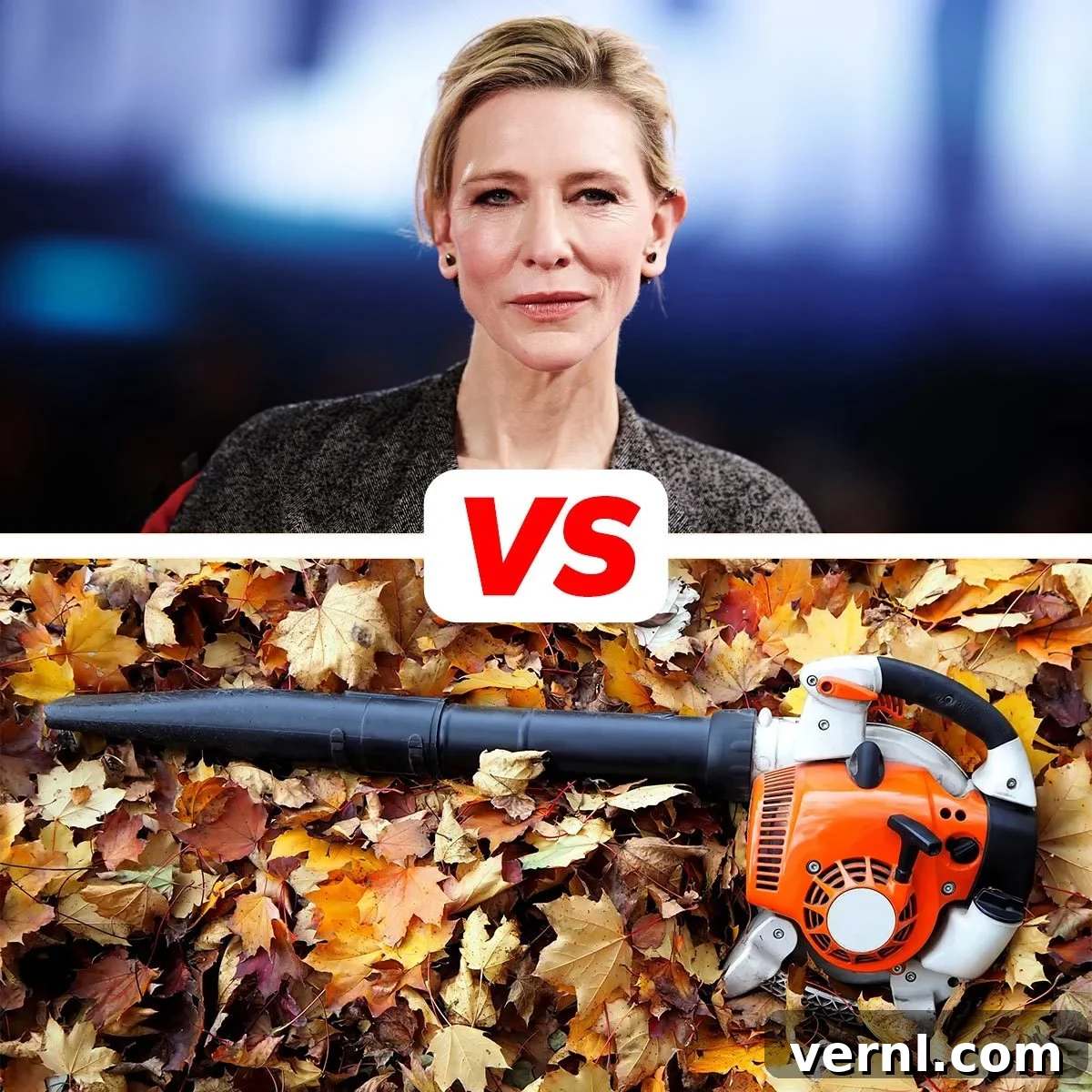
Cate Blanchett’s Decades-Long Battle Against Leaf Blowers: A Fiery Environmental Standpoint
For many homeowners, the crisp air of autumn brings with it a familiar, often dreaded, chore: collecting fallen leaves. This annual ritual of yard work frequently tops the list of mundane tasks, a seemingly endless battle against nature’s seasonal shedding. Yet, while most of us resign ourselves to rakes and bags, or perhaps embrace the convenience of modern machinery, one Hollywood luminary sees this task through a remarkably different, and fiercely passionate, lens.
Academy Award-winning actress Cate Blanchett, renowned for her transformative roles in films like Indiana Jones and Thor: Ragnarok, views the humble act of leaf removal not as a trivial household duty, but as a profound metaphor for humanity’s environmental shortcomings. Her particular target? The ubiquitous and often noisy leaf blower.
It’s an unusual crusade for an A-list star, but Blanchett’s argument is well-researched, deeply felt, and, as we’ll explore, consistently voiced over more than a decade. Far from a passing celebrity whim, her stance on leaf blowers delves into critical discussions about pollution, efficiency, and our collective responsibility towards the planet. Her insights, though delivered with characteristic theatricality, offer a compelling perspective that challenges the very tools we use to maintain our domestic landscapes, urging a re-evaluation of convenience versus ecological impact.
The Passionate Call for Eradication: A Metaphor for Humanity
Blanchett’s outspoken criticism of leaf blowers recently surged into public consciousness during a March episode of the Subway Takes podcast with Kareem Rahma. While promoting her latest cinematic endeavor, Black Bag, the conversation veered towards an unexpected, yet clearly deeply held, pet peeve. With an intensity that captivated listeners, Blanchett declared, “Leaf blowers need to be eradicated from the face of the Earth.” This wasn’t merely a casual complaint; it was a rallying cry born from years of observation and concern about the environment and human behavior.
She elaborated on her stance with profound conviction, framing the issue as a microcosm of larger societal flaws. “The stupidity!” she exclaimed, continuing, “Here’s the thing: It’s a metaphor for what’s wrong with us as a species. We blow shit from one side of our lawn to the other side, and then the wind is just gonna blow it back.” This powerful analogy cuts to the core of what Blanchett perceives as humanity’s often-futile and environmentally detrimental approach to problem-solving. It speaks to a cycle of seemingly productive effort that, in her view, lacks genuine foresight and ultimately achieves little more than displacing problems, rather than resolving them. Her words resonate beyond mere annoyance; they highlight a fundamental disconnect in how we manage our immediate surroundings and, by extension, the broader environment, questioning the very definition of ‘progress’ in lawn care.
Efficiency vs. Ecology: The Unseen Costs of Convenience
The primary allure of leaf blowers undeniably lies in their promise of efficiency and time-saving. In an era where every minute counts, the ability to clear a vast expanse of leaves in a fraction of the time it would take with traditional rakes is a powerful incentive for homeowners. The physical exertion associated with manual raking can be significant, making the mechanical alternative seem like a modern marvel, a tool designed to ease the burdens of property maintenance. This perceived benefit often overshadows any reservations about their use, cementing leaf blowers as an indispensable item in many garden sheds across the nation. The immediate gratification of a ‘clean’ yard quickly achieved often outweighs the consideration of long-term environmental consequences for many users.
However, this conventional wisdom about convenience clashes directly with Blanchett’s environmental calculus. For her, the temporary savings in labor and time are dwarfed by the long-term ecological damage. Her argument is not merely anecdotal; it is grounded in scientific data that reveals a startling truth about these seemingly innocuous machines. Blanchett emphatically stated that just 30 minutes of leaf blower operation can generate more pollution than a heavy-duty pickup truck traveling all the way from Texas to Alaska. This isn’t hyperbole; it’s a statistic that has garnered significant attention and underpins much of the environmental advocacy against these devices. Her ability to recall and cite such impactful research underscores the depth of her engagement with the issue.
The Edmunds Study: Unmasking the Emission Scandal
Blanchett’s assertion about the extreme pollution generated by leaf blowers is not an arbitrary claim. It finds robust support in a seminal 2011 study conducted by Edmunds, a reputable automotive information resource. The study, titled “Leaf Blower’s Emissions Dirtier than High-Performance Pick-Up Truck’s, Says Edmunds’ InsideLine.com,” rigorously tested the emissions of popular two-stroke gasoline-powered leaf blowers. The findings were nothing short of shocking and quickly became a cornerstone for environmental arguments against these tools, altering public perception about their ecological footprint.
Edmunds’ researchers found that common two-stroke leaf blowers, often powered by inefficient engines, emitted extraordinarily high levels of hydrocarbons and carbon monoxide. Specifically, a commercial-grade leaf blower was found to emit as much hydrocarbon pollution in half an hour as a 2011 Ford F-150 Raptor pickup truck driving nearly 3,000 miles – a distance comparable to a round trip from Houston, Texas to Anchorage, Alaska. The carbon monoxide emissions were also alarmingly high, exceeding those of the truck by several magnitudes. This staggering comparison immediately highlighted the disproportionate environmental footprint of these small engines, often used casually in residential areas, bringing into question their true cost of convenience.
The primary reason for these excessive emissions lies in the design of two-stroke engines. Unlike four-stroke engines found in most modern cars and even some lawnmowers, two-stroke engines burn oil mixed with gasoline and are inherently less fuel-efficient and less effective at burning all fuel. This results in a significant portion of unburnt fuel being expelled into the atmosphere as exhaust, contributing to smog formation, ground-level ozone, and particulate matter pollution. These pollutants are not just an environmental concern; they pose serious health risks to operators and nearby residents, including respiratory issues, cardiovascular problems, and even increased risk of certain cancers due to prolonged exposure. The fine particulate matter can travel significant distances, affecting air quality far beyond the immediate vicinity of operation.
The revelations from the Edmunds study provided concrete scientific evidence that bolstered calls for stricter regulations and outright bans on leaf blowers in various municipalities. Washington D.C., for instance, stands as a prominent example, having banned the sale and use of gasoline-powered leaf blowers, effective January 1, 2022, largely due to concerns over air pollution and noise. This landmark decision reflects a growing recognition among policymakers that the convenience of these machines comes at a significant public health and environmental cost. Blanchett’s advocacy, therefore, is not an isolated celebrity rant but aligns with a growing movement driven by scientific understanding and public health considerations.
A Decade of Dedication: Blanchett’s Consistent Crusade
What makes Cate Blanchett’s stance particularly noteworthy is its unwavering consistency. Her passion for environmental issues, specifically concerning leaf blowers, is not a recent development or a fleeting thought born from a moment of irritation. Her well-documented hatred for these devices dates back well over a decade, showcasing a deep-seated conviction rather than a momentary outrage. This enduring commitment speaks volumes about the gravity with which she views the issue.
As early as 2007, the esteemed actress shared her burgeoning frustrations with W Magazine, articulating her viewpoint in strikingly similar terms to her recent podcast appearance. In an interview titled “Queen Cate,” she remarked that leaf blowers “sum up everything that is wrong with the human race.” This early declaration demonstrates that her recent comments on Subway Takes are not new sentiments, but rather a consistent articulation of a long-held belief. This continuity underscores the seriousness with which she approaches the issue, positioning her as a steadfast advocate rather than a casual commentator merely jumping on a trend.
Such enduring commitment to a seemingly niche environmental cause is rare among public figures. While many celebrities champion various global issues, Blanchett’s focus on an everyday household tool highlights how even small, localized practices can have significant environmental ramifications. Her decade-long crusade has undoubtedly contributed to public discourse, prompting many to reconsider the convenience of leaf blowers against their environmental and health costs. Whether one agrees with her fervent call for eradication or not, her unwavering passion and diligent research, evidenced by her recall of the Edmunds study, command respect and encourage a deeper look at our daily habits.
Beyond the Blower: Exploring Sustainable Lawn Care Alternatives
Blanchett’s critique naturally begs the question: if not leaf blowers, then what? The answer lies in a spectrum of more environmentally conscious and sustainable lawn care practices. Understanding these alternatives is crucial for homeowners seeking to reduce their environmental footprint and promote healthier ecosystems in their own backyards, fostering a more harmonious relationship with nature.
Noise Pollution: An Unsung Detriment
Beyond air pollution, leaf blowers are also notorious for their excessive noise. Gas-powered models can reach noise levels upwards of 100 decibels, comparable to a jackhammer or a motorcycle. This level of noise is not just an annoyance; it can cause hearing damage to operators and contributes significantly to noise pollution in residential neighborhoods, disrupting peace and quiet and negatively impacting local wildlife. The constant drone can be particularly disruptive to remote workers, young children, and the elderly, eroding community well-being. Electric leaf blowers are quieter, but still contribute to the overall noise burden, albeit to a lesser extent.
Health Hazards for Operators and Neighbors
The powerful air currents generated by leaf blowers, especially those with high velocity, do more than just move leaves. They kick up enormous amounts of dust, pollen, mold spores, pesticides, fertilizers, and other fine particulate matter hidden within lawns. Operators, even with protective gear, and nearby individuals can inhale these fine particles, exacerbating allergies, asthma, and other respiratory conditions. The exhaust fumes from gas models also contain known carcinogens like benzene and formaldehyde, posing long-term health risks to those frequently exposed. This invisible cocktail of pollutants represents a significant public health concern.
Sustainable Solutions for Fall Leaf Management:
- Raking: The traditional method remains one of the most eco-friendly. It provides excellent exercise, produces no emissions, and generates no noise pollution. While more labor-intensive, it’s a pure, unadulterated form of yard work that connects individuals to their outdoor spaces and minimizes environmental impact.
- Mulching Mowers: Many modern lawnmowers come with a mulching setting or attachment. These machines finely chop fallen leaves, returning nutrient-rich organic matter directly back into the lawn. This acts as a natural fertilizer, improving soil health, reducing the need for chemical fertilizers, and eliminating the need to bag and dispose of leaves. It’s a “leave it and feed it” approach that benefits both your lawn and the environment.
- Composting: Leaves are an invaluable “brown” resource for compost piles. Mixed with “green” waste like grass clippings, they decompose into rich, dark compost that can be used to enrich garden beds, potting mixes, and lawns. Composting diverts organic waste from landfills, reducing methane emissions, and creates a free, high-quality soil amendment that boosts plant growth and soil structure.
- Leaving Leaves in Place (in moderation): For certain areas of a yard, especially under trees, in naturalized sections, or as protective mulch around perennials, leaving a thin layer of leaves can provide essential habitat for beneficial insects, insulate plant roots from winter cold, and slowly break down to enrich the soil. This supports biodiversity and the natural nutrient cycle. Care must be taken to avoid smothering lawns or creating fire hazards near structures.
- Electric Leaf Blowers: While still contributing to noise and dust, battery-powered electric leaf blowers are a significant improvement over gasoline models in terms of air emissions. They produce zero direct exhaust fumes. For those who cannot physically rake or mulch, or need to clear hard surfaces efficiently, these offer a less environmentally damaging option, especially if powered by renewable energy sources.
The Enduring Impact of a Celebrity Voice
Cate Blanchett’s fervent advocacy against leaf blowers underscores the power of a celebrity voice in drawing attention to often-overlooked environmental issues. While her primary profession lies in captivating audiences on screen, her willingness to speak out on seemingly mundane topics elevates the discussion from niche environmental circles to mainstream awareness. By passionately articulating her concerns, backed by scientific data, she compels a broader audience to pause and critically evaluate their own practices, sparking important conversations in households and communities.
Her commitment not only reinforces the validity of environmental arguments against these tools but also serves as a reminder that environmental stewardship isn’t solely about grand global challenges; it also resides in the seemingly small, everyday choices we make in our homes and gardens. Her call for the eradication of leaf blowers, while strong, acts as a catalyst for discussion about sustainable living, clean air, and the responsibility that comes with modern convenience, proving that even a single voice, particularly a renowned one, can ignite significant change and awareness.
Watch Cate Blanchett’s Fiery “Subway Takes” Segment
@subwaytakes Episode 310: Leaf blowers need to be eradicated from the face of the earth!! Feat Cate Blanchett 🚋🚋🚋🚋🚋 Hosted by @KAREEM RAHMA Created by Kareem Rahma and Andrew Kuo Shot by @Anthony DiMieri and Thomas Kasem Edited by Tyler Christie Associate producer @Ramy #podcast #subway #hottakes #subwaytakes #interview #nyc #opinions #cateblanchett #movies #films #leafblowers ♬ original sound – SubwayTakes
Sources and Further Reading
- Edmunds: Leaf Blower’s Emissions Dirtier than High-Performance Pick-Up Truck’s, Says Edmunds’ InsideLine.com (2011)
- W Magazine: “Queen Cate” (2007)
- Family Handyman: Leaf Blower Buying Guide
- D.C. Department of Energy & Environment: Gas-Powered Leaf Blower Ban