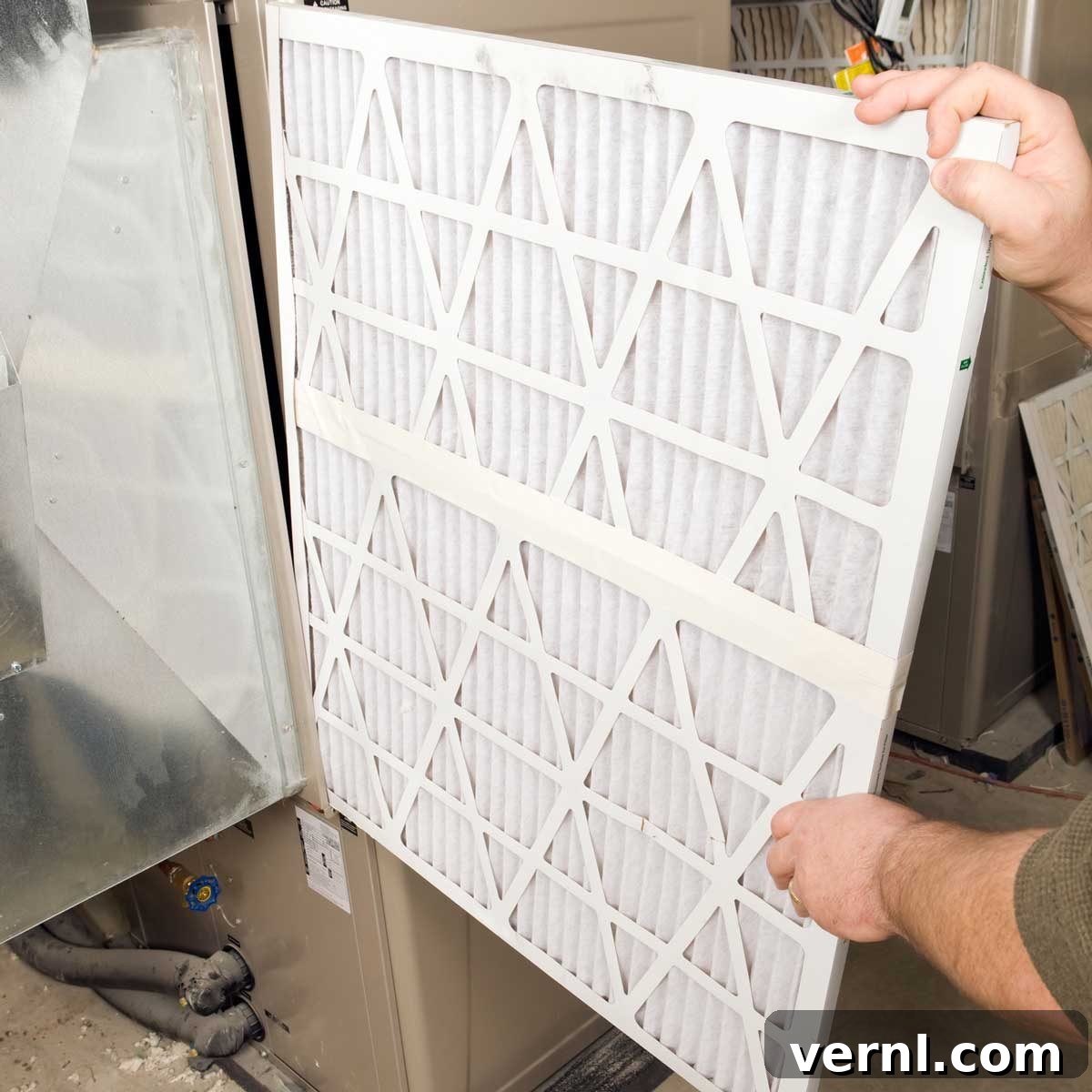
Optimizing HVAC Performance: The Critical Role of Furnace Filters and Airflow Management
In modern homes, the desire for superior indoor air quality (IAQ) has led to an increased demand for advanced furnace filters. While these filters excel at capturing microscopic particles, their restrictive nature can inadvertently introduce significant stress on an HVAC system’s blower, impeding crucial airflow. This often results in diminished system efficiency, increased energy consumption, premature component wear, and even unexpected breakdowns. Fortunately, strategic design adjustments during installation, or even through a well-planned retrofit, can effectively resolve these issues, ensuring both clean air and optimal system performance.
Understanding the delicate balance between air filtration and system dynamics is paramount for any homeowner or HVAC professional. This article delves into the “filter effect” on your heating, ventilation, and air conditioning system and outlines key design adjustments that can prevent common problems, enhance system longevity, and ensure consistent indoor comfort.
The Filter Effect: Balancing Clean Air with System Health
The primary function of a blower filter in any typical HVAC installation is straightforward: to safeguard the delicate components of the blower motor from accumulated dirt, dust, and debris. Without this protective barrier, airborne contaminants would quickly foul the fan blades, motor windings, and other critical parts, leading to reduced efficiency and eventual mechanical failure. However, a significant shift in filter technology and consumer demand has introduced a complex challenge.
Furnace filter manufacturers have responded to homeowners’ growing concern for indoor air quality, especially with tighter home construction preventing natural ventilation. They market filters categorized as “Better” and “Best,” promising to capture an ever-wider range of airborne particles. These high-efficiency filters are designed to trap everything from common dust and pollen to pet dander, mold spores, and even microscopic particles as small as 0.3 microns, often meeting HEPA-standard compliance.
Understanding the MERV Scale and Its Limitations
Filter efficiency is typically measured using the MERV (Minimum Efficiency Reporting Value) scale, which ranges from 1 to 20. A MERV 1 filter offers minimal filtration, primarily catching larger particles like lint, while a MERV 20 filter is nearly impenetrable, used in environments like surgical suites. For most residential applications, filters in the MERV 8 to 13 range are popular, offering a good balance between particle capture and airflow.
However, as Eric Weiss, a seasoned technical trainer for Trane Residential, points out, the MERV scale measures a filter’s ability to improve indoor air quality by capturing particles—it does not, crucially, measure how efficiently the filter allows air to pass through to the blower. This distinction is vital. Weiss draws a helpful analogy: imagine wearing a highly effective mask for virus containment. While it does its job admirably, you’ll quickly find it hot and difficult to breathe through when exerting yourself. The same principle applies to your HVAC system.
The Detrimental Impact of Restrictive Air Filters
When homeowners replace the lower-resistance, high-airflow filters originally installed by HVAC professionals with highly restrictive, high-MERV filters, they inadvertently set the stage for a cascade of problems:
- Increased Blower Motor Stress: The most immediate consequence is that the blower motor must work significantly harder to pull the required volume of air through the dense filter media. This increased workload puts immense strain on the motor, leading to higher operating temperatures. The blower relies on the flow of air passing over it for cooling; when airflow is restricted, this crucial cooling action is diminished, causing the motor to overheat.
- Reduced System Lifespan: Elevated operating temperatures and constant overexertion accelerate wear and tear on critical blower components, including motor bearings and windings. This significantly shortens the effective lifespan of the blower motor, leading to costly repairs or premature system replacement.
- Decreased Energy Efficiency: A blower motor working harder directly translates to increased electrical consumption. Furthermore, if the system cannot efficiently circulate conditioned air throughout the house due to poor airflow, it will run for longer periods to meet the thermostat’s set temperature. This sustained operation needlessly inflates energy bills, negating any perceived benefit of cleaner air through system inefficiency.
- Inconsistent Home Comfort: Restricted airflow can lead to uneven temperature distribution across different zones of your home. Some rooms might feel too hot or too cold, as insufficient conditioned air reaches them. This compromises the overall comfort that an efficient HVAC system is designed to provide.
- Increased Noise Levels: As Weiss observed during his tenure as a field technician, noise complaints are common among homeowners. While sometimes related to improperly sized heating/cooling units, noise often stems directly from poor airflow. A strained blower motor can produce whining or humming sounds, and the turbulent air attempting to force its way through restrictive filters and ductwork can create whistling or roaring noises that disrupt the peace of your home.
The core message is clear: while a high-MERV filter offers excellent particle capture, it can compromise the very system designed to deliver conditioned air, leading to a host of performance, efficiency, and longevity issues.
Making Smart Adjustments: Designing for Optimal Airflow
The good news is that these challenges are not insurmountable. According to Eric Weiss, addressing these issues is entirely feasible during the design and installation phase of a new HVAC system. Even existing systems can be retrofitted, though typically at a higher cost and with more effort due to the need to modify existing infrastructure. Proactive planning is always the most cost-effective and efficient approach.
When designing a new system, Weiss aims for a remarkably low pressure drop of only 0.1-inch w.c. (water column) between the supply static pressure and the air moving through the return ducting. Static pressure essentially measures the resistance airflow encounters within the ductwork. A lower static pressure indicates less resistance and more efficient airflow. To put this target into perspective, a common 12 MERV filter, depending on the manufacturer and specific construction, can alone introduce a static pressure increase of approximately 0.4-inch w.c. This stark difference immediately highlights the need for design intervention to bring the system back into the optimal operating range.
Here are the most common and effective strategies Weiss employs to reduce static pressure and restore proper airflow:
Design Adjustment 1: Maximizing Filter Area
The most direct way to reduce resistance and improve airflow to the blower is to increase the physical surface area of the filter. More surface area means the air has a larger path to travel through, decreasing the velocity needed to move a given volume of air, thereby reducing friction and static pressure. There are two primary methods to achieve this:
1. Upgrade Ductwork to Accommodate a Larger Single Filter:
This approach involves modifying the return air plenum or ductwork to accept a filter larger than the standard size. For instance, if a furnace typically uses a 20×25-inch filter, the ductwork might be redesigned to accommodate a 24×30-inch or even larger filter. This often requires moving the filter housing away from the immediate side of the furnace to create the necessary space for the duct to “flare out.” The duct would widen to match the larger filter size and then taper back to rejoin the existing ductwork. While this can involve more significant ductwork alterations, it offers the benefit of simplifying filter changes, as there’s still only one filter to manage.
2. Doubling or Multiplying the Filter Area with Multiple Filters:
A highly effective strategy involves distributing the filtration load across multiple filters. This can be achieved by ducting in a second filter to supply the blower from another side of the unit (e.g., from underneath or from an adjacent side) or by using multiple return air grilles in different parts of the home, each equipped with a filter. According to Weiss, doubling the effective filter area dramatically reduces the air velocity needed by half. This seemingly simple reduction has a profound impact: it reduces the air pressure resisting the blower’s action by a factor of four. This exponential reduction in resistance makes a significant difference in alleviating blower strain and improving overall system efficiency.
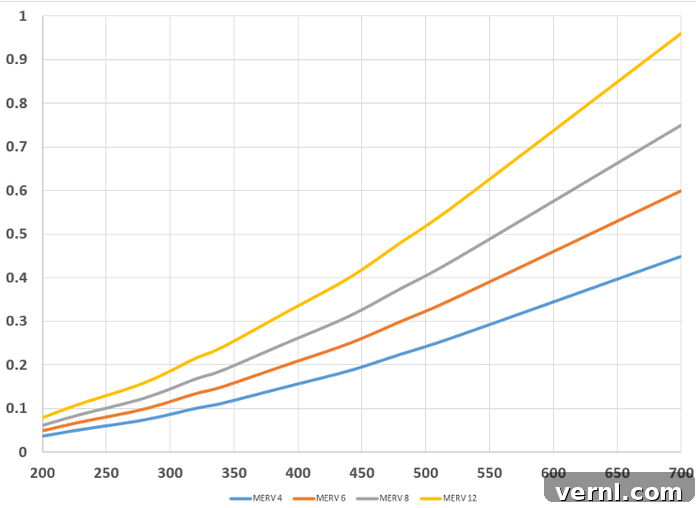
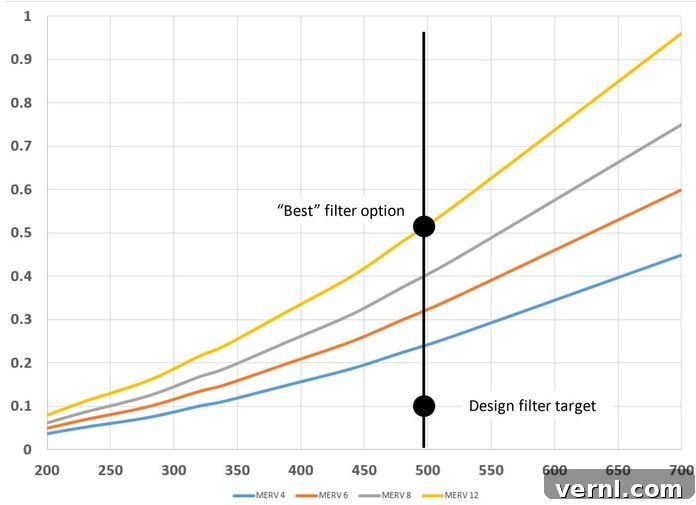
The accompanying chart vividly illustrates the static pressure drop curves for filters at various MERV ratings. The vertical axis represents the system static pressure drop in 0.1-inch w.c. increments, while the horizontal axis shows the system airflow in cubic feet per minute (CFPM). The black line denotes the testing standard of 492 CFPM, indicating where the optimal design target (0.1 pressure drop) and a typical MERV-12 filter would fall. As you can see, a standard MERV-12 filter causes a significant pressure drop well above the target.
Weiss explains that by effectively doubling the filter area, you halve the flow rate through each individual filter while still delivering the same total volume of air to the blower. If you trace the yellow line back to the 250 CFPM mark (representing the halved flow rate through each of two filters), you observe that a double MERV-12 filter configuration can deliver airflow at a rate that very nearly matches the ideal target pressure drop of 0.1-inch w.c. This demonstrates the powerful impact of increasing filter area.
NOTE: The data set used to create this chart is a general representation of products available in the market. Specific filter performance may vary somewhat from this illustration based on its unique construction and manufacturing characteristics. However, the fundamental principle remains consistent.
Design Adjustment 2: Incorporating Thicker Filter Media
Another highly recommended adjustment, whenever space permits, is to install or modify the system to accommodate a thicker filter. Traditional, thin, single-ply filters typically offer a relatively small amount of filter media—perhaps 18 to 24 inches in total length—for the returning air to pass through. This limited surface area means air is forced through a very constricted path, leading to higher velocity and increased resistance.
In stark contrast, a modern five-inch thick pleated filter, measuring approximately 21 inches wide by 23.5 inches tall, can provide an astounding 16 feet of filter media when fully stretched out. This massive increase in surface area is achieved through the intricate pleating design, which allows for significantly more contact between the air and the filter material within the same physical frame.
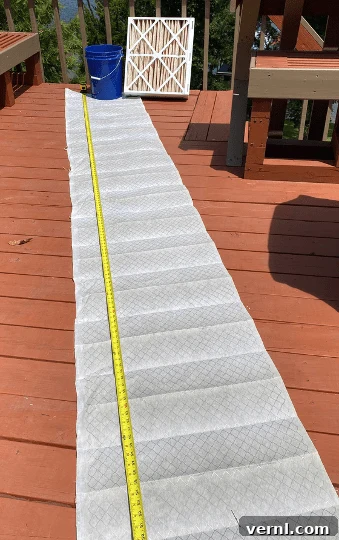
The benefits of using thicker filter media are substantial:
- Significantly Reduced Static Pressure: With 16 feet of media compared to 18-24 inches, the air has an immensely larger surface area to flow through. This dramatically lowers air velocity, friction, and ultimately, the static pressure resistance on the blower.
- Enhanced Particle Capture without Compromise: A thicker filter, even at the same MERV rating as a thinner counterpart, can often capture more particles over its lifespan and maintain its efficiency longer due to the expanded surface area. The air simply has more opportunities to interact with the filtration material.
- Extended Filter Lifespan: More filter media means the filter can hold a much greater volume of dust and debris before becoming restrictive. This translates into less frequent filter changes for the homeowner, improving convenience and reducing maintenance costs.
- Consistent Performance: The filter maintains optimal performance for a longer period, ensuring that both air quality and system efficiency are consistently met between changes.
Implementing this adjustment often involves “cutting in a frame” – modifying the return air plenum to create a deeper housing that can accommodate the thicker filter. While this is an additional step during installation, the long-term benefits in system health, efficiency, and homeowner convenience far outweigh the initial effort.
The Power of Proactive Communication: Learning the Homeowner’s Intentions Early
The most effective strategy for preventing all these potential issues begins not with tools and ductwork, but with open and honest communication between the HVAC contractor and the customer. As Eric Weiss sagely advises, “One of the most important questions I have is: ‘Are you concerned about indoor air quality?’ Then, ‘Are you looking to use a better air filter with your new system?'” He emphasizes that gaining this insight early on is critical, stating, “If they are, that’s going to affect my system design.”
By asking these questions upfront, HVAC professionals can:
- Tailor the System Design: Understanding the homeowner’s priorities regarding IAQ allows the contractor to proactively incorporate the necessary design adjustments—whether it’s expanded filter areas, thicker filter media, or both—from the very beginning. This ensures the system is built to perform optimally with the desired level of filtration, rather than being retrofitted later.
- Educate the Customer: This initial conversation is an invaluable opportunity for the HVAC professional to educate the homeowner about the trade-offs involved. Explaining the relationship between high MERV ratings, airflow restriction, static pressure, energy consumption, and system longevity empowers homeowners to make informed decisions. It helps them understand that “better” filtration doesn’t automatically mean “better” for the entire HVAC system without proper design.
- Set Realistic Expectations: By openly discussing the implications of filter choices, contractors can set realistic expectations regarding system performance, maintenance requirements, and potential energy costs. This transparency builds trust and prevents future dissatisfaction.
- Prevent Costly Callbacks: Addressing potential airflow issues during the design phase is significantly more cost-effective and less disruptive than fixing problems after installation. Proactive communication reduces the likelihood of “off-hours calls from an unhappy customer” complaining about noise, poor heating/cooling, or premature system failure.
- Enhance Customer Satisfaction: Ultimately, a well-designed system that meets the homeowner’s IAQ needs without compromising efficiency or longevity leads to greater long-term customer satisfaction and positive referrals.
The key takeaway is that an HVAC system is an integrated whole. The filter, while seemingly a minor component, plays a pivotal role in its overall performance. By having early conversations and applying smart design adjustments, HVAC professionals can ensure their installations deliver both pristine indoor air and peak operational efficiency for years to come.
All About Furnace Filters: Further Resources
To deepen your understanding of furnace filters and how to best utilize them in your home, explore these related topics:
- Best Furnace Filters for Allergies, Dust, Pet Owners and More
- How to Change a Dirty Furnace Filter
- Debunking Common Furnace Filter Myths
- This Simple Trick Can Refresh Your Entire Home