Ultimate Guide to Drill Bits: Choosing the Right Bit for Every Project
Every seasoned DIYer understands that the foundation of any successful project lies in selecting the correct tool. While countless hours might be dedicated to researching and purchasing the best drill or driver, a crucial component often overlooked is the drill bit itself. Yet, it’s the humble drill bit that makes direct contact with your material, determining the cleanliness, precision, and efficiency of your work.
Choosing the right drill bit isn’t just about avoiding frustration; it’s about optimizing your most valuable resource: your time. A well-chosen drill bit will cut faster, last longer, and produce superior results, ultimately saving you effort and material. Conversely, using the wrong bit can lead to botched holes, damaged materials, prematurely dulled tools, and even safety hazards. For peak efficiency and professional-grade outcomes in all your home improvement and crafting endeavors, a thorough understanding of the diverse types of drill bits and their specific applications is essential.
What Exactly Is a Drill Bit?
At its core, a drill bit is a rotary cutting tool meticulously engineered to create circular holes in various materials. It consists of several key components: the point, which is the tip that initiates the cut; the cutting edges (or lips), which perform the actual material removal; the flutes, spiral grooves along the body that guide waste material out of the hole; and the shank, the smooth, cylindrical (or sometimes hex-shaped) rear end that is firmly secured within the jaws of a drill chuck. When the drill rotates, the bit spins, and its sharp point and cutting edges bore into the workpiece, progressively removing material to form a perfectly round hole.
The world of drill bits is incredibly vast, reflecting the myriad materials and tasks they are designed for. A walk down the drill bit aisle of any hardware store reveals a dizzying array of shapes, sizes, and materials. For the purpose of this comprehensive guide, we will focus on the most commonly encountered and widely used drill bits that are indispensable for typical DIY projects, empowering you to tackle everything from hanging a picture to assembling furniture with confidence.
Common Uses and Applications for Drill Bits
Drill bits serve the primary function of creating clean, circular holes in an extensive range of materials, including wood, plastics, drywall, various metals, and even tough masonry. The applications are virtually limitless. They might be used to:
- Prepare for Fasteners: Drilling pilot holes for screws or bolts to prevent splitting and ensure a secure fit.
- Install Anchors: Creating holes for wall anchors in drywall or concrete.
- Cable Management: Boring passages for electrical wiring, network cables, or plumbing lines.
- Joinery and Assembly: Making holes for dowels, mortise and tenon joints, or other woodworking connections.
- Crafting and Fabrication: Essential for a myriad of creative projects, from jewelry making to model building.
- Enlarging Existing Holes: Gradually expanding a smaller hole to a larger diameter.
Drill bits are available individually, allowing you to replace a worn-out bit or acquire a specific size for a unique task. More commonly, they are sold in multi-sized sets, often referred to as drill indexes or bit sets, providing a range of diameters to cover most common needs. When selecting a drill bit, three primary factors should always guide your decision: its physical shape, the material it is made from, and crucially, the specific work material you intend to drill into.
Drill Bit Types: Understanding Physical Shape and Design
The easiest factor to consider when navigating the world of drill bits is their physical shape. Each design is optimized for specific tasks and materials.
Twist Bit: The Versatile Workhorse
The twist bit, sometimes referred to as a fluted bit or jobber bit, is unequivocally the most common and widely recognized type of drill bit. Its omnipresence stems from its remarkable versatility, making it a go-to choice for a vast array of materials and applications.
Characterized by its distinctive spiraled grooves, known as flutes, running along its cylindrical body, the twist bit derives its name from this design. As the bit rotates and penetrates the work material, the flutes play a critical role in directing the waste material (chips or dust) up and out of the hole, preventing clogging and ensuring continuous cutting action. Twist bits are generally the fundamental starting point for creating most holes, and many specialized bits, such as brad point bits or masonry bits, are essentially variations built upon this basic twist bit structure.
While exceptionally versatile, twist bits do have practical size limitations. Beyond approximately one inch in diameter, the increasing weight, heat generation, and material removal volume can render them impractical for larger holes. For applications requiring holes larger than an inch, specialized bits like spade bits or hole saws become far more efficient and appropriate.
Brad Point Bit: Precision for Wood
A specialized variation of the twist bit, the brad point bit is specifically designed for woodworking. It features a sharp, central point (the brad point) that acts like a nail, precisely locating the hole and preventing the bit from “walking” or wandering across the wood surface at startup. Flanking this central point are two spurs or cutting wings that score the outer perimeter of the hole before the main cutting edges remove material. This design ensures exceptionally clean, splinter-free holes, which is crucial for visible woodworking projects and joinery. Brad point bits are ideal for precision drilling in softwoods, hardwoods, and composite materials like plywood and MDF.
Spade Bit: Aggressive Cutting for Wood
Also known as paddle bits due to their flat, spade-like profile, these bits are designed for aggressively removing large sections of material, primarily in wood. A spade bit features a sharp, pointed tip in its center, which serves to precisely locate the hole and prevent skidding on smooth surfaces. Extending outwards from this central point are two flared wings with sharp edges. As the bit spins, the tips of these wings first score the outside perimeter of the circle, effectively severing wood fibers and minimizing tear-out, especially on the exit side of the hole. The wide, flat blades then rapidly chip away the interior material. Spade bits are excellent for quickly drilling large diameter holes (typically from 1/4 inch up to 1-1/2 inches or more) for tasks like running electrical wires, plumbing, or creating clearance holes where absolute precision and finish quality are less critical than speed and material removal volume.
Hole Saw: Large, Clean Holes and Material Preservation
When the task calls for creating very large diameter holes, especially in materials like wood, metal, plastic, or even thin masonry, a hole saw is the tool of choice. Unlike spade bits that remove all material from the hole, a hole saw works differently. It features a central twist drill bit, known as a pilot bit, which guides the saw and prevents wandering. Encircling this pilot bit is a hollow, cylindrical saw blade with teeth along its edge. The hole saw cuts only the outside diameter of the hole, leaving behind a perfectly round disc or “core” of the material. This design offers several advantages: it generates less waste, produces cleaner cuts, and is more efficient for very large diameters compared to attempting to use a massive twist or spade bit. Hole saws are commonly used for installing recessed lighting, door hardware, and creating access holes.
Step Bit: Versatility for Thin Materials
Step bits are a highly versatile and ingenious tool, essentially functioning as multiple drill bits integrated into a single tool. Instead of a traditional cylindrical profile, these bits are cone-shaped, characterized by a distinctive stair-step design. Each “step” along the cone represents a different, incrementally larger drill size. This innovative design allows you to drill a hole of a precise diameter, or progressively enlarge an existing hole, without the need to constantly switch between different bits. Step bits are particularly effective for drilling clean, burr-free holes in thin materials such as sheet metal, plastic, or PVC, and are often used by electricians for creating holes in electrical boxes. Their design also allows for effective deburring of the drilled hole edges.
Forstner Bit: Flat-Bottomed and Overlapping Holes
Primarily used in woodworking, Forstner bits are designed to create exceptionally clean, precise, and flat-bottomed holes. They feature a central point that acts as a pivot, guiding the bit, and razor-sharp cutting edges along the rim that shear the wood fibers. This design allows for drilling partial holes, overlapping holes, or holes at an angle without splintering. Forstner bits are ideal for tasks like creating hinge mortises, drilling pocket holes, or any application where a clean, flat-bottomed hole is required in wood or composites.
Countersink Bit: Flush Fasteners
While not for drilling a through-hole, a countersink bit is essential for achieving a professional finish with screws. It creates a conical-shaped recess at the top of a pilot hole, allowing the head of a countersunk screw (like a flat-head or Phillips-head screw) to sit flush with or slightly below the surface of the material. This prevents screw heads from protruding, ensuring a smooth surface and a neat appearance, particularly important in woodworking and furniture making.
Drill Bit Types: Understanding Bit Material and Coatings
The material from which a drill bit is manufactured, or any coatings applied to it, significantly impacts its durability, heat resistance, and performance when drilling into different workpieces. The following materials are most commonly encountered and useful for the average DIYer.
High-Carbon Steel (HCS)
These are robust drill bits made from high-carbon steel, offering good performance for drilling into softer materials such as wood, most plastics, and even some softer metals. Their main advantage is their affordability, making them a good choice for occasional use. However, a significant drawback is their susceptibility to overheating. At high drill speeds, especially when drilling into harder metals without proper lubrication, high-carbon steel bits can rapidly lose their temper, soften, and become dull very quickly, rendering them ineffective. To prolong their life, it’s crucial to use slower speeds and appropriate lubricants when drilling metals.
High-Speed Steel (HSS)
High-speed steel (HSS) bits represent a significant upgrade from high-carbon steel. HSS is an alloy that contains elements like tungsten, molybdenum, chromium, and vanadium, which enhance its hardness and, crucially, its ability to maintain a sharp edge at much higher temperatures. This means HSS bits are capable of prolonged drilling without losing their edge, making them ideal for more demanding tasks. They perform almost identically to high-carbon steel bits when cutting softer materials like drywall or wood but truly excel when drilling into metal. If you’re comparing prices and the difference between a carbon steel bit and an HSS bit is minor, opting for the HSS version is almost always the smarter investment for its superior durability and versatility.
Cobalt (M42) Drill Bits
An even more robust form of HSS, cobalt drill bits (often designated as M42 HSS) incorporate a small percentage of cobalt alloyed into the steel (typically 5-8%). This addition dramatically increases the bit’s heat resistance and hardness, making them exceptionally tough and ideal for drilling into very hard or abrasive materials like stainless steel, cast iron, titanium, and other difficult alloys. Cobalt bits are more expensive than standard HSS but offer significantly extended tool life and performance in challenging applications. They are designed to withstand extreme temperatures generated during heavy-duty drilling tasks.
Carbide or Carbide-Tipped Drill Bits
Drill bits made entirely of solid carbide, or more commonly, those with carbide-coated tips, are significantly harder and more durable than any steel-based bits. Tungsten carbide is an extremely hard, brittle material capable of maintaining an edge even under immense pressure and heat. This makes carbide-tipped bits indispensable for drilling into exceptionally tough and abrasive materials such as concrete, brick, ceramic tile, glass, and stone. While their resilience is unmatched for these specific applications, they also come with a significantly higher price tag. Most DIYers don’t require the extreme hardness of solid carbide for everyday tasks, though carbide-tipped masonry bits are standard. If you invest in one, it’s wise to reserve it for the really tough jobs and use more traditional, less expensive bits for softer materials. A notable advantage is that carbide drill bits can be resharpened effectively, extending their lifespan.
Specialized Coatings
Beyond the base material, many drill bits come with specialized coatings that further enhance their performance, prolong their life, or make them resistant to specific conditions. Common coatings include:
- Titanium Nitride (TiN): A golden-colored ceramic coating applied to HSS bits. TiN increases surface hardness, reduces friction, and improves heat resistance, leading to longer bit life and faster drilling speeds, especially in metal.
- Titanium Carbonitride (TiCN): Similar to TiN but even harder and more lubricious, offering superior performance in abrasive materials.
- Black Oxide: A black finish applied to HSS bits. This coating provides some corrosion resistance, reduces friction, and helps to dissipate heat, preventing rust and prolonging bit life, especially in non-ferrous metals and wood.
- Bronze/Brass Oxide: Often used on bits intended for masonry, providing some corrosion resistance.
- Diamond Grit: For cutting extremely hard, brittle materials like glass, ceramic, porcelain, and stone, bits coated with crushed industrial diamond particles are used. These bits don’t cut in the traditional sense but rather abrade the material.
Drill Bit Types: Selecting by Working Material
Understanding the material you’re drilling into is perhaps the most critical factor in selecting the appropriate drill bit. Matching the bit to the material ensures optimal performance, prevents damage, and ensures safety.
Drill Bits for Metal
For drilling into metals, including softer aluminum, brass, or tougher stainless steel, your best bet is almost always a High-Speed Steel (HSS) twist bit. HSS offers superior resistance to the high temperatures generated when drilling into metal, preventing the bit from dulling prematurely. The flutes on a twist bit are effective at clearing the metal swarf (shavings), which are relatively easy to clean up. For very hard metals like stainless steel, consider cobalt HSS bits for their enhanced heat resistance and durability.
If you’re working with thin sheet metal or need to widen existing holes with precision, a step bit is an excellent choice as it provides multiple diameters in one tool and deburrs the hole edges. For creating large holes (one inch or more) in metal surfaces, such as for conduit or plumbing, a bi-metal hole saw is highly effective, offering clean cuts with minimal effort. Remember to use appropriate cutting fluid or lubricant when drilling metal to reduce friction, dissipate heat, and prolong the bit’s life.
Drill Bits for Masonry
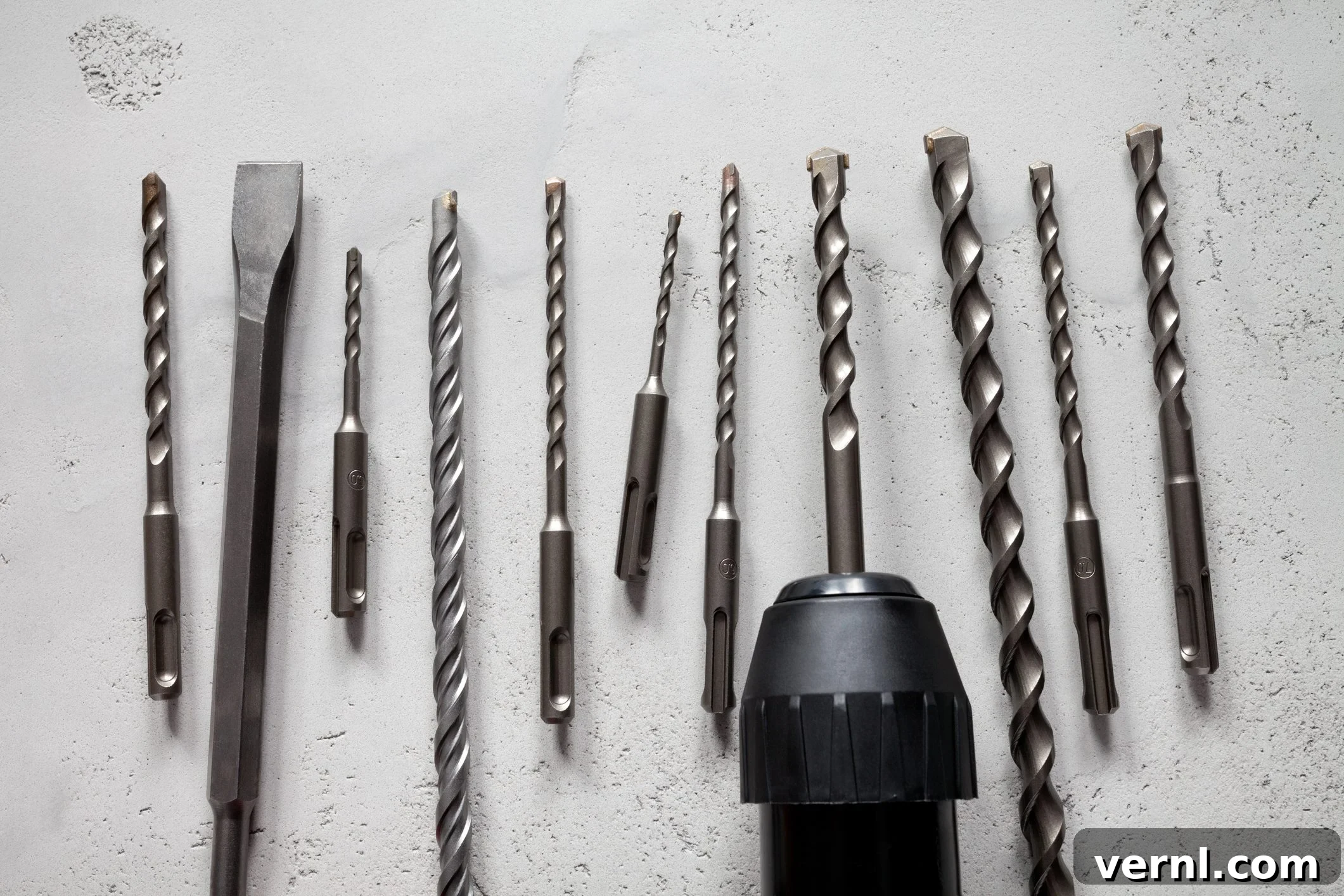
Masonry drill bits are specifically designed for boring into hard, abrasive surfaces such as concrete, brick, mortar, stone, and cinder blocks. They are typically twist bits distinguished by a carbide fin or tip brazed onto their point. The incredibly hard carbide tip is engineered to pulverize the masonry material through a hammering or chiseling action, while the flutes on the bit body efficiently remove the resulting dust and debris from the hole.
Masonry bits are most effective when used with a hammer drill. A hammer drill is a specialized power tool that adds a rapid, percussive (hammering) action to the rotary motion of the drill bit. This combined rotation and hammering allows the carbide tip to effectively break up the hard masonry, enabling it to reach fresh material and remove dust far more efficiently than a standard drill. Always wear appropriate safety gear, including eye and hearing protection, when using a hammer drill for masonry.
Drill Bits for Wood
Wood is a versatile material that accommodates several drill bit types, depending on the desired hole and finish. For general-purpose drilling in wood, the go-to bit is typically a twist drill bit, especially those with a brad point. The brad point on the drill bit creates a precise “bite,” helping to prevent the bit from walking across the wood surface as you get up to speed, ensuring an accurately placed hole. The spurs on a brad point bit also score the wood fibers, minimizing tear-out and producing cleaner entry and exit holes.
For creating clean, flat-bottomed holes, or for boring overlapping holes in woodworking, Forstner bits are unparalleled. For larger diameter holes of one inch or more where speed is more critical than absolute finish, consider a spade bit. Auger bits are also excellent for drilling deep, clean holes in wood, as their aggressive spiral design quickly clears chips. When drilling wood, especially hardwoods, using a slower speed can help prevent burning the wood and extend the life of your bit. For very large holes or through-holes, a hole saw is an ideal choice.
Drill Bits for Plastic and Acrylic
Drilling into plastics and acrylics requires a delicate approach to prevent cracking, chipping, or melting the material. Standard twist bits can be used, but it’s often beneficial to use a slow speed and light pressure to prevent friction from melting the plastic. Some specific twist bits designed for plastic have a less aggressive cutting angle and a more acute point angle to reduce chipping. For acrylics, specialized “plastic bits” or “Plexiglas bits” often have a 0-degree rake angle to scrape rather than cut, preventing stress cracks. Always support the material well and use a backing board to prevent blow-out on the exit side.
Drill Bits for Tile and Glass
Drilling into brittle materials like ceramic tile, porcelain, glass, and mirrors requires very specialized bits and techniques. Standard drill bits will dull instantly or simply crack the material. The most common bits for these materials are diamond-tipped core bits or spear-point bits. Diamond-tipped bits abrade the material rather than cutting it, while spear-point bits have a carbide tip shaped like an arrowhead. Always use a very slow drill speed and constant water cooling to prevent overheating and cracking. Lubrication is crucial to dissipate heat and flush away debris. Start with light pressure and maintain a steady hand to avoid breakage.
Essential Drilling Best Practices for All Materials
Beyond selecting the right bit, employing proper drilling techniques can significantly improve your results, enhance safety, and extend the life of your tools:
- Safety First: Always wear safety glasses to protect your eyes from flying debris. Gloves are often advisable, but ensure they won’t get caught in the rotating bit. Secure your workpiece with clamps to prevent it from spinning or shifting.
- Start with a Pilot Hole: For most materials, especially wood and metal, starting with a smaller pilot hole before drilling with a larger bit improves accuracy, reduces the chance of the bit walking, and eases the load on the drill.
- Optimal Speed and Pressure: Use the appropriate speed for the material. Harder materials (metal, masonry) generally require slower speeds and firm, steady pressure. Softer materials (wood, plastic) can often handle higher speeds, but excessive speed can cause burning or melting. Avoid excessive pressure, which can overheat the bit or damage the drill.
- Cooling and Lubrication: When drilling metal, always use cutting oil or lubricant to reduce friction, dissipate heat, and prolong the bit’s life. For drilling glass or tile, constant water cooling is essential.
- Clear Chips and Debris: Periodically withdraw the drill bit from the hole to clear chips (in metal or wood) or dust (in masonry). This prevents clogging, reduces heat buildup, and allows the bit to cut more efficiently.
- Maintain Bit Sharpness: A dull bit is inefficient and dangerous. Learn to sharpen your bits or replace them when they become dull.
- Use a Backing Board: When drilling through wood or plastic, place a sacrificial piece of wood or scrap material underneath your workpiece. This prevents “blow-out” or splintering on the exit side of the hole, ensuring a clean finish.
By understanding the nuances of drill bit types, materials, and their specific applications, you’re now equipped to approach any drilling project with confidence and achieve precise, clean, and efficient results. Invest wisely in your drill bits, and they will serve as indispensable allies in your workshop for years to come.