
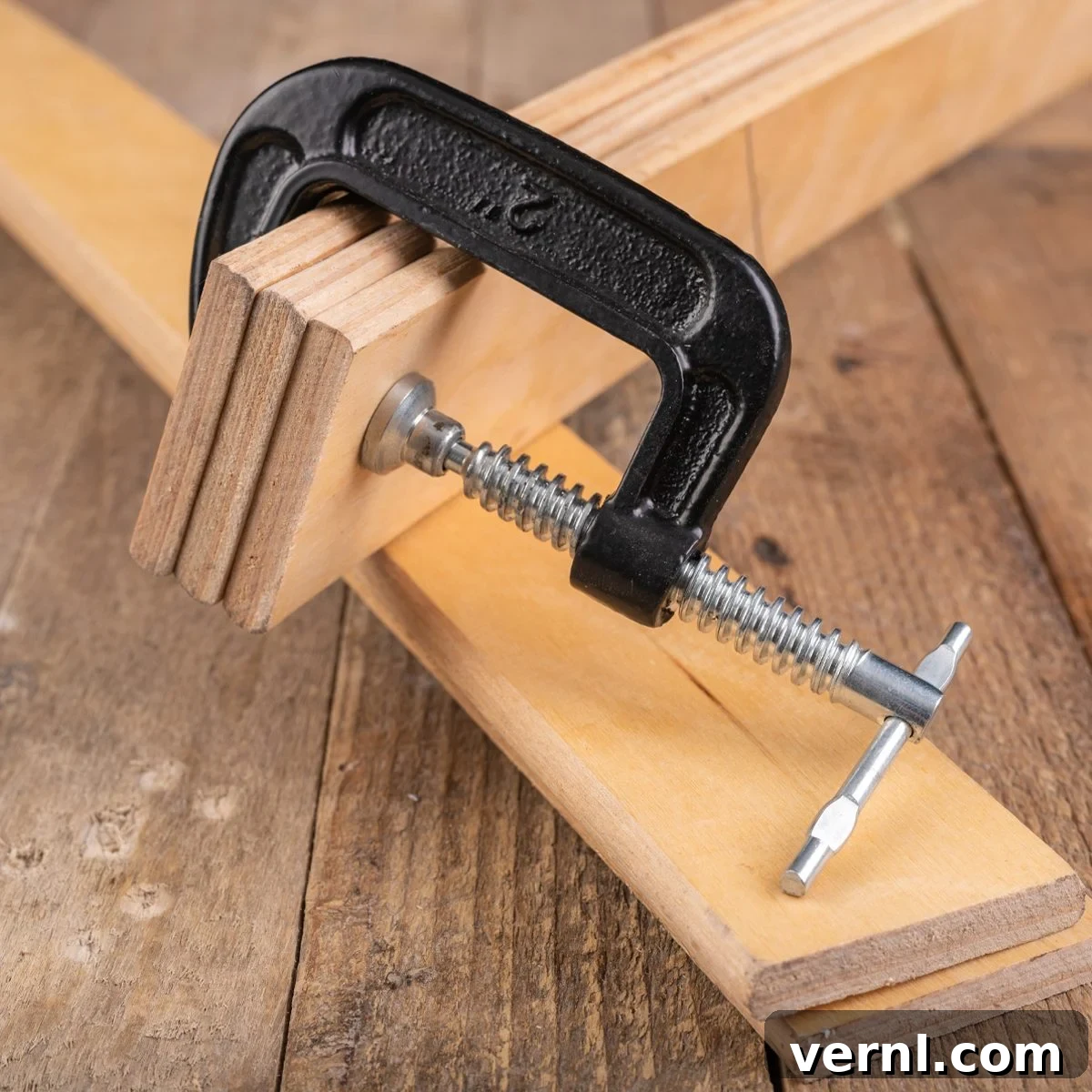
All clamps serve a singular, crucial purpose: to hold objects securely. Yet, the sheer diversity of clamps available is astonishing, with each type engineered for specific tasks and materials. From the intricate demands of fine woodworking to the robust requirements of heavy-duty construction, clamps are indispensable tools that provide stability, precision, and safety across countless applications.
Whether you’re a seasoned carpenter, a weekend DIY enthusiast, a professional plumber, or an automotive mechanic, understanding the different types of clamps and their optimal uses is fundamental. Clamps are the silent workhorses that free up your hands, allowing you to cut, drill, shape, fasten, or glue with confidence and accuracy. They temporarily secure components, enabling permanent bonds to form or complex assemblies to take shape without movement or misalignment.
The versatility of clamps often extends beyond their intended design. For instance, a common C-clamp, typically found in a woodworking shop, can be remarkably effective for compressing car brake pistons during a brake pad change, a task where it excels as much as any specialized automotive tool. Similarly, an improvised clamp might even serve as a temporary fix for a broken faucet handle, proving that ingenuity combined with the right basic tool can solve unexpected problems.
While there are dozens, if not hundreds, of clamp variations, focusing on the most common and versatile types will equip you with the knowledge to tackle a vast array of projects. Often, a cleverly adapted general-purpose clamp can negate the need for a highly specialized one, saving both money and space in your toolbox. This guide will explore the essential clamps, their unique mechanisms, and their myriad applications.
Why Clamps Are Indispensable Tools
Clamps are far more than just “holders.” They are critical components in almost every workshop and job site, offering a range of benefits that impact project quality and safety:
- Enhanced Safety: Securing a workpiece firmly prevents it from slipping or moving, significantly reducing the risk of accidents during cutting, drilling, or routing operations.
- Increased Precision: A stable workpiece allows for more accurate measurements, cuts, and alignments, leading to higher quality and professional-looking results.
- Temporary Fastening: Clamps hold parts together during crucial stages like glue curing, welding, or before permanent fasteners (screws, nails, bolts) are applied. They effectively act as an extra pair of hands.
- Even Pressure Distribution: Many clamps are designed to apply consistent and even pressure, which is vital for strong glue joints and preventing warping or distortion of materials.
- Versatility: From delicate craft projects to robust construction, there’s a clamp designed to handle the specific requirements, ensuring optimal support for diverse materials and tasks.
Key Considerations When Choosing a Clamp
Selecting the right clamp for your project involves evaluating several factors to ensure optimal performance and prevent damage to your materials:
- Clamping Force: Determine how much pressure is needed. Light-duty tasks might only require a spring clamp, while heavy-duty glue-ups demand the immense force of a bar clamp or C-clamp.
- Jaw Capacity: This refers to the maximum opening between the jaws. Ensure the clamp can comfortably accommodate the thickness of your workpiece.
- Throat Depth: How far back from the edge of the material can the clamp reach? Deep-throated clamps are essential for securing workpieces in the middle of a panel.
- Material Compatibility: Consider the material you’re clamping. Metal clamps can mar softwoods or plastics if not protected with pads. Wooden-jawed clamps are ideal for delicate finishes.
- Ease of Use and Speed: For repetitive tasks or quick adjustments, quick-release clamps offer efficiency. For precise, long-term holds, screw-driven clamps provide superior stability.
- Jaw Protection: Always look for clamps with padded jaws or be prepared to use sacrificial wood blocks or rubber pads to protect finished surfaces from indentations or scratches.
Exploring Diverse Clamp Types: A Comprehensive Overview
Screw-Driven Clamps: The Power of Precision
Screw clamps are renowned for their ability to generate significant clamping force with minimal effort. Their mechanism relies on a threaded rod, which, when turned, advances a movable jaw toward a stationary one. This mechanical advantage allows for tremendous pressure on the workpiece, ensuring a secure and unyielding hold. Thanks to the threads, the rod cannot back off on its own, providing a reliable, sustained grip. This category includes some of the most fundamental and powerful clamps in any workshop.
C-Clamps (G-Clamps): The Iconic Workhorse
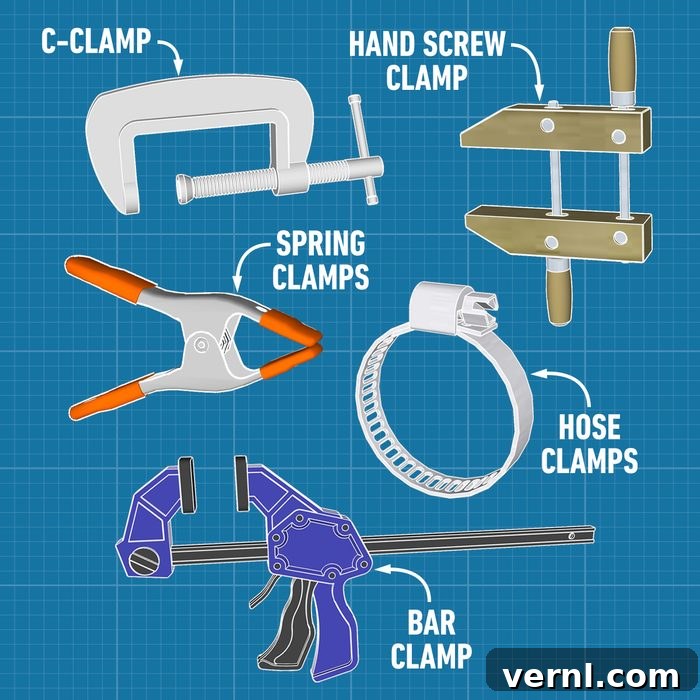
Instantly recognizable by their “C” or “G” shape, C-clamps are perhaps the most common and versatile screw-driven clamps. They consist of a robust frame, a fixed jaw at one end, and a movable jaw attached to a threaded rod that passes through the frame. A sliding cross pin on the end of the rod provides the leverage needed to tighten the clamp securely.
- Description: Typically made from cast iron or steel, C-clamps come in a vast range of sizes, with jaw capacities varying from less than an inch for small projects to over 12 inches for heavy-duty applications. The swivel pad on the movable jaw ensures even pressure distribution and adapts to angled surfaces without marring.
- Expanded Uses:
- Woodworking: Essential for holding pieces of wood together for gluing or fastening, securing jigs to workpieces, or temporarily holding panels during assembly.
- Metalworking: Perfect for holding metal components in place for welding, grinding, or drilling, providing a stable platform for precision work.
- Automotive & DIY: My personal favorite for pushing pistons back into brake calipers during a pad change. They can also secure objects to a workbench for various tasks like cutting, filing, or shaping. The anecdote of fixing a faucet handle with a C-clamp beautifully illustrates their adaptability.
- Pros: Extremely strong clamping force, highly durable, and incredibly versatile for numerous tasks across different trades.
- Cons: Slower to adjust compared to quick-release clamps and can potentially mar delicate surfaces if not used with protective pads.
- Tips: Always place scrap wood or rubber pads between the clamp jaws and your workpiece to prevent damage, especially on finished or soft materials.
Bench Vises: The Workbench Essential
Often referred to simply as a vise, a bench vise is a permanently mounted clamping device that is integral to any well-equipped workshop. Unlike portable clamps, a vise becomes an extension of your workbench, providing an unshakeable grip for demanding tasks.
- Description: Bench vises are typically made from heavy-duty cast iron or steel, featuring a fixed jaw securely bolted to the workbench and a movable jaw operated by a robust screw mechanism. Many come with an anvil surface for light hammering and a swivel base for adjusting the clamping angle.
- Expanded Uses:
- Metalworking: Indispensable for holding metal securely for drilling, filing, grinding, sawing, and shaping. Their robust construction can withstand the forces involved in these tasks.
- Woodworking: While specific woodworking vises exist, general-purpose bench vises can hold wood for planing, chiseling, or routing, especially when fitted with wooden jaw pads to protect the material.
- Assembly & Repair: Acts as a crucial third hand for holding components steady during intricate assembly, soldering, or repair work.
- Pros: Provides exceptional clamping force and stability, frees up both hands for detailed work, and is built to withstand heavy-duty use over many years.
- Cons: Permanent fixture, which means it occupies dedicated workbench space. High-quality vises can also represent a significant investment.
- Installation: Proper installation with heavy-duty bolts through the workbench is paramount to ensure the vise’s stability and maximize its clamping power.
Bar Clamps (Sash Clamps): For Wider Reach
When your project demands a wider jaw capacity than a C-clamp can offer, bar clamps are the go-to solution. Also known as sash clamps, they are designed for large-scale clamping operations, especially in woodworking.
- Description: Bar clamps feature a long metal bar, often steel or aluminum. One jaw is fixed to a threaded rod at the end of the bar, while the other jaw slides freely along the bar and locks into position via a clutch mechanism or pins. Tightening is achieved with a screw handle, generating substantial, even pressure across wide surfaces.
- Expanded Uses:
- Panel Gluing: They are essential for gluing up wide panels for tabletops, doors, or cabinet sides, ensuring tight and strong joints across the entire surface.
- Frame Assembly: Ideal for holding large frames, such as window sashes (hence “sash clamp”), door frames, or cabinet carcasses, ensuring squareness and strong glue lines.
- Laminating: Used to secure multiple layers of wood or other materials together, applying uniform pressure for a strong bond.
- Cabinetry & Furniture: Critical for holding large furniture components during glue-up or while fasteners are installed.
- Pros: Excellent for wide workpieces, capable of generating very strong clamping force, and available in exceptionally long lengths to accommodate virtually any project size.
- Cons: Can be somewhat cumbersome to handle due to their length and weight. Cheaper models might flex slightly under extreme pressure.
- Tips: Use wooden “cauls” (flat boards) between the clamp jaws and your workpiece to distribute pressure more evenly and prevent marring or bowing. When gluing wide panels, alternate clamps above and below the workpiece to prevent cupping.
Quick-Release Clamps (One-Handed Clamps, Speed Clamps): Fast and Convenient
Quick-release clamps, often called one-handed or speed clamps, prioritize speed and ease of use. They are designed for situations where rapid setup and adjustment are more critical than immense clamping force.
- Description: These clamps typically feature a pistol-grip style handle with a trigger mechanism. Squeezing the trigger unlocks the movable jaw, allowing it to slide rapidly along the bar for quick positioning. Repeated squeezes of the handle then engage a ratcheting mechanism to apply pressure. They commonly feature padded jaws to protect delicate surfaces.
- Expanded Uses:
- Rapid Positioning: Perfect for quickly holding pieces in place for drilling, sawing, or fastening, acting as a valuable third hand.
- Light-to-Medium Duty Gluing: Ideal for smaller glue-ups where moderate pressure is sufficient, such as assembling small boxes or securing trim.
- Temporary Fixturing: Excellent for holding jigs, fences, or guides to a workpiece or workbench.
- Spreading Function: Many quick-release clamps have reversible jaws, allowing them to function as spreaders to gently pry apart glued joints or hold cabinet boxes apart during assembly.
- Pros: Extremely fast to apply and remove, can be operated with one hand, and padded jaws prevent damage to surfaces. The spreading function adds to their versatility.
- Cons: Generally provide less clamping force than traditional C-clamps or bar clamps, making them unsuitable for heavy-duty or high-pressure applications.
- Tips: Always check the maximum clamping force for your specific model. They are invaluable for quick setups and light assembly tasks.
Hand Screw Clamps: The Cabinetmaker’s Friend
Distinctly a woodworking tool, hand screw clamps offer unparalleled flexibility and gentleness, making them a favorite among cabinetmakers and fine woodworkers.
- Description: These clamps feature two thick, independent wooden jaws, typically made from hard maple, and two parallel metal screw rods with handles at opposite ends. The unique design allows the jaws to be angled independently, adapting to irregular or non-parallel surfaces.
- Expanded Uses:
- Clamping Irregular Shapes: Their greatest strength lies in their ability to clamp angled, curved, or irregularly shaped pieces that traditional clamps cannot handle effectively.
- Delicate Work: The wooden jaws distribute pressure gently and do not leave imprints or mar the wood, even on softwoods or finished surfaces.
- Complex Joinery: Ideal for holding intricate joinery like dovetails, mortise and tenons, or scarf joints during glue-up, allowing for precise alignment.
- Edge Banding & Veneering: Excellent for applying edge banding or veneer, ensuring consistent pressure without damaging the material.
- Pros: Extremely versatile for non-parallel surfaces, absolutely non-marring, and provides precise control over jaw angle and pressure distribution.
- Cons: Slower to set up and adjust compared to other clamp types. Can be bulky, and limited throat depth on smaller models.
- Tips: Learn to adjust both screws simultaneously to quickly achieve the desired angle and pressure. Regularly lubricate the screws with wax for smooth operation.
Spring Clamps: Quick Grip, Light Duty
When you need to hold two pieces of material together during assembly quickly and easily, a spring clamp is an excellent alternative to a screw clamp. They offer instant, light-to-medium pressure without the need for manual tightening.
- Description: Spring clamps operate with a scissors-like action. Squeezing the two handles together opens the padded jaws, and an embedded, powerful spring automatically clamps the jaws shut with constant pressure once the handles are released. They are typically made from plastic or metal with rubber or plastic jaw pads.
- Expanded Uses:
- Temporary Holds: Ideal for quickly holding small pieces of wood for painting, drying, or light assembly tasks.
- Crafts & Hobbies: Indispensable for model making, paper crafts, securing fabric, or other light-duty tasks where precise, gentle pressure is needed.
- Securing Covers: Excellent for holding protective covers, tarps, or dust sheets in place temporarily.
- Photo Studios: Widely used to secure backdrops or diffusers.
- Pros: Very fast and easy to apply and remove with one hand, lightweight, inexpensive, and with padded jaws, they typically leave no marks.
- Cons: Offer significantly less clamping force than screw-driven clamps, making them unsuitable for heavy-duty tasks or applications requiring prolonged, strong pressure.
- Variations: Available in various sizes, from mini clamps for delicate work to larger versions for moderate holding power.
Strap Clamps (Web Clamps): Embracing Irregularities
Strap clamps, also known as web clamps, are uniquely designed to apply even pressure around irregular or multi-sided objects that traditional rigid clamps cannot effectively grasp.
- Description: A strap clamp consists of a long, strong nylon or polyester strap and a ratcheting or cam-locking mechanism affixed to one end. The strap wraps around the object, and the free end is fed through the ratchet. Pumping the ratchet then tightens the strap, applying uniform pressure around the entire perimeter of the workpiece.
- Expanded Uses:
- Frame Assembly: Perfect for securing large frames, such as picture frames, mirror frames, or box assemblies, especially those with mitered corners, ensuring they stay square while glue sets.
- Round or Irregular Objects: Ideal for clamping barrels, columns, curved furniture components, or other non-square items that require circumferential pressure.
- Furniture Repair: Excellent for holding complex or delicate furniture assemblies where conventional clamps might damage the shape or finish.
- Transportation & Securing: Larger versions (ratchet straps) are commonly used to secure objects in truck beds, trailers, or rooftops during transport, proving their immense holding power.
- Pros: Outstanding for clamping irregular shapes and large perimeters, applies very even pressure around the entire object, and incredibly versatile for various non-standard clamping needs.
- Cons: Can be slower to set up than other clamps, and requires the use of corner blocks (often included or sold separately) to prevent marring and maintain squareness when clamping rectangular frames. The strap can also sometimes slip if not properly aligned.
- Tips: Always use dedicated corner blocks for square or rectangular frames to distribute pressure evenly and protect the edges. Ensure the strap is flat and not twisted to avoid uneven pressure.
Workbench Hold-Down Clamps: Surface Securing
Distinct from bench vises, workbench hold-down clamps are designed to secure a workpiece directly to the surface of a workbench, rather than between jaws. They are essential for tasks where the top surface needs to be accessible and unobstructed.
- Description: These clamps typically feature a base that fits into pre-drilled dog holes or T-tracks on a workbench. A single padded jaw then operates via a squeeze handle (ratchet mechanism) or a screw mechanism to press down and hold the workpiece firmly against the bench surface.
- Expanded Uses:
- Sanding & Shaping: Ideal for holding wood flat and stable for sanding, routing, planing, or carving, as they leave the edges and top surface completely clear.
- Drilling: Securing smaller pieces for drilling operations without needing to use a vise, providing quick and precise positioning.
- Assembly & Gluing: Holding parts temporarily on the bench surface while other components are added or glue sets, preventing movement.
- Jig Work: Anchoring jigs, templates, or fences securely to the workbench for repeatable and accurate cuts or operations.
- Pros: Frees up the edges of the workpiece, allowing for full access. Quick to set up for surface work, and highly versatile, especially when used with a system of bench dog holes or T-tracks.
- Cons: Requires a workbench with appropriate holes or track systems. Limited to holding work on the surface and cannot provide the same side-to-side compression as a vise.
- Variations: Traditional holdfasts (metal rods hammered into bench holes), dedicated track clamps for MFT-style workbenches, and various screw-down or cam-locking bench dogs.
Hose Clamps: Sealing Connections
Hose clamps are specialized fasteners designed to secure flexible hoses to rigid pipes, fittings, or nozzles, creating a tight, leak-proof seal. They are critically important in plumbing, automotive, and industrial applications.
- Description: These metal bands come in various designs, all aiming to compress the hose around its fitting. Their primary role is to prevent fluids or gases from escaping under pressure or suction.
- Types & Mechanisms:
- Worm Drive Clamps (Screw Clamps): The most common type. They consist of a perforated metal band formed into a circle, tightened by a screw that engages the perforations as a worm drive. Turning the screw expands or contracts the band, applying adjustable and strong pressure.
- Spring Clamps (Double-Eared): These feature a circular spring steel ring with two “ears.” Squeezing the ears with specialized pliers expands the ring for installation. Upon release, the spring tension provides constant, self-adjusting pressure, making them ideal for systems that experience temperature fluctuations.
- Wire Clamps: Simpler, often single or double-wire designs, used for lighter duty applications or where space is limited.
- Pinch Clamps (Oetiker Style): These clamps are installed using a special crimping tool, creating a very secure, tamper-proof, and low-profile connection.
- Expanded Uses:
- Automotive: Securing radiator hoses, fuel lines, vacuum lines, and exhaust connections to prevent leaks and ensure proper system function.
- Plumbing: Attaching flexible water supply lines, drain hoses for appliances, and various other pipe connections.
- HVAC: Sealing ductwork connections and ventilation hoses.
- Garden Hoses: Repairing or joining garden hoses to fittings.
- Pros: Essential for preventing leaks in fluid and air systems, available in a wide variety of types to suit different needs, and generally durable.
- Cons: Over-tightening worm drive clamps can potentially damage softer hoses. Spring clamps often require specific tools for installation and removal.
Specialty Clamps: Niche Solutions for Specific Tasks
While the general-purpose clamps cover a broad spectrum of needs, certain tasks benefit immensely from purpose-built specialty clamps. These tools are designed to solve very specific problems with efficiency and precision.
- Miter Clamps: Engineered specifically to hold miter joints (cuts at an angle, typically 45 degrees for a 90-degree corner) perfectly aligned and tight while glue sets or fasteners are applied. They ensure the corner remains square and the joint strong.
- Edge Clamps: Used in conjunction with other clamps (like bar clamps), edge clamps help apply pressure to thin strips, such as edge banding or veneer, against the edge of a thicker board. They typically have a small jaw that clamps to the edge and a screw that presses the strip onto the board.
- Corner Clamps: Similar to miter clamps but often more robust, corner clamps are designed to hold two pieces of material at a perfect 90-degree angle, commonly used for assembling cabinets, boxes, or frames.
- Pinch Dogs: Simple, wedge-shaped metal fasteners with points, driven into the end grain of two boards to pull a joint tightly together. Often used for rustic or rougher woodworking, or large panel glue-ups where extreme clamping force is desired across a joint.
- Gluing Clamps for Panels: Often large, heavy-duty clamps designed to apply immense pressure over broad panel surfaces, ensuring perfectly flat and strong glue-ups for tabletops or doors.
Maintaining Your Clamps for Longevity
Like all tools, clamps benefit from regular maintenance to ensure their longevity and optimal performance. Proper care will keep them functioning smoothly and reliably for years to come.
- Cleanliness: After each use, take a moment to wipe down your clamps. Remove any accumulated glue, sawdust, paint, or grime from the bars, screws, and jaws. Dried glue can hinder smooth operation and mar future projects.
- Lubrication: Periodically apply a light coat of machine oil or dry lubricant (like paraffin wax) to the screw threads of C-clamps, bar clamps, and hand screw clamps. This ensures smooth turning, prevents corrosion, and prolongs the life of the threading.
- Storage: Store your clamps neatly to prevent them from tangling, getting bent, or falling. Wall-mounted racks are an excellent solution, keeping them organized, easily accessible, and protecting them from damage on a crowded workbench or floor.
- Inspection: Regularly inspect your clamps for any signs of wear or damage. Check for bent bars, stripped threads, loose rivets, or worn jaw pads. Replace damaged parts if possible, or retire severely compromised clamps to ensure safety and effectiveness.
In conclusion, clamps are the unsung heroes of countless projects, providing the stability and precision necessary to transform raw materials into finished masterpieces. Building a diverse collection of clamps and understanding their specific applications will significantly enhance your capabilities, improve the quality of your work, and make your projects safer and more enjoyable. From the powerful grip of a C-clamp to the gentle embrace of a hand screw clamp, each type plays a vital role in bringing your creative visions to life. Invest in a good set, learn their nuances, and you’ll find yourself reaching for these essential tools time and again.