Understanding the Vital Role of Roof Vents: A Comprehensive Guide to Attic Ventilation
In the intricate ecosystem of your home, few components are as unsung yet as critical as your attic ventilation system. Often overlooked, a properly functioning network of roof vents is the cornerstone of a healthy, energy-efficient, and long-lasting home. This comprehensive guide delves into the mechanics, benefits, and considerations surrounding roof vents, demystifying their crucial role in protecting your property and enhancing your comfort.
The Science Behind Airflow: How Roof Vents Work
At its core, attic ventilation is about creating a continuous flow of air through your attic space. This airflow is driven by fundamental principles of thermodynamics and fluid dynamics, primarily the natural phenomenon known as the “stack effect.” Hot air, being less dense, naturally rises and seeks an escape route. Roof vents leverage this principle, allowing hot, moist air to exit at the highest points of the roof, while simultaneously drawing in cooler, drier air from the lower parts of the roof or eaves.
The efficiency of this system hinges on a crucial balance: the ratio of intake to exhaust ventilation. Building codes and industry best practices universally recommend a specific amount of vented area relative to the attic’s footprint. A widely adopted rule of thumb, integrated into most building codes, mandates at least 1 square foot of net free ventilating area for every 300 square feet of attic floor space. This ratio is vital to ensure adequate air exchange. For instance, if you have an attic spanning 1,500 square feet, your ventilation system should provide a minimum of 5 square feet of total vent space.
Crucially, this total vent area must be balanced, with approximately half dedicated to air intake and the other half to air exhaust. Intake vents are typically located in the soffits (the underside of the eaves) or at the lower parts of the roof. Their purpose is to allow cooler, outside air to enter the attic. Exhaust vents, on the other hand, are situated at or near the roof ridge, facilitating the escape of hot, moist air. This balanced approach creates a convective loop, ensuring a steady and effective exchange of air throughout the entire attic space, preventing dead air pockets and maximizing efficiency.
Why Proper Attic Ventilation is Non-Negotiable
The benefits of robust attic ventilation extend far beyond simple air circulation. It’s a foundational element in protecting your home from a host of environmental challenges and significantly contributes to its overall longevity and efficiency. Ignoring attic ventilation can lead to costly repairs, reduced comfort, and decreased home value. Generally, when it comes to attic ventilation, more is often better, provided it’s balanced and correctly installed.
Preventing Destructive Ice Dams
In colder climates, one of the most destructive consequences of poor attic ventilation is the formation of ice dams. Ice dams occur when heat from your living space escapes into the attic, warms the roof deck, and melts snow on the roof. This melted water then flows down the roof until it reaches the colder eaves, which are typically outside the home’s heated envelope. Here, the water refreezes, creating a barrier of ice. Subsequent meltwater backs up behind this dam, seeping under shingles and into your attic and walls, leading to extensive water damage, mold growth, and compromised insulation. Good attic ventilation helps to keep the entire roof deck, from ridge to eave, at a more uniform temperature, preventing localized melting and refreezing, thereby drastically reducing the risk of ice dam formation.
Enhancing Summer Comfort and Energy Efficiency
During warmer months, an unventilated attic can transform into a superheated oven. Temperatures inside an attic can easily soar to 150 degrees Fahrenheit or more, even when outside temperatures are much lower. This intense heat radiates downwards into your living spaces, forcing your air conditioning system to work harder and longer to maintain a comfortable indoor temperature. This increased workload translates directly into higher energy bills and accelerated wear and tear on your HVAC equipment. Effective attic ventilation acts as a release valve, expelling this trapped heat and allowing your home to remain cooler, more comfortable, and significantly more energy-efficient.
Managing Destructive Moisture
Moisture is another silent enemy that can wreak havoc in an attic. Sources of attic moisture include humidity from everyday activities within the home (showering, cooking, laundry) that finds its way into the attic, as well as potential leaks from a damaged roof or plumbing. Without proper ventilation, this moisture can condense on cold surfaces within the attic, creating an ideal breeding ground for mold and mildew. These fungal growths not only pose health risks but can also degrade wooden structural components, reduce the effectiveness of insulation, and lead to unpleasant odors. A continuous flow of air through the attic helps to dry out any moisture, preventing condensation and its associated problems.
Extending the Lifespan of Your Roof
Your roof shingles are constantly exposed to the elements, and extreme temperatures are particularly detrimental. Excessive heat buildup in an unventilated attic can accelerate the aging process of asphalt shingles from below. This internal heat can cause shingles to dry out, curl, crack, and become brittle prematurely, significantly shortening the lifespan of your entire roofing system. By keeping the roof deck cooler, proper ventilation helps to protect your shingles from thermal shock and degradation, ensuring they perform effectively for their intended duration and postponing the need for costly roof replacements.
Types of Roof Vents: Matching Your Needs and Aesthetics
When selecting roof vents, homeowners have several options, each with distinct advantages and considerations regarding efficiency, aesthetics, and cost. Understanding these differences is key to making an informed decision that suits your home’s architecture, climate, and ventilation requirements.
Exhaust Vents: Releasing the Heat and Humidity
Ridge Vents
Ridge vents are arguably the most effective and aesthetically pleasing exhaust ventilation solution. Installed along the entire peak of the roof, they provide a continuous, unobtrusive opening for hot, moist air to escape. Their linear design blends seamlessly with the roofline, often going unnoticed. Ridge vents work exceptionally well with soffit intake vents, creating a highly efficient, balanced system that draws air evenly from the entire attic. They are passive vents, relying solely on the stack effect and wind pressure to move air, and have no moving parts, ensuring quiet operation and minimal maintenance.
Wind-Driven Turbine Vents (Whirlybirds)
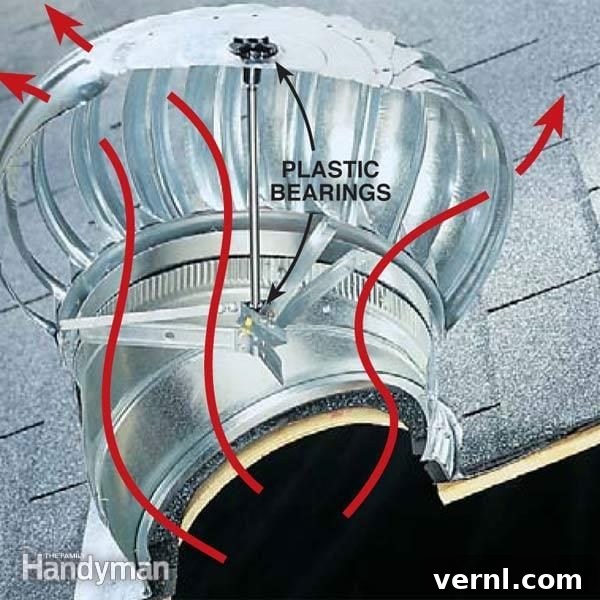
Wind-driven turbine vents, often referred to as “whirlybirds,” are recognizable by their distinctive spinning domes. These vents harness wind energy to create a vacuum effect, actively pulling air out of the attic. They can be very effective in areas with consistent wind, moving significantly more air than static vents under windy conditions. High-quality turbine vents are manufactured with permanently lubricated ball bearings or durable plastic bushings in their spinning mechanisms, ensuring smooth, quiet operation for many years. However, cheaper units often use metal bushings that can squeak loudly in windy conditions, becoming a nuisance for homeowners and neighbors alike. While effective, their visible spinning nature might be a deterrent for those prioritizing roofline aesthetics.
Static (Box) Vents
Static vents, also known as box vents or fixed vents, are simple, non-mechanical vents that rely solely on natural convection and wind pressure to exhaust air. These are typically square or rectangular units installed in openings cut into the roof deck. They are durable, cost-effective, and have no moving parts, making them maintenance-free and silent. However, they are less efficient than ridge vents or wind turbines, as they only vent a localized area and their airflow capacity is fixed, not adapting to wind conditions. To achieve adequate ventilation, a greater number of static vents may be required compared to other types.
Gable Vents
Gable vents are decorative vents installed in the exterior walls of an attic space, typically found on homes with gable roofs. While they can be used as part of a ventilation system, particularly for intake, their effectiveness as an exhaust-only solution can be limited. If an attic has both gable vents and ridge vents, they can sometimes create a short-circuiting effect, where air enters one gable vent and immediately exits the other, bypassing the rest of the attic and rendering other vents less effective. They are best utilized in conjunction with soffit vents or as primary exhaust only when other roof-mounted options are not feasible.
Intake Vents: The Foundation of Balanced Airflow
Soffit Vents
Soffit vents are the most common and effective type of intake vent. They are installed in the underside of the eaves (the soffit) and allow cooler, outside air to enter the attic. Soffit vents can be continuous (running the length of the soffit) or individual rectangular or circular vents. Their placement at the lowest point of the attic helps to create the ideal air current, drawing fresh air upwards towards the exhaust vents at the ridge. It’s crucial that these vents are not blocked by insulation within the attic, which would severely impede airflow.
Fascia Vents
For homes without traditional soffits or where soffit ventilation is impractical, fascia vents offer an alternative for intake. These vents are installed directly into the fascia board, the horizontal board that runs along the edge of the roof. While effective, they may not provide the same broad distribution of intake air as soffit vents.
Making the Right Choice: Turbines vs. Flat Roof Vents and Other Considerations
The decision between different vent types often comes down to a balance of performance, aesthetics, and budget. If you prioritize an uninterrupted roofline and quiet operation, flat, low-profile vents like ridge vents or static box vents are excellent choices, assuming you meet the 1:300 square foot rule for total net free area. These systems are robust, require little to no maintenance, and provide consistent, passive ventilation.
However, if your home is in an area with reliable wind and you’re seeking to maximize airflow, high-quality wind-driven turbine vents can be exceptionally efficient. The key here is “high-quality.” Investing in units with permanently lubricated ball bearings or durable plastic bushings is crucial. These superior components ensure quiet, smooth operation even in strong winds, preventing the irritating squeaks and eventual failure that often plague cheaper models with metal bushings. While turbines are more visible, their enhanced performance in windy conditions can be a significant advantage.
Factors to Consider During Selection:
- Climate: In hot, humid climates, maximum exhaust is critical. In cold climates, ice dam prevention takes precedence, emphasizing a consistent, even airflow.
- Roof Design: The pitch and complexity of your roof will influence which vent types are most suitable and aesthetically pleasing.
- Aesthetics: Some homeowners prefer the subtle integration of ridge vents, while others don’t mind the more prominent appearance of turbine or box vents.
- Budget: While some vent types might have a higher upfront cost, consider the long-term savings in energy bills and reduced roof maintenance.
- Local Building Codes: Always consult your local building department to ensure your ventilation plan complies with all regional regulations and requirements.
Common Ventilation Mistakes to Avoid
Even with the best intentions, several common pitfalls can compromise the effectiveness of an attic ventilation system:
- Blocked Soffit Vents: This is perhaps the most frequent issue. Insulation, paint, or debris can block the critical intake airflow from the soffits, effectively choking the entire system. Ensure there are clear pathways for air to enter.
- Insufficient Intake or Exhaust: An unbalanced system, where either intake or exhaust is inadequate, will lead to poor airflow and stagnant air pockets. Remember the 50/50 rule.
- Mixing Exhaust Vent Types: As mentioned, combining different exhaust vents like ridge vents and gable vents can create a “short-circuit.” Air will simply enter one and exit another nearby, bypassing the majority of the attic and rendering the system inefficient. Stick to one primary exhaust type for optimal performance.
- Improper Installation: Vents must be installed correctly, with adequate openings cut into the roof deck and sealed properly to prevent leaks.
- Lack of Maintenance: While most vents require little maintenance, occasional checks for blockages (nests, leaves), damage, or wear can ensure continuous functionality.
Installation and Maintenance
While installing simple box vents might seem like a DIY task, setting up a comprehensive, balanced attic ventilation system, especially one involving ridge vents or multiple turbine vents, is best left to experienced roofing professionals. They can accurately calculate the required net free area, ensure proper vent placement, and guarantee a watertight installation that adheres to all building codes.
Once installed, attic vents typically require minimal maintenance. Periodically inspect soffit vents to ensure they are free from obstructions like paint, dirt, or insulation. For turbine vents, listen for any unusual noises, which could indicate worn bearings needing attention or replacement. Regularly checking for any signs of water leaks around the vents from the attic interior is also a good practice.
Conclusion: The Unseen Guardian of Your Home
Roof vents and a well-designed attic ventilation system are the unseen guardians of your home. They tirelessly work to regulate temperature, manage moisture, protect your roofing investment, and enhance your family’s comfort year-round. Understanding how these systems function and why they are so vital empowers you to make informed decisions about your home’s health. By ensuring your attic is properly vented, you’re not just moving air; you’re safeguarding your home’s structural integrity, improving its energy efficiency, and investing in its long-term value. If you have any doubts about your current ventilation setup, consulting with a qualified roofing or home performance professional is always the wisest course of action to ensure your home benefits from optimal attic airflow.