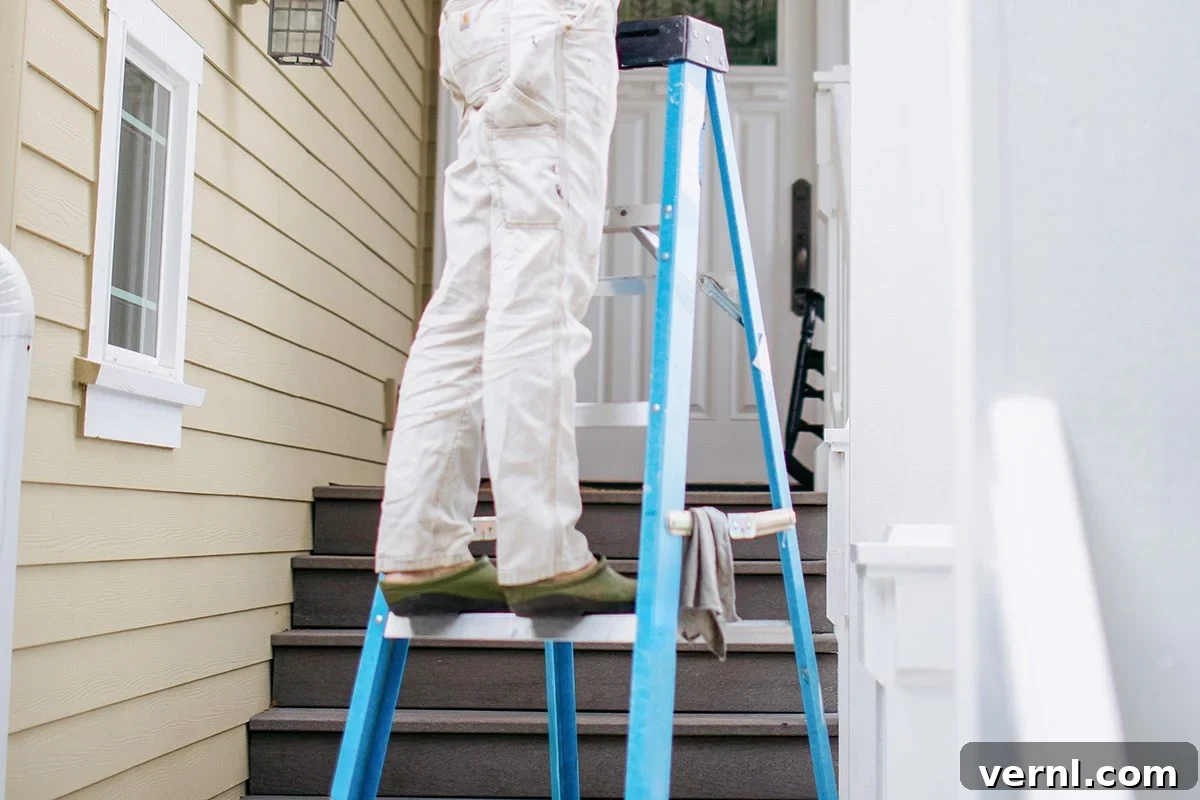
Working at height is inherently risky, but the potential for accidents multiplies significantly when you introduce a ladder to the uneven, unpredictable terrain of a staircase. Whether your task involves meticulous installation or urgent repair of drywall, the precise fitting of electrical fixtures, applying a fresh coat of paint, or any other essential work within a stairwell, the reality is that ladder access is frequently unavoidable. Given this pervasive challenge, understanding and implementing the most robust safety protocols is not merely advisable but absolutely imperative. Mastering the techniques for secure ladder placement and usage on stairs is the cornerstone of ensuring both a successful project completion and, more importantly, the safety of the individual performing the work.
“As a master electrician with over two decades of hands-on experience, I’ve dedicated countless hours to various forms of ladder work, often in the most challenging environments. Staircases, in particular, stand out as among the trickiest and most precarious spots,” shares Josh Leclair, the seasoned owner of a highly regarded electrical contracting business. “Over the years, through extensive practical application and continuous learning from every job, I’ve developed and refined a core set of key strategies and practical tips that consistently ensure safety and stability when working on stairs, no matter the specific circumstances or architectural nuances.”
Leclair, along with a diverse panel of other seasoned professionals who regularly navigate these potentially dangerous situations, has generously contributed their invaluable insights. This comprehensive guide synthesizes their collective wisdom, offering proven ladder safety tips and best practices specifically tailored for stairwell applications. Their expert advice aims to equip you with the knowledge and confidence required to approach these elevated tasks with the utmost caution, precision, and effectiveness, significantly reducing the inherent risks involved.
Is It Truly Safe to Use a Ladder on Stairs? Deciphering the Elevated Risks
“From a visual standpoint, setting up and working with a ladder on stairs can often appear precarious and unsettling, even when every single safety guideline is being meticulously adhered to,” observes Francisco Fuenmayor, a highly regarded licensed professional handyman. This initial visual impression is, unfortunately, rooted in stark reality. The U.S. Occupational Safety and Health Administration (OSHA) consistently identifies stairways and ladders as primary contributors to severe injuries among construction workers, frequently leading to significant time away from work and, in some tragic cases, life-altering consequences. The fundamental reason for this heightened risk profile lies in the inherent instability presented by varying tread heights and depths, which drastically compromises the foundational stability typically expected for ladder use on a flat, level surface.
A critical factor amplifying the danger is the unforgiving nature of a fall down a staircase. Unlike a relatively benign fall on flat ground, an uncontrolled descent on stairs typically involves multiple, violent impacts with the sharp, unyielding edges of stair treads. This drastically increases the likelihood of severe injuries, including but not limited to broken bones, debilitating head trauma, and internal injuries. Furthermore, the momentum generated during such a fall can propel an individual to the very bottom of the staircase, compounding the severity of the damage. Despite these alarming possibilities, skilled and experienced professionals like Fuenmayor routinely execute complex and demanding tasks in stairwells. They achieve this not by disregarding the inherent dangers, but by rigorously adopting specialized methods, employing purpose-built equipment, and maintaining an unwavering commitment to safety protocols. While it is true that no elevated work can ever be categorized as 100 percent risk-free due to the dynamic variables involved, these expertly devised strategies are specifically designed to significantly mitigate hazards, aiming to establish a level of safety comparable to, and in many respects exceeding, that achieved when using a ladder on a perfectly level surface.
Unveiling the Hidden Dangers: Key Risks Amplifying Ladder Use on Stairs
The principal and most alarming risk associated with using a ladder on stairs is, without question, the potential for a catastrophic fall. However, this fundamental danger is not isolated; it is frequently exacerbated by a combination of specific environmental conditions, improper equipment, and poor work practices. Understanding these interconnected amplifiers is the crucial first step toward proactive prevention and ensuring a safe working environment:
- Inadequate and Fluctuating Lighting: Stairwells are notorious for their poor illumination, often lacking sufficient natural light and, during renovation or construction, proper temporary lighting. Dim or uneven lighting can severely impair depth perception, making it challenging to accurately judge step heights, identify subtle hazards like debris, or properly position ladder feet. This increased visual ambiguity significantly raises the probability of missteps, unstable ladder placement, and ultimately, falls.
- Cluttered and Obstructed Pathways: A cluttered stairway—riddled with discarded tools, stray construction materials, household items, or even simple dust—presents numerous tripping hazards for anyone navigating the space. Introducing a ladder into such an environment magnifies the risk exponentially. Attempting to maneuver around obstacles can lead to loss of balance, sudden distractions, or even cause the ladder itself to shift or become dislodged, rendering a stable approach and descent virtually impossible.
- Compromising the Three Points of Contact Rule: The cardinal rule of ladder safety mandates maintaining three points of contact (either two hands and one foot, or two feet and one hand) at all times while ascending, descending, or working. This critical safety measure is almost always compromised, becoming exceedingly difficult or entirely impossible, when attempting to carry cumbersome or heavy items such as a full sheet of drywall, a large bucket of paint, or an oversized electrical fixture. The inevitable compromise to balance, grip strength, and overall stability dramatically escalates the risk of an uncontrolled fall.
- Compromised or Damaged Ladder Integrity: It is a fundamental truth that cannot be overstated: never, under any circumstances, should you utilize a damaged, unstable, or improperly maintained ladder on a stairway—or indeed, in any working environment. A seemingly minor defect such as a bent rail, a hairline crack in a rung, a loose rivet, or a malfunctioning hinge can lead to catastrophic structural failure, particularly when subjected to the uneven and dynamic stresses inherent in stairwell work. A meticulous, pre-use inspection of every ladder component is an absolutely non-negotiable safety procedure.
- Slippery Underfoot Conditions: Environmental factors can transform an already challenging situation into an extremely perilous one. Outdoors, the presence of ice, snow, rain, or even wet leaves on stair treads can drastically reduce friction, causing a ladder’s feet to lose traction and abruptly slip out from underneath the user. Indoors, factors such as accidental spills, highly polished or waxed surfaces, loose or poorly secured rugs/carpeting, or even fine construction dust can create equally dangerous, low-friction conditions, making truly stable ladder placement virtually impossible.
- Use of Improper Ladder Type or Unsuitable Equipment: Attempting to use a standard, non-adjustable stepladder or an extension ladder without the aid of purpose-designed leveling accessories on a staircase is a recipe for disaster. These ladders are engineered for flat, level surfaces; forcing them onto the varying heights of stair treads creates an inherently unstable, unsafe, and often teetering setup that is prone to tipping.
- Overreaching Beyond the Ladder’s Safe Zone: This alarmingly common mistake is a leading cause of ladder-related falls. When an individual attempts to stretch too far to the side, front, or back to access a work area, their center of gravity shifts dangerously outside the ladder’s stable base. This imbalance dramatically increases the risk of the ladder tipping sideways or backward. This hazard is significantly amplified on stairs due to the pre-existing compromised stability of the setup.
- Working Alone Without a Dedicated Spotter: While practical constraints may sometimes necessitate working alone, doing so removes a critical layer of safety. A dedicated spotter provides immediate physical stability to the ladder, acts as an extra set of eyes for potential hazards, assists with material handling to maintain the user’s three points of contact, and can prevent others from inadvertently entering the hazardous work zone.
- Personal Factors: Fatigue, Distraction, and Rushing: An individual’s physical and mental state plays a profound role in workplace safety. Working while experiencing significant fatigue, being mentally distracted, or feeling pressured to rush a task can severely impair judgment, reaction time, and physical coordination. These personal factors significantly increase the likelihood of making critical mistakes that lead to accidents.
Mastering Stability and Security: How to Safely Use a Ladder on Stairs
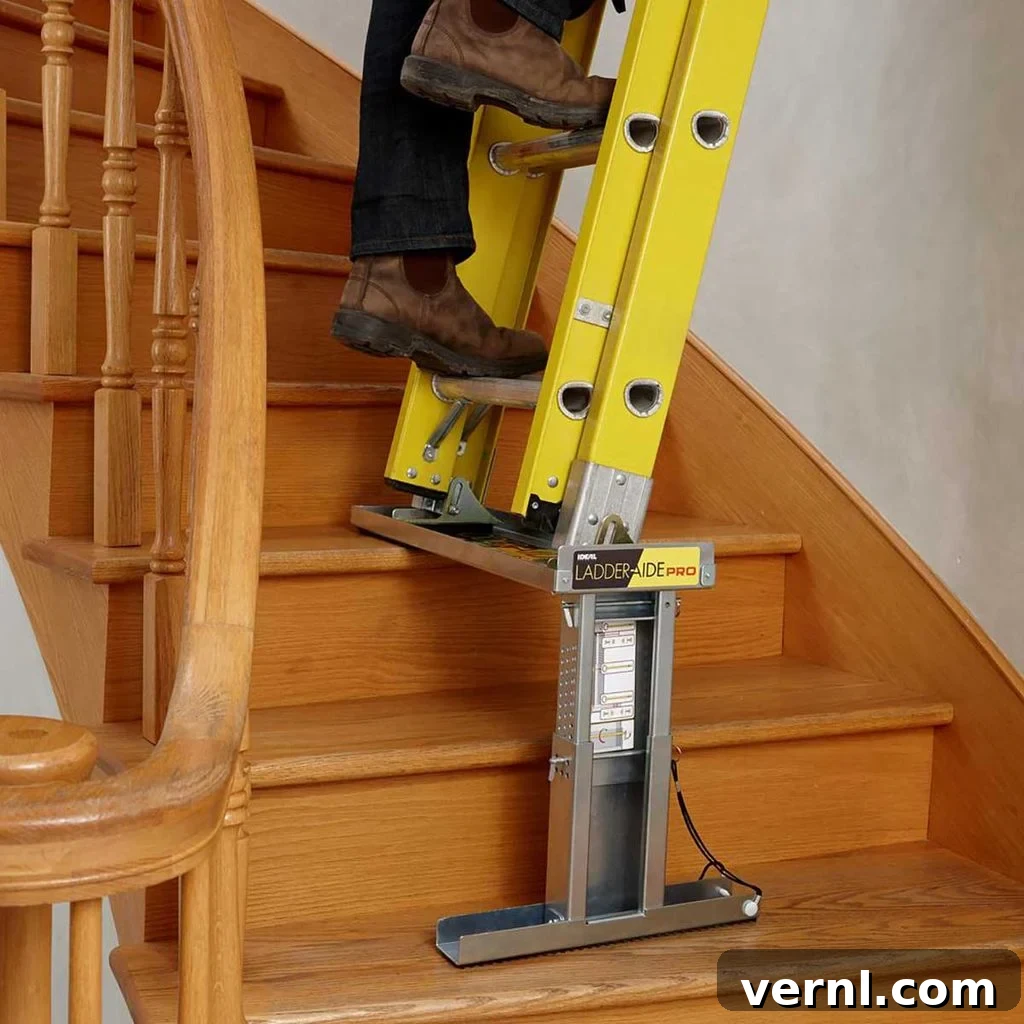
The paramount challenge when using any ladder on stairs is achieving a perfectly level and unequivocally stable base, effectively compensating for the distinct and varying heights of individual stair treads. It is absolutely imperative to understand and internalize that improvising a level surface with haphazard stacks of unfastened wood blocks, loose bricks, precariously balanced plywood, or any other unsuitable material is an extremely dangerous and strongly discouraged practice. “Never, under any circumstances, attempt to ‘make do’ with a standard ladder and improvised, unstable blocks or shims—I have personally witnessed far too many alarming near misses and actual serious accidents that have resulted directly from such perilous shortcuts,” sternly warns Josh Leclair. For true, uncompromised safety, it is an absolute necessity to invest in or utilize specialized, robust, and slip-proof equipment that has been specifically engineered and rigorously tested to provide secure, unwavering support for both your body weight and the structural integrity of the ladder.
The Indispensable Ladder Platform: Your Engineered Foundation for Safety
Among the ten highly experienced tradespeople consulted for the creation of this comprehensive guide, a resounding eight enthusiastically recommended the utilization of an adjustable ladder platform as the premier and most reliable solution for safely executing work within stairwells. These remarkably ingenious devices are designed to provide a wide, inherently stable, and perfectly level surface directly upon which you can confidently and securely set the base of your ladder. A high-quality ladder platform typically incorporates an intelligently engineered extendable base, coupled with a set of independently telescoping legs that can be precisely adjusted. This intricate adjustability allows the platform to conform with absolute precision to the diverse and often significant variations in stair tread heights. The outcome is a platform that sits perfectly level, even on the most challenging and uneven steps, thereby creating an unyielding and supremely secure foundation for your ladder. Prominent and universally respected brands in this specialized category include the innovative PIVIT ladder tool and the robust Ladder-Aide, both of which are widely celebrated for their durable construction, intuitive user-friendly adjustment mechanisms, and unwavering commitment to safety. The fundamental benefit of employing a dedicated ladder platform lies in its exceptional ability to evenly distribute the ladder’s weight across a significantly larger surface area, thereby preventing concentrated pressure points that could otherwise lead to dangerous slippage, potential damage to the stair materials, or instability.
Precision Leveling with an Advanced Ladder Leveler
Remodeling expert Danny Niemela champions a distinct yet equally effective tool designed for meticulously leveling your ladder: the specialized ladder leveler. This innovative device is typically engineered to attach securely and integrally to the base of one side of an existing stepladder or an extension ladder leg. Its sophisticated, integrated mechanism empowers the user to precisely adjust the length of that specific ladder leg, thereby flawlessly compensating for any height discrepancies between individual stair treads. This ingenious design means that one ladder leg can rest safely on a lower step while the corresponding leg rests on a higher step, with the ladder leveler ensuring that the top of the ladder remains perfectly horizontal and perfectly balanced. Leading brands such as Vevor are widely recognized for producing exceptionally durable and highly reliable ladder levelers that deliver essential stability across a wide variety of ladder types. These precision tools facilitate fine-tuned, millimeter-accurate adjustments that standard, non-adjustable ladders simply cannot offer, transforming an unstable setup into a secure working platform.
The Unrivaled Versatility of an A-Frame Ladder with Adjustable Legs
“In my extensive experience spanning many years as a professional painter, I have arrived at the unequivocal conclusion that the only truly safe and consistently reliable ladders for regular and sustained use on staircases are well-engineered adjustable A-frame ladders,” asserts Carr Lanphier, the insightful CEO of Improovy. “The inherent, ingenious design of these ladders, which allows for the independent and precise adjustment of one side’s legs to be set either lower or higher than the other, provides an unparalleled and superior level of stability. This critical adjustability is what guarantees that you can always establish a perfectly sturdy and unequivocally level working surface, a factor that is absolutely paramount for executing precision-demanding tasks such as meticulously painting intricate trim, or safely reaching high, vaulted ceilings within a stairwell.” He particularly highlights and highly recommends ladders from the renowned Little Giant brand, which are universally celebrated for their exceptional versatility, robust construction, and innovative design. These ladders are not only designed to be foldable for incredibly convenient storage and effortless transport but also boast an impressive structural integrity, capable of safely supporting up to 300 pounds. This makes them eminently suitable for a vast array of demanding professional and DIY tasks, while simultaneously offering multiple safe configurations beyond just stair work, including traditional extension ladder setups and even compact scaffolding arrangements.
Beyond Equipment: Essential Safety Tips for Elevating Ladder Use on Stairs
Even after investing in the most sophisticated leveling equipment and meticulously setting it up, the inherently dynamic and often confined environment of a stairwell continues to present an elevated risk profile. Successfully mitigating these persistent dangers demands unwavering adherence to a rigorous set of safety guidelines, transforming these critical best practices into an ingrained second nature for every elevated task. This holistic approach ensures not only stability but also awareness and preparedness:
- Execute a Comprehensive Pre-Climb Inspection Checklist: Before even contemplating ascending the ladder, conduct a thorough and meticulous inspection. Begin by ensuring the ladder’s base is absolutely firmly and securely seated on the leveling device or, if using an adjustable A-frame, directly and stably on the treads. Critically scrutinize the stair treads themselves: are they completely free of ice, standing water, oil, fine dust, loose debris, or any other slippery contaminants? Josh Leclair specifically issues a vital caution: if the stairs are carpeted, it is absolutely imperative to verify that the carpet is immovably attached to the floor and shows no signs of looseness, buckling, or fraying, any of which could catastrophically lead to instability and slippage. Furthermore, perform a meticulous inspection of the ladder itself for any visible signs of damage, wear, or loose components.
- Enlist the Indispensable Aid of a Dedicated Spotter: Whenever and wherever logistically feasible, having a dedicated spotter is not merely a recommendation but an absolutely non-negotiable safety measure. The spotter’s role extends far beyond simply holding the ladder; they are critically positioned to provide immediate physical stability should the ladder begin to shift or sway, to alert you to critical hazards below or around you, to safely pass tools and materials up to you (thereby helping you maintain the crucial three points of contact), and, most importantly, to vigilantly keep the immediate work area clear of other individuals, pets, or obstructions. If circumstances absolutely preclude the presence of a human spotter, Danny Niemela offers a vital alternative: securely strap or anchor the ladder to a sturdy, immovable structural element such as a robust handrail or a load-bearing wall. Ensure that the chosen anchoring points are undeniably robust and that the straps utilized are taut, non-stretching, and specifically designed for load bearing, effectively preventing any lateral movement, backward tipping, or unexpected displacement.
- Maintain Three Points of Contact with Unwavering Discipline: This foundational and paramount rule of ladder safety is amplified in its critical importance when working on stairs. At all times, ensure you have either two hands and one foot, or two feet and one hand, firmly and securely on the ladder as you ascend, descend, or perform work. This continuous and deliberate contact provides maximum balance, optimizes your control, and allows for an immediate and effective recovery in the event of a slight shift or unexpected movement. Absolutely avoid carrying items that force you to sacrifice this critical rule; instead, utilize a purpose-designed tool belt, employ a hoist system, or, ideally, have your spotter safely pass up materials as needed.
- Never Overreach: Rigorously Keep Your Center of Gravity Aligned: “I consistently drill this fundamental principle into every member of my crew: your center of your chest must always remain comfortably and stably positioned between the ladder rails,” advises Francisco Fuenmayor. Overreaching to access a distant corner, to apply pressure far to the side, or to stretch for an out-of-reach point causes your body’s center of gravity to shift precariously outside the ladder’s inherently stable footprint, dramatically increasing the risk of the ladder tipping sideways or becoming unstable. If you ever find yourself straining, stretching, or feeling off-balance, it is an immediate and unequivocal signal: safely descend the ladder, carefully reposition it closer to your work area, and then re-ascend. This discipline prevents catastrophic loss of balance.
- Strictly Adhere to the One-to-Four Rule for Extension Ladders: This crucial stability guideline, passionately championed by experienced roofing contractor Robert O’Sullivan, dictates: “For every four feet of vertical height that the ladder extends, its base should be moved out one foot from the wall or vertical support.” While this rule is primarily applicable to extension ladders leaning against a wall, the underlying principle of establishing and maintaining an optimal angle for maximum stability is absolutely paramount in all ladder setups. This precise ratio ensures optimal stability, effectively preventing the ladder from dangerously sliding out at its base or falling backward at its upper contact point. When positioning an extension ladder over stairs, accurately measure the vertical height from the point where the ladder contacts the upper wall down to the base of its lowest foot on the leveling device, and adjust the horizontal distance of the base accordingly.
- Always Wear Appropriate and Protective Footwear: Consistently wear closed-toe, robust work boots or shoes that feature non-slip soles and provide adequate ankle support. Absolutely avoid open-toed footwear, sandals, or any shoes with smooth, worn, or untextured soles, as these significantly diminish traction and dramatically increase the risk of slipping off rungs or unstable stair treads.
- Ensure the Entire Work Area is Comprehensively Clear: Prior to commencing any ladder setup or work, conduct a thorough and meticulous clearing of the entire stairwell area, including the landings at both the top and bottom of the stairs. Remove all debris, excess tools, loose materials, household items, or any other potential obstructions that could create a tripping hazard or impede safe movement. Establishing a clean and clear work zone is crucial for both your safety and that of your spotter.
- Secure All Tools and Materials to Prevent Falling Hazards: Proactively prevent tools or materials from falling from the ladder, as they can cause serious injury to anyone below, damage sensitive surfaces, or create new and unexpected tripping hazards. Utilize practical solutions such as purpose-designed tool belts, specialized buckets with secure handles that hook onto ladder rungs, or, ideally, have your spotter safely hand you items as and when they are required.
- Avoid Working When Fatigued, Distracted, or Rushed: Your personal physical and mental condition plays an exceptionally significant role in ensuring workplace safety. Undertaking work when you are tired, mentally distracted, feeling unwell, or experiencing pressure to rush can lead to critical lapses in judgment, impaired coordination, and slowed reaction times, making accidents far more probable. Always prioritize your well-being by taking regular, restorative breaks and only performing elevated work when you are fully alert, focused, and feeling capable.
- Always Thoroughly Read and Understand Manufacturer’s Instructions: Every single ladder and ladder accessory is accompanied by specific, detailed instructions for its safe use, correct setup, and permissible weight limits. It is absolutely essential to familiarize yourself thoroughly with these guidelines, as they frequently contain critical safety information and operational nuances unique to that particular piece of equipment, which can be vital for preventing accidents.
- Implement Warning Signs and Physical Barricades: If work is being conducted in a public area, a shared space, or a busy household, clearly mark the entire work area with prominent warning signs (e.g., “Ladder Work in Progress,” “Danger – Keep Out,” “Caution: Uneven Surface”). Furthermore, if the situation warrants, set up physical barricades or safety cones to effectively prevent unauthorized access to the stairwell, thereby protecting both workers and bystanders from accidental entry into a hazardous zone.
Smart Alternatives to Ladders for Stairwell Work: Enhancing Safety and Efficiency
While ladders are often indispensable for tasks at height, there are specific scenarios where they are either excessively dangerous, inherently inefficient, or simply not the optimal tool for the job. Recognizing these situations and proactively opting for a suitable alternative can dramatically enhance both safety and overall project productivity, offering superior stability and reduced risk:
- Harness the Power and Reach of an Extension Pole: For a multitude of routine painting, cleaning, or minor repair tasks within a stairwell, you can frequently minimize—or in many instances, entirely eliminate—the necessity for a ladder by intelligently employing a high-quality extension pole. Painter Brian Kemnitz frequently champions this highly effective approach. These versatile poles can be securely fitted with various attachments such as paint rollers, specialized brushes, dusters, or even small scraping tools, allowing you to comfortably and safely reach high walls, ceilings, and intricate areas from a stable position on the ground or a lower step. This method significantly reduces the duration and frequency of time spent on a ladder, inherently lowering the risk of falls and improving ergonomic comfort.
- Erect Robust and Secure Scaffolding for Major Projects: If your project involves extended periods of work, requires the handling of heavy or bulky materials, or necessitates multiple workers to be active in the stairwell simultaneously, renting and meticulously erecting proper scaffolding is almost invariably the safer, more efficient, and ultimately more economical choice. In stark contrast to a ladder, scaffolding provides a wide, inherently stable, and perfectly level working platform, typically equipped with crucial guardrails, thereby offering superior comfort, unparalleled stability, and ample space for tools and materials. This is particularly advantageous for extensive tasks such as comprehensive drywall finishing, complex ceiling repairs, intricate decorative work, or major structural renovations. Modern rolling scaffolding systems are specifically designed and can be safely configured to span challenging stairwells, providing an expansive and supremely secure work area that promotes efficiency and reduces fatigue.
- Utilize Specialized Lifts for Unparalleled Stability and Reach: For demanding professional-grade tasks that require maximum stability, significant working height, and the highest degree of safety, especially when dealing with very high ceilings, complex heavy installations, or prolonged work at elevated positions, seriously consider renting a specialized lift. Viable options include a scissor lift (which is ideal for wider stairwells or when working from a generous landing) or a push-around vertical (PAV) lift, which is noted for its compact footprint and suitability for narrower stairwell spaces. Lifts offer an incredibly stable, powered, and precisely maneuverable platform that can be accurately positioned, significantly minimizing manual ladder work and all of its associated risks, while often allowing for substantially greater load capacity for tools, materials, and even additional personnel.
- Consider a Comprehensive Stairwell Work Platform or Staging System: Beyond individual ladder platforms, some advanced, specialized systems offer a more extensive, modular, and integrated work surface specifically engineered for the unique challenges of stairwells. These sophisticated systems typically consist of robust adjustable legs and interlocking platforms that can be configured to create a safe, expansive, and highly stable work area that spans multiple steps. This provides significantly greater freedom of movement and stability than a single ladder, making them an excellent choice for tasks that require frequent repositioning or cover a wide area. While these systems may be more involved and time-consuming to set up than a simple ladder, they represent a fantastic and often superior option for multi-day projects requiring continuous, secure access across a substantial section of a stairwell.
Frequently Asked Questions About Ladder Safety on Stairs
What type of ladder is universally considered best for use on stairs?
According to our esteemed panel of experts, an A-frame ladder equipped with independently adjustable legs, such as the highly versatile models offered by Little Giant, is consistently recommended as the best and safest type of ladder for the vast majority of work scenarios encountered on stairs. Its adaptable design allows for the creation of a stable and perfectly level working platform even on the most uneven stair treads.
Are there specific ladder types that should be absolutely avoided when working on stairs?
Yes, it is critically important to strictly avoid using standard, non-adjustable straight ladders or traditional stepladders on stairs without the indispensable aid of specialized leveling equipment. Their inherent design makes them fundamentally unstable and exceedingly dangerous when placed on uneven stair surfaces, posing a severe risk of tipping or slippage.
What single safety tip is paramount when using a ladder on stairs?
While every safety tip discussed holds significant importance, establishing a truly stable, perfectly level, and unyielding base for your ladder is arguably the single most critical step. Whether achieved through the intelligent use of an adjustable A-frame ladder, a dedicated ladder platform, or a precision ladder leveler, a solid foundation is non-negotiable. Without it, the effectiveness of all other safety measures is severely compromised.
What is the crucial importance of having a spotter when employing a ladder on stairs?
A dedicated spotter provides an invaluable additional layer of safety by actively steadying the ladder, alerting you to potential hazards in your immediate vicinity, assisting with the safe transfer of tools and materials (which helps you maintain the critical three points of contact), and, crucially, ensuring that no unauthorized individuals inadvertently enter the hazardous work area. Their vigilant presence dramatically reduces the risk of the ladder tipping, slipping, or being accidentally disturbed.
How frequently should I thoroughly inspect my ladder for damage or wear?
It is imperative to perform a quick, yet thorough, visual inspection of your ladder before *every single use*, and this becomes even more critical before using it on stairs. Additionally, you should conduct a more detailed and comprehensive inspection at least once a month if the ladder is used regularly. During this detailed check, meticulously examine all components, including rungs, rails, feet, hinges, and spreader bars, for any signs of wear, damage, corrosion, or loose parts.
About the Experts
- Josh Leclair is a highly skilled master electrician and the esteemed owner of Village Home Services, a comprehensive and reputable business renowned for offering top-tier electrical, HVAC, and plumbing services across various regions.
- Francisco Fuenmayor is an insured and exceptionally skilled professional handyman, currently serving with distinction as a dedicated construction manager at Fran the Handyman and also acting as an expert handyman consultant at LocalProBook, sharing his vast practical knowledge.
- Danny Niemela is a distinguished professional remodeler and contractor, currently holding the vital position of Vice President and CFO at ArDan Construction, a leading luxury home remodeling company based in the vibrant and sunny city of Scottsdale, Arizona.
- Carr Lanphier is the innovative and dynamic CEO of Improovy, an accessible and highly efficient online platform that specializes in connecting clients with trusted and professional house painting referral services.
- Robert O’Sullivan is a seasoned business owner and a highly regarded roofing and siding contractor at Ranch Roofing Inc., a well-established and respected company proudly serving the community in Arlington, MA, for many years.
- Brian Kemnitz is the dedicated and passionate owner of Pearl Painters, a reputable and quality-focused painting company committed to excellence and based in the thriving and artistic city of Portland, OR.
Sources
- U.S. Occupational Safety and Health Administration (OSHA): Stairways and Ladders: A Guide to OSHA Rules; (2003)