
Elevate Your Workshop Safety: The Indispensable Role of Push Sticks in Woodworking
In the vibrant world of woodworking, power tools like table saws, band saws, and jointers are essential for transforming raw lumber into finely crafted pieces. While these machines empower creation, they also demand unwavering respect for safety. Among the myriad safety devices available, the push stick stands out as a deceptively simple yet profoundly crucial tool. It acts as an invaluable extension of your hands, designed to keep your fingers at a safe distance from rapidly spinning blades and cutters. This comprehensive guide will explore why push sticks are not just an accessory but a fundamental requirement for any woodworker, detailing their function, diverse types, and the significant benefits they bring to both personal safety and the precision of your craft.
Understanding the Core Functionality of a Push Stick
At its essence, a push stick serves one primary, critical objective: to safely guide and feed lumber through various cutting or shaping operations. Whether you’re ripping a narrow strip on a table saw, guiding a workpiece through a band saw, or flattening an edge on a jointer, the push stick ensures consistent contact and pressure on the material while safeguarding your hands. Without a push stick, certain operations would force your fingers dangerously close to moving blades, an unnecessary risk that can lead to severe injury. By providing a secure point of contact, a push stick allows you to maintain full control over the workpiece from start to finish, ensuring both safety and accuracy.
Why Push Sticks Are an Absolute Must-Have for Woodworking Safety
The potential for accidents in a woodworking shop is ever-present, but many incidents can be averted with the right tools and practices. Push sticks specifically address several key safety concerns:
- Mitigating Hand and Finger Injuries: This is the most immediate and critical benefit. By creating a physical barrier between your hands and the cutting edge, push sticks drastically reduce the risk of cuts, lacerations, and even catastrophic amputations. They ensure your hands remain well clear of the danger zone throughout the entire cutting process.
- Preventing Dangerous Kickback: Kickback occurs when a piece of wood suddenly binds against the blade and is violently thrown back towards the operator. This phenomenon can cause serious injury and damage. While other factors contribute to kickback, a push stick helps maintain continuous, firm control over the workpiece, preventing it from twisting, binding, or lifting into the blade in an uncontrolled manner. Consistent pressure and proper guidance are key to minimizing this hazard.
- Enhancing Control and Precision: Beyond safety, push sticks contribute significantly to the quality of your work. They allow for uniform and consistent pressure to be applied to the material, which is essential for achieving smooth, straight, and accurate cuts. Attempting to manually push smaller pieces often leads to uneven pressure, wobbling, and consequently, inferior results and increased waste.
- Protecting the Workpiece Itself: Direct hand contact, especially with delicate or finished surfaces, can leave unwanted marks or cause the material to shift unpredictably. A push stick, particularly one with a non-marring tip, provides a dedicated, secure contact point that grips the wood without damaging its surface, preserving the integrity of your project.
Anatomy of an Effective Push Stick: Design Features for Optimal Performance
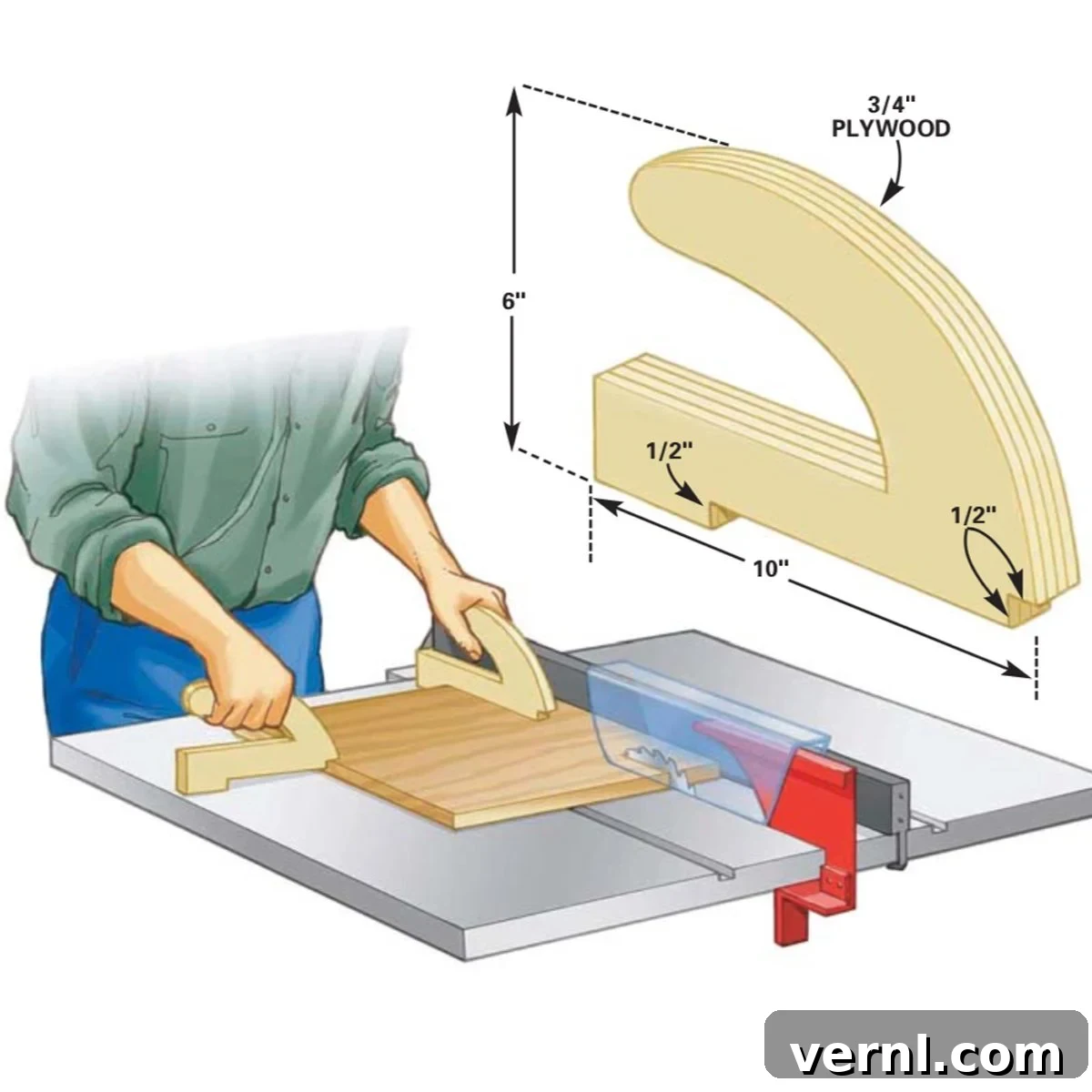
While push sticks come in various shapes and sizes, the most effective designs incorporate specific features that maximize both safety and utility. The original text highlighted a clever dual-notch design, which is an excellent starting point for understanding optimal push stick construction.
The Dual-Notch Advantage: Front and Back for Comprehensive Control
A highly recommended design, as suggested in the initial description, features two distinct notches, each serving a crucial role:
- The Front Notch: Positioned at the leading edge of the push stick, this notch is designed to firmly engage the front or top-front edge of the lumber. Its primary function is to provide forward propulsion, guiding the workpiece smoothly and steadily through the cutting action. This positive engagement ensures the material moves consistently and purposefully across the tool’s surface, all while keeping your fingers at a safe distance from the blade.
- The Back Notch: Located towards the rear of the push stick, this notch is engineered to apply downward pressure on the trailing end of the workpiece. Its vital role is to keep the wood held flat against the table or fence as it exits the blade. This prevents the material from lifting, tipping, or flipping up—a common cause of kickback and inaccurate cuts. Together, these two notches create a robust system that not only pushes the material forward but also stabilizes it vertically, offering unparalleled control throughout the entire cut.
Beyond the Notches: Other Essential Design Elements
- Ergonomic Handle: A comfortable and secure grip is paramount for maintaining control. Handles should be designed to fit naturally in the hand, allowing for firm pressure to be applied without causing strain or slippage. Common designs include pistol grips, curved handles, or simple elongated blocks.
- Durable Material: Push sticks are typically crafted from sturdy materials like plywood, MDF (medium-density fiberboard), or hardwood scraps. The material must be robust enough to withstand the forces of pushing and occasional, accidental contact with a blade without splintering or breaking.
- High Visibility: Many experienced woodworkers paint their push sticks a bright, contrasting color (such as fluorescent orange or yellow). This makes them easily identifiable in a busy workshop, serving as a constant visual reminder to grab and use them, and making them harder to misplace.
- Appropriate Length and Reach: A good push stick should be long enough to allow your hand to remain comfortably far from the blade throughout the entire cut, even when working with longer pieces of stock. Conversely, a shorter push stick might be ideal for more intricate, smaller work.
- Non-Slip Features: To enhance grip and prevent slippage on the workpiece, some push stick designs incorporate rubber pads, sandpaper, or textured surfaces on the contact points. This added friction ensures better control and reduces the chance of the push stick slipping off the material.
Employing Push Sticks Across Diverse Woodworking Tools
While the fundamental purpose of a push stick remains consistent, its application can be tailored to suit the specific requirements of different woodworking machines:
For Table Saws
The table saw is perhaps where push sticks are most critical. When ripping narrow stock, a push stick is non-negotiable. Typically, one hand uses the push stick to provide forward motion and downward pressure, while the other hand (or a separate push block/featherboard) might apply sideways pressure against the fence to keep the material tight. Never use your bare hands to push small pieces as they approach or pass the blade.
For Band Saws
On a band saw, push sticks are instrumental for feeding material steadily into the blade, particularly for operations like resawing or cutting intricate curves. They help maintain a consistent feed rate, which reduces strain on the blade and improves the overall quality of the cut. More importantly, they keep your fingers well clear of the continuously moving blade, which, despite appearing less aggressive than a table saw blade, can still cause severe injuries.
For Jointers
When jointing the face or edge of a board, specialized push blocks (often larger and more robust, with comfortable handles) are used. These are critical for pressing the workpiece firmly down onto the infeed and outfeed tables and securely against the fence. This ensures a uniform cut and, crucially, keeps your hands from sliding over the spinning, exposed cutter head. For wider stock, it’s often recommended to use two push blocks—one for each hand—to maintain even pressure across the entire surface of the material.
Constructing Your Own Push Sticks: A DIY Workshop Essential
The suggestion to “Construct a pair of these push sticks” in the original article highlights a valuable DIY ethos. Making your own push sticks is not only an economical choice but also allows for complete customization to suit your personal working style and specific project requirements. Scraps of plywood, MDF, or even hardwood are excellent, readily available materials for this purpose. Designs can range from incredibly simple angled cuts on a piece of wood to more sophisticated pistol-grip styles with integrated safety features and multiple notches.
When embarking on a DIY push stick project, prioritize safety above all else: ensure the handle provides a comfortable and secure grip, and that any notches or gripping points are deep and effective enough to engage the material without slipping. It’s wise to create several different types for various applications: a long, narrow one for thin rips, a wider paddle-style one for broader stock, and perhaps a specialized design like the Fence-Straddling Push Stick. This particular design offers enhanced stability by straddling the table saw fence, providing superior control for certain ripping operations.
Best Practices for Effective Push Stick Utilization
- Make It a Habit: Develop the routine of always reaching for a push stick whenever your hands would otherwise come within 6-8 inches of a blade. When in doubt, use it. It’s better to be overly cautious than to regret a moment of complacency.
- Apply Consistent Pressure: Maintain steady downward and forward pressure throughout the entire cut. This technique is vital for preventing kickback, ensuring clean cuts, and maintaining control over the workpiece.
- Select the Right Push Stick: Match the push stick to the task at hand. A narrow push stick is ideal for thin rips, a wider paddle-style for broader stock, and specialized designs for unique challenges. Having a variety on hand is beneficial.
- Keep Them Accessible: Store your push sticks in an easily reachable location near your power tools. If they are hidden away, you are less likely to use them consistently. Consider hooks or a dedicated holder.
- Regular Inspection: Periodically check your push sticks for signs of wear, damage, or slippage on their gripping surfaces. A worn push stick is less effective and can compromise safety. Replace or repair them as needed to ensure optimal performance.
- Part of a Larger System: While critical, push sticks are just one component of comprehensive workshop safety. Always use them in conjunction with other safety measures such as blade guards, splitters, featherboards, and appropriate personal protective equipment (PPE) like safety glasses and hearing protection.
Beyond Safety: Enhancing Woodworking Quality and Efficiency
While the primary motivation for using push sticks is undoubtedly safety, their consistent application offers significant benefits that extend directly to the quality and efficiency of your woodworking projects. By ensuring the steady, controlled movement of the workpiece, push sticks help in achieving perfectly straight cuts, preventing undesirable burning of the wood, and significantly reducing tear-out along the cut line. This meticulous control results in less material waste, fewer re-cuts, and a consistently higher standard of craftsmanship. Ultimately, embracing push sticks in your workflow saves valuable time, money, and frustration, allowing you to focus more on the creative aspects of woodworking.
Conclusion: Your Safest Path to Precision Woodworking
In the demanding world of woodworking, safety must always be the highest priority. Push sticks, though simple in their design, are profoundly effective and indispensable tools that provide a critical layer of protection for anyone operating table saws, band saws, or jointers. By keeping your hands safely away from dangerous blades while simultaneously enhancing your control and precision over the workpiece, they empower you to work with confidence and produce exceptional results. Whether you choose to construct your own custom pair, perhaps incorporating those essential front and back notches for superior grip, or opt for a commercially available design, integrating push sticks into your daily woodworking routine is a fundamental step towards a safer, more enjoyable, and ultimately more productive workshop experience. Make them a staple in your shop, and prioritize your well-being with every single cut.