
Geothermal Heat Pumps: The Ultimate Guide to Eco-Friendly Home Comfort
In today’s evolving energy landscape, homeowners are increasingly seeking sustainable and cost-effective solutions for heating and cooling. Among the most innovative and efficient options available, heat pumps stand out, particularly geothermal systems. Renowned for their exceptional energy efficiency and eco-friendly footprint, these advanced HVAC systems offer a compelling alternative to traditional furnaces and air conditioners by leveraging the stable temperatures of the earth.
While the initial investment for a geothermal heat pump can be higher than conventional systems, the long-term savings on energy bills, combined with significant rebates and tax incentives, make them an increasingly attractive choice for modern homes. These powerful incentives, designed to encourage the adoption of renewable energy technologies, help offset upfront costs, making sustainable home comfort more accessible than ever before.
Larry Lessard, a respected authority in geothermal energy, highlights two primary types of heat pumps used for home electrification: Ground Source (also known as geothermal or GeoExchange) Heat Pumps and Air Source Heat Pumps (ASHPs). With Lessard’s expert insights guiding our discussion, this comprehensive guide will help you understand the nuances of geothermal systems and determine if this cutting-edge technology is the right fit for your home.
What Exactly is a Geothermal Heat Pump?
To truly appreciate the innovation behind geothermal heat pumps, it’s essential to grasp their fundamental principle. Larry Lessard succinctly defines them as follows:
“A geothermal heat pump is a clean, renewable energy source that uses a machine to move heat energy from one place to another. Specifically, it uses the Earth as an underground heat source and leverages its natural low temperatures to provide heating and cooling for homes and commercial buildings.”
This definition underscores the core difference between a geothermal system and traditional heating methods. Unlike furnaces or boilers that burn fuel to generate heat, geothermal heat pumps simply transfer existing heat. This distinction is critical to their superior efficiency. Instead of consuming energy to create warmth, they efficiently move thermal energy from one location to another, dramatically reducing energy consumption.
The Earth’s subsurface acts as a massive, stable thermal battery. Below the frost line, ground temperatures remain remarkably constant, typically hovering between 50 to 60 degrees Fahrenheit (10 to 16 degrees Celsius) year-round, regardless of extreme seasonal air temperatures above ground. This consistent underground temperature provides a reliable and moderate heat source in winter and a cool heat sink in summer.
Because the geothermal system exchanges heat with this stable underground reservoir, it requires significantly less energy to condition your home compared to a conventional air conditioning system or an air-source heat pump, which must contend with much wider and more volatile outdoor air temperatures. While air-source heat pumps are more common and generally more affordable to install due to their reliance on ambient air, geothermal systems offer unparalleled efficiency and stability due to their connection to the Earth’s thermal mass. Water-source heat pumps, leveraging nearby bodies of water, are also an option in suitable locations.
How Does a Geothermal Heat Pump System Operate?
Understanding the operation of a geothermal heat pump can be simplified by comparing it to a common household appliance: your refrigerator. A refrigerator removes heat from its interior compartment and expels it into your kitchen. A geothermal heat pump employs the identical thermodynamic principle, but on a larger scale, transferring heat between your home and the Earth.
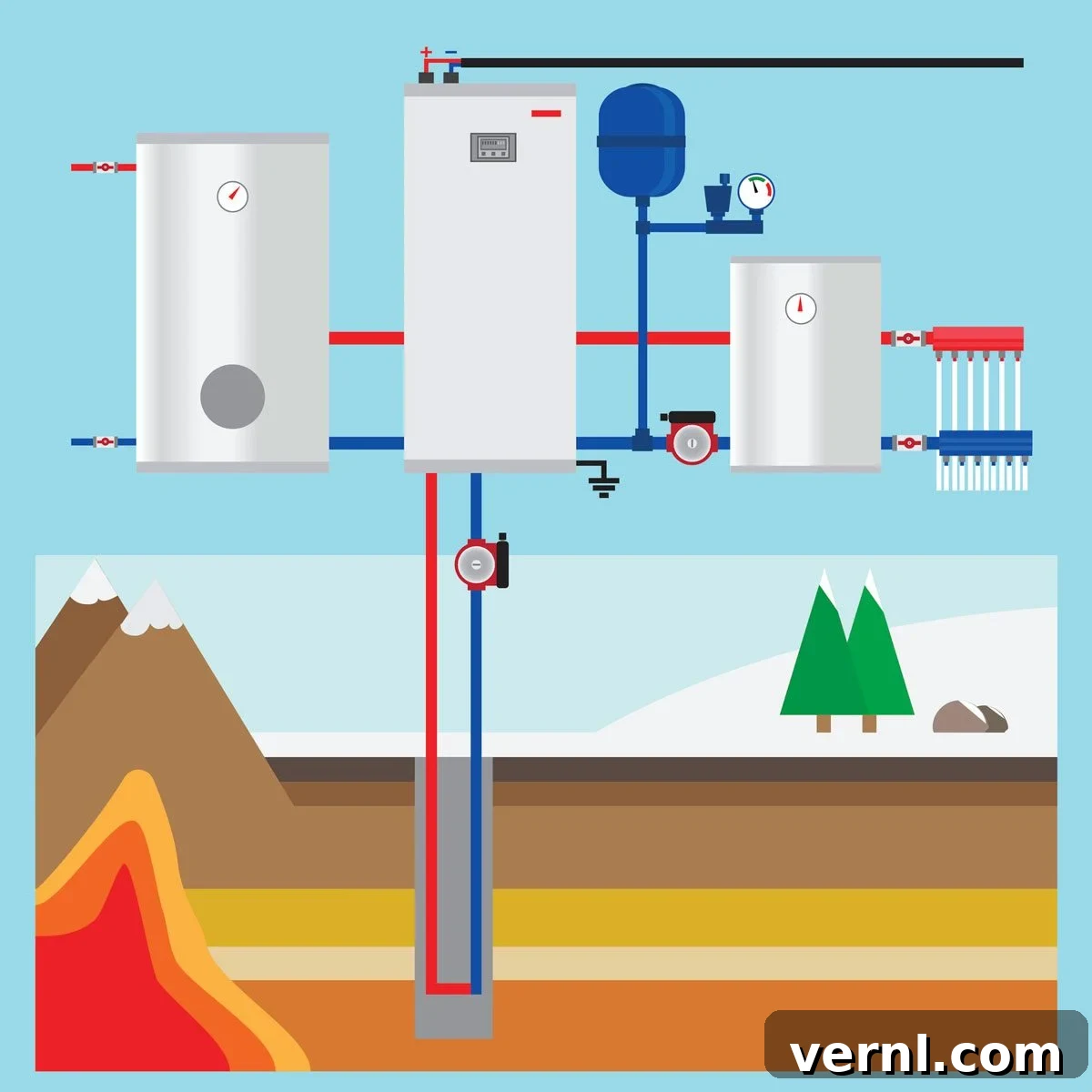
The system utilizes an intricate network of long, durable pipes, known as a ground loop, buried underground. These pipes are filled with a circulating liquid – typically water or an environmentally friendly antifreeze solution. This ground loop is connected to a geothermal heat pump unit located inside your home, which functions ingeniously as both a high-efficiency furnace and a powerful air conditioner.
The Heating Cycle: Harnessing Earth’s Warmth
During the colder heating season, the liquid circulating through the underground pipes absorbs natural thermal energy from the relatively warmer earth. As this warmed liquid returns to the indoor geothermal unit, it passes through a heat exchanger, transferring its latent heat to a refrigerant. The refrigerant then undergoes a compression process, which further concentrates its heat and significantly raises its temperature. This superheated refrigerant then circulates through coils, where the intensified heat is efficiently distributed throughout your home via a forced-air duct system or a hydronic (radiant) heating system. This continuous cycle ensures a steady and comfortable indoor temperature, drawing warmth directly from the ground.
The Cooling Cycle: Dissipating Heat into the Earth
When the warmer cooling season arrives, the process seamlessly reverses. The geothermal heat pump actively removes excess heat from the air inside your home. This unwanted indoor heat is absorbed by the refrigerant, which then transfers it to the circulating liquid in the ground loop. As the liquid carries this heat back into the cooler earth, the ground acts as an efficient heat sink, absorbing and dissipating the thermal energy. The now-cooled liquid returns to the indoor unit, ready to absorb more heat from your home, thus providing effective and energy-efficient air conditioning. Many advanced geothermal units can also integrate with your domestic hot water system, providing supplementary water heating and further enhancing overall energy savings.
Exploring the Types of Geothermal Heat Pump Systems
The configuration of the underground loop system is a crucial aspect of geothermal installation, dictating both cost and efficiency. The three most common closed-loop systems are detailed below, each with specific advantages depending on site conditions. Additionally, a less common open-loop system exists, which circulates surface water or water from a well directly through the system before returning it to the ground via a discharge pipe.
Selecting the optimal system, determining the appropriate loop length, and designing the layout for a particular home involves careful consideration of several factors. These include the local climate, the geological characteristics of the soil, the amount of available land, the specific heating and cooling load requirements of the building, and the prevailing local installation costs.
Horizontal System
The horizontal system is generally the most economical underground installation option, provided ample land is available. It involves placing coiled layers or straight runs of durable polyethylene pipe within trenches dug approximately six feet deep. While cost-effective, this method requires a substantial amount of open space. For instance, a typical 2,000-square-foot house might necessitate up to 400 feet of two-foot-wide trenches. This system is best suited for properties with generous outdoor areas that can accommodate the extensive trenching without significant disruption to existing landscaping or structures.
Vertical System
When property size is limited, or when preserving existing landscaping is a priority, a vertical geothermal system is often the preferred choice. This method involves drilling several four-inch-diameter holes, typically spaced about 15 feet apart, to depths ranging from 100 to 400 feet. Two pipes are then inserted into each borehole and connected at the bottom with a U-bend. While drilling is more complex and generally more expensive than trenching, the vertical system minimizes surface disturbance, making it ideal for urban lots, homes with compact yards, or properties with extensive existing landscaping that cannot be disturbed.
Pond/Lake System
For homes situated near a suitable body of water, such as a pond or a lake, the pond/lake system presents the lowest-cost installation option. This system draws heat directly from the water rather than from the soil. Coils of pipe are typically anchored on racks at a depth of about 10 feet, where a consistent blanket of water covers them, ensuring stable heat exchange. This method is highly efficient due to the excellent thermal conductivity of water but is, of course, limited to properties with direct and appropriate access to a natural or artificial water body.
Open-Loop Systems: Utilizing Ground or Surface Water
Less common but still viable in certain locations are open-loop geothermal systems. These systems utilize an existing water well or a nearby surface water source (like a pond or river) by circulating the water directly through the heat pump’s heat exchanger. After the heat transfer occurs, the water is then discharged back into the same aquifer or body of water through a separate discharge pipe. While potentially highly efficient, open-loop systems require a sufficient and consistent water supply, must comply with local regulations regarding water discharge, and need careful consideration of water quality to prevent mineral buildup in the system.
The Investment: How Much Does a Geothermal Heat Pump Cost?
The most significant hurdle for many homeowners considering a geothermal heat pump is the initial upfront cost. A complete system, including equipment and professional installation, can range substantially from $10,000 to $40,000 or even higher. This wide price variation is influenced by several critical factors, including the specific soil conditions (e.g., rocky vs. soft), the overall plot size, the chosen system configuration (horizontal, vertical, pond/lake), site accessibility for drilling or excavation equipment, and the sheer amount of digging and drilling required for the ground loop installation.
For an existing 2,000-square-foot home, a geothermal retrofit can be particularly complex and costly, potentially reaching up to $30,000. Retrofits often necessitate modifications to existing ductwork, in addition to extensive excavation and drilling. In contrast, installing a geothermal system in a new construction project typically falls on the lower end of the cost spectrum, as the groundwork can be integrated seamlessly into the construction process. Even so, a geothermal system will generally cost approximately 40 percent more than a traditional HVAC system.
Despite the higher initial investment, the long-term energy savings offered by geothermal systems are substantial. Recouping these upfront costs through reduced utility bills can take anywhere from as little as four years to as long as 15 years, depending primarily on local utility rates for electricity, natural gas, or oil, as well as the specific installation costs incurred. To make an informed decision and accurately assess the financial viability of a geothermal system for your unique situation, it is highly recommended to conduct thorough research, gather multiple professional estimates, and analyze the potential payback period based on your estimated energy consumption and savings.
Maximizing Savings: Tax Incentives and Rebates for Heat Pump Installation
While the initial cost of a geothermal heat pump can be a deterrent, federal, state, and local governments, along with utility companies, offer substantial financial incentives to make these energy-efficient systems more affordable. These programs are designed to encourage the adoption of renewable energy technologies and contribute to broader climate goals.
A prime example is the federal tax credit available through the Inflation Reduction Act of 2022. This legislation provides a generous tax credit that can cover as much as 30 percent of the cost for residential installations of Energy Star qualified geothermal heat pump systems. This significant incentive is available through 2032, offering a substantial reduction in the overall cost of installation for both homeowners and commercial entities.
Beyond federal programs, it’s crucial to investigate additional savings opportunities. Many utility companies offer their own rebates for installing energy-efficient systems like geothermal heat pumps, which can often be combined with federal credits. Furthermore, state and local governments frequently provide incentives, which may include grants, low-interest loans, or additional tax credits tailored to specific regional energy goals. Some programs may even offer incentives based on household income levels to ensure accessibility for a wider range of homeowners. Therefore, if you are considering installing a heat pump in a new home or retrofitting an existing house, it is highly advisable to consult with your utility provider, state energy office, and local municipality to explore all available financial assistance programs.
The Unrivaled Benefits of a Geothermal Heat Pump
Geothermal heat pumps offer a compelling array of advantages that extend beyond mere energy savings, providing a superior home comfort solution with a reduced environmental impact. Larry Lessard emphasizes their efficiency:
“Ground source heat pumps are more than twice as efficient as air source heat pumps. They can replace existing ducted heating or cooling and support radiant flooring and domestic hot water. Even further, ground source heat pumps can be built out to support electric grids, buildings, and transportation.”
Here’s a deeper dive into the key benefits:
- Significantly Lower Operating Costs: This is arguably the most attractive benefit. A geothermal heat pump will immediately reduce your heating costs by 30 to 60 percent and your cooling costs by 20 to 50 percent compared to conventional heating and cooling systems. These substantial savings accumulate over time, offsetting the initial investment and leading to considerable long-term financial advantages. The consistent earth temperatures minimize the energy required for heat exchange, leading to predictable and lower monthly utility bills.
- Harnesses Clean, Renewable Energy: Geothermal systems are fundamentally eco-friendly. Since there is no onsite combustion of fossil fuels, they produce zero direct emissions of carbon dioxide, carbon monoxide, or other greenhouse gases. This dramatically reduces your home’s carbon footprint and contributes to cleaner air quality both indoors and outdoors. Furthermore, the absence of combustion means there are no associated safety concerns like carbon monoxide poisoning or risks from open flames, enhancing indoor air quality and safety. While the pump unit does consume a small amount of electricity to operate, this electricity can increasingly be sourced from renewable grids, further minimizing environmental impact.
- Versatile Installation for New Construction and Retrofits: Geothermal systems are adaptable and can be installed in both newly constructed homes and existing residences. In new construction, the integration is often smoother and less costly. For retrofits, while potentially more expensive due to required ductwork modifications or extensive ground disturbance, the long-term benefits often justify the investment, transforming older, inefficient homes into models of sustainable energy use.
- Exceptionally Quiet Operation: One of the often-underestimated benefits is the quiet operation of a geothermal system. Unlike traditional air conditioners that feature noisy outdoor compressor or fan units, a geothermal heat pump’s primary mechanical components are housed indoors or underground. The indoor unit operates with a sound level comparable to that of a refrigerator, providing peaceful and undisturbed home comfort without the distracting hum or roar of outdoor machinery.
- Minimal Maintenance and Extended Lifespan: Geothermal heat pumps are designed for durability and longevity. The indoor components typically last about 25 years, significantly longer than the 15 to 20 years expected for a furnace or conventional AC unit. Even more impressive, the underground loop system, made of robust polyethylene piping, can last for 50 years or even longer. With fewer moving parts and being largely protected from harsh outdoor elements, these systems require minimal maintenance, translating to fewer service calls and lower repair costs over their extensive lifespan.
Understanding the Downsides of a Geothermal Heat Pump
While the advantages of geothermal heat pumps are compelling, it’s equally important to consider the potential drawbacks to make an informed decision. Larry Lessard points out the primary concern:
“The cost of installing a geothermal heat pump can sometimes be 40-50% more than a quality conventional system.”
However, he adds that installation costs can fluctuate widely based on the geological conditions of the land, potentially being even higher in specific circumstances. “To evaluate cost, it is a good idea to get pricing from more than one reputable installer.” Beyond the significant upfront expense, other considerations include:
- Not a DIY Project: Geothermal heat pump systems are complex, requiring specialized knowledge for proper sizing, precise design, and meticulous installation. This is not a project for the average homeowner. Professional expertise is absolutely essential to ensure the system operates at its maximum efficiency and longevity, preventing costly errors and performance issues down the line.
- Still a Relatively Niche Market: Despite growing interest, geothermal technology is still considered relatively new compared to traditional HVAC systems. This means there are fewer qualified installers in many regions, which can lead to less competition and, consequently, higher installation prices. As the market matures and more technicians gain expertise, these costs are expected to become more competitive over time.
- Installation is Highly Disruptive to the Landscape: Installing the underground loop system, whether horizontal or vertical, can be significantly disruptive to your property’s landscape. Trenching for horizontal loops or drilling boreholes for vertical systems involves heavy machinery and can temporarily tear up lawns, flowerbeds, and other landscaping features. Homeowners must be prepared for this extensive excavation and the subsequent restoration work, which can add to the overall project timeline and cost, and definitely crush your prize petunias.
Is a Geothermal System the Right Choice for Your Home?
Interest in geothermal HVAC solutions is definitely on the rise, as noted by Bob Donley, customer support manager at GeoSystems LLC in Minnesota. With approximately 100,000 geothermal cooling and heat pumps installed in the United States each year, more homeowners are recognizing their long-term value. Deciding if geothermal is right for you involves evaluating your property, finances, and long-term goals.
Here are several key factors that suggest your home might be an excellent candidate for a geothermal HVAC system:
- Long-Term Residency and Financial Preparedness: You are comfortable with the higher upfront costs and plan to remain in your home for an extended period. For new construction, this typically means at least four to seven years to recoup the initial investment through energy and cost savings. For a retrofit, the payback period might be longer, perhaps 10 to 12 years. Your commitment to long-term residency allows you to fully realize the significant financial returns.
- Suitable Property Characteristics: You own a large lot with ample open space, ideally with a pond or a well. A spacious property can easily accommodate a less expensive horizontal ground loop system, significantly reducing installation costs. Furthermore, access to a pond or well could make a highly efficient pond/lake system or an open-loop system feasible, offering even greater cost-effectiveness in specific scenarios.
- New Home Construction: You are in the process of building a new house. Integrating a geothermal system into new construction is generally simpler and less disruptive, and the upfront costs can often be rolled directly into your mortgage. This allows you to benefit from substantial heating and cooling cost savings from day one, without the added complexity and cost of a retrofit.
- High Existing Energy Bills: Your current home suffers from unusually high energy bills, especially if you rely on expensive heating fuels like propane, oil, or traditional electric resistance heating. In such cases, the switch to a highly efficient geothermal system will generate much larger and faster energy savings, accelerating your payback period and providing immediate relief from exorbitant utility costs.
Common Heat Pump Questions, Answered
Heat pumps offer a marvelously efficient way to heat and cool your home by simply transferring thermal energy. A solid understanding of their operation and benefits is crucial for selecting the ideal system for your specific needs. To further your knowledge, explore these related topics:
- The Pros and Cons of Geothermal Heat Pumps
- What Is a Heat Pump System?
- How to Buy a Heat Pump
- Stay Warm This Winter: Why the Emergency Heat Setting Matters
- What to Know About Types of Baseboard Heaters
- Lasko All-Season High-Velocity Hybrid Fan and Heater: We Tried It
About the Expert
Larry Lessard is the Founder and Director of Achieve Renewable Energy, LLC, based in Salem, Massachusetts. He brings extensive expertise to the field as an accredited installer, a licensed construction supervisor, a Certified Geothermal Inspector, and a Certified GeoExchange Designer, making him a trusted authority in renewable energy solutions.