
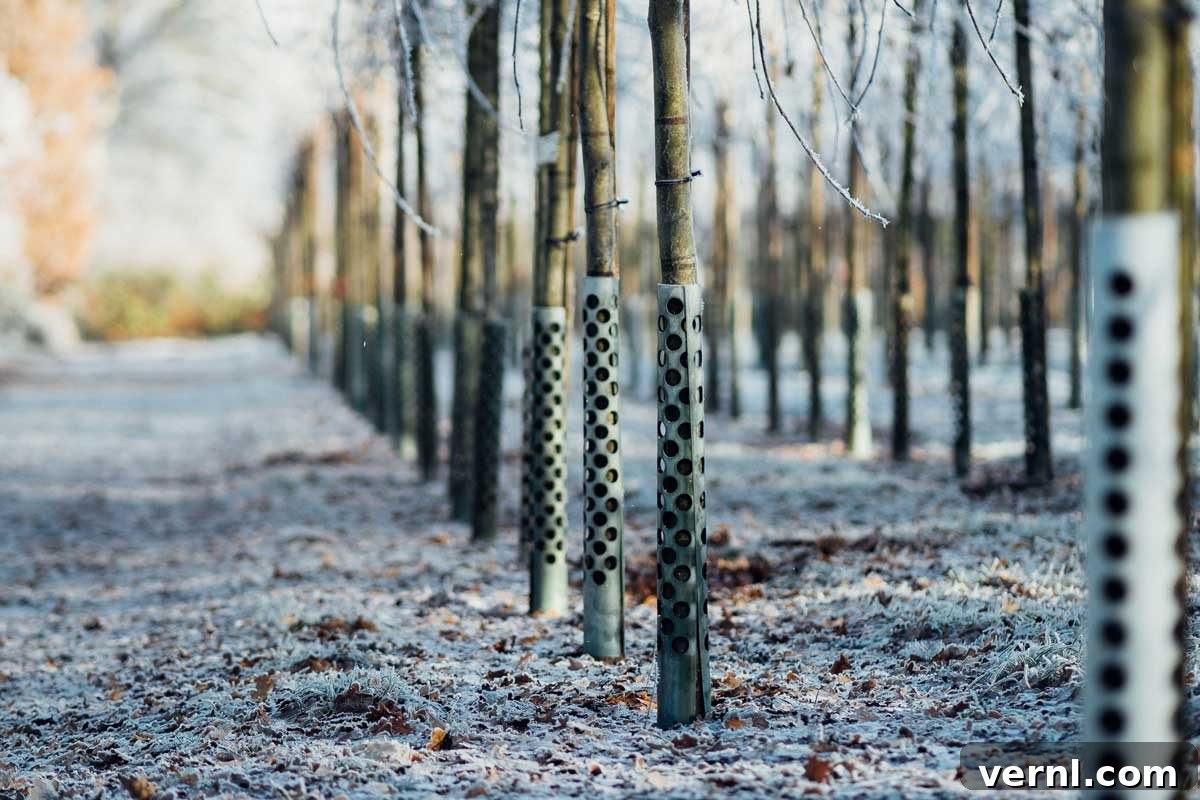
Have you ever found yourself strolling through a neighborhood, only to be stopped by the curious sight of tree trunks meticulously wrapped in gleaming sheet metal? These reflective, metallic cuffs are a surprisingly common fixture, dotting landscapes from bustling urban centers like Charlotte and Los Angeles to the serene stretches of Miami and Northern Maine. They often spark curiosity, leaving many wondering about their true purpose.
Far from being mere decorative elements, these tree wrappings – frequently referred to as “baffles” – serve a vital, practical function. Their primary role is to protect trees from a host of unwanted pests, including agile squirrels, resourceful rats, and clever raccoons. You might also encounter similar devices shaped like metal cones, which achieve the same goal and share the same functional name.
While many commercial baffles available online are primarily designed for bird feeder poles or trees with smaller trunk diameters, this often presents a challenge for homeowners dealing with larger, established trees that have become a magnet for persistent critters. So, what’s the secret to effectively utilizing metal wraps on the grand old trees in your yard? This comprehensive guide will equip you with all the essential knowledge for successfully wrapping metal around your trees, ensuring their protection and your peace of mind.
Mastering Tree Trunk Protection: Your Guide to Metal Baffles for Pest Control
Why People Embrace Metal Baffles for Their Trees: A Deep Dive into Pest Deterrence
The practice of wrapping tree trunks with sheet metal is rooted in a clever understanding of animal behavior and a desire to protect both arboreal health and residential spaces. Much like applying grease to a bird feeder pole to thwart squirrels, the inherently slick surface of sheet metal creates an almost insurmountable obstacle for small climbing creatures. This lack of traction makes it incredibly difficult for pests to ascend the tree trunk, effectively cutting off their primary route.
This strategic barrier serves multiple critical functions. Firstly, it prevents pests from establishing nests within the tree’s canopy, which can be detrimental to the tree’s health and lead to messy, unhealthy conditions. More importantly, it denies them access to higher branches that often serve as direct conduits to your home’s roof or attic. Squirrels, rats, and raccoons are notorious for exploiting these arboreal bridges to gain entry into residential structures, leading to significant damage, contamination, and costly repairs. In fact, many professional arborists enthusiastically recommend wrapping your cherished shade trees in metal as a straightforward, cost-effective method to safeguard both your home and your valuable trees.
While the concept of tree protection might bring to mind other forms of tree wraps, it’s crucial to understand the distinct purposes. Traditional tree wraps, typically made from polypropylene fabric, paper, or burlap, primarily focus on shielding the tree’s trunk and bark from environmental stressors such as sunscald, frost cracks, and even accidental damage from string trimmers or herbicides. They are particularly beneficial for younger, more vulnerable trees with thin bark. While these fabric wraps can offer some protection against gnawing pests, their efficacy as a climbing deterrent is limited compared to the slick surface of metal baffles.
For owners of fruit and nut trees, metal baffles represent an indispensable preventive measure. Fruit and nut trees are natural magnets for hungry squirrels, rats, and raccoons, who are drawn to the tempting harvest. While sharing some fruit might seem harmless, these opportunistic critters often extend their activities beyond mere feeding. They may begin to chew on the tree’s bark, which can leave the tree severely vulnerable to disease, insect infestation, and even structural weakness. In such scenarios, a well-installed metal baffle performs double duty: it actively deters climbing altogether and simultaneously provides a physical shield, protecting the tree’s delicate bark from gnawing damage.
Beyond immediate physical damage, the motivation to protect trees from climbing pests sometimes stems from more profound concerns. Nesting animals like rats, and even certain bird species, can establish homes within your trees, and from there, easily migrate into attics, walls, and other hidden recesses of your house. These infestations can introduce serious health risks, including the transmission of viral diseases that pose threats to human health and local agriculture. By creating an inhospitable environment on your tree trunks, you significantly reduce the likelihood of these unwanted visitors or permanent residents, thereby enhancing your family’s safety and restoring your peace of mind.
Crafting an Impenetrable Barrier: How To Effectively Wrap Metal Around Trees
Effective installation is paramount when it comes to maximizing the protective capabilities of a tree baffle. The goal is to create a seamless, slick barrier that pests cannot bypass. Start by wrapping the metal completely around the entire trunk, ensuring an overlap of several inches. This overlap should be securely fastened to prevent any gaps. Crucially, the top edge of this barrier must be positioned at least five feet off the ground. This height is essential because many climbing pests, especially raccoons, are surprisingly adept at standing on their hind legs and reaching upwards. The sheet metal itself should be at least 18 inches wide (and preferably 24 inches for larger pests like raccoons) to inhibit animals from simply jumping over it or finding purchase at the top edge.
For larger trees, readily available commercial baffles often fall short in size and robustness. In these cases, you’ll need to embark on a DIY project, fabricating your own baffle from sheet metal or sturdy aluminum. Galvanized steel is a popular choice due to its durability and resistance to rust. When constructing your baffle, ensure the edges are smooth to prevent injury to the tree or yourself. The metal sections are typically held together using sturdy wire, rust-resistant nails, or screws. When fastening, remember to leave some allowance for future tree growth, as explained below.
While it might be tempting to paint your metal baffle to better blend with your landscape, it’s important to consider the potential trade-off. Paint, especially matte or textured finishes, can significantly reduce the slickness of the surface, making it easier for pests to gain a foothold and climb. If aesthetics are a high priority, opt for a glossy, high-sheen paint or a color that naturally camouflages with the tree bark while retaining maximum slickness.
The Efficacy of Tree Baffles: Do They Truly Work?
When it comes to the question of whether metal tree baffles are effective, the consensus among experts and homeowners is largely positive: they are certainly “worth a shot.” While it’s true that some particularly cunning squirrels may eventually learn to circumvent these diversions over time, a properly installed baffle can deter them long enough for your fruit- or nut-bearing tree to successfully produce a harvest, or for young trees to grow stronger without pest interference.
For instance, esteemed horticulturist and gardening expert Neil Sperry frequently champions baffles as a reliable solution for protecting pecan trees in his Texas region. “If a pecan tree is free-standing, that is, not touching other trees, power lines, fences, or structures, you can successfully install a sheet metal collar around its trunk,” Sperry advises. This emphasizes a critical point: baffles are most effective when the tree is isolated, preventing alternative access routes for agile climbers.
Sperry also notes that while other visual deterrents, such as reflective strips or fake owls, might offer temporary relief, pests like squirrels are quick to adapt and eventually dismiss them as harmless. Some arborists even argue that squirrels are incredibly challenging to manage in general due to their intelligence and persistence. Baffles, while highly effective, are not a standalone miracle solution. Their success hinges entirely on the absence of any alternative paths for squirrels and other pests to navigate, such as low-hanging tree limbs that brush against the ground, nearby trees, fences, power lines, or adjacent structures that pests could use as a bridge to bypass the baffle.
Therefore, for optimal effectiveness, it’s crucial to prune any branches that are within six to eight feet of the ground or any nearby structures. This creates a clear ‘air gap’ that the baffle can then fully secure, making the tree truly inaccessible from the ground up. Integrating baffles into a broader pest management strategy, which includes regular pruning and maintaining a clean garden environment, will yield the best long-term results.
Frequently Asked Questions About Metal Tree Wraps
Can a tree survive if metal has been wrapped around it for years?
Yes, a tree can absolutely survive with a metal baffle around its trunk for many years, provided you adhere to proper tree care precautions. As Neil Sperry wisely states, “Keep it loose so that it won’t girdle the tree over time.” Girdling occurs when a tight band restricts the flow of nutrients and water through the tree’s phloem and xylem, eventually killing the tree. To prevent this, ensure there’s sufficient space between the baffle and the trunk – at least an inch or two – to accommodate the tree’s growth. Even better, Sperry suggests affixing it in a way that allows for seasonal removal. “Much better yet, affix it so that you can put it in place in early summer and remove it […] in late fall.” This allows the tree to breathe and grow freely during its dormant period, minimizing any long-term impact.
What should I do if I find metal embedded in a tree?
Finding metal embedded in a tree can be concerning, but the approach depends on how deeply the metal has become integrated. If the tree has not yet completely grown around the metal, Sperry recommends a careful, gentle approach. He advises taking a sharpened 1-inch wood chisel and meticulously cleaning away the wood that has begun to cover the metal. “It should pop right out after you’ve done that,” he advises. This method minimizes damage to the tree while freeing the foreign object. If, however, the tree has significantly grown around and encased the piece of metal, attempting removal yourself could cause more harm than good. In such cases, it is imperative to consult with a certified arborist. They possess the expertise and specialized tools to safely assess the situation and determine the best course of action, which might involve partial removal, leaving it in place, or other professional techniques.
In either scenario, and particularly if the tree is not on your property, always remember to check with the property owner before taking any action, Sperry notes. Unauthorized removal or alteration could lead to legal issues or further damage.
Are there alternatives to metal baffles for tree pest control?
While metal baffles are highly effective for climbing pests, other methods exist depending on the specific pest and tree. Sticky tree bands can deter crawling insects like ants and cankerworms. Chemical repellents or bait stations might be used for rodent issues away from the tree itself. Physical barriers like netting can protect fruit from birds and larger animals. However, for deterring climbing mammals like squirrels and raccoons from accessing a tree’s canopy or your home, metal baffles remain one of the most robust and long-lasting solutions.
Is wrapping metal around a tree safe for the tree’s health?
Yes, when installed correctly, metal baffles are safe for tree health. The key is to ensure the baffle is not installed too tightly, which can lead to girdling. Always allow ample space for the trunk to expand as the tree grows. Using rust-resistant materials and inspecting the baffle annually will ensure it remains effective without causing harm to your valuable trees.
About the Expert
Neil Sperry is a highly respected horticulturist based in North Texas, boasting an impressive career spanning over five decades. He is widely recognized for his long-standing role as the weekend garden columnist for the Fort Worth Star-Telegram and is the esteemed author of Neil Sperry’s Complete Guide to Texas Gardening, a definitive resource for gardeners in the region. Sperry holds a master’s degree in horticulture from Ohio State University, underpinning his vast knowledge and practical expertise in plant science and garden care.