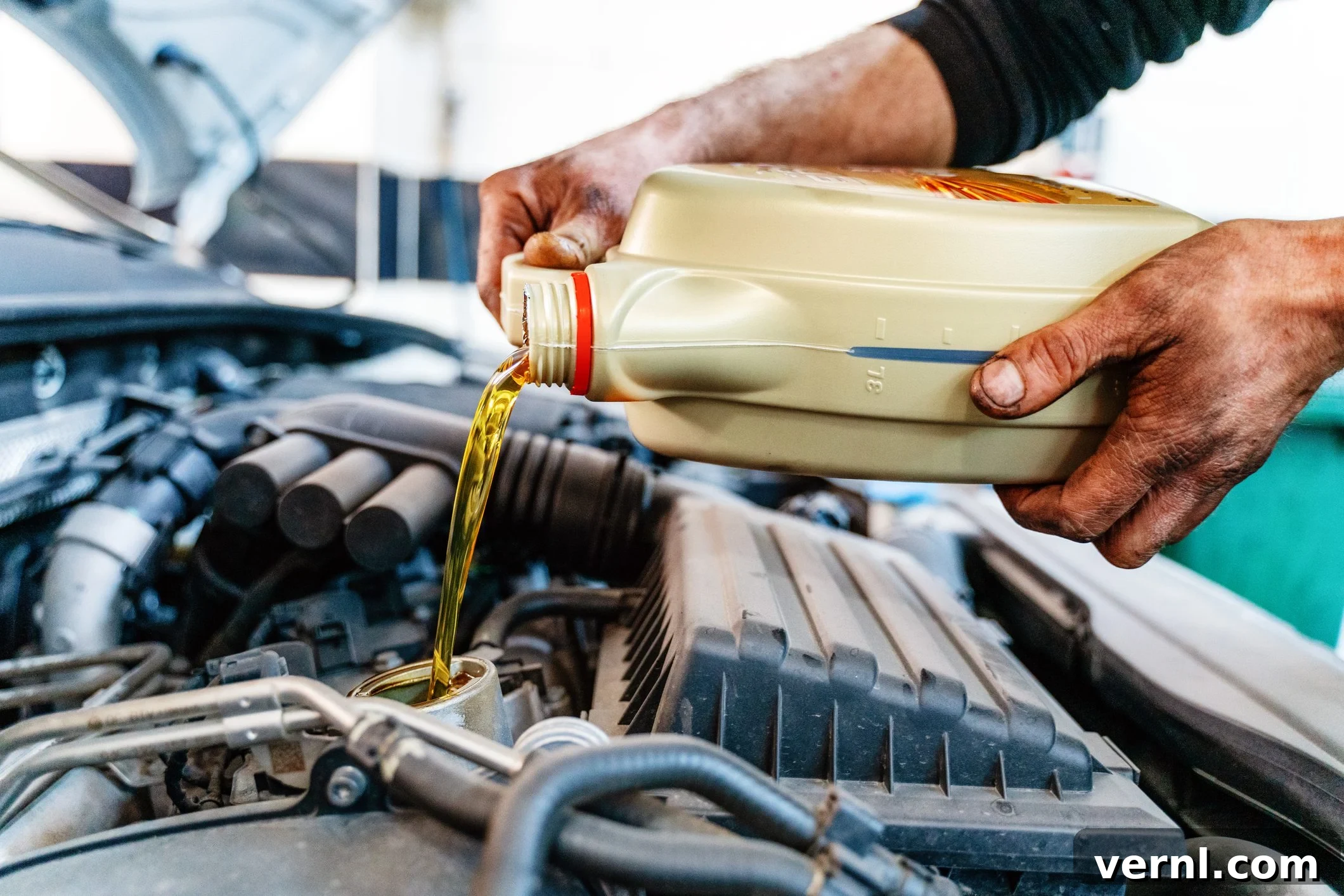
Synthetic motor oil has become the preferred choice for most modern vehicles, especially those featuring high-performance engines, turbochargers, or demanding driving conditions. While it typically comes with a higher upfront cost, synthetic oil offers unparalleled benefits that can significantly extend your engine’s lifespan. Motor oil is, after all, the lifeblood of your engine, performing a multitude of critical tasks from lubricating and cooling to cleaning and protecting vital mechanical components. It effectively suspends harmful elements like sludge, abrasive particles, and corrosive chemicals, preventing them from causing wear and tear.
“Synthetic oil is distinguished by its man-made components and precisely engineered molecules that enhance its performance,” explains Chris “Moose” Pyle, a seasoned automotive expert with JustAnswer. “It possesses the capability to last anywhere from 7,500 to 12,000 miles, though the exact interval largely depends on driving conditions, the engine’s build quality, and its inherent internal wear.” Understanding when and how to change this advanced lubricant is crucial for harnessing its full potential.
Whether you’re currently using synthetic oil or contemplating making the switch for your vehicle, this comprehensive guide will walk you through everything you need to know about its properties, benefits, and optimal change frequencies.
What Exactly Is Synthetic Oil?
At its core, virtually all full-synthetic oil originates from high-quality crude (base) oil. However, it undergoes a far more advanced and meticulous refining process than conventional oils. Through enhanced distillation methods and the strategic addition of chemically engineered friction modifiers and other performance-boosting additives, a product is created that offers truly exceptional engine protection—a level simply not attainable with conventional or even synthetic blended oils.
It’s important to note that the term “full-synthetic” is largely a marketing designation, as there isn’t a universally standardized definition for synthetic oil across the industry. This lack of a single standard means that the formulation and exact properties can vary from one brand to another, ensuring no two brands are precisely alike. This is why checking product specifications and manufacturer recommendations is always a good practice.
The Science Behind Synthetic Oil’s Superiority
One of the most significant advantages automotive manufacturers prioritize in synthetic oil is its remarkably low viscosity. Low viscosity allows the oil to flow more easily and quickly, especially during cold starts, ensuring rapid lubrication to critical engine parts. This improved flow helps the engine spin with less resistance, reducing internal friction, leading to cooler operation, and effectively dissolving deposits left by contaminated and oxidized conventional oils. The net result is several tangible benefits: increased gas mileage due to reduced engine drag, lower tailpipe emissions, and a significantly cleaner engine that enjoys an extended operational life.
Beyond low viscosity, synthetic oils are engineered for superior thermal stability. This means they resist breakdown much better under the extreme heat generated by modern engines, preventing the formation of harmful sludge and varnish. Their uniform molecular structure also provides a more consistent lubricating film, even under high stress, offering enhanced protection against wear.
However, it’s worth noting that full-synthetic oils are generally not recommended for vehicles manufactured prior to 1990, or for those specifically designed to operate with conventional motor oils. Paradoxically, the very qualities that make full-synthetic oil so beneficial—its advanced detergents and thinner consistency—can sometimes exacerbate issues in older, neglected engines with already failing oil seals and gaskets. The powerful detergents can clean away years of sludge that might have been acting as a temporary seal, potentially leading to leaks. Conversely, when used in a well-maintained engine, whether old or new, full-synthetic oil rarely causes problems and almost always offers superior protection.
Synthetic vs. Conventional Oil: A Detailed Comparison
The fundamental distinction between synthetic and conventional oil lies in their molecular structure and refinement process. While both originate from crude oil, synthetic oil is purpose-engineered for superior engine protection, exhibiting greater longevity and far better performance across a wider range of extreme temperatures than its conventional counterpart.
“Synthetic oil boasts a much slicker consistency, characterized by its remarkably consistent and uniform molecules,” explains Pyle. “Imagine an ice skating rink: conventional oil might have patches of drag and varying slickness. Synthetic oil, however, creates a surface as consistently smooth as glass across the entire rink and maintains that optimal condition for a significantly longer period.” This molecular uniformity is key to its enhanced performance.
According to the U.S. Energy Information Administration, crude oil is classified by its density and sulfur content. Higher-quality crude typically undergoes more extensive and sophisticated distilling processes to produce the base oils for synthetics. But the real game-changer in synthetic oil comes from its state-of-the-art artificial additives. These include a sophisticated blend of antioxidants, corrosion inhibitors, foam inhibitors, anti-wear agents, powerful detergents, and water dispersants. This advanced additive package works synergistically to produce an oil that offers far superior engine protection, cleanliness, and performance compared to conventional motor oil, which relies on a more basic additive formulation.
In essence, as Duane “Doc” Watson, technical trainer at Bosch Mobility Aftermarket, succinctly puts it, “Regular oil breaks down faster and can lead to more sludge and carbon buildup over time. While synthetic oil costs more upfront, its enhanced protective qualities can translate into significant long-term savings through reduced engine wear, fewer potential repairs, and extended oil change intervals.” This cost-benefit analysis often tips in favor of synthetic oil for the discerning vehicle owner.
How Long Does Synthetic Oil Truly Last?
The lifespan of synthetic oil, like any lubricant, is not a fixed number and “it depends” on various internal and external factors. Regardless of type, all motor oils degrade over time, losing their ability to protect engine parts from wear and tear. Once introduced into an engine, motor oil should be changed at least once a year, even if you haven’t reached the recommended mileage interval, as it degrades over time even when not actively being driven.
Understanding Oil Degradation Factors
Oil degradation is primarily caused by oxidation, contamination (from fuel, combustion byproducts, and moisture), and shear forces within the engine. Synthetic oil’s stable molecular structure makes it much more resistant to these processes, allowing it to maintain its protective properties for longer. However, no oil is immune to these forces indefinitely.
Shelf Life of Unopened Synthetic Oil
The shelf-life of a sealed bottle of synthetic oil can typically range from two to five years, depending on the producer and storage conditions. For optimal longevity, store oil in a cool, dry place, away from direct sunlight and extreme temperature fluctuations. Always ensure the cap is tightly sealed to prevent air and moisture contamination.
The Dangers of Contaminated Oil
Unless you are absolutely certain that no dust, debris, or moisture has entered an opened bottle of oil, it is strongly advised not to use it. Even if it’s an expensive bottle of high-quality synthetic oil, the potential cost of engine repair from topping off with contaminated motor oil will far outweigh the savings of reusing old oil. Always prioritize engine health. When disposing of used or contaminated oil, remember to recycle oil and other hazardous waste responsibly at designated facilities.
Do Synthetic Oil Containers Have Expiration Dates?
Again, the answer here often “depends” on the specific manufacturer. While some producers do include a “Best By” or expiration date printed on their bottles, many others opt to simply provide the production date. John Paul from Pennzoil technical support, for example, clarifies that a production date like “JAN2323” on their bottles signifies that the oil was manufactured on January 23, 2023. Understanding this distinction helps consumers gauge the freshness of the product.
How Often Should You Change Synthetic Oil?
Determining the exact frequency for changing synthetic oil also “depends” heavily on your specific vehicle, driving habits, and environmental conditions. While synthetic oil offers extended protection, ignoring manufacturer recommendations or severe driving conditions can shorten its effective lifespan.
Under what are considered “normal” driving conditions—which typically involve a mix of highway and city driving without extreme temperatures or heavy loads—synthetic oil can reliably last between 10,000 to 15,000 miles, or approximately six to 12 months, whichever comes first. However, for maximum engine health, it is always best to consult your vehicle’s owner’s manual for precise manufacturer recommendations.
It’s crucial to adjust these intervals when driving under certain extreme conditions, as they place significantly more stress on your engine and accelerate oil degradation. Follow these more stringent guidelines for changing oil if your driving habits fall into any of these categories:
Short Trips (Commutes Less Than 10 Miles)
If your daily commute or typical driving involves trips shorter than 10 miles, your engine oil often doesn’t reach its optimal operating temperature. This prevents moisture, fuel dilutants, and combustion byproducts from effectively evaporating and burning off. As a result, these contaminants accumulate in the oil, leading to faster degradation and reduced lubrication effectiveness. For such conditions, it is recommended to change your oil every 5,000 miles or every six months, or even sooner if your owner’s manual suggests it.
Extreme Climate Conditions
Living in an area that experiences drastic temperature fluctuations, such as winters with temperatures dropping to 0 degrees Fahrenheit and summers soaring to 100 degrees Fahrenheit, significantly challenges motor oil’s ability to protect your engine. Extreme cold thickens the oil, making it harder to pump, while extreme heat accelerates thermal breakdown and oxidation. To counter these effects, change your oil right before and right after the winter and summer seasons, and after no more than 5,000 miles of driving under such conditions.
Harsh Driving Conditions and Heavy Loads
Certain driving scenarios place extraordinary demands on your engine and its lubricant, necessitating more frequent oil changes:
- High-Speed Highway Driving: While seemingly less stressful, sustained high speeds generate significant engine heat. Change oil every 6,000 miles or every six months to ensure consistent protection against thermal breakdown.
- Driving on Dusty, Gravel, Sandy, or Salty Roads: These environments introduce excessive contaminants into the engine through the air intake, accelerating oil contamination. Change oil every 3,000 miles, and remember to frequently check and potentially replace your air filter as well.
- Driving at Low Speeds for Long Distances (e.g., Delivery Vehicles): Similar to short trips, extended low-speed operation might not allow the oil to reach optimal temperatures consistently, leading to contaminant buildup. Change oil every 3,000 miles or every three months.
- Frequent Stop-and-Go Driving or Prolonged Idling: This type of driving creates extreme thermal cycling and increased fuel dilution, stressing the oil significantly. Change oil every 4,000 miles or every four months.
- Towing a Trailer or Heavy Loads: Hauling heavy loads places immense strain on your engine, generating excessive heat and causing the oil to work harder. Change oil every 4,000 miles or every four months, and even more frequently if towing in sandy, dusty, or muddy conditions.
When in doubt about the appropriate interval, always defer to your vehicle’s manufacturer’s recommended service intervals as specified in your owner’s manual, or opt for an even sooner change if conditions warrant. Furthermore, it is a definitive recommendation to change your oil when your vehicle’s oil life monitor reaches 25% or less.
Understanding Synthetic Oil Change Cost
The higher cost of synthetic oil compared to conventional oil is attributable to several factors: the use of higher quality base oils, the expensive and intricate refining processes, and the sophisticated, often pricey, additive packages. These elements combine to produce a superior lubricant, but they also contribute to its premium price tag.
“However, those costs are steadily decreasing,” notes Pyle. “Today, you can often purchase base synthetic oil and full synthetic in quarts or gallons for only a few dollars more than conventional options. As synthetic oil becomes increasingly normalized and oil companies continue to streamline production processes, the price difference will likely diminish even further, making it an even more accessible choice for consumers.” This trend makes the long-term benefits of synthetic oil even more appealing.
If you prefer not to undertake DIY oil changes, it’s worth knowing that many automotive repair shops and quick-lube centers frequently offer discounts and promotions on synthetic oil changes. Keep an eye out for coupons, seasonal deals, and loyalty programs to help mitigate the cost.
The Rewards of a DIY Oil Change
While many professional shops charge only slightly more for an oil and filter change than the cost of purchasing the supplies yourself, there are compelling reasons to consider a DIY oil change. Beyond potential monetary savings and time saved waiting at a service center, performing your own oil change offers a unique sense of accomplishment and a deeper connection to your vehicle’s maintenance needs. If you already possess the necessary tools—such as a jack, jack stands, wrenches, an oil filter wrench, a drain pan, and a funnel—the process becomes even more efficient.
The satisfaction of knowing you’ve personally overseen a crucial aspect of your car’s upkeep, coupled with the potential savings and convenience, serve as excellent motivations for learning how to change your car’s oil yourself. It’s a valuable skill that empowers you to take control of your vehicle’s longevity and performance.
About Our Automotive Experts
- Chris “Moose” Pyle is a distinguished master-certified technician boasting over two decades of extensive automotive experience. His expertise has been a valuable asset to JustAnswer, the leading expert on-demand platform, where he has served as an expert since 2006.
- Duane “Doc” Watson holds the position of technical trainer at Bosch Mobility Aftermarket. With more than 45 years in the automotive repair industry, he has dedicated his career to training thousands of technicians and has received numerous prestigious industry accolades, including the Chevrolet Technician of the Year and Buick Service Master of the Year awards.