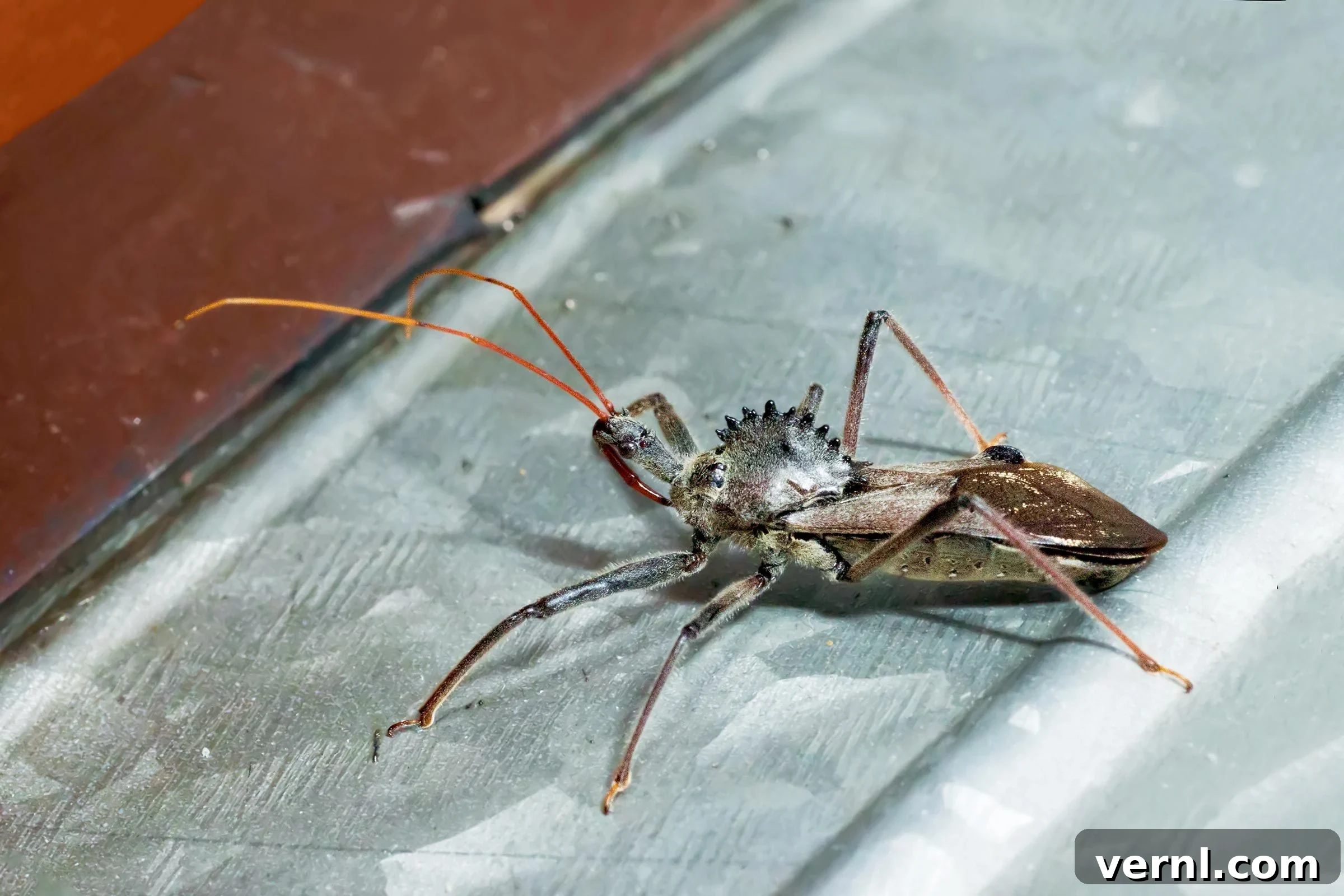
In the vast and intricate world of insects, few creatures embody the paradox of predator and ally quite like the assassin bug. Imagine a stealthy hunter, patiently lying in wait, before striking with lightning speed and an element of surprise. Once it pounces on its prey, it delivers a potent, paralyzing toxin that quickly overcomes and kills the victim. And, if that wasn’t gruesome enough, it then proceeds to suck the prey’s liquified innards through its unique, straw-like mouthparts. This highly efficient, almost macabre, hunting method makes them formidable forces in the insect kingdom.
While this vivid description might sound like something ripped from a horror movie, the reality is far more nuanced. Dr. Katelyn A. Kesheimer, Ph.D., an assistant professor and extension specialist at the Alabama Cooperative Extension System, Auburn University, provides crucial context: “While this sounds like something out of a horror movie, the fact is that most assassin bugs are actually beneficial! It is common to find assassin bugs in your backyard.” This surprising revelation prompts a critical question: are these formidable predators a menace to humans, pets, and the environment, or are they a valuable asset in our ecosystem? Let’s delve deeper into the intriguing world of the assassin bug to uncover their true nature.
Clearly, this bug is a grizzly menace to its insect prey, demonstrating an incredible efficiency in its predatory endeavors. However, understanding their broader impact, particularly concerning human health and domestic animals, requires a closer look at their diverse species and behaviors. This comprehensive guide will explore the various types of assassin bugs, their habits, their ecological contributions, and crucially, address any potential risks they might pose to you and your loved ones.
What Is an Assassin Bug? Understanding These Remarkable Predators
Assassin bugs are members of the family Reduviidae, a vast and highly diverse group within the order Hemiptera, commonly known as “true bugs.” Characterized by their long legs and predominantly terrestrial (crawling) nature, these insects are classified as generalist predators. This means that, unlike specialized hunters, they do not restrict their diet to a single type of prey. Instead, they feed on a wide variety of other insects and invertebrates, making them invaluable allies in natural pest control across diverse environments, including agricultural crops, forests, and even urban backyards.
The Reduviidae family is incredibly extensive, boasting some 25 distinct subfamilies and encompassing over 7,000 known species worldwide. This immense diversity highlights their adaptability and widespread presence across nearly every continent. In North America alone, more than 160 species contribute to the continent’s ecological balance. Among the most commonly encountered subspecies found in this region are the distinctive wheel bug, recognizable by its unique cogwheel-like crest; the elusive ambush bug, a master of camouflage and surprise attacks; the masked hunter, often found indoors preying on household pests; and the notorious kissing bug (or triatomine bug), a specific type of assassin bug that warrants particular attention due to its potential health implications, as it can transmit serious diseases to humans and animals.
What Do Assassin Bugs Look Like? A Comprehensive Guide to Identification
The appearance of an assassin bug can vary significantly depending on the specific subspecies, making precise identification a nuanced task. However, several general characteristics unite these fascinating insects, alongside distinct features that help differentiate specific types. In general, adult assassin bugs are typically slender-bodied insects, ranging in length from approximately 1/2 inch (1.25 cm) to 1-1/4 inches (3.2 cm). Their bodies often feature a robust, shield-like back, and their coloration typically includes shades of brown, black, or gray, providing excellent camouflage against bark, soil, or foliage. Some species, however, exhibit brighter hues, such as yellowish-green, allowing them to blend seamlessly with flowers as part of their predatory strategy.
A hallmark of the assassin bug is its elongated head, which often tapers into a comparatively thin neck, adorned with prominent reddish eyes that provide excellent vision crucial for hunting. Perhaps the most distinctive and formidable feature is their long, curved proboscis. Dr. Kesheimer elaborates on its function: “The proboscis is the straw-like beak that rests under their body when not in use. Assassin bugs can quickly engage their beak to feed on a prey item.” This robust, three-segmented proboscis is not designed for feeding on plant sap like many other true bugs. Instead, it is a formidable, dagger-like weapon specifically adapted for piercing the tough exoskeletons of their prey, injecting paralyzing venom, and then drawing out the liquefied internal contents.
Beyond these general traits, specific varieties of assassin bugs possess unique visual markers:
- Wheel Bug: This is one of the largest and most recognizable assassin bugs in North America, typically gray in color and reaching impressive lengths of up to 1-1/4 inches. Its most striking feature is a prominent, saw-toothed, semicircle crest located on its mid-section, which gives it the appearance of half of a cogwheel.
- Ambush Bug: Smaller in stature, usually 1/2 inch long or less, ambush bugs are often yellowish-green or brown, allowing them to camouflage perfectly among flowers. They possess a stocky body and distinctively thick, raptorial front legs that are uncannily similar to those of a praying mantis, perfectly adapted for rapidly grasping and holding prey.
- Masked Hunter Bug: These brownish-black insects are frequently found indoors, particularly in dusty environments. Their nymphs are renowned for their unique camouflage, covering their bodies with dust, lint, and debris, hence the “masked” name. They are beneficial for consuming other indoor pests like bed bugs and silverfish.
- Kissing Bug (Triatomine Bug): This group is particularly significant due to its health implications. Kissing bugs typically possess a cone-shaped head and often exhibit flattened, striped borders along their abdomen. Their appearance can vary by species, but the distinct cone-shaped head is a key distinguishing feature.
Sexual dimorphism is also observed in many species, with egg-laying female assassin bugs often being noticeably larger and more robust than their male counterparts. Nymphs, the juvenile stage of assassin bugs, are smaller versions of the adults, typically wingless, and undergo several molts, shedding their exoskeletons, before reaching full maturity and developing wings.
Where Do Assassin Bugs Live? Global Distribution and Habitat Preferences
The global reach of assassin bugs is truly impressive, showcasing their remarkable adaptability to diverse climates and ecosystems around the world. With over 7,000 species identified, they are found on almost every continent, thriving in a multitude of environments. As previously mentioned, North America alone hosts a significant population of more than 160 species, highlighting the continent’s rich insect biodiversity. These resilient insects can be found across a broad spectrum of habitats, inhabiting bustling urban landscapes, sprawling rural agricultural areas, and even rugged mountainous regions.
In the United States, assassin bugs are particularly prevalent in southwestern states such as Arizona, California, and New Mexico, where warmer, often arid, climates support a greater diversity of insect life. However, their presence extends much further north, demonstrating their robust nature. Unlike many insect species that cannot tolerate cold temperatures, adult assassin bugs exhibit a remarkable tolerance for harsh winters. They are capable of surviving by seeking shelter in protected, secluded locations, such as inside homes, beneath leaf litter, under loose bark on trees, within rock crevices, in dog houses, or even inside chicken coops. This exceptional ability to overwinter allows them to persist in colder climates and emerge in spring ready to resume their vital predatory activities, contributing to year-round ecological balance and pest control.
What Do Assassin Bugs Eat? The Apex Predators of the Insect World
The assassin bug’s diet is as varied and extensive as its species count, truly reflecting its crucial role as a generalist predator within its ecosystem. These voracious hunters target a wide array of small to medium-sized insects and other invertebrates, making them exceptionally valuable natural pest control agents. Their diverse menu typically includes numerous common garden pests and other arthropods such as various species of beetles, spiders, bees, flies, caterpillars (including many destructive moth and butterfly larvae), worms, grasshoppers, and crickets. This broad and opportunistic dietary preference means that wherever tasty garden pests gather in abundance, assassin bugs are likely to follow, actively seeking out their next meal and helping to keep pest populations in check.
Their hunting strategy is a testament to their predatory prowess, often involving a combination of patience and precision. Many species employ a classic “sit-and-wait” ambush technique, blending seamlessly into their surroundings—whether it be foliage, bark, or flowers—and remaining motionless until an unsuspecting prey item comes within striking distance. Other species are more active hunters, stalking their prey with deliberate movements, relying on their keen eyesight and swift bursts of speed to close the gap. Once they pounce and grasp their victim, the powerful, piercing proboscis is swiftly deployed. It first injects a potent, paralyzing venom that quickly immobilizes the prey, followed by digestive enzymes that liquefy the internal tissues. The assassin bug then methodically draws out these liquefied contents, leaving behind only a hollowed-out carcass. This highly efficient method of predation significantly helps in managing populations of agricultural and garden pests, thereby reducing the need for synthetic chemical insecticides and fostering a healthier, more balanced, and sustainable environment.
Do Assassin Bugs Bite? Understanding the Risks to Humans and Pets
Yes, assassin bugs do bite, and it’s important to approach them with a healthy dose of caution. While the vast majority of assassin bug species are not aggressive towards humans and primarily focus on their insect prey, they will bite defensively if they feel threatened, are accidentally handled, or inadvertently squeezed. A bite from a typical, non-kissing assassin bug can be quite painful, often described as feeling like a sharp, intense sting. The area around the bite may develop localized swelling, redness, and discomfort, and in some cases, can lead to a secondary bacterial infection if the wound is not kept clean. Therefore, it is always best to admire these fascinating insects from a distance and avoid handling them directly.
However, a specific and distinct group within the assassin bug family, commonly known as “kissing bugs” (or more scientifically, triatomine bugs), presents a much more significant and serious health concern. These particular bugs are hematophagous, meaning they feed exclusively on the blood of vertebrates, including humans, pets, livestock, and various wildlife. Wizzie Brown, BCE (Bachelor’s of Science in Entomology) Extension Program Specialist at the Integrated Pest Management (IPM), Texas AgriLife Extension Service, issues a strong warning: “If you find this type of assassin bug in your yard, you would not want to keep them around since they are capable of transmitting Chagas disease.”
Kissing bugs are primarily nocturnal feeders, emerging at night to seek blood meals. They often bite people around the face or lips while they sleep, which is how they earned their common, albeit misleading, name. The true danger lies not directly in the bite itself, but in the feces the bug often deposits near the bite wound during or after feeding. If these feces, which may contain the protozoan parasite Trypanosoma cruzi, are accidentally rubbed into the fresh bite wound, or into the eyes or mouth, infection with Chagas disease can occur. The disease can also be transmitted through contaminated blood transfusions, organ transplantation, or from an infected mother to her child during pregnancy or birth, though vector-borne transmission from the bug remains the most common route.
Signs you may have contracted Chagas disease are varied and can range from mild to severe, often appearing in two distinct phases: acute and chronic. The acute phase, which can last for several weeks or months, may include symptoms such as fever, fatigue, body aches, headaches, rash, loss of appetite, diarrhea, or vomiting. A localized swelling called a “chagoma” may also appear at the infection site, particularly if the bite occurred near the eye (known as Romaña’s sign). While the acute phase is often mild or asymptomatic, if left untreated, Chagas disease can progress into a potentially life-threatening illness. The chronic phase, which can develop years or even decades after the initial infection, can lead to serious and irreversible cardiac complications (such as enlarged heart, heart failure, or sudden death) and gastrointestinal problems (like enlarged esophagus or colon). If you present any of these symptoms, however mild, after being bitten by what you suspect might be a kissing bug or any assassin bug, it is highly recommended that you seek medical attention immediately for proper diagnosis and timely treatment.
Note: According to the Center for Disease Control and Prevention (CDC), Chagas disease is caused by the protozoan parasite, Trypanosoma cruzi. This microorganism can be transmitted to humans and other mammals by vector-borne triatomine bugs carrying the disease. Early detection and treatment with antiparasitic medications are crucial for preventing the progression of this serious illness and its associated long-term complications.
Do Assassin Bugs Cause Damage or Are They Beneficial? Balancing Their Impact
As noted throughout this discussion, the overwhelming majority of assassin bugs are overwhelmingly beneficial. Their role as relentless and efficient predators of pest insects makes them invaluable allies for gardeners, farmers, and anyone seeking natural and sustainable pest control solutions. By actively preying on a wide array of destructive insects, they contribute significantly to maintaining the delicate eco-balance in your garden, agricultural fields, and natural landscapes, thereby reducing the need for potentially harmful chemical pesticides. They effectively control populations of common plant-destroying pests such as aphids, leaf-munching caterpillars, damaging beetle larvae (like Colorado potato beetles or cucumber beetles), grasshoppers, slugs, and many other common garden invaders, allowing desirable plants to thrive and increasing crop yields.
To encourage these “good” assassin bugs to reside and flourish in your garden, and to maximize their pest control services, consider implementing the following integrated pest management practices:
- Plant Diverse Flora: Cultivate a rich variety of native flowers, vegetables, shrubs, and trees. A diverse plant ecosystem will attract a broader spectrum of beneficial insects and, crucially, provide a consistent buffet of food sources (pest insects) for assassin bugs, thereby supporting a healthy population.
- Minimize Pesticide Use: Avoid spraying broad-spectrum pesticides whenever possible. These chemicals indiscriminately kill both harmful pests and beneficial insects like assassin bugs, disrupting the natural predator-prey balance. Opt for targeted treatments or organic, less harmful pest control methods only when absolutely necessary.
- Provide Shelter and Habitat: Allow assassin bugs to find suitable places to live, reproduce, and overwinter. This can include leaving some leaf litter, perennial plant stalks, or other natural debris in undisturbed areas of your garden. Providing rock piles, log piles, or native plant groupings offers essential protection from harsh winter conditions and adverse weather.
- Relocate Harmless Species: If you happen to find a non-kissing assassin bug species indoors, do not harm it. Instead, gently scoop it up using a piece of paper and a cup, and release it back into your garden. They are much more valuable outside, where they can continue their vital work as natural pest controllers.
How To Get Rid of Undesirable Assassin Bugs, Especially Kissing Bugs
Understanding the critical distinction between beneficial assassin bugs and the potentially dangerous kissing bugs (triatomine bugs) is paramount for effective management and personal safety. As Dr. Kesheimer clearly states, “An important distinction to make here is that all kissing bugs are assassin bugs but not all assassin bugs are kissing bugs.” This highlights the crucial importance of accurate identification and the implementation of targeted management strategies specifically for kissing bugs.
Should you encounter kissing bugs in your backyard, garden, or, most concerningly, inside your home, implementing effective preventative and management strategies is crucial for keeping them (and other unwanted insects) outside and minimizing potential health risks associated with Chagas disease. Here are several proactive steps you can take to protect yourself, your family, and your pets:
- Seal Entry Points Thoroughly: Conduct a meticulous inspection of your home’s foundation, exterior walls, and roofline. Fill any existing holes and cracks in foundations, brickwork, or siding. Seal gaps around windows, exterior doors, utility entry points (like pipes or wires), and roof vents. Ensure that all screens on windows and doors are intact, free of tears, and fit tightly within their frames. These comprehensive measures are essential to prevent bugs from gaining entry.
- Strategic Pet Management: Keep pets indoors at night, particularly in areas where kissing bugs are known to be prevalent. Avoid allowing pets to sleep in bedrooms, especially on beds or furniture, as they can inadvertently bring bugs inside or be bitten themselves. Regular veterinary check-ups for Chagas disease are recommended for outdoor pets in endemic areas.
- Maintain Clean Pet Areas: Frequently clean pet beds, kennels, dog houses, and any other areas where pets rest. Regularly wash pet bedding in hot water and thoroughly inspect these areas for any signs of insect activity, including actual bugs or their droppings.
- Clear Exterior Clutter: Keep potential harborage areas for kissing bugs away from the immediate vicinity of your house. This includes relocating woodpiles, stacks of organic debris (like leaf piles), dense tree branches that touch the house, and animal cages or shelters. These areas can provide ideal hiding spots for kissing bugs and other pests.
- Outdoor Lighting Control: Turn off unnecessary outdoor lights at night, or consider replacing standard white bulbs with yellow “bug lights.” Bright white lights can attract various insects, including kissing bugs, to your home’s exterior, increasing the likelihood of them finding a way inside.
If despite these diligent preventative measures, you find kissing bugs inside your house, especially if you encounter them in multiple instances or suspect an infestation, it may be time to call a professional pest management expert. They possess the knowledge and tools to accurately identify the specific species of bug and administer appropriate, targeted treatment. Dr. Kesheimer notes, “For chemical control, the chemical class pyrethroids are effective against kissing bugs.”
Note: While effective, these professional-grade insecticides can be harmful to humans and pets if not applied correctly or according to safety guidelines. Always work closely with a reputable and licensed pest control company to ensure the safe and proper application of any chemical treatments, prioritizing the safety and well-being of your family and pets during and after the treatment process.
In conclusion, the assassin bug, a creature of formidable hunting prowess, truly embodies a fascinating dichotomy in the natural world. While some specific species, particularly the kissing bug, demand our vigilance and proactive management due to their potential to transmit serious diseases, the vast majority of assassin bugs serve as invaluable allies in our ongoing struggle against garden and agricultural pests. By understanding their diverse habits, appreciating their significant ecological contributions as natural pest controllers, and taking appropriate precautions against the few harmful species, we can foster a balanced and healthier environment where these captivating insects can continue to play their crucial and beneficial role.