When embarking on any construction project, from building a new home to adding a humble deck or extension, understanding the foundational principles of structural integrity is paramount. Among these, the concept of the frost line stands as a critical, yet often overlooked, element that can significantly impact the longevity, safety, and overall stability of a structure. While a house built precisely to code in its region may alleviate immediate homeowner concerns, those undertaking new builds or significant additions must delve deeper into this vital aspect of regional construction. Knowing how deep frost typically penetrates the ground in an average winter is not just a recommendation; it is a crucial prerequisite for robust and enduring construction.
The intricacies of frost depth and local building codes are highly variable, shifting dramatically from one region to another. What might be acceptable in a warmer climate could lead to catastrophic structural failure in a colder one. This guide will illuminate the essential knowledge you need concerning frost lines before you break ground on your next home build or any outdoor construction endeavor.
What Is the Frost Line? Unpacking the Science of Frozen Ground
At its core, the frost line, also known as the frost depth or freezing depth, represents the maximum depth to which soil moisture is expected to freeze in the ground during the coldest periods of the year. This isn’t a static measurement; it’s a dynamic point influenced by a complex interplay of environmental factors. The primary determinants include prevailing winter temperatures, the duration of cold spells, and the soil’s moisture content and composition. Consequently, the frost line is far from uniform across different geographical areas. For instance, in the perpetually cold regions of Minnesota, the frost line can extend several feet deep, posing significant challenges for builders. In stark contrast, warmer climates like Florida might experience a frost line that is only a few inches deep, or even none at all, making construction requirements vastly different.
The science behind the frost line is rooted in the unique properties of water. When water freezes, it undergoes a volumetric expansion of approximately 9%. This might seem like a small percentage, but when vast quantities of water trapped within soil particles transform into ice, the collective force exerted by this expansion can be immense. Different soil types respond differently to freezing; clay soils, for example, tend to retain more moisture and thus are more susceptible to frost-related issues than sandy soils, which drain more efficiently. Understanding this fundamental principle is the first step in appreciating why the frost line holds such importance in construction.
Why Do Frost Lines Matter So Critically for Construction?
The consequences of disregarding the frost line are significant and can lead to costly, sometimes irreparable, structural damage. To grasp why, consider the everyday phenomenon of water freezing and thawing. A can of soda left in a freezer or a car trunk during winter will likely explode due to the expanding liquid. Similarly, frozen roads and sidewalks are notorious for developing cracks, pits, and potholes as the ground beneath them undergoes cycles of freezing and thawing. These same destructive forces are at play, albeit unseen, beneath the ground surrounding building foundations and utility lines.
The primary concern associated with frost lines is a phenomenon known as “frost heave.” As Josh Risberg, a lead carpenter and former set builder for Family Handyman, succinctly puts it, “anything above them can move when it freezes.” Frost heave occurs when the moisture in the soil below a structure freezes, expands, and pushes the soil upwards, lifting the foundation or footing along with it. This upward movement is not uniform; different parts of a foundation can be lifted to varying degrees, leading to what is known as differential settlement. The impact of frost heave is not limited to foundations; it also critically affects deck footings, retaining walls, utility lines (such as water pipes, sewer lines, gas lines, and electrical conduits), and even fence posts. “The farther north you go, the farther down you need to go for footings,” Risberg emphasizes, highlighting the direct correlation between geographic location and required foundation depth.
If footings or foundations are not extended deep enough, below the local frost line, they become highly susceptible to this upward “heaving” in winter. This shifting can precipitate a cascade of serious problems. Risberg points out that these issues include “cracking in the foundation, drywall or other things, like doors not shutting right.” These cracks are not merely cosmetic; they can compromise the structural integrity of the entire building, leading to expensive and extensive repairs. Furthermore, problems arise when connecting elements that are securely anchored below the frost line to components that are not. The differential movement can stress connections, causing them to fail.
This critical vulnerability is precisely why building permits and rigorous inspections are indispensable aspects of construction. While building a deck might seem like a straightforward DIY project, neglecting the frost depth can transform it into a wobbly, unsafe, and ultimately failed endeavor. Ensuring that all structural elements are adequately protected from frost heave is a fundamental requirement for the safety and longevity of any construction.
How Deep Is the Frost Line? Understanding Regional Variations and Influencing Factors
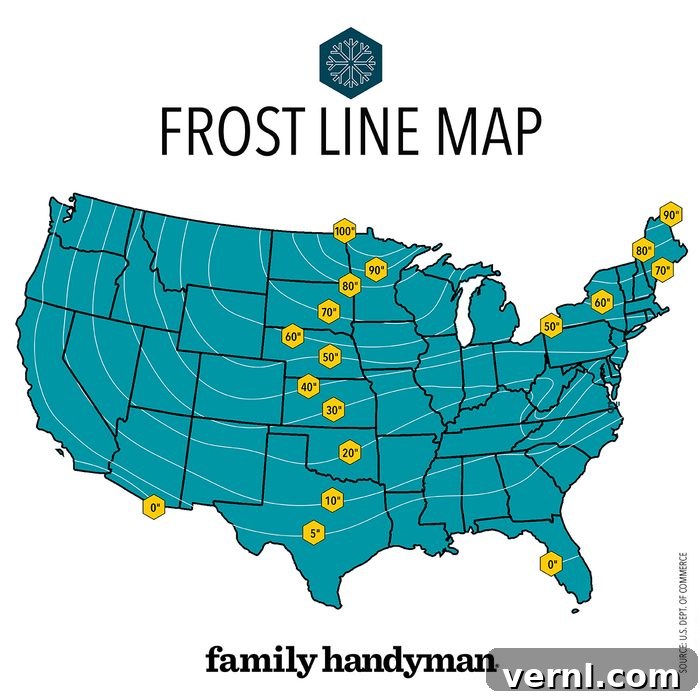
The depth of the frost line is not uniform and varies significantly based on geographic location and a multitude of environmental conditions. In regions characterized by bitterly cold winters, such as the northern states of the U.S. and Canada, the National Weather Service reports that frost lines can extend as deep as six feet or even more. Conversely, in warm climates like Arizona or South Florida, the frost line is considerably shallower, often just a few inches, or may not exist at all. The included frost depth map above offers a general visual representation of these variations across the United States, providing a useful starting point for understanding your local conditions.
Several factors beyond average winter temperatures influence how deep the ground freezes:
- Duration of Cold Spells: Prolonged periods of sub-freezing temperatures allow frost to penetrate deeper than short, intense cold snaps.
- Snow Cover: Paradoxically, a thick blanket of snow acts as an insulator, trapping heat in the ground and preventing deep frost penetration. Areas with minimal snow cover are often more susceptible to deeper frost lines.
- Soil Type: As mentioned, clay soils, with their high water retention, are prone to deeper and more problematic freezing than well-draining sandy or gravelly soils.
- Groundwater Levels: High water tables mean more moisture is available to freeze, potentially exacerbating frost heave.
- Vegetation: Dense vegetation can provide some insulation and influence soil moisture content, indirectly affecting frost depth.
- Human Activity: Heated basements can raise the soil temperature immediately adjacent to the foundation, effectively pushing the localized frost line deeper or eliminating it. However, this effect diminishes rapidly away from the structure.
How to Read and Interpret the Frost Line Depth Map Effectively
Frost line maps are valuable tools that illustrate the typical depth at which soil is expected to freeze during the coldest part of the season. To utilize such a map, first locate your specific region. Once identified, you can trace the corresponding lines or color codes to determine the average frost line depth for your area. These maps often show depths in increments of inches or feet, giving you a general understanding of the required foundation depth.
However, it is crucial not to rely solely on these generalized maps. As Risberg rightly cautions, “Each zone is different.” Maps provide a broad overview, but local microclimates, specific soil conditions, and unique site characteristics can lead to variations. Therefore, the most reliable and legally compliant approach is always to “check with your local building inspectors on what depths are needed.” This reiterates the critical importance of obtaining building permits and consulting local authorities.
Local building codes and regulations are meticulously crafted to address the specific environmental needs of a given area. Because the frost line can vary even within different zip codes of the same state, your local building department or municipal government is the definitive source for precise requirements for your property. Adhering to these local codes is not merely about avoiding fines or legal complications; it is fundamentally about ensuring the construction of safe, stable, and long-lasting structures that can withstand the test of time and environmental forces. Ignoring these guidelines can result in structures that fail prematurely, pose safety risks, and incur significant financial burdens for repairs.
Building Below the Frost Line: Essential Strategies for Lasting Construction
To prevent the devastating effects of frost heave, it’s imperative that all load-bearing structural elements extend below the frost line. Builders employ several proven strategies to achieve this, ensuring the stability and longevity of your investment:
Deep Foundations: The Traditional Approach
The most common and traditional method involves extending foundations, footings, or piers deep enough so that their base rests on undisturbed soil that remains unfrozen throughout the year. For residential construction, this typically means:
- Continuous Footings: For full basements and crawl spaces, a continuous concrete footing is poured below the frost line, forming a sturdy base for the foundation walls.
- Piers and Caissons: For decks, porches, or lighter structures, concrete piers (often cylindrical) are dug or drilled to extend below the frost line. These piers are then capped to support posts or beams. The sides of these piers are often flared at the bottom or bell-shaped to resist uplift due to adfreezing (where the frozen soil sticks to the side of the foundation and pulls it up).
Proper sizing and reinforcement with rebar are critical for these deep foundations to effectively transfer the building’s load to stable ground and resist lateral forces.
Shallow Frost-Protected Foundations (SFPs): An Insulated Alternative
In certain climates and for specific building types, shallow frost-protected foundations (SFPs) offer an energy-efficient alternative. This method allows foundations to be constructed at a shallower depth than the local frost line by strategically using rigid insulation. The insulation, typically made of extruded polystyrene, is placed around the perimeter of the foundation to:
- Trap Earth’s Heat: It redirects geothermal heat from the earth beneath the foundation, preventing the soil from freezing.
- Prevent Heat Loss: It also minimizes heat loss from the building into the ground, contributing to overall energy efficiency.
SFPs are often used for slab-on-grade constructions and can be a cost-effective solution, particularly in regions with moderate to deep frost lines, provided they are designed and installed by professionals familiar with the specific engineering requirements.
Effective Site Drainage: Controlling Soil Moisture
While not a direct method of building below the frost line, excellent site drainage is a complementary and vital strategy to minimize frost heave risk. By managing the amount of moisture in the soil around the foundation, you reduce the volume of water available to freeze and expand. Key drainage strategies include:
- Proper Grading: Ensure the ground around your home slopes away from the foundation at least six inches over the first ten feet.
- Gutters and Downspouts: Install and maintain effective gutter systems that divert rainwater and snowmelt away from the foundation. Downspout extensions should discharge water several feet away from the building.
- French Drains: In areas with persistent groundwater issues or heavy clay soils, installing a French drain system can effectively collect and channel subsurface water away from the foundation.
Controlling soil moisture is a proactive measure that significantly reduces the potential for frost-related damage, regardless of the foundation type.
The Crucial Role of Building Codes and Permits in Frost Line Compliance
The discussions surrounding frost lines invariably lead back to the critical importance of building codes and the permitting process. These regulations are not arbitrary bureaucratic hurdles; they are meticulously developed standards designed to protect public safety, ensure structural integrity, and preserve property values. When it comes to frost lines, local building codes mandate the minimum depth required for foundations and footings in a given area, taking into account historical weather data, soil types, and local expertise.
The permitting process serves as a vital safeguard. When you apply for a building permit, your plans are reviewed by qualified inspectors to ensure they comply with all applicable codes, including those pertaining to frost depth. During construction, scheduled inspections – most notably the “footing inspection” – verify that the foundation has been excavated to the correct depth and installed according to approved plans before it is backfilled. This oversight prevents costly mistakes and ensures long-term structural stability.
Ignoring building codes and proceeding without permits can have severe repercussions. These include:
- Fines and Penalties: Local authorities can issue hefty fines, stop-work orders, or even demand demolition of non-compliant structures.
- Structural Failure: Without proper adherence to frost line requirements, structures are highly susceptible to damage from frost heave, leading to cracks, instability, and potential collapse.
- Difficulty Selling: Unpermitted construction can complicate or even prevent the sale of a property, as buyers and lenders often require proof of code compliance.
- Insurance Issues: In the event of damage, insurance claims related to unpermitted construction may be denied.
- Personal Liability: If an unpermitted structure causes injury or property damage, the builder or homeowner could face significant legal liability.
In essence, adhering to local building codes regarding frost lines is a non-negotiable step for any responsible builder or homeowner. It’s an investment in the safety, durability, and value of your construction project.
Conclusion: The Indispensable Role of Frost Line Understanding
The frost line, though invisible, exerts a profound influence on the success and longevity of any construction project. It serves as a natural boundary that dictates the minimum depth to which structural foundations must extend to prevent the destructive forces of frost heave. From the subtle shifting that leads to minor cracks to the more dramatic failures that compromise entire structures, the consequences of ignoring this environmental factor are substantial, both in terms of safety and financial outlay.
Understanding what the frost line is, why it matters, and how to effectively build below it are not merely technical considerations; they are fundamental principles of responsible construction. While regional maps offer a useful starting point, the ultimate authority lies with your local building codes and the expertise of local inspectors. Engaging with these resources early in your planning process will ensure that your home, addition, or deck is built not just to stand, but to endure, providing safety, stability, and peace of mind for decades to come.
Frequently Asked Questions About Frost Lines
How do I find the most accurate frost line depth for my specific area?
While general frost line maps provide a helpful visual guide, for any actual construction project, the most accurate and legally binding information comes from your local building department or municipal government. You should consult their official building codes, which will specify the minimum required frost depth for foundations and footings in your specific zip code or jurisdiction. Additionally, reaching out to local building inspectors in your community can provide invaluable, precise details and clarify any specific site considerations.
What exactly is frost heave, and how does it occur?
Frost heave is the upward movement of soil and anything embedded in it, caused by the expansion of water as it freezes. It primarily occurs through two mechanisms:
- Adfreezing: Water in the soil freezes onto the surface of a foundation or footing, creating a bond. As the soil freezes and expands, it physically lifts the foundation along with it.
- Ice Lens Formation: As the freezing front penetrates the soil, water from deeper, unfrozen soil is drawn upwards towards the freezing zone (due to capillary action). This water then freezes into distinct layers of ice, known as “ice lenses,” which grow in thickness and push the overlying soil and structure upwards. This process is particularly pronounced in fine-grained soils like silt and clay.
Both mechanisms contribute to the differential settlement and structural stress seen in buildings not properly founded below the frost line.
What happens if a foundation or footing is not placed below the frost line?
Failing to extend foundations below the frost line can lead to severe and systemic problems for a structure. The most common consequence is frost heave, which causes the foundation to lift and shift irregularly. This movement can result in:
- Structural Cracks: Visible cracks in the foundation, basement walls, drywall, and plaster.
- Misaligned Features: Doors and windows that stick or no longer close properly.
- Utility Line Damage: Burst water pipes, cracked sewer lines, or damaged gas and electrical conduits due to ground movement.
- Uneven Floors: Causing safety hazards and making furniture difficult to level.
- Compromised Stability: Over time, repeated freeze-thaw cycles can weaken the entire structure, potentially leading to significant repair costs or even making the building unsafe.
Can the frost line depth change over time or vary locally?
Yes, the frost line can and does change. While general maps show average historical depths, actual frost penetration in any given year can vary due to:
- Annual Weather Variability: Exceptionally cold winters with minimal snow cover will likely result in deeper frost penetration than mild winters.
- Climate Change: Long-term shifts in global and regional climates can alter average frost depths over decades.
- Local Microclimates: Factors like elevation, proximity to large bodies of water, dense urban areas (heat island effect), and even significant tree cover can create localized variations in frost depth within a small geographic area.
This variability underscores the importance of consulting local codes and considering worst-case scenarios when designing foundations.
Does having a heated basement or crawl space affect the frost line around a house?
Yes, a heated basement or crawl space can have a localized effect on the frost line immediately adjacent to the building. The heat emanating from the structure can warm the surrounding soil, effectively pushing the frost line deeper or eliminating it directly beneath and around the heated portion of the foundation. However, this effect typically diminishes rapidly as you move away from the building. Unheated portions of a structure, like an attached garage or an unheated addition, will still require their foundations to extend below the regional frost line.