
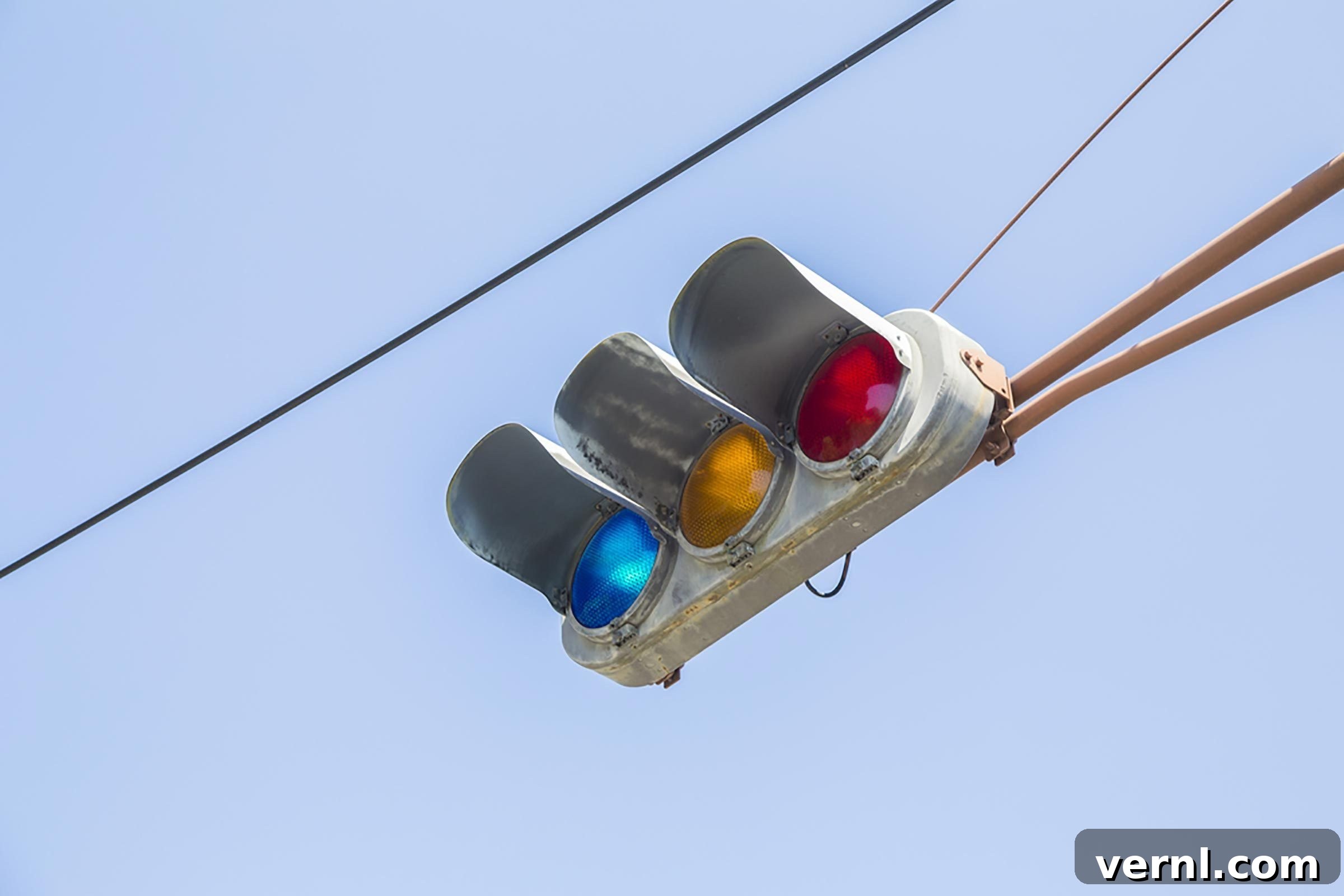
Unraveling the Mystery: Why Japan’s ‘Green’ Traffic Lights Are Blue
From our earliest days, we learn a fundamental truth about navigating the world: red signifies ‘stop,’ and green signals ‘go.’ This simple, universal code of dashboard and traffic lights forms the bedrock of road safety across most nations. Yet, imagine encountering a culture where the color we universally perceive as green is officially recognized and even visually rendered as blue. This intriguing paradox is not a design flaw but a profound intersection of language, history, and cultural identity, most vividly exemplified in Japan. Before we dive into Japan’s unique approach, it’s worth understanding the historical reasons behind the red, yellow, and green system that predominates worldwide.
Indeed, while the vast majority of countries adhere to the familiar green, yellow, and red color scheme for their traffic signals, Japan stands out with its distinctive bluish hue for what is essentially its ‘go’ signal. This peculiar deviation often sparks confusion and curiosity among international visitors. Attorney Angel Reyes notes, “While most countries use the standard green, yellow and red color system, Japan uses a bluish hue for green.”
Venturing onto Japan’s roads offers a unique visual experience for drivers. It won’t take long before you encounter one of the country’s much-discussed blue traffic lights, which visually appears like this in practice. Beyond these overtly blue signals, you’ll find other ‘go’ lights around the archipelago that present a clear spectrum of teal, turquoise, and aqua. For the uninitiated, such sights naturally provoke questions: “Is this signal malfunctioning?” or “Has someone mistakenly installed the wrong bulbs?”
The Deep Roots of Japan’s Blue-Green Distinction: A Linguistic Legacy
The answer, as illuminated by publications like Atlas Obscura, does not lie in faulty electrical wiring or manufacturing errors. Instead, it is deeply embedded in the rich tapestry of the Japanese language itself, a testament to how culture can shape perception and even infrastructure.
Centuries ago, the ancient Japanese language possessed a more streamlined color vocabulary compared to many Western languages. It primarily recognized only four fundamental colors: black (kuro), white (shiro), red (aka), and blue (ao). In this linguistic framework, anything we would today describe as green was categorized under the umbrella term of ao. Thus, whether describing the vast ocean or the lush foliage of a forest, the word ao sufficed for both blue and green.
This system, while seemingly simplistic, served the communication needs of the time effectively until approximately the end of the first millennium. Around this period, a new word began to emerge in written form: midori. Originally derived from a term meaning ‘sprout’ or ‘new growth,’ midori started to gain traction specifically to describe the color we universally recognize as green. However, even with the introduction of midori, its status was not immediately independent. For a considerable time, midori was still largely perceived and conceptually categorized as a distinct shade or variant of ao, rather than an entirely separate color entity.
This nuanced historical evolution in color terminology had profound and lasting effects on various aspects of Japanese culture and daily life. The legacy of ao encompassing green continues to manifest in fascinating ways even today. For example, a fruit vendor might sell you an ao-ringo, which literally translates to “blue apple,” even though the apple in question is distinctly green. Similarly, the vibrant green bamboo stalks are traditionally referred to as aodake, or “blue bamboos.” The concept extends metaphorically as well; an inexperienced individual, who might be described as “green” in English, could be called aonisai in Japanese, meaning a “blue two-year-old.” These linguistic quirks highlight the deep-seated cultural understanding that green remains intrinsically linked to blue.
The Traffic Light Conundrum: International Standards Meet Linguistic Heritage
The linguistic legacy of ao inevitably converged with the necessity of modern infrastructure, specifically traffic lights. When Japan first adopted traffic signals, they were, in fact, colored green, aligning with international standards and expectations. Despite the physical color of the lights, official traffic documents and public discourse within the country continued to refer to these green ‘go’ signals using the traditional word, ao, rather than the emerging midori.
This linguistic discrepancy, where a visually green light was officially labeled “blue,” eventually sparked a significant debate. International traffic law, particularly the Vienna Convention on Road Traffic, broadly dictates that ‘go’ signals must be represented by green lights to ensure universal understanding and road safety. Japanese linguists, however, voiced strong objections to their government’s continued practice of using the word ao to describe what was visually and increasingly understood as midori. They argued for linguistic accuracy, advocating that the official terminology should reflect the actual color of the lights.
Faced with this unique cultural and linguistic dilemma, the Japanese government sought a pragmatic solution that would honor both international regulations and cherished national linguistic traditions. The result was a remarkable compromise reached in 1973. Allan Richarz, writing for Atlas Obscura, details this resolution: “In 1973, the government mandated through a cabinet order that traffic lights use the bluest shade of green possible — still technically green, but noticeably blue enough to justifiably continue using the ao nomenclature.”
This ingenious decision meant that Japanese manufacturers began producing traffic lights that were a very specific shade of green – one pushed as far towards the blue end of the spectrum as possible without crossing the technical threshold into pure blue. The outcome is a color that, while unequivocally green by scientific measurement and international standards, possesses a distinct bluish cast. This allows the lights to be referred to as ao without contradicting the visual reality for Japanese speakers, while also satisfying the critical requirement of international regulations for a ‘green’ signal.
Thus, what appears to many international observers as Japan’s use of blue traffic lights is, in the eyes of the Japanese government and its people, simply a very blue shade of green. It’s green enough to conform to global road safety guidelines, yet blue enough to maintain the linguistic integrity of ao. This fascinating example serves as a powerful reminder that bureaucracy, when faced with a cultural challenge, can sometimes devise truly creative and insightful solutions, bridging the gap between global uniformity and local identity.
Frequently Asked Questions About Japan’s Blue Traffic Lights and Global Road Safety
Are blue traffic lights safe?
Generally, yes, blue traffic lights in Japan are considered safe within their national context, as Japanese drivers are accustomed to this specific hue. The government’s 1973 mandate ensured the lights remained within the technically ‘green’ spectrum to comply with international safety standards, albeit leaning heavily towards blue. However, the primary safety concern arises for international travelers who are unfamiliar with this cultural distinction. As attorney Angel Reyes points out, “Likewise, Japanese tourists visiting countries like the United States may misinterpret traffic signals due to these differences, potentially resulting in accidents.” The visual difference can lead to momentary confusion or misjudgment for drivers used to a more conventional, vibrant green. Therefore, if you are planning to travel abroad and intend to rent a vehicle, it is absolutely essential to thoroughly review that country’s specific traffic laws, road signage, and any unique signal interpretations beforehand. This proactive approach can significantly help in avoiding accidents and the legal repercussions that may follow.
What does a blue light at an intersection mean in the United States?
In the United States, a small blue light observed at an intersection, typically mounted above or alongside the standard red-yellow-green signal array, serves a completely different purpose than a ‘go’ signal. These blue lights are exclusively for law enforcement. Auto dealership manager Kevin Oliff explains, “These lights light up when the traffic signal turns red, allowing officers to monitor intersections better.” This enables police officers, positioned at a distance or out of direct view, to clearly identify vehicles that run red lights, thereby improving their ability to enforce traffic laws and enhance road safety without needing to be directly at the intersection. It’s a tool for surveillance and enforcement, not a signal for drivers.
What does a flashing red light mean?
A flashing red traffic light is universally understood to be equivalent to a stop sign. This means drivers encountering a flashing red light must bring their vehicle to a complete stop before the stop line, crosswalk, or intersection, whichever comes first. After coming to a full stop, drivers must yield to all cross-traffic and pedestrians. They may only proceed when it is absolutely safe to do so, treating the intersection as if there were a four-way stop or a regular stop sign. This rule is critical for preventing collisions at intersections where the traffic light system may be temporarily malfunctioning or configured for specific traffic control scenarios.
Are there different traffic light colors or patterns used in other countries?
While the red-yellow-green system is widely adopted globally, minor variations in traffic light colors or signal patterns do exist in some countries, though these are relatively rare. These differences often reflect specific historical developments or local traffic management philosophies. For instance, in the United Kingdom and some other European countries, there’s often an additional phase where the lights alternate between red and amber (or yellow). This ‘red and amber’ signal informs drivers that the light is about to change to green, allowing them to prepare to move off. Similarly, some lights in the UK may flash amber before turning green, particularly at pedestrian crosswalks, indicating that drivers can proceed with caution if the way is clear, but must yield to any pedestrians still crossing. These subtle deviations underscore the importance of familiarizing oneself with local traffic regulations when driving internationally, as even minor differences can impact driver behavior and safety.
About the Experts
- Angel Reyes is the owner and attorney at Reyes Law, a firm dedicated to personal injury and road safety cases. His expertise provides valuable insights into the legal aspects of traffic regulations and their international implications.
- Kevin Oliff serves as the general manager at AutoNation BMW Buena Park in California. With over 20 years of extensive experience in the automotive industry, he offers a practical perspective on vehicle operation, traffic signals, and driver behavior.