
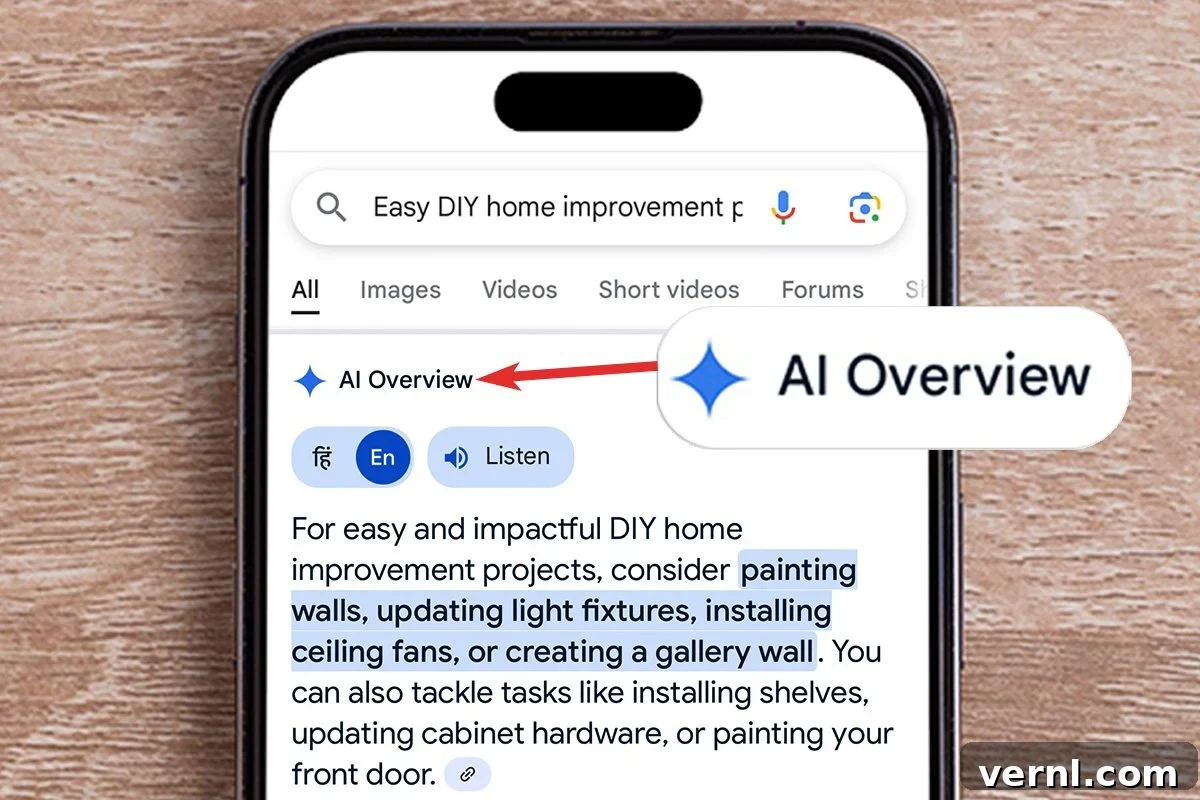
Google AI Overview for DIY: A Reliable Guide or a Risky Gamble?
Since its release in May 2024, Google’s AI Overview has rapidly emerged as a prominent feature in search results, promising quick and comprehensive answers to a myriad of queries. For the burgeoning community of DIY enthusiasts, this raises a crucial question: Is AI Overview a definitive, one-stop shop for all your home improvement needs, or merely a starting point that demands careful scrutiny? As someone who has dedicated over a decade to researching and writing DIY content, publishing more than 10,000 articles and projects across various online platforms, my answer leans towards the latter, echoing the wisdom of an earlier AI: ChatGPT.
- “AI results can be useful but should be taken with a grain of salt. Double-checking and cross-referencing is key for successful DIY outcomes!”
Indeed, that sentiment perfectly encapsulates the nuanced reality of relying on artificial intelligence for practical, real-world tasks. While I generally find Google AI helpful for initial research and generating broad overviews, I’ve also observed its propensity to “hallucinate.” This means it can sometimes provide misleading, incomplete, or even outright incorrect answers based on flawed data interpretation or insufficient context. We’ve all encountered the widely circulated anecdotes of chatbots suggesting bizarre and dangerous advice, such as eating one small rock per day or advocating for adding glue to pizza. While these examples are obviously absurd and easily dismissed, other AI-generated errors can be far more subtle, making them insidiously dangerous for DIY projects.
For appliance repair, routine home maintenance, or even interior design ideas, Google AI Overview can serve as a convenient starting point. In fact, its prominent placement at the top of Google search results means it’s often unavoidable. However, as this article will demonstrate through specific examples, relying on it exclusively for critical DIY tasks could lead to significant mistakes, wasted time, and potentially even safety hazards. The key to successful DIY in the age of AI lies in diligent fact-checking and critical evaluation.
Beyond Surface-Level Sweetness: The Pear vs. Orange Fallacy
Let’s consider a seemingly innocuous comparison. If you ask Google AI Overview whether pears or oranges are sweeter, the AI responds:
- “Generally, oranges are considered to be sweeter than pears.”
For me, having enjoyed countless ripe pears that were intensely sweet and juicy, this statement immediately raised an eyebrow. My personal experience strongly contradicted this AI-generated conclusion. Faced with this discrepancy, a DIYer has a few options: one, simply disregard the AI’s answer based on personal knowledge; two, passively accept that the AI’s vast data pool must outweigh personal experience; or three, and most crucially, embrace the advice to fact-check the answer by diligently following the provided source links.
Choosing the third option, I delved into the links. I found data from Medical News Today cited by Overview, which indeed seemed to support the claim. However, upon closer inspection, the data was far from conclusive or truly comparable. It stated that a “large orange” contains 17.2 g of sugar, while a “cup of cubed pears” contains 15.7 g. The fundamental problem here lies in the inconsistent units of measurement and the lack of standardization. How “large” is a large orange? How big are the “cubes” in a cup of pears? These aren’t equivalent quantities, making a direct sweetness comparison based solely on these numbers inherently flawed. An AI, processing patterns and raw numbers without true contextual understanding, might overlook such nuances.
Thus, while Google’s answer wasn’t technically “wrong” in isolation, the context and data it was based on were unconvincing and misleading. This simple fruit comparison highlights a critical issue: AI can synthesize data, but it often lacks the human judgment and critical thinking skills required to interpret that data accurately, especially when comparing non-standardized units or considering subjective experiences. For DIYers, where precision and accurate measurements are paramount, this kind of subtle data misinterpretation can have far-reaching consequences.
Illuminating AI’s Electrical Misconceptions
The implications of AI inaccuracies become far more serious when dealing with technical subjects like home electrical systems. While conducting research for a recent post, I posed a common question to Google AI Overview: Does plugging multiple devices into a single electrical outlet slow down charging?
The Overview replied:
- “Yes, plugging multiple devices into a single electrical outlet can potentially slow down the charging speed of each device, as they are all sharing the same power source, which can lead to a reduced current available for each individual device.”
If this explanation sounds like a flawed understanding of how electricity is distributed in a standard residential circuit, you would be correct. This is a classic example of an AI’s simplified, yet fundamentally incorrect, interpretation of a complex system. After consulting with electrical experts to confirm my understanding, I explained in detail in my subsequent post that in a properly functioning parallel circuit, each electrical device draws its prescribed current load independently. The charging rate of individual devices is generally not affected by other devices plugged into the same outlet or circuit, as long as the circuit’s total capacity is not exceeded. The only time charging would slow down or cease is if there’s a problem with the circuit itself, or if the circuit becomes overloaded, which would typically trip the circuit breaker, cutting off power entirely as a safety measure.
In essence, the AI’s answer should have been “no,” accompanied by crucial qualifiers about circuit capacity and safety. The AI’s explanation of devices “sharing the same power source” and leading to “reduced current available” misrepresents the fundamental principles of parallel circuits used in homes. This isn’t just a minor inaccuracy; it represents a misunderstanding that could lead DIYers to make incorrect assumptions about their electrical systems, potentially overlooking real hazards or taking unnecessary actions.
Interestingly, the very post I published — which directly contradicts Google’s AI Overview answer and provides the correct electrical principles — now appears as a trending reference right next to Google’s answer. This illustrates a crucial point: Google AI Overview, much like a dynamic knowledge base, is a work in progress. It’s constantly evolving as new information becomes available and as its algorithms refine their understanding. While this continuous improvement is beneficial, it underscores the inherent risk of accepting its answers at face value without thorough fact-checking. Uncritically adopting AI-generated information could lead to absorbing and inadvertently spreading misinformation, not to mention causing potential damage or safety risks to whatever DIY project you’re tackling.
Navigating the DIY Landscape with AI: When to Trust, When to Verify
So, can DIYers truly trust Google AI Overview? The answer is a pragmatic “yes and no,” depending heavily on the nature and complexity of the task at hand. DIYers use Google for a vast spectrum of home improvement advice, from the remarkably simple to the intensely intricate. Over many years, countless human experts, like myself, have meticulously covered common and straightforward DIY issues. Since Google AI Overview draws extensively from this published and vetted content, its answers for very simple problems can often be quite complete and reliable. If you need a quick definition, a list of basic tools, or a general idea for a very low-risk task (e.g., “how to hang a picture” or “what size drill bit for drywall anchor”), AI Overview can usually provide what you need efficiently.
However, things become considerably less straightforward when questions are complex, involve subjective judgment calls, or touch upon regulatory and safety issues. This includes tasks such as choosing the optimal building materials for a specific climate, designing a kitchen layout for maximum functionality, or understanding local building codes and permits, which vary significantly by locality. For such questions, AI Overview functions best as a preliminary research tool, a starting point that helps frame your investigation, rather than a definitive final answer. In these scenarios, diligently following the provided links and diving deeper into the original sources becomes absolutely imperative.
It’s especially vital to remember that AI, despite its sophisticated algorithms, does not possess its own consciousness, experiences, or opinions. If an AI Overview response sounds like it’s expressing a personal opinion or making a subjective recommendation, it’s merely synthesizing and echoing opinions found in its vast training data. In such cases, your responsibility is to research the human sources upon which that “opinion” is based. Identify the expert, assess their credentials, and understand the context of their advice before applying it to your project. Blindly following an AI’s synthesized “opinion” without understanding its provenance can be a dangerous oversight in DIY.
The Pitfalls of AI-Generated How-To Guides
When it comes to actual step-by-step procedures for DIY projects, there is often an abundance of online material available for AI Overview to distill. The AI can process and combine various sources to create what appears to be a coherent set of instructions. However, these AI-generated procedures can often be a “mishmash” drawn from disparate origins, potentially combining contradictory advice, outdated methods, or even unsafe practices. Following such instructions verbatim carries significant risks, particularly for complex procedures like building a deck, installing a new plumbing fixture, or undertaking a roof repair.
A major reason for this caution is that AI Overview scans and incorporates content from a wide array of online sources, including informal online forums and chat rooms, alongside professionally curated content. The AI, lacking true discernment, may inadvertently equate half-baked, unvetted procedures shared by amateurs with expert-level, safety-compliant instructions from certified professionals. This lack of qualitative judgment is a critical flaw when dealing with practical instructions where accuracy and safety are paramount.
For DIY how-to guides, it is always safer to follow the links provided by the AI, and specifically seek out sources that demonstrate clear expertise. Video links from reputable creators, official product manuals, or established home improvement publications are often invaluable. These sources typically show the procedure visually, often with explanations of potential pitfalls, safety precautions, and specific tool usage, allowing you to gauge the instructor’s expertise and the thoroughness of the instructions. Prioritizing human-verified and professionally produced content is crucial for the safety and success of your DIY endeavors.
Best Practices for DIYers Using AI Overview
To leverage Google AI Overview effectively and safely in your DIY projects, consider adopting these best practices:
- Treat AI as a “Smart Index,” Not a Guru: View AI Overview as a highly advanced search tool that provides initial summaries and links. It’s excellent for brainstorming ideas, finding definitions, or getting a general understanding of a topic. Do not treat it as the final authority on complex or safety-critical tasks.
- Always Cross-Reference: For any significant DIY project, especially those involving electricity, plumbing, structural changes, or potentially hazardous materials, always cross-reference the AI’s information with at least two to three other reliable sources. Prioritize official manufacturer manuals, established home improvement websites with expert contributors, and professional association guidelines.
- Prioritize Safety: If a project involves any risk of injury, property damage, or code violations, do not rely solely on AI. Consult human experts such as licensed electricians, plumbers, contractors, or structural engineers. AI cannot assess real-world conditions or provide on-site safety advice.
- Scrutinize the Sources: Always look at the sources AI provides. Follow the links to understand the context of the information. Evaluate the credibility of the source: Is it an authoritative publication, a personal blog, or an unmoderated forum? Reputable sources are key.
- Develop Critical Thinking Skills: Actively question the AI’s assumptions and conclusions. Does the information seem logical? Are there any missing details? Does it align with your own understanding or experience? AI is a tool that requires a discerning human operator.
- Look for Visual Aids from Experts: When following step-by-step instructions, prioritize sources that include detailed photos or, even better, video tutorials from credible experts. Visuals can often clarify ambiguities in text-based instructions and demonstrate proper techniques more effectively.
Conclusion: A Partner, Not a Guru
Google AI Overview is undoubtedly a powerful and evolving tool that can significantly enhance our ability to find information quickly. For DIY enthusiasts, it offers a glimpse into a vast ocean of knowledge, capable of kickstarting research and providing initial insights. However, its current iteration is not, and perhaps never will be, a substitute for human expertise, critical thinking, and the invaluable process of thorough fact-checking. To ensure the safety, efficiency, and success of your DIY projects, use AI Overview as a smart assistant – a capable partner in your research journey, but never the sole guru. Empower yourself with knowledge, verify every critical step, and remember that for true mastery and safety in home improvement, human judgment remains indispensable.
Sources
- Medical News Today: Which fruits have the highest amount of sugar?; (2023)
- IBM: What are AI hallucination?; (2023)
- MIT Technology Review: Why Google’s AI Overviews get things wrong; (2024)